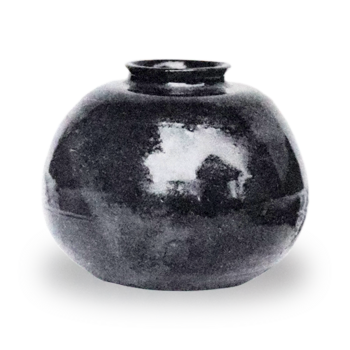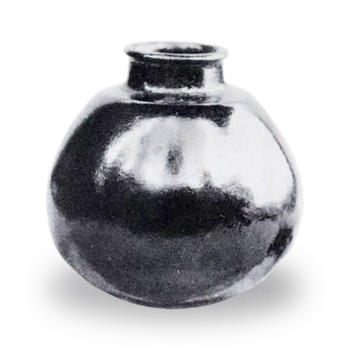
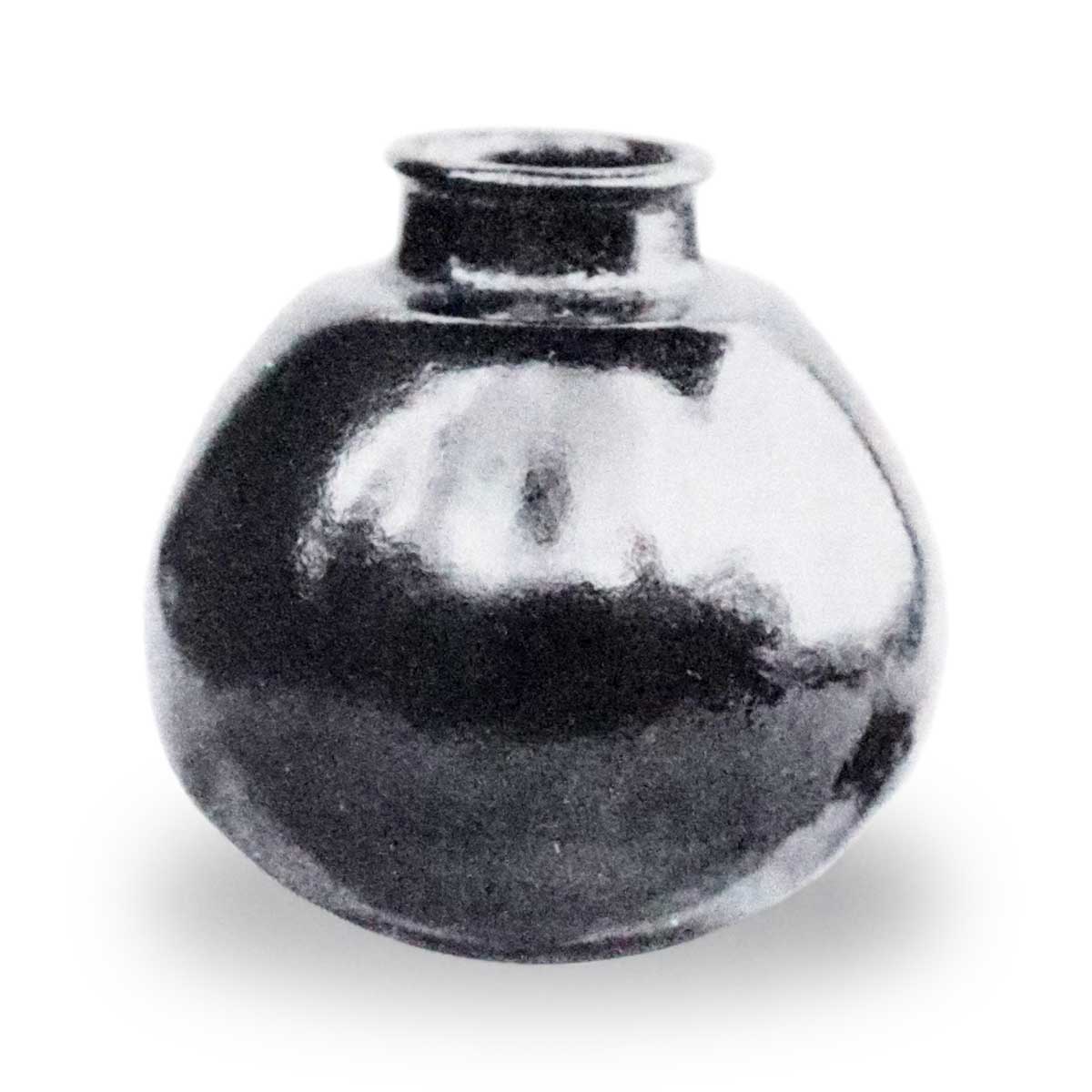
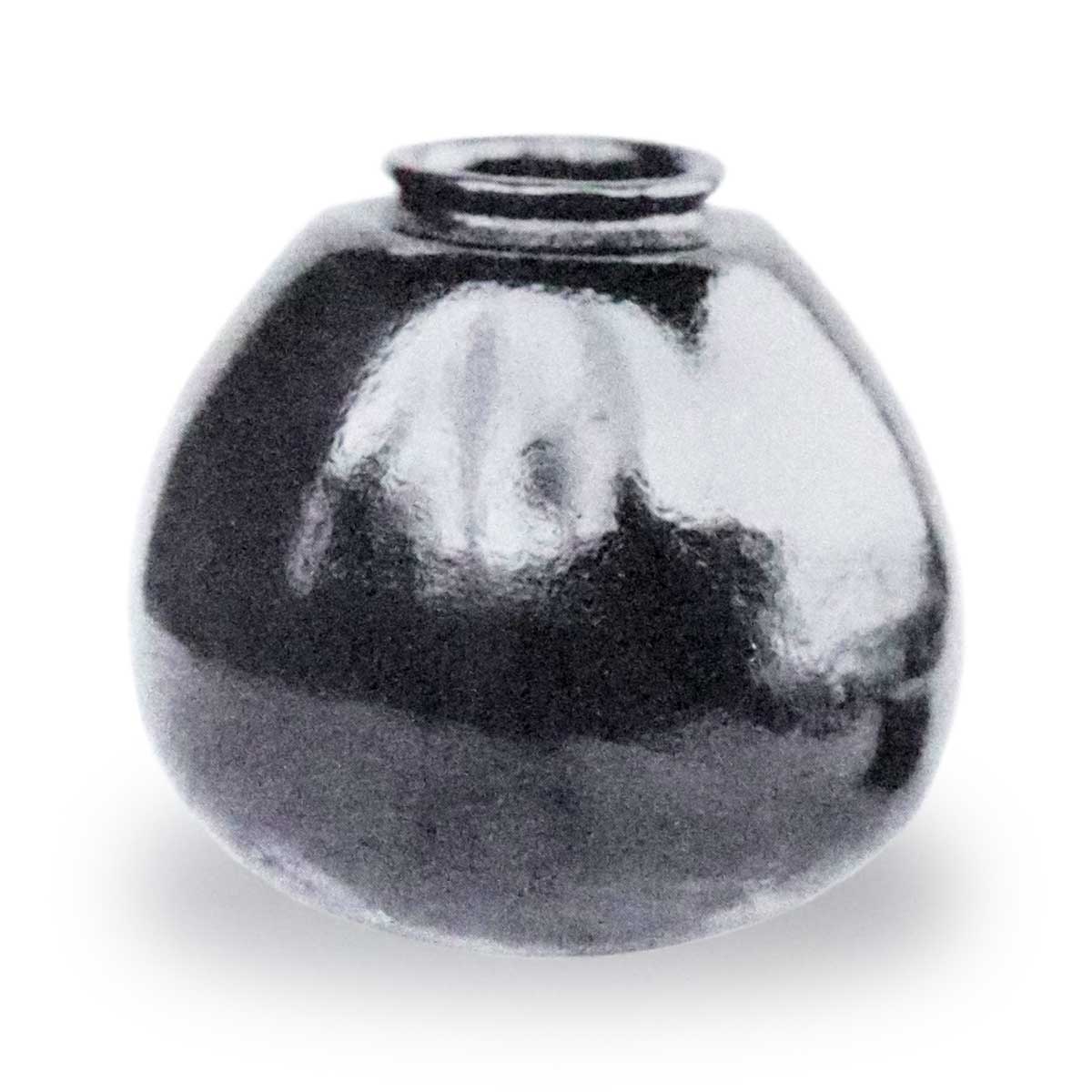
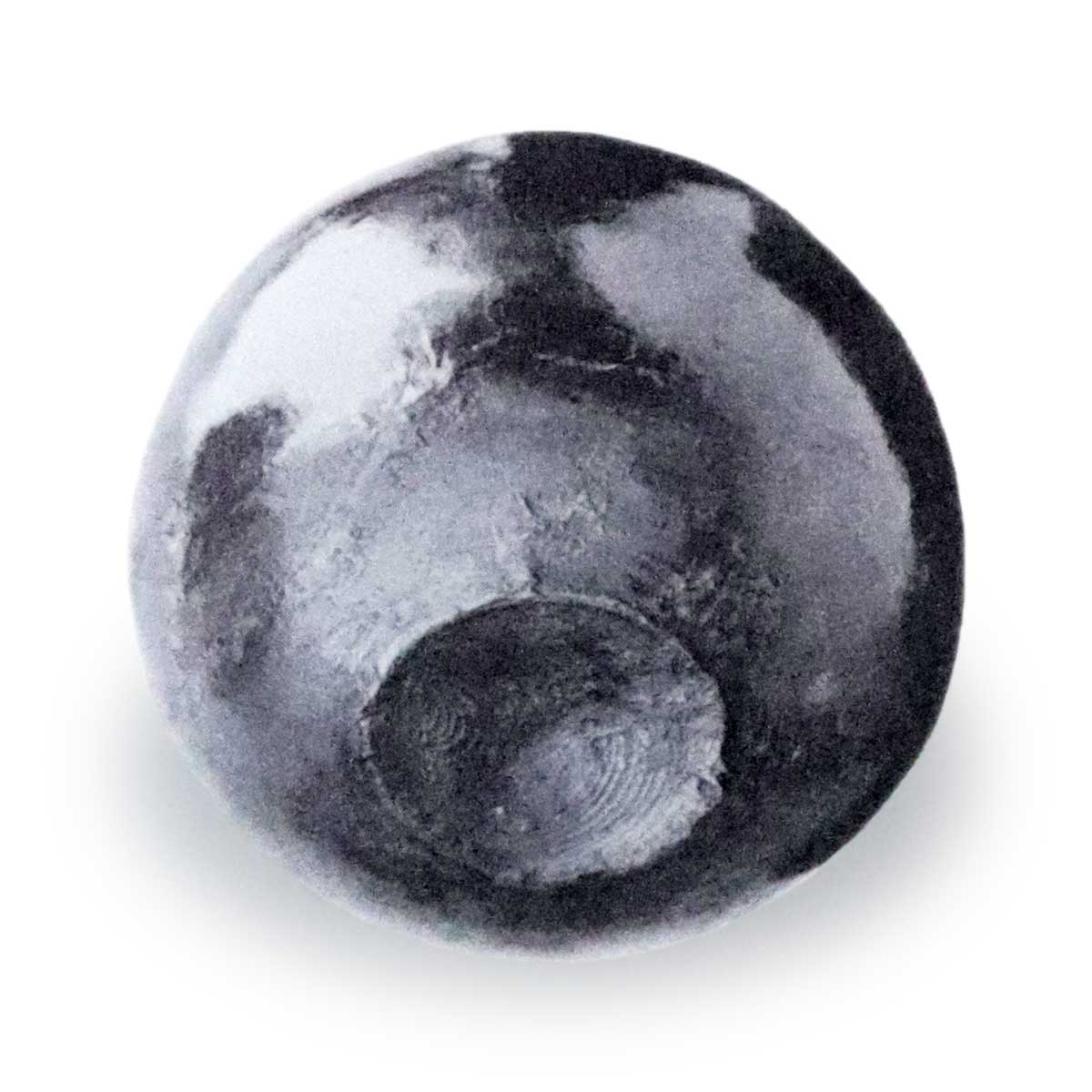
Tsukumo Eggplant
Also known as Matsunaga Eggplant or Tsukumo-gami; Chinese-made (Han-style) Daimeibutsu
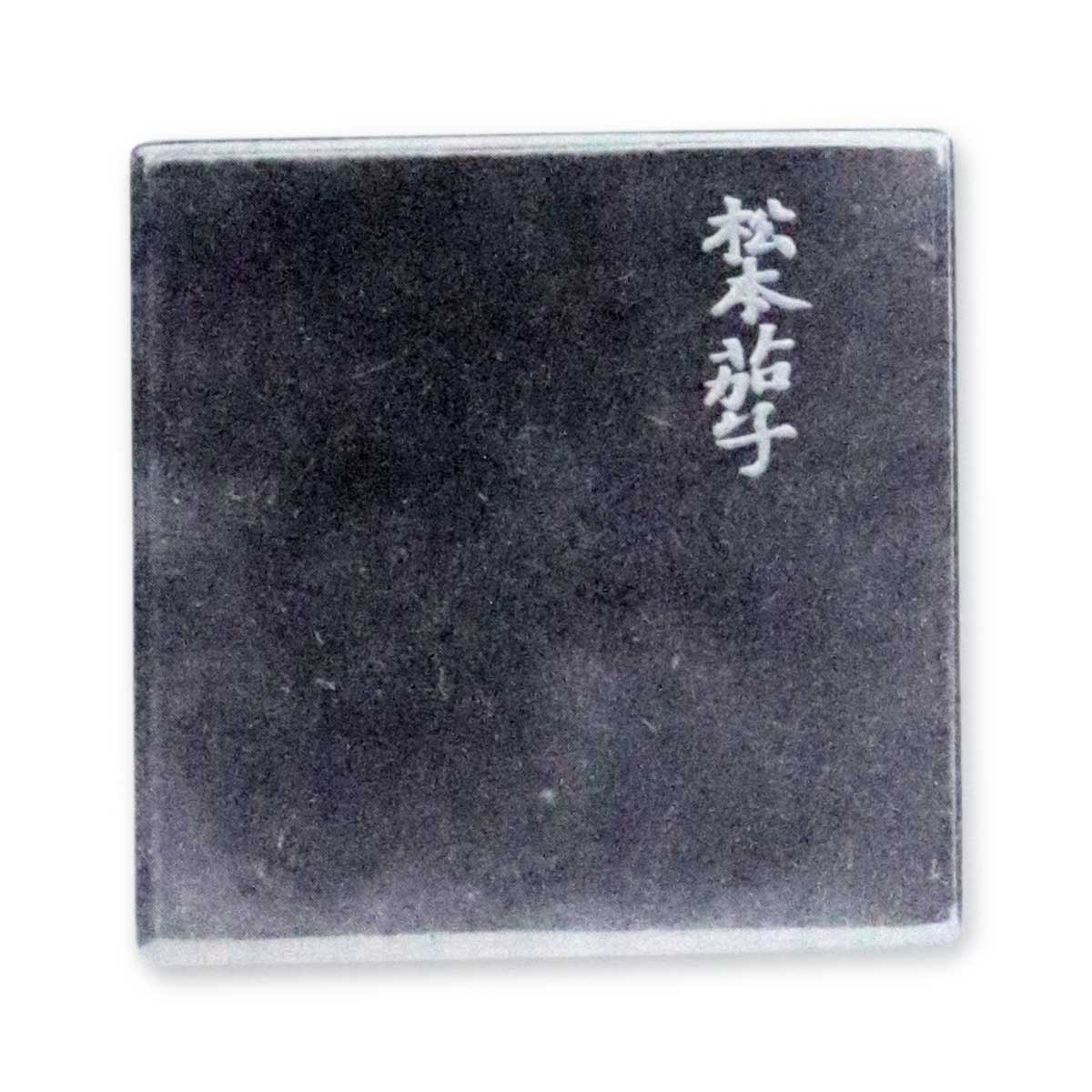
Matsumoto Eggplant
Chinese-made (Han-style) Daimeibutsu; Collection of Baron Hisaya Iwasaki
Regarding the Name
“Tsukumo” is also written as “Ezawa-mo,” “Eura-kusa,” or “Tsukumo-saku.” In the Ise Monogatari
“It appears to be the image of a ‘Tsukumo-gami’—a hair that is one short of a hundred in a hundred years (Tsukumogami)
seems to resemble the face of the one I long for.“
. Consequently, this tea caddy is called Tsukumo or Tsukumogami. It is said that the name originally stems from the fact that Jukō purchased it for ninety-nine kan. In a text by the monk Yotaka of Shōkoku-ji regarding the Tsukumo Eggplant, it states: ”This treasure jar was acquired for a sum one short of a hundred (ninety-nine), and it was named Tsukumo, taking its meaning from an ancient waka poem.” It is also called “Matsunaga Eggplant” because it was once owned by Matsunaga Hisahide.
Although there is no definitive evidence regarding the name “Matsumoto Eggplant,” it was likely owned by Matsumoto Juhō, a disciple of Jukō. The Genealogy of Japanese Tea Masters states that Matsumoto Juhō was known as Eishōbō Shōraku and lived in Kyoto. One book states, “He served Lord Hatakeyama Masanaga (or was said to be a retainer of the Yamana clan), and after the Ōnin War, he became a rōnin and lived in Nanto (Nara). He possessed a treasured tea caddy, which is a family heirloom of the Tsuchi-mon clan of Nanto. Today, this is called the Matsuya Katatsuki, and is also known as the Matsumoto Katatsuki.” If this is the case, just as the katatsuki he owned came to be called the Matsumoto Katatsuki, might this nasu-style tea caddy have been named “Matsumoto Eggplant.” For the time being, I will leave this question open and await the research of future experts.
Dimensions
Eggplant with Attached Algae
Height: 2 sun 3 bu 5 ri (approx. 7.1 cm)
Body diameter: 2 sun 4 bu 5 ri (approx. 7.4 cm)
Mouth diameter: 9 bu (approx. 2.7 cm)
Base diameter: 9 bu or 1 sun (approx. 2.7 cm or 3.0 cm)
Height of the rim (koshi): 3 bu 2 rin (approx. 1.0 cm)
Shoulder width: 1 bu 5 rin (approx. 0.5 cm)
Weight: 20 monme 4 rin (approx. 76.5 g)
Matsumoto Eggplant
Height: 2 sun 1 bu 5 rin (approx. 6.5 cm)
Body diameter: 2 sun 3 bu 3 rin (approx. 7.1 cm)
Mouth diameter: 9 bu (approx. 2.7 cm)
Base diameter: 9 bu (approx. 2.7 cm)
Rim height: 1 bu 3 rin (approx. 0.4 cm)
Shoulder width: None
Weight: 17 monme 9 bu (approx. 67.1 g)
Accessories
Tsukumo Eggplant
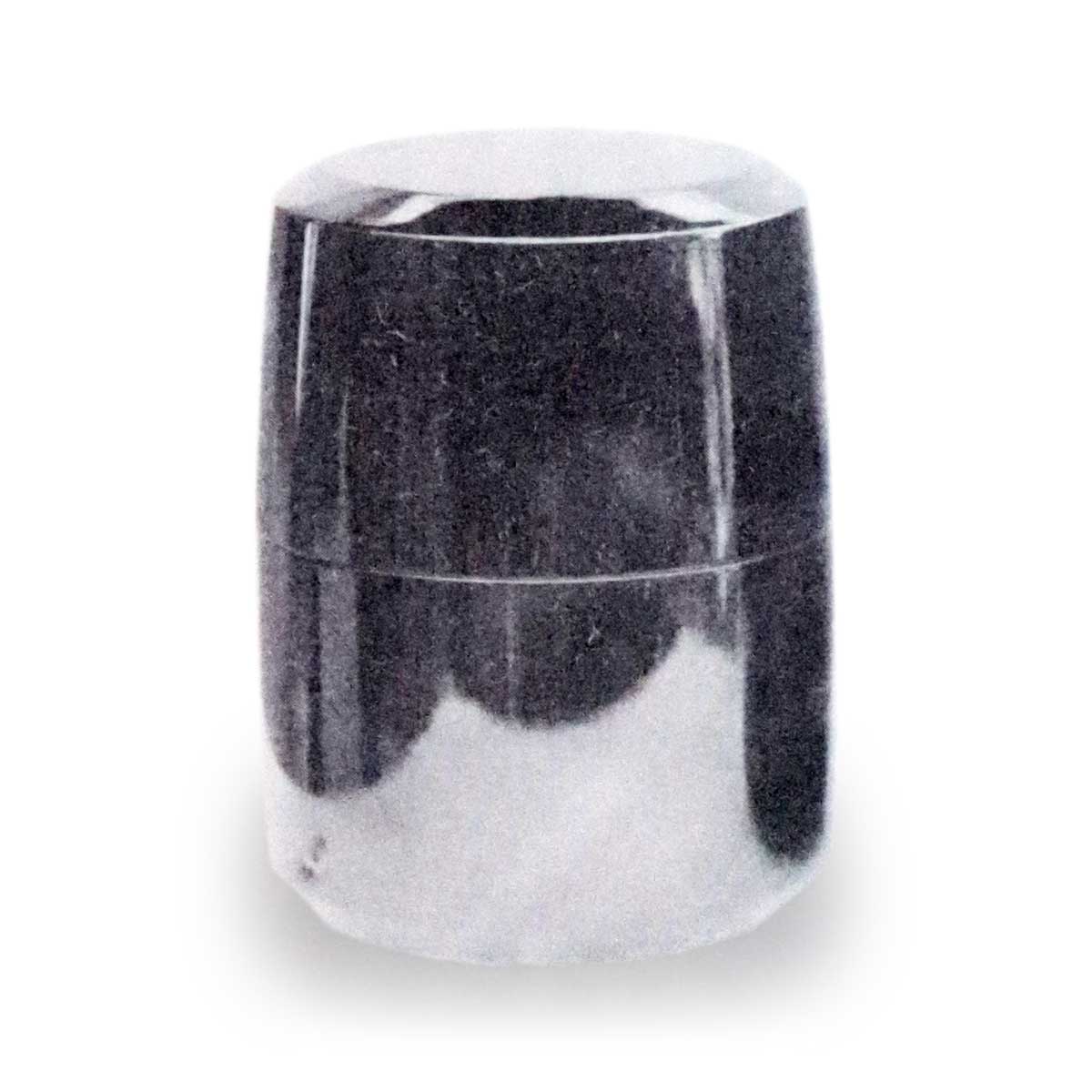
One lid: Ivory, with a depression (suba)
One storage bag: White ha-niji silk, with light yellow braided cord
One Hikiya: Black lacquer
Bag (cover): Black velvet, with purple and wisteria-colored braided cord
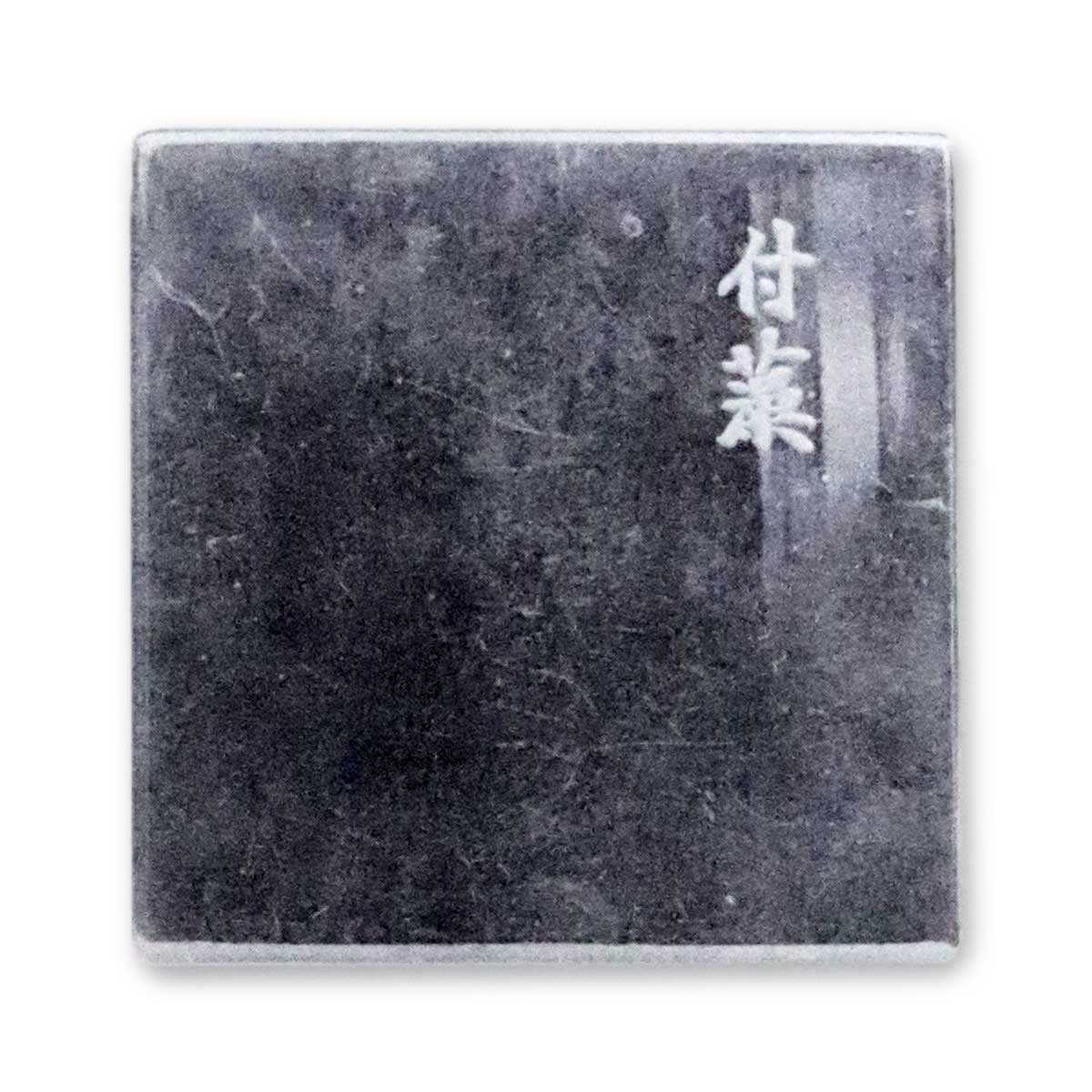
One box: Black lacquer, with gold powder lettering
“Tsukumo”
Matsumoto Eggplant
One lid: Ivory, with a recess; shows traces as if it had been exposed to fire
Tsukumo Eggplant, Matsumoto Eggplant
One Imperial Pouch: White ha-ni-ju, braided cord in white
One Hikiya: Black lacquer
Pouch: Black velvet, braided cord in pale sea-green and wisteria
One Box: Black lacquer, with characters in gold powder
“Matsumoto Eggplant”
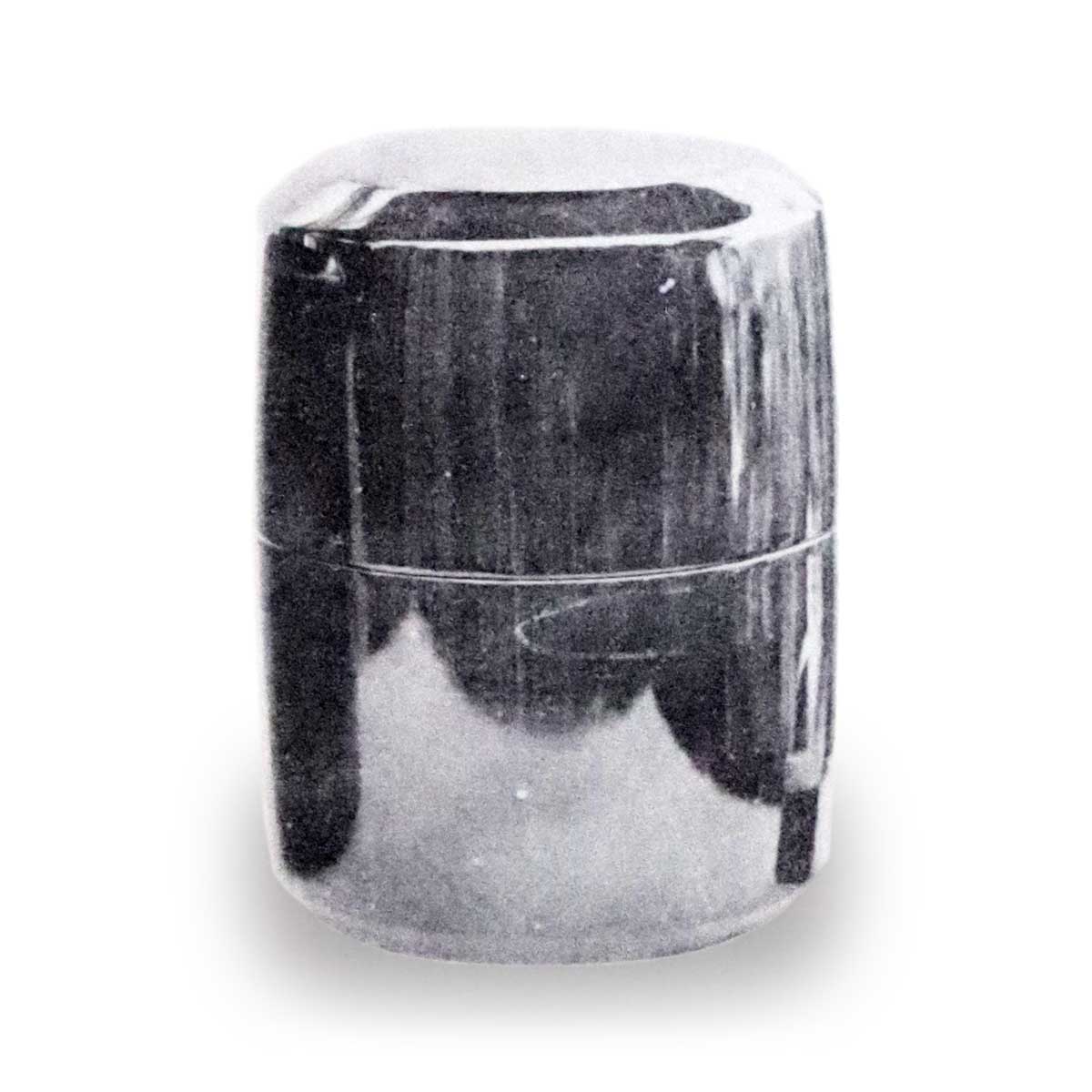
One Inner Box: Paulownia wood, black kaki-awase lacquer, with a lock
There is a shimenawa
(shimenawa) in maki-e; the interior of the box is partitioned to hold two eggplants.
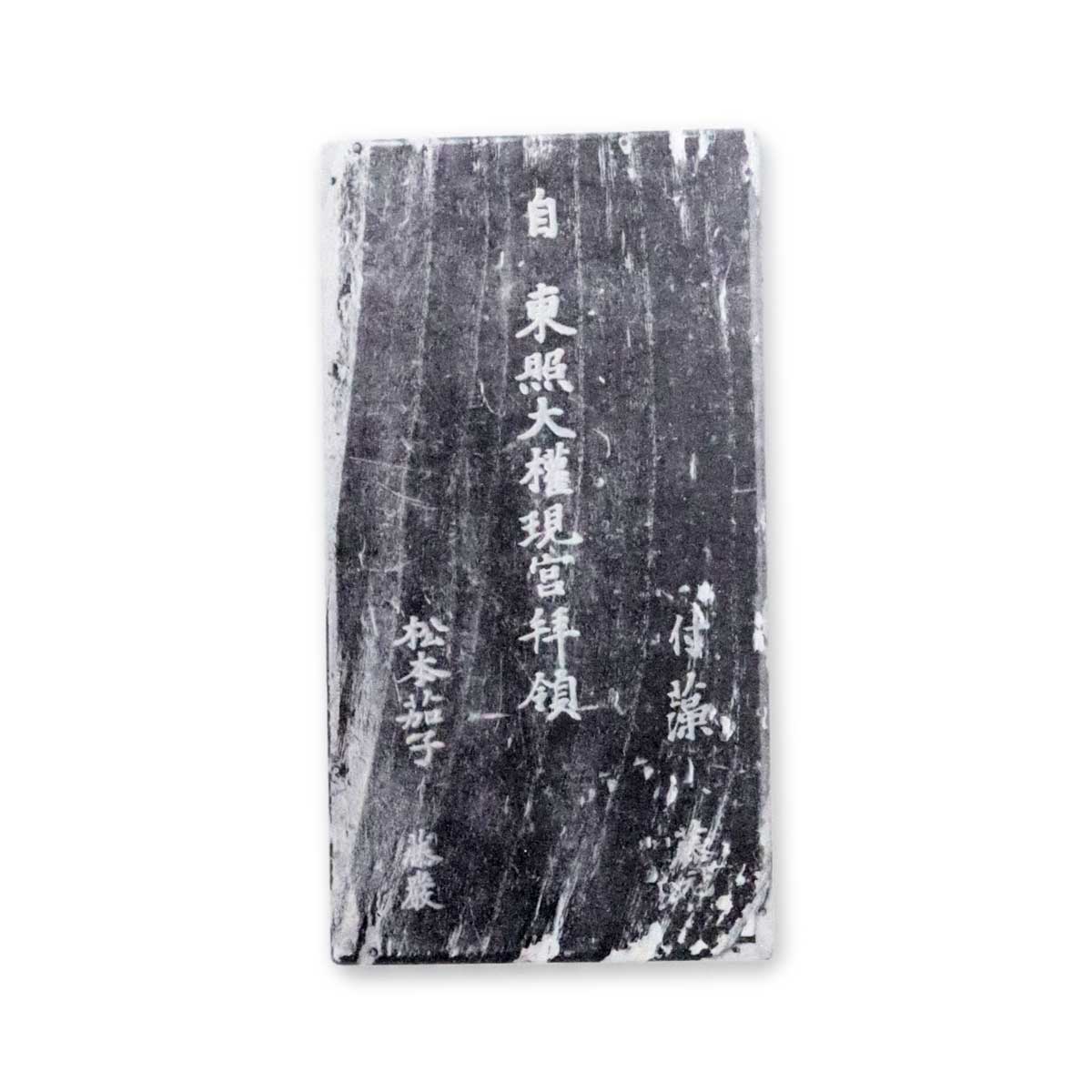
The inscription on the lid of the box is in gold powder and reads as follows.
“Tsukumo Fujimoto
Received from Tōshō Daigongen Shrine (Tokugawa Ieyasu)
Matsumoto Eggplant Fujigane”
One outer box: natural-finish paulownia wood
The inscription on the back reads as follows.
“Made in Meiji 13 (1880)
Mr. Iwasaki”
One main box: Unfinished hinoki wood
“Tea utensils”
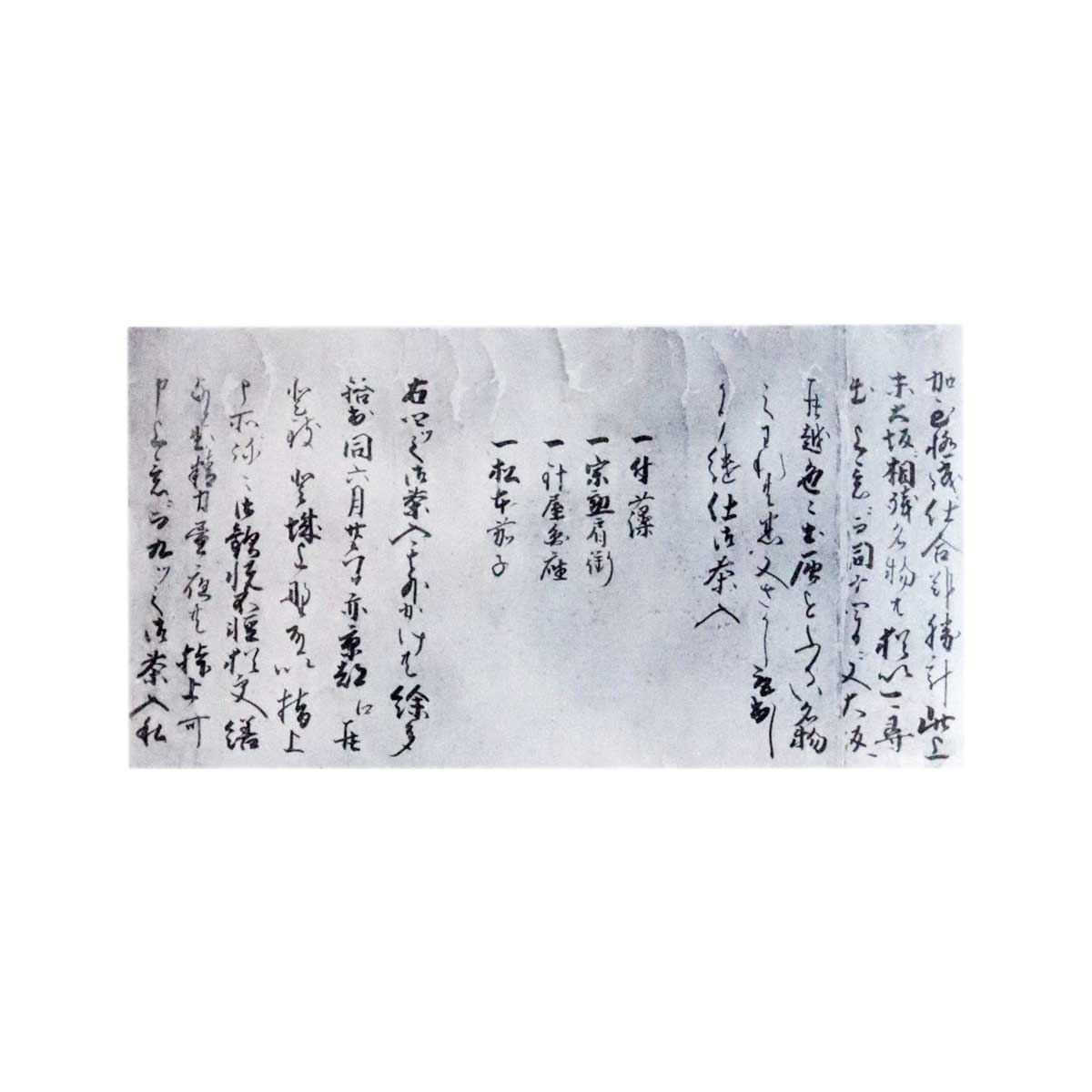
One accompanying scroll: One scroll
“The circumstances of receiving
the Tsukumo eggplant
and the Matsumoto eggplant
from Lord Ieyasu
- On May 7, 1615 (Genna 1), Osaka Castle fell, and subsequently, on May 28 of the same year, Fujishige, Fujimoto, and Fujiiwa—father and sons—were summoned from Nijo Castle. Lord Honda Uenokami, acting as magistrate, issued the following imperial decree: ‘There must be numerous tea caddies and other Meibutsu secretly held by Lord Hideyori on this occasion. If, by any chance, even a single item has survived the fire, it will be greatly treasured. Fujiiwa is to hurry to the ruins of Osaka Castle. Even if an item is shattered in two, search diligently, gather it up, and do not allow a single piece to be lost.” He then hurried to Osaka. He was instructed to carefully identify the general locations of the storehouses likely to contain the famous Meibutsu tea caddies and to search them out. That same night, he set out for Osaka by boat, and for several days, day and night, he dug through the dirt and ashes. Sure enough, he hurriedly searched for the famous Meibutsu tea caddies and other items, each trying to be the first to find them. First, he performed temporary repairs and brought them to Kyoto on June 12. That tea caddy,
One, Nitta Katatsuki
One, Eki (Asamaya) Katatsuki
One, Tamakaki Bunrin
One, Ko-katatsuki
One, Oshiri-hari
I brought these five Meibutsu to Nijo Castle and presented them through Lord Honda Uezumori. When Lord Ieyasu viewed them, he was exceptionally pleased. He immediately summoned Fujimoto and Fujii to his presence and granted them an audience. He then declared, “It is unprecedented that you have unearthed such a variety of rare and wondrous Meibutsu,” and, in high spirits, bestowed upon them a reward of one hundred koku of rice and stipends for twenty retainers. That Lord Honda Uezumori received this as magistrate was truly a source of pride for the family and a blessing (divine grace) and a source of great joy. Furthermore, the Emperor commanded, “Search even more diligently for the Meibutsu still remaining in Osaka.” On the 14th of the same month, they set out for Osaka once more. Sifting through various clumps of earth and ash, they recovered every single fragment of the Meibutsu. The tea caddies that had been temporarily repaired were: - Tsukimo
- Sōkun Katatsuki
- Hariya Enza
- Matsumoto Nasu
I gathered all four of these tea caddies and every other fragment without exception, and on June 26 of that same year, I returned to Kyoto and entered the castle. When I presented them through Lord Ueno, his delight was immense, and he issued the imperial command: “Devote yourself further to repairs and restoration, and bring them up here, exerting your utmost effort day and night.” As a result, nine tea caddies were bestowed upon me at my private residence. After spending time until September 16 of that same year restoring them and presenting them,
His Majesty was in an exceptionally good mood, and both father and son were summoned to his presence. “Fujishige is Japan’s most prized artisan. His skill, both ancient and modern, is so extraordinary that even the craftsmen of old could not match it; it will serve as a testament for future generations.” With these words, he personally bestowed the “Tsukumo” directly upon Fujimoto and the “Matsumoto Nasu” upon Fujigane. We were also granted the remaining broken fragments, and furthermore, he commanded, “Hone the secret techniques passed down through your family so that the glory of your clan may continue unbroken for generations to come.” is a source of pride for our family and a memory to last a lifetime; there is nothing greater than this. Later, when Lord Ieyasu traveled to Sunpu, he bestowed ten gold coins as a reward at the Mizuguchi post station, which we received with a personal endorsement from Lord Matsudaira Uemon-taiyu. I believe that all these unmerited blessings are solely due to the providence of the Great Kasuga Deity and the divine protection of the gods and Buddhas. - Regarding the original details of the tea utensils lost in the fall of Osaka Castle, Lord Honda Ueno stated in your presence: “It is truly regrettable that so many of the nation’s Meibutsu, treasured since the time of the Taiko, have been burned. “It would be of great value if even a single item that survived the fire could be recovered, so I intend to dispatch Fujiiwa to search for them,” he stated plainly, without a single obscure word or convoluted argument. However, Lord Ieyasu did not understand this at all; in the end, he merely laughed at Lord Ueno and said “There is no way I would leave behind such valuable items when departing from Japan’s finest castle. There is truly little room for dispute; there is no way something like a flower-decorated cart could have remained. And needless to say, something as small as a mustard seed certainly would not have.” Even as Lord Ueno pleaded earnestly, a secret discussion to this effect took place between Fujishige and his son. Fujiwara could not refuse, and since he spoke in a tone suggesting, “We should be able to find it with considerable effort,” Lord Ueno pressed him further, saying, “If by any chance we unearth it and it proves to be a Meibutsu, it will surely be bestowed upon the common people and held in high esteem.” When Lord Ueno spoke with great respect, the imperial decree regarding the matter was, “First, send Fujiiwa to investigate.” Fujiiwa then hurried to the ruins of Osaka, deliberating day and night until he unearthed the nine Meibutsu from the ashes. When he brought them to Kyoto and presented them before the Emperor, Ieyasu was astonished beyond expectation, utterly dumbfounded, and his joy was unlike anything seen before. This fortunate event in the presence of the Shogun, which became a matter of national importance that brought Fujishige fame, was entirely due to the wisdom and ingenuity of Lord Honda Ueno from start to finish, and it was through his efforts that these Meibutsu tea caddies were safely preserved for posterity.
First, as Lord Honda Ueno has just explained, everything went smoothly, and we were deeply grateful to receive various rewards from His Highness. He was delighted that this achievement not only earned public acclaim but also truly brought honor to our family, and he bestowed upon each of the two men ten silver coins and a single kosode. Furthermore, his intercession in the presence of His Majesty was unparalleled. For this reason, the Fujishige clan must never, not even for a single moment, become complacent, but must steadfastly uphold the family’s livelihood. I record the above for posterity.
Tsukumo Eggplant, Matsumoto Eggplant
Miscellaneous Notes
Tsumo Eggplant: Height just over 2 sun 3 bu; height from shoulder to base just over 1 sun 9 bu; mouth diameter (external measurement) 1 sun; base 1 sun; thread-cut. Body diameter 2 sun 4 bu 5 ri; body circumference 1 shaku 7 sun 7 bu. The lid is ivory. The pouch is made of off-white Donshu silk (though the cord is purple); the spare pouch is made of Guangdong cotton (with vertical stripes in brown and dark brown, and two horizontal brown stripes with small dots on one outer edge, though the cord is purple) . The Hikiya is black with a bluish tint, covered in a reddish-brown glaze, and the uneven texture across its surface is indescribably beautiful. An illustration of the tea caddy is included. I have had the good fortune to come across the two tea caddies on the right—the Tsukumo and the Matsumoto—as well as the document detailing the history of the pouch. After keeping them in my care for a while and examining them closely, I can say that they are truly masterpieces of the highest order. Therefore, I am recording this description.
Early July of the Year of the Yin-Wood Rabbit (Tenpō 2, 1831) Mitsui Michio
(Letter accompanying the Iwasaki Family Collection)
Ezawa Mo (Tsukumo Nasu): Once owned by Lord Nobunaga. Height: 2 sun; width: just over 2 sun 4 bu; circumference: 7 sun 6 bu; base: 1 sun; mouth: 1 sun; bulge: 8 bu. The clay is blue-black. The vermilion glaze contains a high proportion of cinnabar (vermilion) (illustration of the tea caddy included).
(From the Manpō Zenshū)
Tsukumo Nasu: Viewed in Tenmei 6 (1786). The overall glaze is chestnut brown; the base clay is mouse-gray. An amber-colored glaze covers the front, which is a brown amber glaze. It is more brownish than the amber glaze of the Matsuya Katatsuki and lacks luster. Although there are scratches in places, it is exceptionally fine. The base is mouse-gray clay, covered with a watery glaze that has a reddish tint. There are some glaze splatters. The clay is visible in one spot within the thread-cut decoration. An illustration of the tea caddy with a description is available.
(From “Meibutsu-ki: A Record of Famous Tea Caddies”)
Tsukumo Nasu: Comes with two pouches—a white-ground Donshu style Junko and a cotton Guangdong. The Hikiya is black-lacquered with chamfered edges; the pouches are made of black velvet. The box is black-lacquered with the word “Tsukumo” written in gold powder, and features a genuine thread-cut design (illustration of the tea caddy included).
(From “Illustrated Guide to Tea Caddies” by Yoshimasu Kōen)
Tsukumo Eggplant: A gift from the court; formerly owned by Fujishige Fujimoto. Mouth diameter: 1 sun; rim height: just over 2 bu; circumference: 7 sun 6 bu; base: 1 sun; thread-cut on the left. Height: just over 2 sun 3 bu 5 rin; width: just over 2 sun 4 bu 5 rin (slightly large). The lid is made of ivory and bears lathe marks; the underside is lined with period gold leaf. The pouch is made of cotton Guangdong silk (with a cord featuring red and navy blue sea wave patterns), adzuki bean-colored Guangdong silk (lined with white ground and white chrysanthemum crest sea wave patterns), and a Donshu silk pouch with a lingzhi ground pattern. The Hikiya pouch is black velvet (lined with purple, purple cord, and iridescent sea wave patterns) . The outer box of the Hikiya family is decorated with gu-nuri lacquer and a gold-powder inscription. The outer box is finished in black kaki-awase lacquer, featuring powder-painted characters reading “Tsukumo Fujimoto, Matsumoto Fujigane,” and maki-e decorations of shimenawa ropes on the outer edges of the form. It is truly magnificent. A scroll of provenance dating from Tenna 2 (1682) is included, indicating it was passed down through the Fujishige family. On the 27th day of the 8th month of autumn in Tenpō 2 (1831), it arrived at the residence of Lord Nagoshi Sakugorō; I insisted on obtaining it and examined it at first glance. Based on this, I revised the measurements and other details once again. An illustration of the tea caddy is included.
(Editor unknown From Shokake Meiki Shū)
The four finest eggplant-shaped tea caddies in the land are the Tsukumo, the Small Eggplant, the Matsumoto Eggplant, and the Fuji Eggplant. Of these, the Tsukumo is the largest. Its mouth is generally the narrowest. Furthermore, the smallest of the lot is the Ko-nasu (omitted). Even though the Tsukumo’s mouth is narrow, it is exceptionally splendid. It is not set in stone that a narrow mouth is good or bad; whether wide or narrow, large or small, it ultimately depends on the form (body) and appearance of the object itself. To use an analogy: when speaking of a beautiful woman, is she called beautiful based on whether her mouth is wide or narrow, large or small, or based on her nose or her eyes? Even if the facial features vary in size, people are called beautiful based on their balance (harmony) that determines whether they are beautiful. One should understand that this applies equally to various objects.
(From the Matsuya Diary)
Tsukumo Eggplant: Owned by Lord Nobunaga.
(From the Tenshō Meibutsu-ki)
Tsukumo Eggplant: Lord Nobunaga, Minister of the Right.
(From the Higashiyama Imperial Treasures Sub-Register)
Tsukumo Eggplant: During the reign of Lord Nobunaga (Sōken-in-dono), it was lost in a fire at Honnō-ji Temple in Kyoto. This vase was brought to light through the discerning eye of Jukō. Its history of transmission is scattered across various accounts: Tarozaemon Asakura of Echizen owned it for 500 kan, and later, a kimono merchant in Fuchū of the same province acquired it for 1,000 kan. Subsequently, during the civil war, it was entrusted to a bag maker in Kyoto; however, it was not returned because it was said to have been lost in the Hokke sect uprising in Kyoto. Matsunaga Hisahide, however, had it retrieved and kept it for 20 years before presenting it to Nobunaga. Although it was lost at Honnō-ji, it resembles one of the four small eggplants (one of Jukō’s and Shōō’s) said to exist in the realm.
(From the Gunzō Shūi edition of Chaki Meibutsu Shū)
Tsukumo Nasu: It is displayed on a tray with a red interior. It is housed in a Kinran bag. It was lost in the fire at Honno-ji during the reign of Sōken-in-dono (Nobunaga). The purchase price was ninety-nine kan. This teapot came to light through the connoisseurship of Jukō. (Omitted) It was owned by Lord Asakura of Echizen.
Later, Rikyu appraised it, and a kimono merchant from Fuchu in the same province purchased it for 500 kan. Although many buyers offered 1,000 kan, the merchant had entrusted it to a bag merchant in Kyoto during the civil unrest in the province. Claiming it had been lost in the Hokke-shu Rebellion, he had not yet returned it; however, he produced it ten years ago and presented it to Lord Nobunaga. The clay, glaze, and form of Tsukumogami are so unparalleled that even people of old praised it as the finest Meibutsu in the land.
(From “Chadan” by Soji Yamagami)
Matsunaga Hisahide, upon receiving the order to subdue Yamato Province, rejoiced greatly, considering it an honor beyond his station. He sought to curry favor with Nobunaga even more, presenting him with Yoshimitsu’s famous short sword—renowned as the finest Meibutsu in the land—and a famous tea caddy named “Tsukumogami (Tsukumo Eggplant).” He flattered and fawned over Nobunaga day after day.
(From the Revised Ōnin Chronicle)
Tsukumo-gasa: It was lost in a fire during the reign of Sōken-in-dono (Nobunaga). This occurred at Honnō-ji. This jar was discovered by Jukō and became part of the imperial collection. It subsequently passed through various hands, and was eventually owned by Asakura Tarōzaemon of Echizen for 500 kan. Later, a kimono merchant in Fuchu, in the same province, purchased it for 1,000 Sen. During a provincial uprising, he entrusted it to a bag maker in Kyoto, who refused to return it, claiming it had been lost during the Nichiren Sect Rebellion. Matsunaga Hisahide retrieved it through his own initiative, kept it for 20 years, and then presented it to Lord Nobunaga. It is housed in a Kinran bag and rests on a square tray. Ancient accounts state that the quality of the clay and glaze, as well as the craftsmanship of this rim, are unmatched in the realm. The overall color of the clay is a bluish black. The surface appears monochromatic, and as one moves toward the sides, the glaze thickens and gathers in a manner that is truly unparalleled. It curves slightly toward the base, and the tips of the glaze drips possess a serpentine charm. Vermilion clay is visible on the sides. On the front, the base glaze appears a pale persimmon color, while on the back there is a single cascade that resembles a crack. The persimmon-colored base is visible in places. The gaps in the glaze are located on the right side of the jar; when facing the jar, this is the left side. It appears as though the side—which looks as if it had been fiddled with by fingertips—has been gently rubbed. In some places, the glaze is close to the surface. The thread-like crack stops behind the cascade at the bottom. The rim is fluttering, and the impression from above that it resembles a red bean refers to the “fold-back” (twist). It sits above the bulge of the waistband, and the bulge is slightly lower. The general shape and the feel of the rim are as described.
(From the Records of the Tea Tradition)
Ezawa-mo (Tsukumo): Miyoshi Sōsan was the younger brother of Kiyun and the uncle of Jikkyū. He possessed a treasured tea caddy called “Kujūku-kami.” Ezawa-mo is mentioned in the Ise Monogatari.
(From the Genealogy of Tea Masters)
Miyoshi Sōsan: He was Jikkyū’s uncle and Kiyun’s younger brother. He possessed a treasured tea caddy called “Kujūku-kami.” In the annotations to the Ise Monogatari, “Kujūku-kami” is referred to as “Ezawa-mo.” Although many people are familiar with this tea caddy, it remains hidden in the possession of a prominent family and cannot be easily viewed today.
(From Genealogy of Japanese Tea Masters and Discussions on Tea Ceremonies)
When Sōeki (Rikyū) was with Lord Nobunaga, during a formal greeting (katsuzumi)—not merely offering a greeting, but when he was instructed to turn around and change the bag of tea leaves—the Lord asked, “I heard that the inscription on this tea bag was written by Priest Yutaka of Shōkoku-ji. Do you know anything about it?” Sōeki replied, “Indeed, I do. I saw it once at a tea gathering hosted by Danjō Matsunaga, but but it was destroyed in the fire at Shigisan Castle during the Tenshō 5 Rebellion. There is a copy in Sakai, so I shall have it sent to you.”
(From Chawa Shigetsu-shū)
Lord Higashiyama (Ashikaga Yoshimasa) was a connoisseur of tea utensils, and as many of the realm’s Meibutsu were gathered in his collection, the “Tsukumo-kami” eggplant-shaped tea caddy was also among his possessions.
(From Chōan-dō-ki by Kubo Gonta)
Inscription on the Matsunaga Eggplant Tea Caddy: At that time, the “Sakumono Eggplant” tea caddy—a Meibutsu of the realm—was in the possession of the Minister’s household (Nobunaga). It is said that the inscription on this tea caddy was composed by Priest Yutaka of Shōkoku-ji Temple in Rakuyō (Kyoto). This inscription was lost in a fire this year at Shigisan Castle in Yamato Province. Consequently, when the matter was again brought to the attention of Priest Yutaka, he informed us that he still possessed a copy of the inscription he had written for the Matsunaga family several years prior, and he immediately presented it to us. The Minister’s household was greatly delighted. The inscription reads:
As the old proverb says, “Objects are considered rare because they come from afar, and events are considered precious because they are seldom seen.” Here is a rare and wondrous treasure. Its form embodies the style of ancient imperial pottery, and its colors and decorations resemble the carvings of King Yu of the Xia Dynasty. It is said that long ago, an artificial mountain of Penglai (a symbolic mountain) was constructed in the capital of China, and a small treasure jar was enshrined at its summit, named the “Wish-Granting Pearl.” This was later presented to the distant land of Fusō (Japan). It is regrettable that the exact date is unknown. According to the records in Huang Kao’s “Daily Stele,” “the Ruyi Pearl is called ‘Mani’ in Sanskrit, and its auspicious signs and virtues are innumerable.” As the finest object in all of Japan, peerless under heaven, it is a rare treasure worthy of being placed at the head of the table. There may be a few things that come close, but compared to this object, named “Little Eggplant,” the difference is as vast as that between heaven and earth, or between Hu and Yue (meaning “far apart”); should they even be mentioned in the same breath? Meanwhile, there is a flaw in this treasure jar—it is one short of a hundred (ninety-nine)—and taking the meaning from an ancient waka poem, it was named “Tsukumo.” There should be no objection to changing its name. Clad in the halo of the moon on all sides and standing among the trees, it belongs to the family of what is commonly called “Otarabashi” in Japan. Passed down through generations and treasured, it is revered precisely because it is rare. This is indeed the case. This is because Lord Shōen (Ashikaga Yoshimasa), on his way to the Battle of Uchino and his encampment, found fortune in the distant colors and favor bestowed upon him by the power of a vengeful spirit. Subsequently, as chaos reigned both within and without, this treasure fell into decline, passing into the hands of merchants, buried in dust and dirt, causing the people of the world to frown and lament in sorrow. Prior to this, in the year Tenbun Bishin (1536), a conflict arose among the monks of Mount Hiei (the Tai sect), leading to the Hoko-Tate incident (a rebellion, the Lotus Sect Uprising). The capital of Kyoto was burned, the jewels were scattered, and the treasure chest was hidden and buried—a truly lamentable affair. Connoisseurs searched high and low, trying every possible means, but its whereabouts remained unknown; this is the result of their utmost efforts. Ah, Fujiwara no Asomi, Matsunaga Danjō Shōshi Hisahide, held the reins of state power, and his authority was feared and obeyed. Thus, in the spring of Eiroku 5 (1558), a person happened to arrive bearing this treasure jar. Accompanying it were a cloisonné stand (the interior also in cloisonné) and a glass lid (truly worthy of being called a “mani gem”). In that place, a multitude of treasures were gathered together. It is said in the sacred scriptures: “The gathering of supreme treasures is obtained without seeking.” These words of wisdom have been proven true. How joyful it is that they have gathered and come to fruition! There is nothing greater than this; it deserves to be praised and revered. Reflecting quietly on the history of the Han dynasty, during the reign of Emperor Shun, Meng Chang, whose courtesy name was Bozhou, was appointed Governor of Hepu. As a statesman, he was virtuous and conducted himself with integrity.
He reformed the abuses of the past, and the pearls that had been lost returned once more. This is the saying: “When Mengchang became Governor of Hepu, the pearls returned.” They were said to be in another sea, or at times were called divine. It is clearly recorded in the history books as a beautiful event for all time. Now, perhaps moved by His Excellency Hisashi’s virtue, the treasure jar, like the Wish-Granting Pearl, has departed only to return once more. It is mysterious and wondrous; unexpectedly, on the shores of Japan, it is as if we have seen the Governor of Hepu (Mengchang) once more. Upon hearing that there was a fairy island called Penglai in Wa, the First Emperor of Qin dispatched Xu Fu to seek the elixir of immortality. Xu Fu reached Mount Kinpō in Nanki and settled at Mount Fuji in Suruga to the east. He designated these lands as Penglai. The Fanghu of Penglai are all sacred realms of immortals. Today’s refined intellectuals delight in emulating the ways of Lu Yu and Lu Tong (both Chinese tea masters); households store ten tea bowls or a single ceramic vessel, and the handsome old man yearns for the son of Lanchuan. Lu Tong once composed a song about tea: “Six bowls connect with the spirits of the immortals; seven bowls—where is Penglai? (Drink six cups and connect with the spirits of the immortals; drink seven cups and where is Penglai?)” Tea is the auspicious herb of the immortals. On days when the Lord has a break from official duties, amidst the paintings drawn by the chamberlain and the pure fragrance of the bedchamber, he gathers with fine guests to drink and praise the taste of the immortal flower. All day long, he dispels his sorrows with pure conversation and laughter; the troubles of the world brush past him like a breeze, and within his body, it is as if he were in the Land of Penglai at seventy. Without walking the three thousand li of the Weak Water, he reaches the mountaintop of his own accord; there is no doubt that he will extend his life, return to the state of a child, and have a complexion like peach blossoms. If so, this single teapot is the supreme wish-granting jewel. The beautiful garments and rare toys of this world, even if piled as high as the Big Dipper, should be regarded as mere dust and dirt. This is something to be cherished and celebrated to the utmost. Mr. Matsunaga asked me to record this matter. I foolishly declined and would not agree to write a single word, but since I was ordered to wait for the Records of the Grand Historian, I am idly recording this.
On the day of the Wish-Granting Pearl in the seventh month (Izo) of the first year of Eiroku (1558), the year of the Horse (Bo-go). Man’nen Kiyohira School, Kaba Rengan-so (Venerable Yuko)
(From the Sōken Nikki)
On one occasion, when I was instructed by Lord Fujishige through Sen Sōeki (Rikyū Kōji) to prepare a tea caddy made from an eggplant, he said, “It was Venerable Yūko of Shōkoku-ji who wrote this record. Did you not know that?” I replied, “I saw it once at a tea gathering at Matsunaga’s residence, but it was lost in the fire at Shigisan Castle. There must be a copy. I will search for it and present it to you,” and had it sent from Sakai (Sakai) and presented it to him. The inscription reads as follows. (Classical Chinese text omitted; same as the aforementioned Sōken Nikki)
(From the Taikōki)
9th day of the 9th month, 4th year of Kōji (1558) (Year of the Horse; later renamed Eiroku) Noon: Lord Matsunaga’s Gathering
Guests: Dōchin, Sōkyū, Sōji
A “Tsukumo Eggplant” was placed on a square tray in the tokonoma and set in the water room; in the tokonoma, white chrysanthemums were arranged with care, etc. The “Tsukumo Eggplant” was 2.35 sun in height, 2.35 sun in body diameter, 1 sun in mouth diameter, and 1 sun in base diameter. The bag was from Kantō (Guangdong), and the braided cord was light blue (illustration of the tea caddy included) .
(Excerpt from Imai Sōkyū’s Diary)
February 25, Eiroku 3 (1560) — Meeting with Lord Matsunaga
Placed a “Tsukumo Eggplant” on a square tray in the tokonoma; the bag is white ground with Kinran brocade and light blue cord. The thin Chinese-style right-hand teapot has a single-color glaze. Sensitive to the atmosphere, the form is graceful and well-proportioned. The base (bottom) is in particularly excellent condition. The clay is of high quality, with a light blue center and a slight hint of purple. Vermilion has been fired out on two sides, and the rim extends on three sides. There is a single streak running down the side, which fades slightly about one-third of the way down. The rim either curves outward or or has a fine twist. There are areas that resemble the gaps between stones; perhaps these are remnants of friction from the gaps in armor (yoroi no ahi). Overall, the construction appears to be wheel-thrown, though the rim is pushed outward. Vermilion glaze drips outward at the tips of the glaze runs, and the pools appear to be black glaze.
(From Tsuda Sōyuki’s Tea Ceremony Diary)
December, Eiroku 5 (1562) — At the Tea Ceremony at Tamon-zan — Lord Matsudaira Danjō Shōsuke
Guests: Seifuku-in, Doctor Dōsan, Hisamasa, Sakai Sōka, Takeuchi Shimōsa-no-kami
“Tsukumo” — Comes in a Kinran pouch. The pouch’s cord is pale yellow.
(From the Matsuya Diary)
January 29, 1565 (Eiroku 8, Year of the Ox) Tea ceremony hosted by Shimodai (Matsunaga Hisahide) at Tamonzan
Guests: Ryusen of Sakai (Ikkyu), Soeki (Rikyu), Hisamasa, and Soka at the end of the seating
A north-facing, left-aligned tea room measuring four and a half tatami mats. In the tokonoma, “crops” were placed on a square tray; the hanging scroll had been removed. The bag was Kinran. The tea ceremony was a private gathering in the woods. The tea was supreme (the highest quality). It was served in a yara (perhaps a kensui) and a Takakou tea bowl. The water for the tea was the famous spring water from the third room in Uji.
(From the Matsuya Diary)
The 10th day of the 12th month of the Year of the Dragon, Eiroku 11 (1568), at the hour of Xu-Xu. At the residence of Kiyasu Munehito in Saiki-cho (Zaimoku-cho) to the north, I had the honor of seeing a “Tsukumo Nasubi” for the first time.
The shape of this jar appears somewhat flat. It is of a large size. The clay is not particularly fine, and the glaze is reddish-black. This pot on the right is surprisingly dull in appearance. The “avalanche” pattern on the surface does not look like an avalanche; rather, it appears as if the glaze has bled. It stops at the rim. There are areas where the pattern blends on either side of the avalanche. The stone-patterned section is located on the right side of the jar, slightly toward the back from the side, and the colored glaze appears slightly faded and chipped. The glaze seems thin. The clay is vermilion in color and is slightly exposed at the bottom. However, to the right of the glaze run, the brushstrokes at the rim are rounded, and the clay appears to be slightly thicker there. The rim appears chipped, and there is no (inward fold), and the glaze extends slightly inward. The area believed to be the stone chamber rises slightly higher, and the “tsumago” (?) feature is not conspicuous. The distance from the shoulder to the neck is about a finger’s width, and it sits slightly lower. The band is positioned slightly lower, and the shoulder protrudes slightly. The shoulder also appears to be moderately high. There is a single band; the pot does not appear to be bald on top, and while the rim looks large when covered, the turned-in edge flutters inward. The interior of the rim narrows. The pot appears to be about 40 years old. Although it appears somewhat dull, there are also vibrant areas. Is there a bit of clay below the rim? The base is open. From the middle of the vase downwards, the waist appears to flare out. Even on the upper part of this vase, the main points of interest are not particularly impressive, and the stone gap is, if anything, not ideal; this stone gap and the clay may not stand out at all to the eye, but they are present within the glaze and appear to be appropriately formed. This stone-like pattern on the side has long been referred to as a “gap” (hima). Furthermore, it does not resemble a demon’s horn; rather, it is a natural feature of the pot’s form. Overall, this pot does not appear vulgar; on the contrary, it seems to possess such dignity that it is almost too splendid. As a tea caddy, it is superior to my Bunrin (Sōrin) pieces. Although there are differences in the craftsmanship, they are minor. The wrapping in the half-sheet of paper is particularly elaborate. It is decorated with Chinese gold leaf. The bag is made of Kinran on a white background. The lining is light blue, and the braided cord is also light blue. It should be smaller than this. There is an illustration of the tea caddy.
(From Tsuda Sōyuki’s Tea Ceremony Diary)
On January 2, Eiroku 11 (1568), a siege was laid upon the residence of Chikugo (presumably Ikeda Katsumasa) at Ikeda Castle, and Nobunaga stationed his forces at Kitayama to observe. (Omitted) The lords believe that the retinue accompanying him on this campaign will be renowned for generations to come.
Tsukumo-gasa, Matsumoto-gasa
Is this what is meant by “renewing oneself daily, fighting like the wind, and attacking like a burst dam”? Since Ikeda Chikugo-no-kami surrendered and presented hostages, the troops were withdrawn to the main camp at Keikawa Castle. The Five Provinces and neighboring regions were all placed under his command. Matsunaga Danjō presented the “Tsukumogami,” a sword unmatched in our realm. Imai Sōkyū, in turn, offered the “Shōō Eggplant,” a Meibutsu of unquestionable renown. It is said that there were even those who presented the armor worn by Lord Hangan (Minamoto no Yoshitsune) when he fought at Ichinotani on Mount Chōkai (Ibukigoe). During his 14-day stay at Akutagawa, vendors gathered in such numbers that a market formed at the gate, all seeking to present rare items from foreign lands and Japan as tokens of gratitude to Nobunaga.
(From the Chronicles of Lord Nobunaga)
August 12, Genki 2 (1571) — Lord Nobunaga held a ceremony at his outpost in Gifu.
In the tokonoma, “a long tray held a bag containing an eggplant, etc., and the lids (or lid) were each examined and placed on the shelf.” A painting of sweets hung in the tokonoma, and within the tray, several Inuyama tenmoku bowls were placed side by side with the vegetables (eggplants). Nobunaga took out the chasen rest and handed it to Nyokui, and tea was served immediately.
(From Mokkin Sōgi’s Bōkyū Chakai-ki)
November 24, 1573 (Tenshō 1, Year of the Rooster): Lord Nobunaga hosted a tea gathering at Myōkaku-ji Temple in Kyoto.
Guests: Yukan, Sōkyū, Sōji
In the tokonoma hung a painting of a returning sail (by Muqi), and in front of it stood a crescent-moon-shaped vase, a flowerless vase shaped like a turnip, and a lacquered board adorned with many white plum blossoms—all arranged by His Lordship (Nobunaga) himself. On the tea tray was a Daikaku-ji tenmoku bowl; on a dragon-patterned stand stood a walnut-shaped kensui; and the tea caddy was an eggplant-shaped “Tsukumo.”
(Excerpt from the Diary of Imai Sōkyū)
Tenshō 2 (1574), Year of the Rooster, October 28: At Lord Nobunaga’s gathering
Guests: Sōeki (Rikyu), Soeki, Soju, Dosetsu
A painting of the evening bell was hung in the tokonoma, with a crescent moon vase placed in front of it. On the tea tray, the “Tsukumo” was placed inside an eggplant-shaped pouch and set on a tray with a red interior, etc. We entered the tea room with a tea bowl by Dosan, and Lord Nobunaga served the tea himself.
(Excerpt from the Diary of Imai Sōkyū)
Tsukumo Eggplant, Matsumoto Eggplant
On September 28, 1575 (Tenshō 3, Year of the Earth Pig), Nobunaga summoned tea masters from Kyoto and Sakai, had Sen no Rikyū prepare tea, and was served it. In the alcove of the tea house hung a scroll depicting the evening bell of Enji Temple (painted by Bokei, formerly owned by Lord Yoshimasa of Higashiyama), along with a tea caddy. On the far shelf were a tea tray, a white tenmoku bowl, a tray with a red interior, a tea caddy called “Tsukumogami” with an incense container beneath it, a Matsushima teapot, and an Otogozé kettle.
(From the Bukoku Hennen Shūsei)
On the morning of October 28, 1575 (Tenshō 3, Year of the Earth Pig), a gathering was held for His Lordship (Nobunaga), attended by those who had come from Sakai to pay their respects.
In the tokonoma, a painting of the evening bell; in front of it, a crescent moon-shaped vase. “Tsukumo” placed in a white-ground Kinran bag on the shelf. A white-ground Kinran bag containing a red-lined tray, and a white Tenmoku on a stand of the same size. An Otogozé kettle in the hearth, etc.
(From Tsuda Sōyū’s Chayū Nikki)
On October 28, 1575 (Tenshō 3, Year of the Earth Pig), 17 tea connoisseurs from Kyoto and Sakai were summoned, and tea was served at Myōkō-ji Temple.
In the tokonoma, a painting of the evening bell; a crescent moon vase (presented by Miyoshi Shōgan). An ornament on the distant shelf; white tenmoku on seven stands; a red-lined tray holding a “Tsukumogami,” with a stand and a black-lacquered (?) vessel placed beneath it; an Otogozan kettle; and tea from the Matsushima vessel. The tea was prepared by Sōeki (Rikyū).
Each performance is accompanied by memories from their lifetimes. That is all.
(From the Nobunaga Koki)
As stated in Meibutsu-ki. On May 28, 1615 (Genna 1), Fujishige, Fujimoto, and Fujigane—father and sons—were summoned to Nijō Castle, where they were instructed: “There must be some Meibutsu tea caddies that survived the fire among the ruins. Go and search the ruins thoroughly.” Upon receiving this order, they traveled down by boat at night and dug through the soil and ashes day and night without rest; sure enough, they discovered five Meibutsu tea caddies. They first made temporary repairs and brought them up to Kyoto on June 12. The tea caddies were the Nitta Katatsuki, Shiki Katatsuki, Tamakaki Bunrin, Ko-katatsuki, and Ōjiri-hari. As a reward, he was granted 100 koku of rice and a stipend for twenty people. On the 14th of the same month, he traveled south again; as he gradually examined the site and sifted through the soil, he discovered four pieces—Tsukumo-nasu, Sōkun Katatsuki, Haruya Enza, and Matsumoto Nasu. On the 26th, I went up to Kyoto and presented them. I was ordered to repair them, and by September 16, the repairs were complete. As they were to his liking, he bestowed the Tsumo on Fujimoto and the Matsumoto Nasu on Fujiiwa. This was in mid-October of the first year of Genna.
(From the Shinsho Taikoki)
Fujishige is his family name. His given name was Fujiiwa. He was a figure from the Rikyu era. Lacquerware was not his main profession, but rather a pastime
(hobby). Because he was a master craftsman, he was summoned to the Kanto region and lived in Edo. At that time, he was commissioned to repair a famous tea utensil that had been damaged during the turbulent times, and as a reward, he was granted the “Tsukumo” tea caddy—a Meibutsu that is still passed down in the Fujishige family today. From the second generation onward, the family became bag makers, and their descendants still exist today.
(From “Sentei: The Way of Tea”)
From Keichō 5 (1600) to 2260 (Imperial Era?), Shogun Tokugawa Ieyasu took over the reins of government from the Toyotomi clan. At that time, there was a master lacquer artisan named Fujishige Fujigane. Fuji-iwa’s original surname was Narai, and he was a native of Nara. Ieyasu summoned him to Edo and had him repair cracks in the porcelain used for preparing tea with lacquer. The practice of repairing porcelain with lacquer began here. Tōgan also frequently crafted items called “nakatsugi,” used for serving matcha. These were made on a potter’s wheel to measure 5 sun in circumference and 1 sun 5 bu in height; they were called “nakatsugi” because they were split in half down the center. The joint was extremely tight, preventing moisture from damaging the matcha. For this reason, people cherished them greatly.
(From Kōgei Shiryō compiled by Kurokawa Shinrai)
On the morning of March 25, 1634 (Kan’ei 11), at the residence of Fujishige Fujigane in Shijō, Kyoto
Shirobe and Hisashige (Matsuya Genzaburō)
In the tokonoma hung a calligraphic work by Shōin (with his seal of approval), mounted by Furuta Oribe. Beside the hanging scroll, a square tray held a bag of eggplants. The bag was made of cotton from Kantō (Guangdong), with white horizontal stripes inside. The square tray was red on the inside and coated with blue lacquer on the outside, appearing black (illustration of the eggplant tea caddy included). It has a slight shoulder, and the mouth appears small. It is black. It has a thread-cut rim. The rim of the lid is high, and the interior is recessed, making it a “suba” lid.
(From the Hisashige Diary and the Matsuya Diary)
Miscellaneous Notes
Matsumoto Eggplant: Height from rim to base is 2 sun 1 bu; height from shoulder to base is just over 1 sun 9 bu. Outer diameter of rim is 9 bu 5 rin; body diameter is 2 sun 2 bu 8 rin; circumference is just over 1 shaku 7 sun 2 bu. Base is 1 sun, with a thread-cut rim. Lid is ivory. The bag features a cloud-and-crane design by Donshu; it is a pale brown with a cloud-and-crane pattern in a storage-room hue, and the cord is purple. A spare bag originally existed but is now missing (omitted; the first half of the inscription is the same as that of the Tsukumo Eggplant). Early July of the 2nd year of Tenpō (1831), the Year of the Yin-Wood Rabbit. Mitsui Michio
(Letter attached to the Iwasaki Family Collection)
Matsumoto Eggplant: Owned by Lord Nobunaga. Height 2 sun, width 2 sun 2 bu, circumference 6 sun 9 bu, base 9 bu, rim 9 bu, bulge 6 bu. The clay is a pale red plum color (illustration of the tea caddy included).
(From the Manpō Zenshū)
Matsumoto Eggplant: High-grade. Height 2 sun, width 2 sun 2 bu, rim 7 bu, base 9 bu. Illustration of the tea caddy included.
(From the “Daian Chajiru Baishi Shō Zushiki”)
Matsumoto Nasu: A gift, owned by Fujishige Fujigane. Mouth diameter 0.9 sun, mouth rim height 0.1 sun, circumference 6.9 sun, base 0.9 sun, with a thread cut on the left. Height 2.1 sun, bulge 0.6 sun, width 2.3 sun. The lid is an ivory nest (suba). The pouch is Shimotsuma satin (lining: navy ground with iridescent sea mist pattern, now missing), and the cloud-and-crane design (lining: storage-chamber-colored tea sea mist pattern). The outer box is lacquered with a gold-leaf inscription. Hikiya is lacquered with a decorative finish, and the bag is black velvet (lining: purple, with a mother-of-pearl sea-green pattern). Recently, Fujimoto restored it and replaced the lining with new black velvet (braided cord: light purple). An illustration of the tea caddy is included.
(From the Collection of Famous Tea Utensils from Various Houses)
Matsumoto Nasu: Owned by Fujigane. Outer diameter of the rim: 9.5 mm; base (including the tray): 9.5 mm; thread-cut. The body curves upward. The clay is visible. The box is black lacquered. “Matsumoto Nasu, Gold Powder” (includes a diagram of the tea caddy’s placement and the base).
(From the Hōian Bunko, Volume A, No. 17)
Matsumoto Nasu: Lord Nobunaga, Minister of the Right.
(From the Higashiyama Imperial Treasures Supplementary Register)
Matsumoto Nasu: Owned by Lord Nobunaga.
(From the Tenshō Meibutsu-ki)
August 12, Genki 2 (1571): Lord Nobunaga displayed it at his outpost in Gifu.
A painting of the Ten Thousand Miles of Mountains and Rivers hung in the tokonoma; the contents of the small island shelf to the right in front of it were the same as before, with no fire tongs. The Matsumoto Eggplant was placed in a square tray, and the Tenmoku bowl containing cold water with smartweed was set on the stand in front of it; Lord Nobunaga came out holding both in his hands. He placed them on the table in front of the tokonoma, and the tea whisk container was placed there as well. Gen’ya served as the chado (tea ceremony attendant) .
(From “Hōkyū Chakai-ki” by Kinkinsōgi)
On the 24th day of the 3rd month of Tenshō 2 (1574), at the hour of the Snake, a tea gathering was held for His Highness (Nobunaga) at Shōkoku-ji.
Tea was served to the Sakai merchants. Midway through, Sōyuki arrived from Sakai and made a request, so tea was served to him alone. On the tray in the tokonoma featuring a painting of five kinds of sweets, he placed Matsumoto eggplant (omitted) in a tea caddy, which His Lordship personally brought out and served tea from a Korean tea bowl. Yukan served as the tea master. In the study, he showed the three men—Sōkyū, Sōeki (Rikyū), and Sōyuki—the Chidori incense burner and the sakubukuro, etc.
(From Tsuda Sōyuki’s Tea Ceremony Diary)
March 24, 1574 (Tenshō 2), Noon: A gathering of His Highness (Nobunaga) at Shōkoku-ji Temple in Kyoto
Guests: Sōeki, Sōkyū, Dōshaku, Dōsetsu, Sōnō, Sōji
A painting of sweets adorned the tokonoma. Matsumoto Nasu was placed on a square tray (omitted), and His Lordship served tea himself. Afterward, Elder Yūkan prepared thin tea in a Goryeo tea bowl, which everyone partake of (Tamahari-sō).
Afterward, in the study, I saw the Chidori incense burner for the first time, etc.
Matsumoto Eggplant: Height 2 sun 1 bu, body 2 sun 3 bu and a little more, rim diameter 9 bu and a little more, base 9 bu and a half. The bag is made of Donshu silk, and the cord is pale yellow. There is an illustration of a tea caddy.
(Excerpt from the Diary of Imai Sōkyū)
Tsukumo Nasu, Matsumoto Nasu
July 11, Tenshō 11 (1583), Noon: An impromptu tea gathering
The Shōō Nasu and Matsumoto Nasu were presented. That is to say, they were displayed alongside the Kyōgoku Nasu. Both were placed on a tray. The Matsumoto Nasu was brought up to Chiku Province (Toyotomi Hideyoshi) and was opened for the first time today.
This is the second or third time I have seen the Matsumoto Eggplant. It is so magnificent that words fail me. The clay is inferior to what I saw before. There is a dry feeling inside the red eye, and the clay is not fine-grained. The glaze is black. The band (stripe) is lower than expected, and it has dropped even further. The glaze also feels thinner than when I saw it before. The glaze appears even thinner. The rim is quite substantial, yet not heavy. The rim is noticeably narrower, and the glaze extends inward. The thread cut is shifted toward the side, a detail I had overlooked previously. Overall, both the glaze and the clay resemble the Katsuki piece from Kibune that Dosei (Taira) possesses. The pot appears generally (larger?) than before. The base is particularly magnificent. The appearance of the glaze is so wonderful that it cannot be described in words.
(From Tsuda Sōyuki’s Tea Ceremony Diary)
September 16, 1583 (Tenshō 11, Year of the Goat) — Tea gathering hosted by Lord Hideyoshi
Attendees: Miyauchi-kyō Hōin, Sōeki (Rikyū), Araki Dōkō, Mozuya Sōan, Sōyuki (five people)
Spectators: Ikeda Katsunori, Yakushi Tokun
Decorations for a 4.5-mat room. In the tokonoma, a Bunrin piece was placed on a shihō-bon (square tray), Sōyuki’s Hatsuhana okatamashi was placed on a hōbon (rectangular tray), and the imperial incense burner was placed on a kōgō (incense container) and a nagabon (long tray). Sōyuki placed his incense burner on a hōbon. Sōeki’s hanging scroll featured a painting of the evening bell at Gyokukan. Behind the imperial items was a Matsumoto eggplant; it is said that Chikushu (Hideyoshi) carried it and made his entrance, etc.
(From Tsuda Sōyuki’s Tea Ceremony Diary)
Morning of November 11, Tenshō 11 (1583) at Sōtsū’s residence in Kyoto
Attendees: Tea was served to Ishikawa Hyūga and Kyuan. Dōkun and Sōyuki withdrew.
The painting was by Asayama. The Matsumoto eggplant was in a Kantō (Guangdong) pouch, placed on a square tray. In the hearth was an arare kettle, hung on a small chain. A water jar shaped like a taro root, and a takotsubo-style kettle (water container). A Daikaku-ji tenmoku bowl was placed on a stand.
(From Tsuda Sōyuki’s Tea Ceremony Diary)
January 3, Tenshō 15 (1587) – A Grand Tea Ceremony at Osaka Castle
The middle tray and lid rest were green. Two Okeido tea bowls were stacked; all of these utensils were made of gold.
Served by Sōmu. The charcoal container is made of a gourd, and all the veins are gilded.
The Matsumoto eggplant is placed on a tray with a red interior. (Omitted) It is slightly slender and tall, and the glaze on the upper layer is darker than that of the Tsukumo eggplant. The proportions of the rim are the same.
(From Sōtan’s Diary)
History
Tsukumo Nasu
Originally owned by Ashikaga Yoshimitsu, it is said that when he went to the Battle of Uchino, he carried this tea caddy tucked inside his armor. Later, Ashikaga Yoshimasa bestowed it upon Yamana Masatoyo. Following a series of wars, its whereabouts were lost, but Jukō discovered it and purchased it for 99 kan. As a result, it came to be known as the “Tsukumo” or “Tsukumogami” tea caddy, named after a poem in the Ise Monogatari. It was subsequently passed down to Miyoshi Sōsan, then purchased by Asakura Tarōzaemon of Echizen for 500 kan, and later by a certain kimono merchant in Fuchū of the same province for 1,000 kan. However, fearing the worst during the turmoil of war, he entrusted it to a certain bag maker in Kyoto; the latter claimed it had been destroyed in the fire during the Nichiren Sect Rebellion of Tenbun 5 (1536) and refused to return it. In the spring of Eiroku 1 (1558), Matsunaga Danjō Hisahide used a stratagem to retrieve it and retained possession of it for the next twenty years. The inscription composed by the then-abbot of Shōkoku-ji, Yūko, is recorded in the Sōkenki or the Taikoki and is widely known. Furthermore, the fact that this tea caddy was used at Hisahide’s tea gatherings during the Kōji and Eiroku periods is evident in the aforementioned texts. In the 11th year of Eiroku (1568), when Nobunaga stopped at the Keikawa encampment on his way to Kyoto, Hisahide presented this tea caddy to him. Nobunaga used it at his tea ceremonies during the Genki and Tenshō eras, but after his death, it passed into the possession of Hideyoshi. It was destroyed along with the treasure house during the fall of Osaka Castle in the first year of Genna (1615). By chance, Honda Uezono (Masazumi) advised Ieyasu that the ruins should be searched, and Ieyasu immediately ordered Fujishige, Fujimoto, and Fujigane—father and sons—to carry out this task. When Fujishige and his sons recovered four Meibutsu tea caddies, including the Nitta Katatsuki, from the ruins, Ieyasu was greatly pleased and ordered them to search again. They subsequently discovered the Tsukumo and Matsumoto Nasu, as well as the Sōkun and and Hariya’s two Katatsuki. Ieyasu immediately praised their achievements and bestowed the Tsukumo Nasu upon Fujimoto and the Matsumoto Nasu upon Fujiiwa. From then on, the Fujishige family retained these items throughout the Edo period, but around Meiji 9 (1876), they were reportedly transferred to Baron Yanosuke Iwasaki through the mediation of sword appraiser Choka Imamura.
Baron Yanosuke Iwasaki later recounted the circumstances surrounding his acquisition of the Tsumo and Matsumoto tea caddies. Since Mr. Uryu Jin (a native of Echizen who served the Iwasaki family and, as a connoisseur of tea ceremonies, went by the name Hyakuri) once spoke of this, I shall present a summary of his account below.
It was late in the year 1876. Mr. Nagayoshi Imamura brought the two eggplant-shaped tea caddies, “Tsukumo” and “Matsumoto,” to the Iwasaki residence in Surugadai and said, “There is someone who wishes to sell these tea caddies to you; what do you think?” When asked the price, he replied, “Four hundred yen—I cannot go a single mon below that.”
At that time, Baron Iwasaki was receiving a monthly salary of 400 yen from Mitsubishi, and since he had just received that month’s pay and was planning to use it as spending money for the year-end festivities, he was greatly perplexed. He hesitated for a while, unsure whether to buy it or decline. Eventually, he summoned his regular supplier, Dogen—aka Motokura Ogawa—to ask for his opinion. Ogawa replied, “This is truly a Daimeibutsu ‘eggplant’ tea caddy, a masterpiece beyond price; you should purchase it regardless of the cost.” At this point, the baron finally made up his mind. He visited his older brother, Yataro, explained the situation, and asked to borrow 400 yen. Yataro replied, “I’ll lend you the money, but I’ll keep the item here as collateral until you repay it.” Baron Yanosuke, who would later be called Japan’s wealthiest man, was thus forced to use the teapot as collateral to borrow 400 yen, and successfully acquired Meibutsu. one cannot help but deeply admire the man’s passion for tea utensils—the curiosity and enthusiasm that led him to spend his entire year-end allowance on purchasing this teapot, and so on.
According to the story above, the two “Nasu” teapots should have been passed down through Baron Yanosuke’s family; however, given that they are currently in the collection of Baron Hisaya (Yatarō’s heir to the family headship) of the main branch, it appears the teapots remained with the main family.
Tsukumo Nasu / Matsumoto Nasu
Matsumoto Eggplant
This eggplant-shaped tea caddy likely once belonged to Matsumoto Juhō, a disciple of Jukō. After coming into Nobunaga’s possession, it was used at tea ceremonies in the second year of Genki (1571) and the second year of Tenshō (1574), as recorded in the tea diaries of Tsuda Sōyuki and Imai Sōkyū. Following Nobunaga’s death, it passed into Hideyoshi’s possession and was frequently used from the eleventh year of Tenshō (1583) through the fifteenth year (1587), as recorded in the aforementioned tea books. After the fall of Osaka Castle, Fujishige, Fujimoto, and Fujiiwa—father and sons—were commissioned by Ieyasu to search the burnt ruins of the castle. For their achievement in locating this tea caddy along with others, it was bestowed upon the son, Fujiiwa. Since then, it had been a treasured possession of the Fujishige family, but as explained in the section on the Tsukumo-nasu mentioned earlier, it came into the possession of the Iwasaki family in 1876.
Record of Actual Viewing
On February 2, 1921, I had the opportunity to view this piece in person at the residence of Baron Hisaya Iwasaki in Yushima-Kiridōri-chō, Hongō Ward, Tokyo.
(Tsukumo Eggplant)
The rim is round, and the inward fold (twist) is shallow. The body (the rise of the rim) is relatively high, with the lower part (shoulders) protruding; the shoulder width is narrow, and the waist is broad. Against an overall dark chestnut-brown ground, patches of persimmon color appear unevenly; there is a slope in the front profile, and it stops at the edge of the base (the part where the base touches the surface) stops abruptly. Like the Matsumoto Eggplant, this piece was retrieved from the ashes for the second time by Fujishige and his son after the fall of Osaka Castle and repaired with lacquer; consequently, very little of the original clay appears to remain. The vermilion-colored clay around the base is in its original state, with fine traces of thread-cutting. Within these, there are areas where clay has adhered or flattened out, partially obscuring the thread-cutting marks.
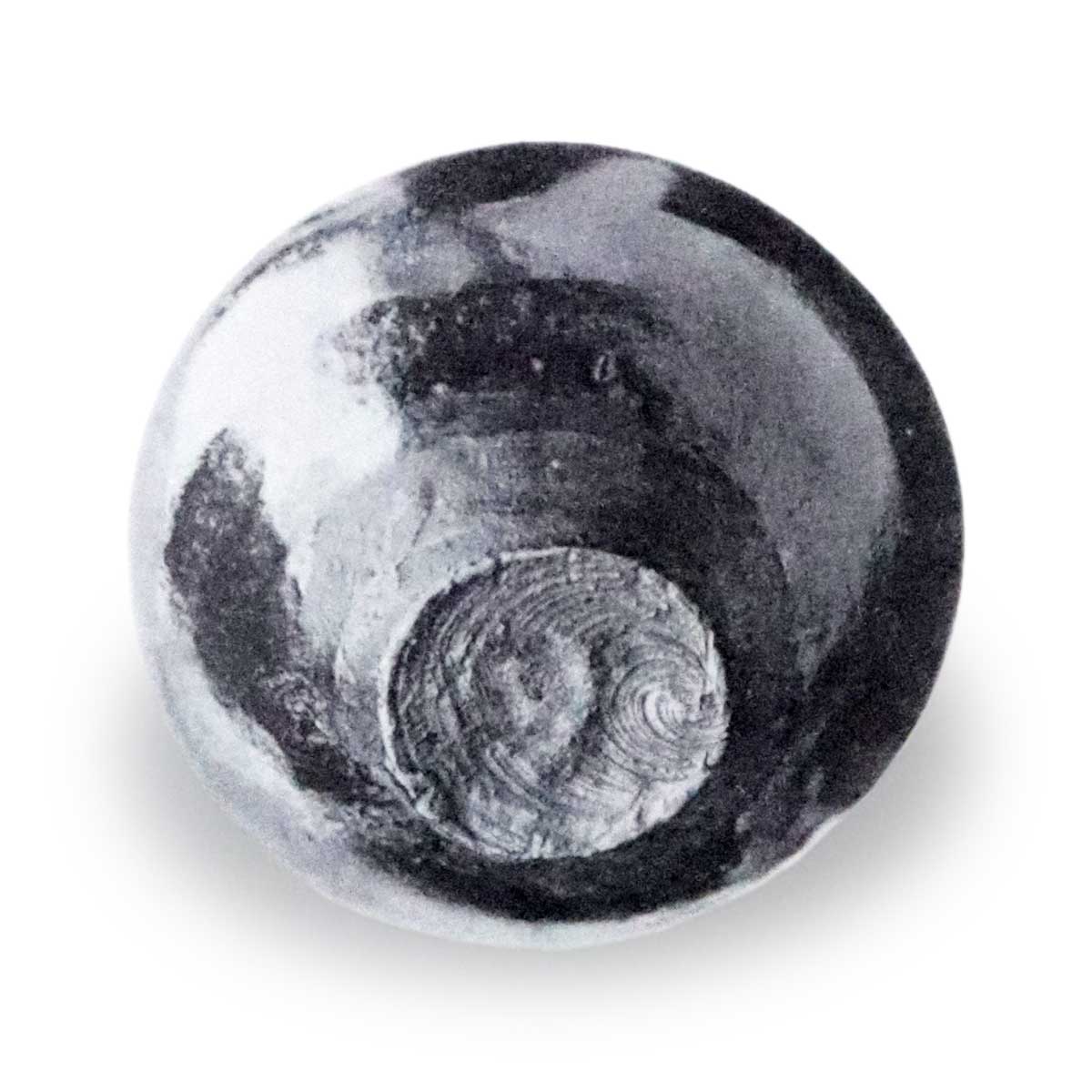
Inside, glaze covers the area around the lid, while below that, rough wheel marks run around the interior, forming a distinct swirl pattern at the center of the base. Although more than half of the original form has been lost, the skill with which Fujishige and his son meticulously reconstructed the appearance using lacquer—to the point where it is almost indistinguishable from the original—has given this tea caddy a new life as a “Meibutsu” (famous artifact). In other words, as a historical artifact, Fujishige’s own handwritten record from the first year of the Genna era (1615) details the provenance of this “Nasu” and other Meibutsu tea caddies from Osaka, making it a document of the utmost historical interest.
(Matsumoto Nasu)
I actually viewed this piece on February 2, 1921, at the residence of Baron Hisaya Iwasaki in Yushima-Kiridōri-chō, Hongō Ward, Tokyo.
The rim is tight with a rounded edge; the inward fold is somewhat deep; the shoulders are narrow and slightly protruding; and from there, the body gradually expands toward the base, forming a handsome eggplant shape. The entire piece has been restored with lacquer (urushi-zuri), making it difficult to discern how much of the original remains. Against a persimmon-colored ground with a metallic luster, patterns emerge in black glaze; from the center of the body on the front, the black glaze billows like a cluster of clouds, cascading down to the edge of the clay at the base. At this edge, there is an area where the persimmon-colored glaze has been lost, outlined by the black glaze (uncovered area). While black glaze patterns are visible throughout the rest of the piece, most of these appear to be lacquer repairs or later imitations. The vermilion-colored clay below the rim bears numerous marks the size of a fingertip (fingerprint-like), and the thread-cutting marks are fine, with some areas showing clay adhesion or flat spots, and slight misalignments at their starting points. The clay portion below the rim has not been restored with lacquer; for the most part, the original clay remains. Furthermore, the bluish glaze that remains along the edge of the clay, as if it were a border, likely corresponds to the original blue-green glaze that was present. Inside, glaze covers the rim of the mouth, while below that, rough wheel marks run around the body; the base is stepped with a slight depression in the center—a feature rarely seen in other eggplant-shaped tea caddies. Since this tea caddy was recovered during the second search conducted by Fujishige and Fujigane, father and son, under Ieyasu’s orders following the fall of Osaka Castle, the damage is far more severe than that found in the first discovery at Nitta or and Tamagaki, the damage is even more severe; about seventy to eighty percent of it has been restored with lacquer, and its appearance was likely recreated based on the memories of eyewitnesses from that time.