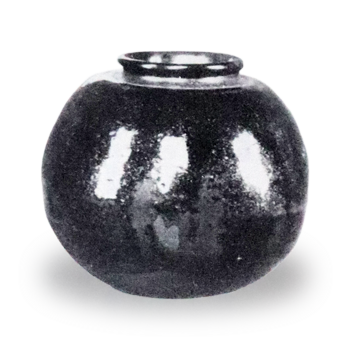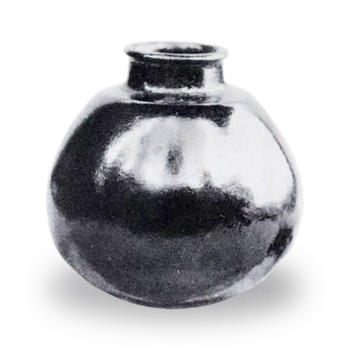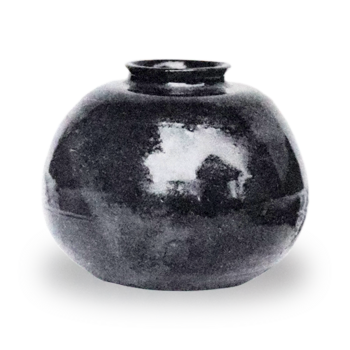


Made in China (Han-style) | Daimeibutsu | Collection of Marquis Toshitame Maeda
Regarding the Name
The design of this tea caddy does not feature any particular characteristics reminiscent of Mount Fuji. If that is the case, perhaps the name was chosen to praise how this piece stands out as tall and distinguished as Mount Fuji among the many eggplant-shaped tea caddies in the world. Or perhaps someone chose this name in reference to the well-known saying, “First Fuji, second hawk, third eggplant.” For now, I will leave this question open and await further consideration at a later date.
Dimensions
Height: 1 sun 9 bu 5 rin (approx. 5.9 cm)
Body diameter: 2 sun 3 bu 5 rin (approx. 7.1 cm)
Mouth diameter: 9 bu (approx. 2.7 cm)
Base diameter: 1 sun or 9 bu 5 rin (approx. 3.0 cm or 2.9 cm)
Height of the rim (koshi): 1 bu 7 rin (approx. 0.5 cm)
Weight: 18 monme (approx. 67.5 g)
Accessories
Lid: 1, without a recess (suba)
One storage pouch: Light yellow mon-ha-nuki fabric, braided cord in Enshu brown
One pouch (cover): 5 pieces
Donshu Ken-saki Naka
Same: Kanto Kai-bukuro
Same: Kanto Jō (lining is brown haiki with severe damage; braided cord is wisteria purple)
Mōru Dan-ori Kanto (lining is brown haiki; braided cord is purple)
Hachizaemon Kanto Unfastened Pouch
One Pouch Box: Untreated Paulownia wood
Fits into one box
Fits into one box
One Wooden Form (Kigata): Paulownia wood, 1 piece, with “Fuji Eggplant” inscription on the body
One Sheath (Hikiya): Tagayasan wood, Tenka Ichimonji shape, interior finished with black lacquer
Pouch: Deer suede, braided cord is purple
One inner box: Untreated paulownia wood; inscription on the front reads “Enshu”; the back is covered with paper bearing an inscription
Front: “Fuji Nasu”
Back: “Hishi Fuji Nasu. Received from Taiko-sama, along with other items of historical significance. An item belonging to Kōtoku-in”
Bag: Smoked leather; purple braided cord
(Note) Kōtoku-in refers to Maeda Toshiie.
One outer box: Paulownia wood with Shunkei lacquer finish; gold-leaf inscription by Sohu (Kobori Enshu); equipped with a lock
Fuji Eggplant
One accompanying tray: Shiki-bon
The interior is plain vermilion lacquer; the exterior features tsuishu lacquer with carved floral motifs, including six flowers and three buds. The exterior of the incense stand features a thunder pattern; the interior is plain black and has some minor scratches.
Height: 1 sun 3 bu 1 rin (approx. 3.9 cm), diameter: just over 5 sun 8 bu (approx. 17.6 cm), inner flat surface (mirror): 3 sun 7 bu (approx. 11.2 cm), incense stand diameter: 3 sun 3 bu 5 rin (approx. 10.1 cm), incense stand height: 4 bu 1 rin (approx. 1.2 cm), weight: 34 monme 2 bu (approx. 128g)
Pouch: Brown-ground Donshu silk with a Tang floral pattern; lining is pale green silk without a pattern; braided cord is purple
Box: Untreated paulownia wood; medicine chest-style lid; ring with cord (metal fitting); one-quarter of the gold leaf has peeled off; the hanabishi base (metal fitting base) has damage in places.
“Fushinasuhi Tray”
Single-handled tea scoop: Made by Rikyu, with matching tube (tube made by the artist himself)
Length: just over 5 sun 6 bu (approx. 17 cm), weight: 4 monme (approx. 15 g). The area below the knot has been shaved down with a spatula, and the tip has been sharpened to a point. There are mottled patterns above and below the knot.
“Made by Rikyu”
Inscription on the box: “Rikyu Fushinasuhi Tea Scoop”
Single-piece box: Unfinished paulownia wood, with a cotton Sanada cord
“Fuji Eggplant”
Miscellaneous Notes
May 1, 1557 (Kōji 3), to Yūjō in Kyoto
(Page count: 232)
Fuji Eggplant
Illustration of a Lock
One Fuji Eggplant
One Painting of a Loquat (by Mokkei)
One Fuji Eggplant: Matagoro and Hisamasa
The clay is thin, with a reddish-plum or reddish hue. The glaze has a reddish tint, appearing as a deep persimmon color or a blended shade, with traces of thread-cutting.
(From Matsuya’s Notes)
On February 27, 1569 (Eiroku 12, Year of the Snake), it was decreed that the Imperial Palace, which had fallen into such disrepair that it was barely recognizable, should be repaired. However, since Nobunaga was not lacking in gold, silver, rice, or money, an edict was issued stating that famous Meibutsu from across the realm, such as Chinese imports, would be confiscated to fund the repairs. First,
- The “Hatsuhana” possessed by the Daimonjiya in Kyoto
- Yujobo’s “Fuji Eggplant” (omitted below)
(From the Chronicles of Lord Nobunaga)
On August 12, 1571 (Genki 2), a record of Lord Nobunaga’s tea ceremony
Lord Nobunaga hosted a tea ceremony at his outpost castle in Gifu.
For the third tokonoma, a painting of Tanjima (by Makkei) was displayed, and in front of it, a flowerless vase shaped like a turnip was placed on a table. At the request of Nyokui, flowers of two colors were arranged. At this time, incense was burned without burning the wood directly (a method of burning incense without charring the wood). Nobunaga himself stated that the arrangement was chosen to complement the flowers and birds (in the painting). It is said that a Fuji Eggplant and an Asami Tenmoku (tea bowl) were placed on a shell stand on a tray.
(From the “Byōkyū Chakai-ki”)
The Fuji Eggplant is in the possession of Dōsan, a physician in Kyoto.
(From the Higashiyama Imperial Treasures Sub-Register, the Tenshō Meibutsu-ki, and the Chaki Meibutsu-shū)
On September 18, 1573 (Tenshō 1), a tea gathering hosted by the physician Dōsan was held, though it took place in a room borrowed from Dōkan in Murasaki-no.
- Fuji Eggplant; 1. Tenmoku bowl with water dropwort cold soup
Attendees: Sōeki (Sen no Rikyū), Sōyuki (Tsuda Sōyuki), Sōji (Yamagami Sōji)
On the morning of July 3, 1575 (Tenshō 3), a tea gathering hosted by Dōsan in Kyoto
Guests: Sōyuki, Mandaiya Shinta
A calligraphy scroll by Daito Kokushi was hung in the tokonoma and set aside in the mizuya room.
- Fuji Eggplant, placed in a bag on a square tray; a yellow Tenmoku tea bowl containing cold water dropwort soup;
a small board on a black stand, a kettle, and a suspended trivet.
The tea was prepared by Sōyuki. The bag was from Guangdong.
(From Tsuda Sōyuki’s Tea Ceremony Diary)
The morning of March 18, Tenshō 11 (1583): Dōsan’s Banquet
Guests: Sōyuki, Keiki
- Before the tea, the Fushinasubi was placed on a square tray. The bag was from Guangdong.
- Tenmoku bowl with cold watercress soup, Amagasaki stand
Sōyuki prepared the tea.
I saw this eggplant (tea caddy) again, and it was even more magnificent than before. Its form is so splendid it cannot be described in words. The rim is thin and poorly made (crude). Both the clay and the glaze are rough. It has two band-like streaks.
(From Tsuda Sōyuki’s Tea Ceremony Diary)
On the morning of February 4, Tenshō 15 (1587), at Uraitsushimu (a person’s name or a place?) on the way to the capital
- Tea gathering at Shihaku. The only guest was Sōmichi.
In the tokonoma of a two-and-a-half-mat tea room, there was an eggplant-shaped tea caddy. It was placed in a bag and set on a square tray. It is said that in the water room, which was about four sun in size, the bag was removed from the eggplant-shaped caddy and placed on the tray.
The Fuji Eggplant is 1.95 sun in height and 0.95 sun in base width. There are two veins at the base of the rim, one slightly below the shoulder, and one large, belt-like vein extending from the waist downward; it is vivid in appearance. The clay has a reddish tint, and the interior where the glaze has peeled off has turned blackish. The glaze is amber-colored with a blackish tinge; it appears faintly silvery, as if it might turn white or yellow. There is a single glaze run on the front, as well as on the sides and bottom. Additionally, the glaze runs down the surface like white paint, converging at a single point from both shoulders. On the right side, there is an area where the glaze has not adhered. On the underside, there is a slightly elongated, stone-like protrusion (possibly a clump) about 2 mm in length. The base is cut with a thread-like finish. The glaze extends about 3 mm up the body. The bag is from Guangdong, though this piece differs from typical Guangdong ware. It was casually remarked that there are only three pieces of this type in the world. Based on the shape of the rim, there are three horizontal lines running across it, and it is of medium size. Within these, two white lines run through one by one. The interior is dark brown, and the braided cord is pale yellow.
(From Sōtan’s Diary)
On the first day of the tenth month of Tenshō 15 (1587), items exhibited at the Kitano Grand Tea Ceremony
Owned by Imakoji Dōsan
- Meguro Daruma, 1. Fuji Eggplant, 1. Tade-reijiru Tenmoku
(From the “Kitano Grand Tea Ceremony” painting, held by Kitano Shrine, Kyoto)
On November 13, Keichō 2 (1597), the Naifu (Tokugawa Ieyasu) traveled to Ōtsu. The Prime Minister (Maeda Toshiie) had recently received a katatsuki tea caddy from the Taikō (Toyotomi Hideyoshi) that had previously been in the possession of the Hatakeyama Imperial Residence, and I saw it this morning. After tea, we relaxed in the study, followed by a meal, and received repeated hospitality. We remained seated for a long time afterward, but I took the lead and went to the inner chambers. Kōkō (a person’s name) went before His Excellency and presented a Bunri small jar to the Naifu, while Kaga Asō Toshie received a Fuji Eggplant. It was said that His Excellency remarked that a tea ceremony on a daiko would be most appropriate.
(From the Imperial University Historical Materials Collection: Collection of Daily Records by Monk Jōtai)
- At Suichiku-in: A tokonoma display of one and a half scrolls, four shaku in size; the guest was Rikyū.
He brewed tea using the Fuji Eggplant and instructed that Rikyū should place it in the tokonoma, so it was placed beside the hanging scroll. It was said to be a rare occurrence.
(From the Matsuya Diary)
Fuji Nasu
January 11, 1629 (Kanei 6, Year of the Snake)
- Suichiku-in of Kyoto was the grandson of Dōsan and a person who received direct instruction (jōden) from Rikyu.
Regarding placing the tea bowl on the tokonoma with the hanging scroll (omitted)
When the aforementioned person possessed the Fuji Eggplant, he was studying under Rikyu. It is said that the eggplant was presented to the Taikō (Hideyoshi).
(From the Matsuya Diary)
Long ago, when Suichiku (Dōsan the physician) possessed a Fuji eggplant, two men living in Sakai—Yoshiya Sōmu and Satsumaya Sōji—asked Kaji Zen’in, the Shoshidai (governor) of Kyoto, to arrange for a tea gathering with Suichiku. Consequently, tea was served in the eggplant tea caddy. After the tea was prepared, the guests requested to see the caddy and examined it (omitted). During the usual breakfast, Sōeki (Rikyū) was visited by Naya Sōyuki and Suichiku, and they had various conversations about the items on the table. There was a discussion about Japan’s Meibutsu (omitted), and it was said that the four finest eggplant teapots in the land are the Tsukumo, Ko-nasu, Matsumoto-nasu, and Fuji-nasu.
(From the Matsuya Diary)
Fuji Eggplant. Owned by Dōsan, it is now at Yūjōbō in Kyoto. Height: 1.95 sun; width: 2.3 sun; base: 0.95 sun; mouth diameter: 0.9 sun; bulge: 0.75 sun. The glaze is either amber-colored or a deep persimmon color, appearing red or vermilion. It is a layered colored glaze. The clay has a pale red plum color (Illustration of the tea caddy included).
(From the Manpō Zenshū)
Biography of Magarase Dōsan (pseudonym)
Magarase Dōsan, whose courtesy name was Ikkei, was a native of Yanagihara in Kyoto. He was exceptionally intelligent from birth and, as a child, entered Tenkō-ji Temple in Ōmi (Kōshū), where he studied the Heart Sutra, the Lotus Sutra, and the Śūraṅgama Mantra. At the age of 13, he entered the Zōshūken at Shōkoku-ji Temple, took the monastic name Tōshō, studied the Three Styles of Calligraphy, read the poetry of Yamaya and Dongpo, and memorized it all. His scholarship advanced day by day; at the age of 25, he saw a medical text for the first time and studied and mastered the Suwen (a medical text). Dōsan, whose given name was Masamori, took the monastic name Kakuō and was also known as Shizan-nin. He studied abroad in Ming China for 12 years, returning home having mastered the teachings of Li and Zhu. From this point on, Ikkei devoted himself to the medical arts. He traveled and studied for several years, mastering everything from the theory of the Five Phases and Six Qi to the methods of the Seven Directions and Ten Agents, leaving no stone unturned as he explored their deepest mysteries. After completing his studies, he returned to Kyoto. Kōgen-in (Lord Ashikaga Yoshiteru) summoned him to the shogunate, where he received special favor. Whenever illness arose, he would present medicine, and because it always took effect quickly, he was granted Fuji eggplants, a mortar, and a bowl for tade-reijiru as a reward. Furthermore, he cured Mōri Motonari of a long-standing illness, bringing him complete recovery, and thus his name became known throughout the Western Provinces. In 1574 (Tenshō 2), an imperial edict was issued by Emperor Ōgimachi summoning him to the Imperial Palace to examine the Emperor, after which he was conferred the rank of Hōin. In addition, his achievements in saving lives were countless. He passed away in 1595 (Bunroku 4) at the age of 89. Works he authored during his lifetime, such as the nine-volume Keidai-shū, Jumō, Seikō, Igō Shinan, Shinkyū Shuyō, Shiken, and Shinjutsu, have been preserved as historical records. There are also several other works, including Jiken, Shuchin, Seishinshu, Teieishu, Yogo-shu, and Kiri-gami. The Keidai-shu was once presented to the Emperor for his perusal, and the Zen monk Sakuhiko, acting as an imperial envoy, wrote its preface. Though he knew hardship, was not the conferral of the monastic name “Suichiku” an honor within the realm of medicine? His disciples numbered in the hundreds, many of whom served in various provinces; among them, numerous became court physicians of the shogunate and gained renown in the world, so it can be said that his school flourished. He drew the legacy of Tankei into a single stream and filled Kurumase with the warmth of fire. Ah, truly a man of virtue, Suichiku is the phoenix of the medical world.
(From Jijibun-hen, edited by Gogyū Hisafumi)
Fuji Eggplant, Lord of Kashiwa (owned by the Maeda family).
(From Gomono Godōki)
Fuji Nasu, Matsudaira Inuchiyo (Maeda Toshiie).
(From Kobutsu-ki and Ganka-butsu-ki)
Fuji Nasu, Chinese small jar, Daimeibutsu, Matsudaira Inuchiyo.
(From Kokon Meibutsu Ruiju)
On the last day of April in the 2nd year of the Jōkyō era (1685), a record was published. In that record, it is stated that Lord Maeda Toshiie received the Fuji Nasu tea caddy as a gift from Lord Hideyoshi, and it was decreed that since this is a reliable record that should be shown to Hyōbu Shinzaemon and others, it would be best to also include it in the Register of the Origins of Imperial Artifacts. The record states: “On November 13, Keichō 2 (1597), it was decreed that a small ‘Bun-nasu’ teapot was bestowed upon the Lord of the Inner Palace (Tokugawa Ieyasu), and a ‘Fuji-nasu’ tea caddy was bestowed upon the Vice-Regent of Kaga, Toshiie, and that this was a cause for great joy.”
(From Kakan Shosetsu by Muro Kanosu)
On November 13, Keichō 2 (1597), he received a tea caddy from the former Kanpaku, Hideyoshi. The caddy was called the “Fuji Eggplant” and was a rare treasure.
(Draft History of the Kaga Domain, entry on Lord Kōtoku, Maeda Toshiie)
Maeda Toshiie (Inuchiyo, Chikuzen-no-kami, Kōtoku-in). Prior to this, the Taikō (Hideyoshi) frequently visited Toshiie’s residence, and his deep affection for the family was unparalleled. He was bestowed with the Sueno tea jar, the Fuji Nasu tea caddy, as well as the tachi of Miike Koden’ta, and swords such as the Sadamune and “Snow Falling on Water.”
(From the Kansei Revised Genealogies of Various Families)
Fuji Nasu: A Chinese import and a Daimeibutsu. It is listed in the Meibuki (Record of Famous Artifacts). Owned by Lord Toyotomi (Hideyoshi). One of the four famous “Nasu” pieces in the land. The clay is a pale red; the underglaze is amber-colored, and both the underglaze and the overglaze feature thread-like patterns extending to the base (the part in contact with the surface). The overglaze transforms into a “snake-scorpion” pattern (a pattern resembling snake scales), draping down from both sides and extending to the base. On the right side of the front view, 7.5 mm above the base, there is a “fire gap” (an area without glaze). There is a single band-like streak; the section where this band is clearly visible is 5 sun 8 bu 5 rin in length. Above the band on the body, there are two faint streaks, and there is one section on the inside of the rim.
(From the Marquess Maeda Family Inventory)
Fuji Nasu (Eggplant) – Made in China (Han-style). Height: 2 sun; body diameter: 2 sun 4 bu; mouth diameter: 9 bu; mouth height: 1 bu 5 rin. The carrying pouch is made of pale yellow mon-silk with a brown cord. The case is made of rosewood with a black lacquered interior; the pouch is white leather with a purple cord. The box is a paulownia wood Hikiya-style lid with a brown cord. Inscribed “Fuji Nasubi” in the hand of Sōfu (Kobori Enshū). The outer box is made of paulownia with square rails, finished in Shunkei lacquer with iron fittings, and the inscription is in gold powder. The pouch is made of smoked leather, and the cord is purple. The paper lining on the underside of the lid reads: “Han-style Fuji Nasubi. Bestowed by the Taikō upon Kōtoku-in (Maeda Toshiie), with other historical origins.” There are three pouches: one with a sword-tip shape (Donshu-style) and two Han-style pouches. The accompanying tray for the Han-style pouches is a Shiki-bon (Four Seasons tray) and a Fushinasubi tray (illustration omitted); the interior is plain vermilion with a kai-mi (?) pattern. The reverse features four types of floral patterns, including chrysanthemums and peonies, with yellow visible in the background. Diameter: 5 sun 8 bu; height: 1 sun 3 bu; incense stand height: 4 bu; diameter: 3 sun 4 bu. The accompanying tea scoop lacks bamboo bark below the joint. The handle was made by Rikyu. The box is labeled “Rikyu Fushinasubi Tea Scoop” (illustration of the tea caddy omitted). The glaze is brown, with an overall pear-skin-like texture, appearing pale yellow with a metallic luster (kinki). The clay is fine-grained, and the color is a pale yellow with a reddish tint. The thread marks are fine and difficult to distinguish. There is a single firing flaw on the right side, below the band on the body of the stand.
(From the Maeda Family Collection)
History
Originally owned by Ashikaga Shogun Yoshiteru, who bestowed it upon the renowned physician Magarase Dōsan; Dōsan, in turn, gave it to Yūjōbō in Kyoto. The Matsuya Notes contain an entry regarding this tea caddy from a tea gathering held by Yūjōbō in Kyoto in the 3rd year of Kōji (1557). Subsequently, on February 27, Eiroku 12 (1569), when Oda Nobunaga entered Kyoto, he confiscated the “Hatsuhana Katatsuki” from Daimonji-ya and the “Fuji Nasu” from Yujobo, and on August 12, Genki 2 (1571), he displayed this tea caddy at a tea gathering at Gifu Castle. After Nobunaga’s death, this tea caddy returned to Dōsan’s possession and was used at his own tea ceremonies in the first, third, and eleventh years of the Tenshō era; it was also exhibited at the Kitano Daichayū on October 1, 1587. Later, Doshin’s grandson, Suichiku, presented it to Toyotomi Hideyoshi, who in turn bestowed it upon Maeda Toshiie on November 13, 1597 (Keichō 2). Since then, it has been a treasured possession of the Maeda family of the Kaga Domain. In the past, the Kaga Domain regarded this tea caddy and the “Asamaya Katatsuki” as the most closely guarded treasures, rarely allowing anyone to view them. It is said that Kobori Sōchū once stayed in Kaga for a long time in an attempt to see it, but was unable to fulfill his goal; he was forced to borrow an illustrated catalog of it from someone who owned it and returned to Edo (the East).
Firsthand Account
On November 25, 1919, I had the opportunity to view it in person at the residence of Marquis Maeda Toshiyuki in Honfuji-chō, Hongō Ward, Tokyo.
The rim is tight and thinly made, with a standard inward fold; the craftsmanship is extremely exquisite. There is a single indented blue line at the edge of the koshiki and at the tip of the shoulder, and a slightly thicker indented line runs around the middle of the body, encircling about 80% of the tea caddy. The amber-colored glaze is beautiful overall; on the front (the view when placed upright), a bluish-white glaze resembling a snake or scorpion is applied unevenly, stopping at the boundary where the unglazed clay of the base becomes visible. In the center of this front view, near the lower edge, there is a small unglazed area (a spot where the glaze did not adhere), and on the body, there is a horizontal streak of clay about 5 mm long. Below the waistline, there is a pattern of splattered bluish-white glaze; the glaze stops slightly lower than the waistline. Around the base, from the rim down, there are lines scraped with a spatula, similar to thread-cutting marks, revealing the reddish-brown clay. The center of the base is slightly worn, and the thread-cutting marks are somewhat indistinct in places; however, where these marks are visible, they naturally form a pattern resembling a clam shell. The overall glaze color and appearance resemble those of the “Kokushi Nasu,” and with its beautiful luster and graceful form, it is an extremely elegant tea caddy. The rim of the interior is coated with an amber-colored glaze, while a thin glaze covers the entire surface below it. Deep wheel marks run around the interior, forming a large swirl at the center of the base. It is truly the finest example (the crowning jewel) among Tang-style eggplant-shaped tea caddies, and it is clear that the name “Fuji” is fitting for this tea caddy in every respect.