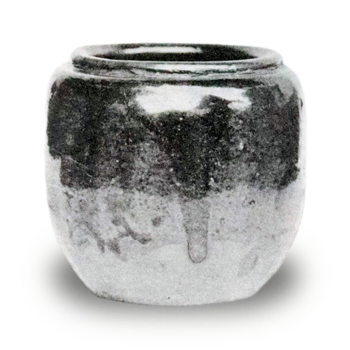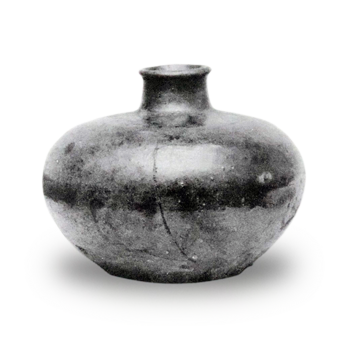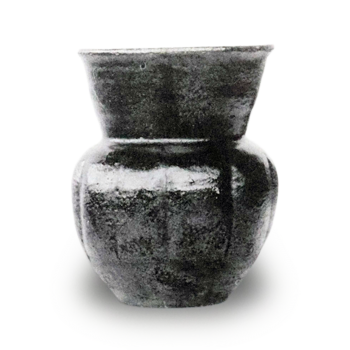
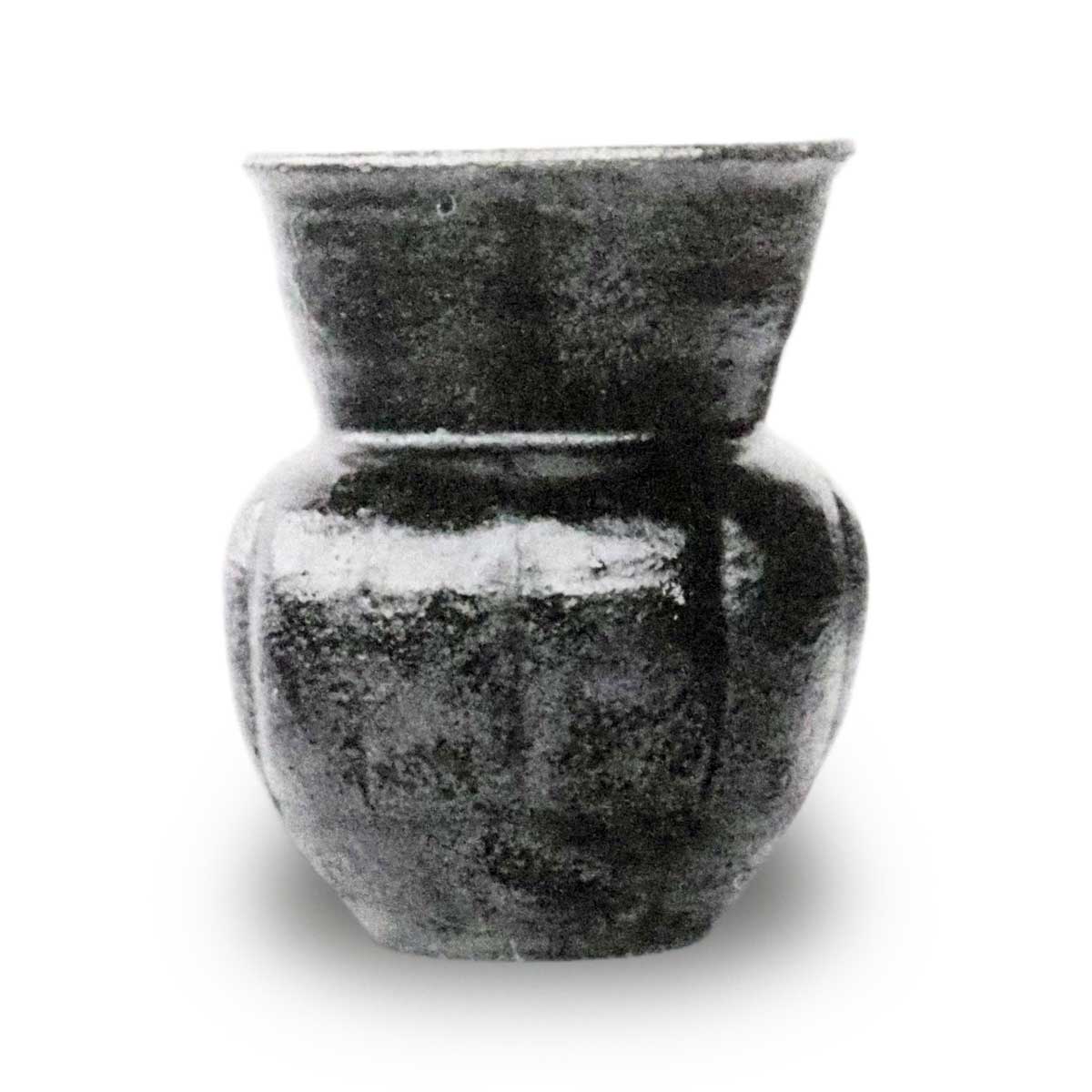
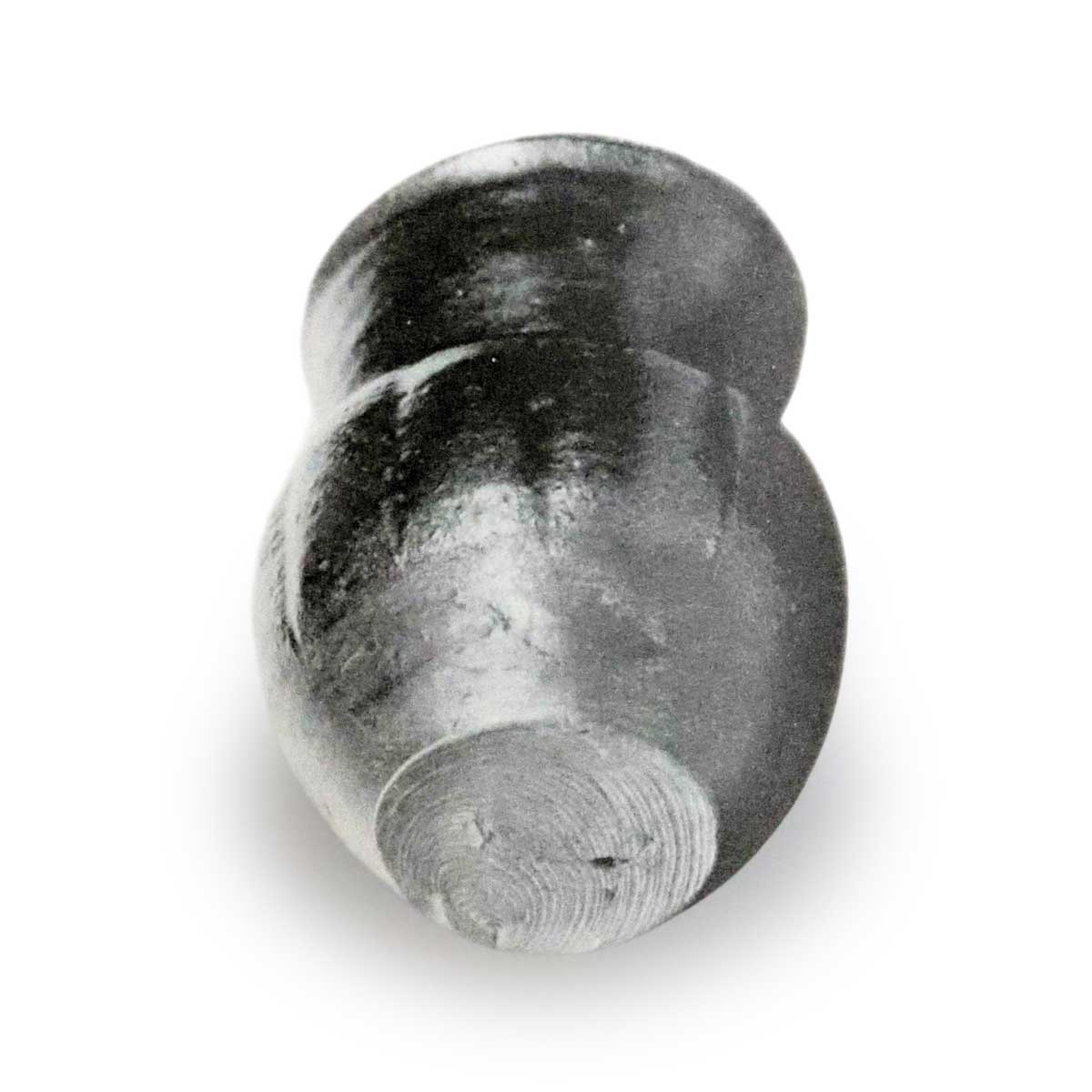
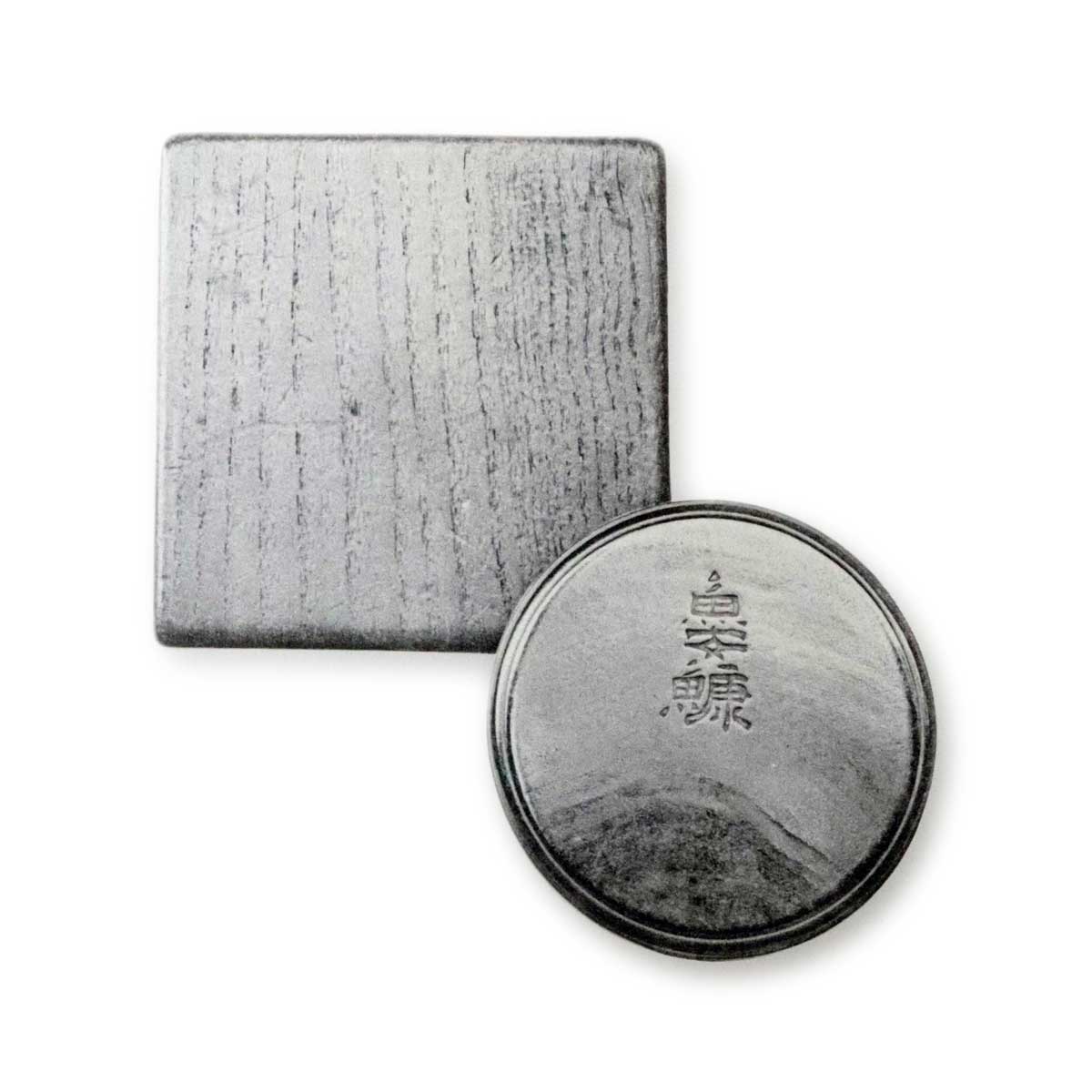
Chinese Ware, Chuko Meibutsu, Collection of Count Tadamichi Sakai
Name
The Chaki Bengyoku-shū states, “It was named ‘Ankou’ because its mouth is as wide as that of an anglerfish.”
Dimensions
Height: Approx. 8.3 cm (2 sun 7 bu 3 rin)
Body diameter: Approx. 6.8 cm (2 sun 2 bu 5 rin)
Mouth diameter: Approx. 7.0 cm (2 sun 3 bu)
Base diameter: Approx. 3.6 cm (1 sun 2 bu)
Length of sloping rim: Approx. 3.0 cm plus (1 sun plus)
Weight: Approx. 87.8 g (23 monme 4 bu)
Accessories
・Lids: 2 (one of which has a chip)
・Imperial pouch: Brown silk (with a brown tie cord)
・Pouches: 2
Aoki indigo-ground Guangdong horizontal stripes (lined with velvet in “Umi-ki” pattern; brown tie cord)
Crimson ground with large Tang-style woven treasure pattern (lined with velvet in “Umi-ki” color; fastening cord in Enshū brown)
(Note) While Kokin Meibutsu Ruiju and Meibutsu-ki list three pouches, only two currently exist, and there is no pouch with a “flower-colored cobblestone” pattern (lined with pale yellow “Kabe-dai” fabric; fastening cord in wisteria color).
・Pouch box: Paulownia, natural finish
“Anglerfish”
Anglerfish Tea Jar—Replacement Pouch
・Hikiya (Cylinder): Red Sandalwood (Shirata)
Inscription “Anglerfish” carved on the front (with verdigris), written by Sōfu (Kobori Enshū)
Pouch: Champa (Cochin) Hard Stripes (Lining: Shōba on a navy blue background)
・Case: Paulownia, natural wood, with gold trim (edges gilded)
“Tang Anglerfish”: The inscription is said to be by either Monk Kōgetsu or Kobori Enshū.
Miscellaneous Notes
This original tea caddy was owned by Enshū, who regarded it as his most prized possession. It was named after the anglerfish, a fish known for its wide mouth, as its shape resembles that of the fish. It is said that this tea caddy was later requested by an elder of the Sakai family. Length: approx. 6.1 cm (2 sun); circumference: approx. 17.1 cm (5 sun 6 bu 5); mouth diameter: approx. 5.3 cm (1 sun 7 bu 5); base diameter: approx. 2.4 cm (8 bu). The clay has a pale reddish hue, and the thread-cut decoration is fine and delicate. The body features a six-leaf pattern; the underglaze is a pale ink color with a slight reddish tint, while the overglaze black amber glaze exhibits slight “higuchi” (burnt edges). “Haiguchi” refers to areas where the glaze has been well-fired, turning a charred color and appearing bubbly. (Image of the tea caddy included)
(From Manpō Zenshū)
Anglerfish Tea Caddy: The original tea caddy, known as “Anglerfish,” was owned by Kobori Enshū (Masakazu). It was named “Anko” because its mouth is wide like that of an anglerfish. It is said that Daio Sōho Kōji (Enshū) regarded it as his most prized possession, but an elderly member of the Sakai family requested it. (All details regarding dimensions, illustrations of the tea caddy, and descriptions are identical to those in Manpō Zenshū)
(From Chaki Bengyoku Shū)
Ankō (Anglerfish) – Chinese import – Chūkyō Meibutsu – Kobori Izumi-no-kami (Enshū). The bulging interior of the tea caddy is lacquered black. Height: approx. 8.3 cm (2 sun 7 bu 3 rin); body diameter: approx. 7.0 cm (2 sun 3 bu); mouth diameter: approx. 6.7 cm (2 sun 2 bu); base diameter: approx. 3.8 cm (1 sun 2 bu and a half). The lid consists of two pieces (one of which has a chip). The pouches feature a floral-patterned cobblestone design (lined with velvet in the “kakemono” style, with a wisteria-colored drawstring); a navy-ground Kandou pattern (lined with “kaiki,” with a brown drawstring); and a Guangdong-style checkered pattern (lined with a brown shade with a iridescent sheen, with a purple drawstring). Hikiya is made of rosewood, with an inscription by Sōfu (Enshū); the pouch features a champa stripe pattern (lined with navy blue with a lightning bolt motif). The box is made of paulownia wood with gold inlay, bearing an inscription by Monk Kōgetsu reading “Anglerfish.”
(From Kokin Meibutsu Ruiju)
Anglerfish: A Tang-era piece owned by Sakai Yukienosuke. I borrowed it and viewed it on June 26 of the Year of the Monkey. The bulging interior of the tea caddy is lacquered black, with a thread-cut design on the bottom featuring ten leaf motifs. (The descriptions of dimensions and accessories are the same as in Kokin Meibutsu Ruiju, and there is an illustration of the tea caddy.)
(From Meibutsu-ki)
Anglerfish: The inscription on the grinding stone attributes it to Sōfu (Enshū), the inscription on the pouch also attributes it to Sōfu; the inscription on the box may be by Priest Kōgetsu.
(From Hatsuhana)
Anglerfish: Owned by Lord Kobori Izumi-no-kami (Enshū). There are eight vertical black glaze stripes on the bulging section; the interior of the tea caddy’s bulging part is lacquered black, and the bottom features a thread-cut design. (The description of dimensions and accessories is the same as in Kokin Meibutsu Ruiju, and an illustration of the tea caddy is included.)
(From Chake Suiko Zatsu)
Anglerfish: Owned by Lord Sakai Shūri-dayū. The interior of the body is lacquered, and the base features a thread-cut design with 10 vertical lines. The outer case is made of untreated paulownia wood and was formerly owned by Lord Enshū; a copy of the inscription on the anglerfish case is included. (Dimensions, accessories, and an illustration of the tea caddy are provided.)
(From Tōan Bunko, Series B, No. 1)
Anglerfish: An island-origin piece (from Southeast Asia) owned by Lord Sakai Shuri-dayu. The rounded interior portion of the tea caddy is lacquered black. (Dimensions and details of accessories are the same as in Meibutsu-ki; an illustration of the tea caddy is included.)
(From Chaki Zushinbō)
Anglerfish: Owned by Sakai Jinfu. (The dimensions, accessories, and illustration of the tea caddy are exactly the same as in the Meibutsu-ki.)
(From Enshū Shijō Meika-ki)
(Year unknown) June 8, morning. Host: Kobori Enshū
Guests: Itakura Suō, Aoki Kai, Igarashi Sōrin, Neigi Jizaemon
・Hanging Scroll: Haruura
・Flower Vase: Large-mouthed; flowers: lotus
・Tea Caddy: Anglerfish; placed next to the furo, with a hikikiri (kenmizu) in front
・Tea Bowl: Ido
(From Enshū Hyakukai Chado)
(Year unknown) Evening gathering on December 16: Host: Kobori Enshū
Guests: Priest Kōgetsu, Hineno Oribe, Shimizu Hisako, Tachibana-ya Sōgen, Nushiya Dōshi
・Floor decoration: Calligraphy by National Preceptor Enkan
・On the shelf: A blue-shelled incense container, tea caddy, and feather broom arranged inside a gourd (fukube)
・Below the shelf: An anko-style tea caddy and a feather broom
・Tea bowl: Goryeo
(From Sōfu’s Record of Tea Ceremony Utensils)
History
Originally owned by Kobori Enshū, this item was acquired by Sakai Shūri-dayū Tadanori upon his request. Since then, it has been passed down through the Sakai family of Wakashū and is known to the world as the “Sakai Anko.”
Record of Actual Observation
On April 28, Taisho 8 (1919), I viewed the actual piece at the residence of Count Tadamichi Sakai in Yarai-cho, Ushigome Ward, Tokyo City.
It is a Chinese import; against a deep, astringent paper-brown background, a dark brown overglaze is applied sparsely and lightly. There are ten vertical spatula marks circling the body, giving it the shape of an “Akoda melon.” From the rim downward, the reddish clay is exposed, and among the clearly visible traces of thread-cutting, there are “frayed edges” (small chips) resembling wormholes. There is a single spot where a small white pebble between the rim and the waist has burst, creating a distinctive visual feature. The texture is plump and soft to the touch, and its age lends it a rich sense of the tea ceremony’s aesthetic. Inside, the upper half reveals the unglazed clay, while the lower half is coated with a deep black amber glaze.