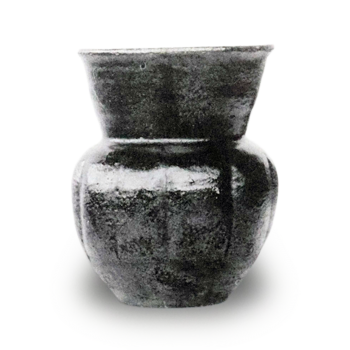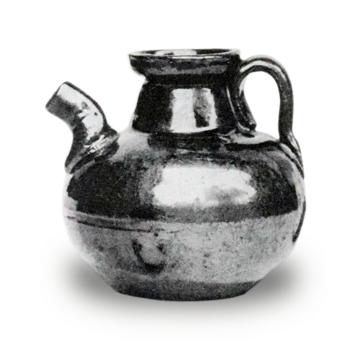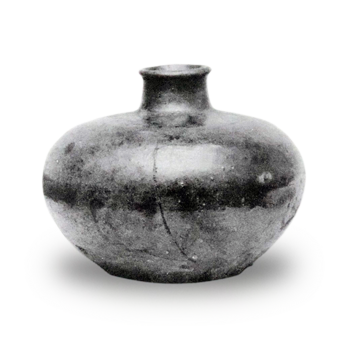
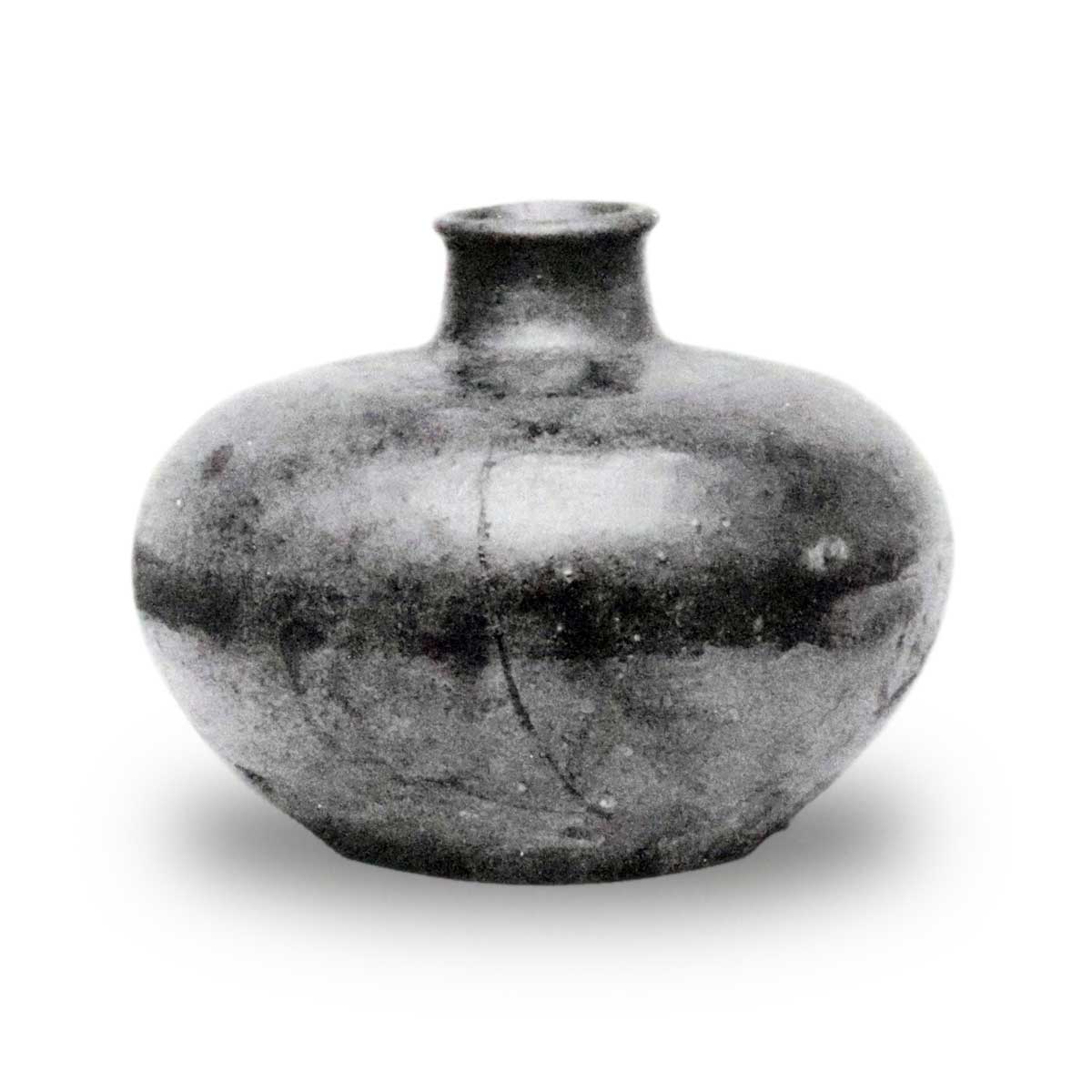
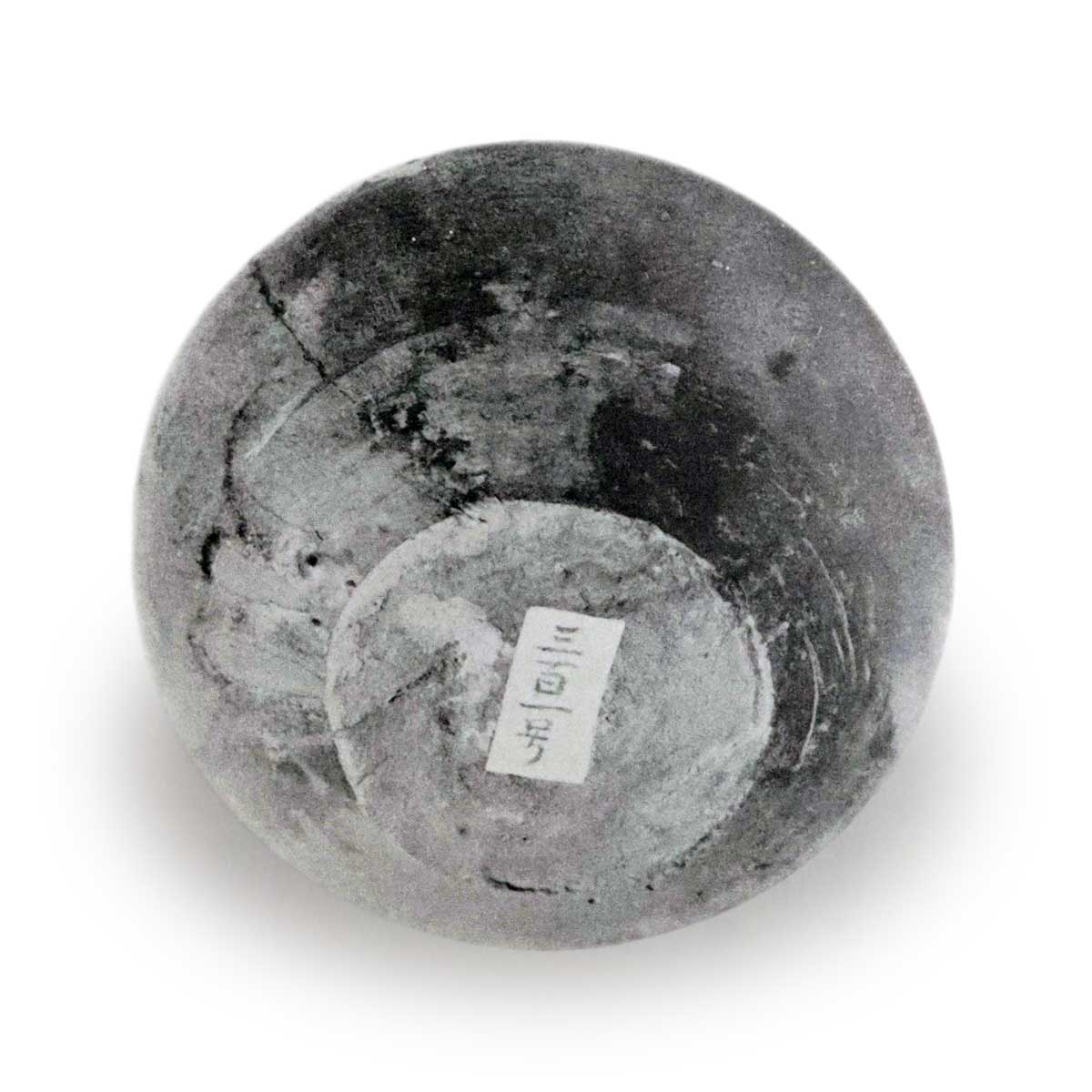
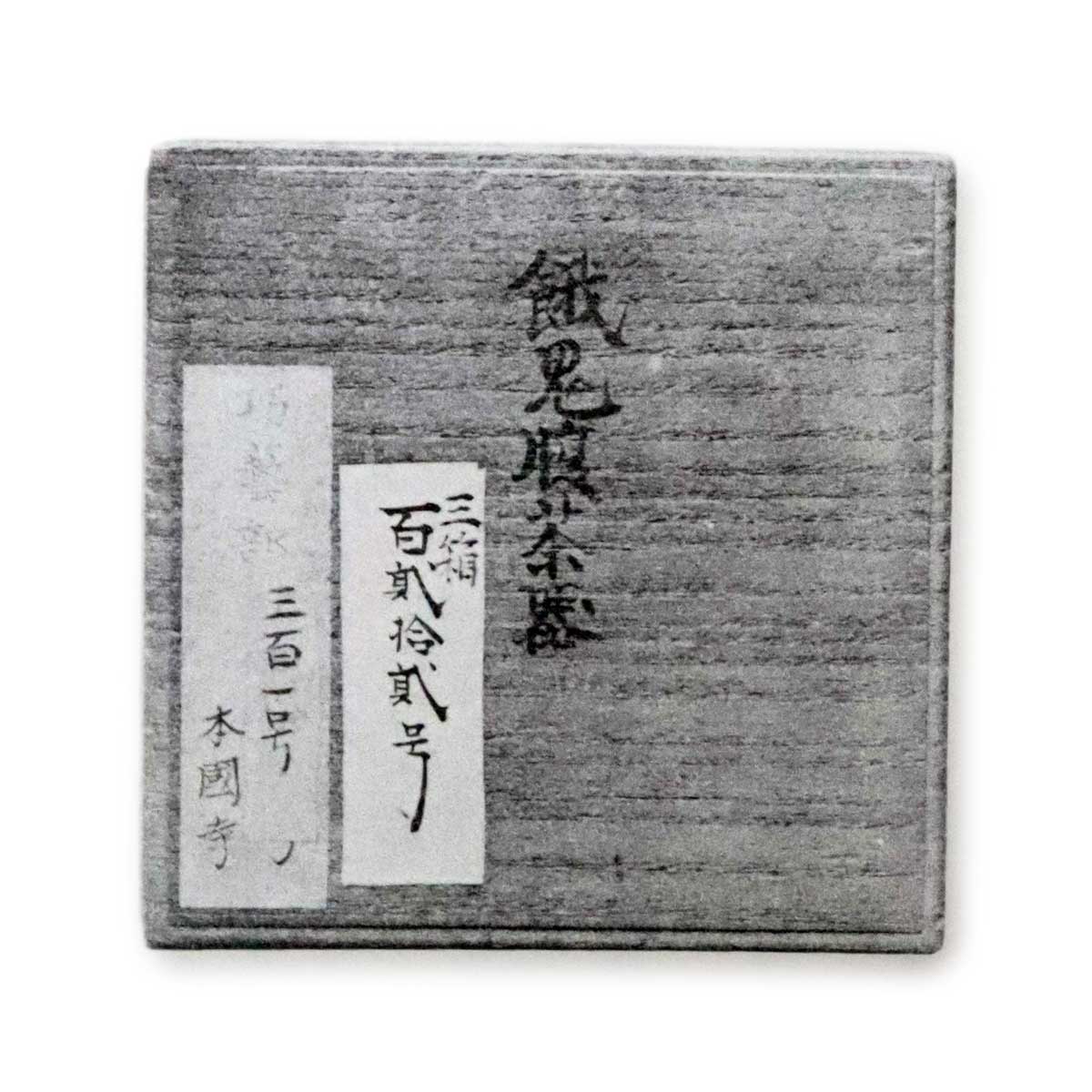
Made in China; Collection of Hongokuji Temple, Kyoto
Name
This teapot is named for its bulging body, which resembles the belly of a hungry ghost.
Dimensions
Height: approx. 7.6 cm (2 sun 5 bu 2 rin)
Body Diameter: Approx. 9.7 cm (3 sun 2 bu)
Mouth Diameter: Approx. 2.7 cm (9 bu)
Base Diameter: Approx. 4.8 cm (1 sun 6 bu)
Height of the “Koshiki” (Neck): Approx. 1.4 cm (4 bu 5 rin)
Weight: Approx. 123.0 g (32 monme 8 bu)
Accessories
・Lid: 1, plain (no indentation)
・Pouches: 2
Brown-ground cloud and arabesque patterned Donshu pouch (lining: white silk; tie cord: pale yellow)
Pale yellow-ground interlocking treasure pattern Donshu pouch (lining: iridescent, heavily damaged; tie cord: brown)
・Storage boxes: 2
Holds one of the above pouches each.
・Inner box: Paulownia, natural wood. The inscription is written along the grain of the wood.
“Gaki-hara Tea Set”
・Outer box: Paulownia, natural wood. The inscription on the front of the lid reads as follows:
“Outer Box for Gaki-hara Tea Canister
Contains three boxes”
The inscription on the underside of the lid reads as follows:
“Inscription: Gaki-hara Tea Canister, one piece. This is a renowned piece that was once owned by Lord Takauji.
To be donated to this temple.
When Priest Dogen traveled to Tang (China), a man named Kato Shirozaemon accompanied him on the journey. Upon their return, he brought back local clay and glaze from the region and was the first to produce this item in Japan. It is commonly said to be the work of Fujishiro, and is said to be approximately 670 years old.
The bag is made of ancient moire; the text on the right is recorded exactly as per the old tradition.
The replacement pouch is made of Sōkun satin.
“Treasure of Daikōzan Hongokuji Temple”
Miscellaneous Notes
“Gaki-hara” Tea Caddy: Chinese import; length approx. 6.4 cm (2 sun 1 bu), circumference approx. 25.5 cm (8 sun 4 bu), mouth diameter approx. 2.7 cm (9 bu), base diameter approx. 3.9 cm (1 sun 3 bu). The neck of the tea caddy rises slenderly, while the body is plump and rounded; the name is a metaphor derived from its resemblance to the belly of a hungry ghost. The clay is pale yellow; the rim’s folded edge is standard, and the thread-cut finish is fine and exquisite. The underglaze is a pale reddish amber glaze, while the overglaze features a black glaze flecked with yellow amber glaze. (Illustration of the tea caddy available)
(From Manpō Zenshū)
“Gaki-hara” (Hungry Ghost’s Belly): Donated by Ashikaga Takauji to Sanmi Chūjōbō Nisshō, the fourth head priest of Hongokuji Temple. Nisshō was Takauji’s uncle. It was destroyed in a fire in Tenbun 5 (1536).
(From Hongokuji Documents)
Gaki-hara: A treasure of Hongoku-ji Temple. Body diameter: approx. 9.5 cm (3 sun 1 bu 5 rin); mouth diameter: approx. 2.9 cm (9 bu 5 rin (is “bu” a misprint for “rin”?)); flat bottom; has a large chip. The pouch is
Transmission History
According to an inscription on the underside of the box lid, this piece was donated to Hongoku-ji Temple by Ashikaga Takauji. Honkokuji Temple was originally located in Matsubagaya, Kamakura; it was founded by the Venerable Nichirō, and Nichijō—Ashikaga Takauji’s uncle—succeeded him. During the Muromachi shogunate, the temple was relocated from Matsubagaya to Kyoto in the 4th year of the Ryakuō era (1341). Ashikaga Naoyoshi greatly expanded the temple grounds for this purpose and constructed halls and pagodas; however, most of the temple buildings were reduced to ashes during the Hokke Uprising (Tenbun Hokke Rebellion) in Tenbun 5 (1536). At that time, this tea caddy was also damaged by fire, causing the color of its glaze to change completely; the damaged areas were repaired with lacquer, and it retains only a faint trace of its original form. It is currently on loan from Hongoku-ji to the Kyoto Imperial Museum (now the Kyoto National Museum).