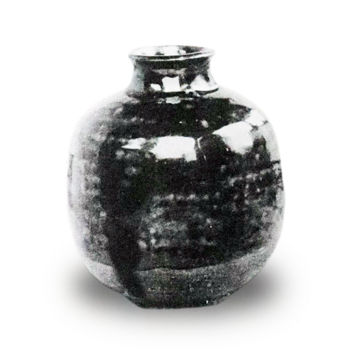
Made in China; a Meibutsu of Hachiman; Collection of Baron Takashi Masuda
Origin of the Name
It is called “Nara Bunrin” because it is the tea caddy that Shōjō Shōkado brought with him when he left the Nakano family in Nara to enter Takimoto-bō at Ishizumi Hachiman Shrine (taking monastic vows and entering the temple).
Dimensions (converted using 1 sun ≈ 3.03 cm and 1 monme ≈ 3.75 g)
Height: Approx. 6.48 cm (2 sun 1 bu 4 rin)
Body diameter: Approx. 6.03 cm (1 sun 9 bu 9 rin)
Mouth diameter: Approx. 2.42 cm (8 bu)
Base diameter: Approx. 2.42 cm (8 bu) and a bit more
Height of the koshiki (steamer): Approx. 0.52 cm (1 bu 7 rin)
Weight: Approx. 47.6 g (12 monme 7 bu)
Accessories
・Lid: 1 (with a recessed center)
・Storage pouches: 4
Floral-colored satin with arabesque pattern (lining: nanako weave; cord: brown)
Satin with a swirl pattern (lining: Nanako weave; cord: light gray)
Hosokawa satin with a woven pattern (lining: Kabashiro with family crest; cord: purple)
Mochizuki Koto weave (lining: iridescent Kai silk; cord: light gray)
・Pouch box: Made of natural paulownia wood, with an inscription by Shōjō of Shōkadō
“Nara Bunrin”
Pouch box
・Hikiya (cylinder for storing the tea caddy): Black lacquer
The pouch features an engraved design of irises (lining and cord unknown, but the cord is brown)
・Inner box: Made of natural-finish paulownia wood, with an inscription by Shōjō of Shōkadō
“Bunrin”
(Note) The statement in Takimoto-bō’s Record of Meibutsu that “the inscription on the box is by Kobori Enshū” is likely an error.
・Outer box: Made of natural paulownia wood, with an inscription by Murakoshi Choseisai
Front: “Made in China (Karamono) Bunrin”
Back: “It is said that the Chinese-made Bunrin tea caddy, passed down at Takimoto-bo, was brought by Seisei-ō (Shōjō of Shokado) from the Nakanuma family of Nara, along with a hanging scroll by Meigan, when he entered the monastery (took monastic vows). Consequently, it is known as the ‘Nara Bunrin,’ and it has been passed down as definitive evidence of the betrothal ceremony.”
Bags: 4
Floral arabesque satin, thin satin
Hosokawa satin, Mochizuki Koto (Kanto)
Murakoshi Choseisai (seal)”
Miscellaneous Notes
Tang-style Bunrin—Made in China. It is said to have been brought along by Shōjō of Shōkadō when he took monastic vows and entered the temple, along with two calligraphic works by Meigān. It is said that these two items constitute the betrothal gifts. The lid consists of two pieces with pine-needle-shaped knobs, and the interior has a recessed area (illustration of the lid included). There are four pouches made of Chinese satin. The Hikiya handles are lacquered black, and the pouches feature a flying pattern of irises and deer spots. The box is a paulownia tea caddy with a sliding lid, bearing the inscription “Bunrin” in the handwriting of Lord Kobori Enshū. It has round-holed feet and is fastened with a brown four-strand cord. The body is covered in an amber-colored glaze, displaying a yellow amber glaze pattern that appears unevenly distributed across the surface. It is made of grayish-brown clay and retains its original thread-cut texture. (Illustration of the tea caddy included)
(From Takimoto-bo Shōji Meibutsu-ki)
Tang-style Bunrin—Made in China. It is said to have been brought by Shōjō when he entered the priesthood. It features two types of calligraphy by Meigan, in accordance with the conventions of the time.
Height: approx. 6.36 cm (2 sun 1 bu); mouth diameter: approx. 2.45 cm (8 bu 1 rin); base diameter: approx. 2.42 cm (8 bu); neck height: approx. 0.61 cm (2 bu). The body is covered in an amber glaze with yellowish amber glaze patterns, appearing uneven throughout. Made of rat-colored clay with an original thread-cut rim. The inside of the lid has a recess and a handle. Hikiya is lacquered black; the pouch features a flying pattern of iris leaves and deer spots, and the cord is brown. The box has a lacquered lid and bears the inscription “Bunrin” by Kobori Enshū (Lord Sōfu). (Illustrations of the lid and tea caddy are included.)
(From “Record of Rare Artifacts from Takimoto-bo” in Kōshi Yawa Zokuhen by Lord Matsuura Seizan)
Tang-style Bunrin—Made in China. Owned by Lord Masuda Katsunori. A famous Meibutsu from Hachiman. Viewed on August 13, Meiji 30 (1897). The glaze has a predominantly black hue and is extremely refined. It is made of purple clay and features thread-cut decoration. The lid is made of ivory with a pitted surface and is of Chinese manufacture. It comes with two pouches: one is a dragon-motif satin with a round crest, woven in navy thread in a sa-ya pattern on a brown ground; the other is a Shimotsuma satin labeled “Kozaburō Satin.” One side of the pouch is pieced together from the remnant of a red-ground Yazaemon Kantō-ori fabric. The bag box bears an inscription by Lord Munetomo; the inscriptions on the box and the poetic inscriptions are as shown in the illustration. The bag is made of striped velvet.
(From Tsukushi no Tomo by Matsuyama Seiko)
March 24, Taishō 9 (1920) — Tea Ceremony for the Saikyū Nyogo
Guests: Nozaki Gen’an, Tanaka Chikami, Hattori Shichibē, Tsuchihashi Kahei, Takahashi Hōan
Host: Masuda Don’ō (Takashi)
・Hanging Scroll: Portrait of the Saikyū Nyogo (painted by Fujiwara no Nobuzane)
The mounting features a central panel with a seven-treasure pattern in gold leaf on a purple background; a single-character border with a seven-treasure pattern on a light green ground; and top and bottom panels of dark light blue satin with family crests.
・Tea caddy: Nara Bunrin (Hachiman Meibutsu)
・Kettle: Meibutsu Miyajima Kettle
・Tea bowl: Gosho-maru, plain white, sandal-shaped
(From Kōshin Taishō Chadōki)
Provenance
This set was once owned by Shōjō of Shokado and is one of the so-called “Hachiman Meibutsu” (treasures passed down in the vicinity of Iwashimizu Hachiman Shrine). It was later passed down to Murakoshi Shirojirō (pen name: Choseisai), also known as Iseya, a rice merchant and moneylender in Kuramae, Edo, and from there came into the possession of Masuda Katsunori (pen name: Muian). In February of Meiji 36 (1903), when Muian’s estate was sold at auction, Asabuki Shian (Eiji) won the bid; however, his older brother, Masuda Takashi (pen name: Don’ō), later pleaded with Mr. Asabuki to transfer ownership to him, arguing that the item was “part of his late younger brother’s estate.”
Record of Actual Viewing
On July 18, Taisho 9 (1920), I had the opportunity to view this piece in person at the residence of Baron Takao Masuda in Gotenyama, Shinagawa, Tokyo Prefecture.
The rim is rounded with minimal outward curvature; the neck is slightly flared at the base, with a single sunken ridge running around it. The body is broad and tapers toward the base.
There are traces of repairs from a large crack extending from the rim to the body.
A mixture of yellow glaze and black amber glaze creates a pattern resembling cumulus clouds, with the yellow glaze particularly prominent around the middle of the vessel. Additionally, in areas where the clay is exposed at the rim’s edge, the glaze has pooled thickly, revealing a blue-lapis-lazuli hue. Below the rim, the clay appears whitish-gray, and there are glaze splatters where the piece meets the tray.
The thread-cutting is fine, exquisite, and unparalleled. The piece is rich in texture throughout and is magnificent from every angle (hachihō-nami), but the area at the very tip of the shoulder, where there is a persimmon-colored glaze omission (an area not covered by glaze), is the most beautiful and exquisite. Inside, the glaze covers the rim of the mouth, while below that, the wheel marks spiral inward, forming a swirl at the center of the base. The form is compact and well-proportioned, and the variations in glaze color are beyond description. It is a single, beautiful gem, truly worthy of being called a “jewel worth a string of cities” (a treasure comparable to multiple castles), and among Chinese Bunrin tea caddies, it can be said to be unsurpassed in beauty.