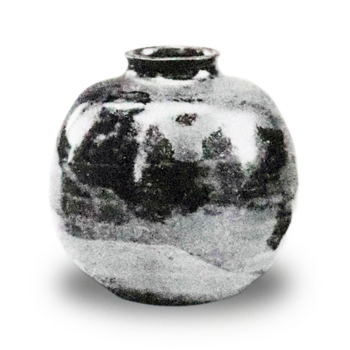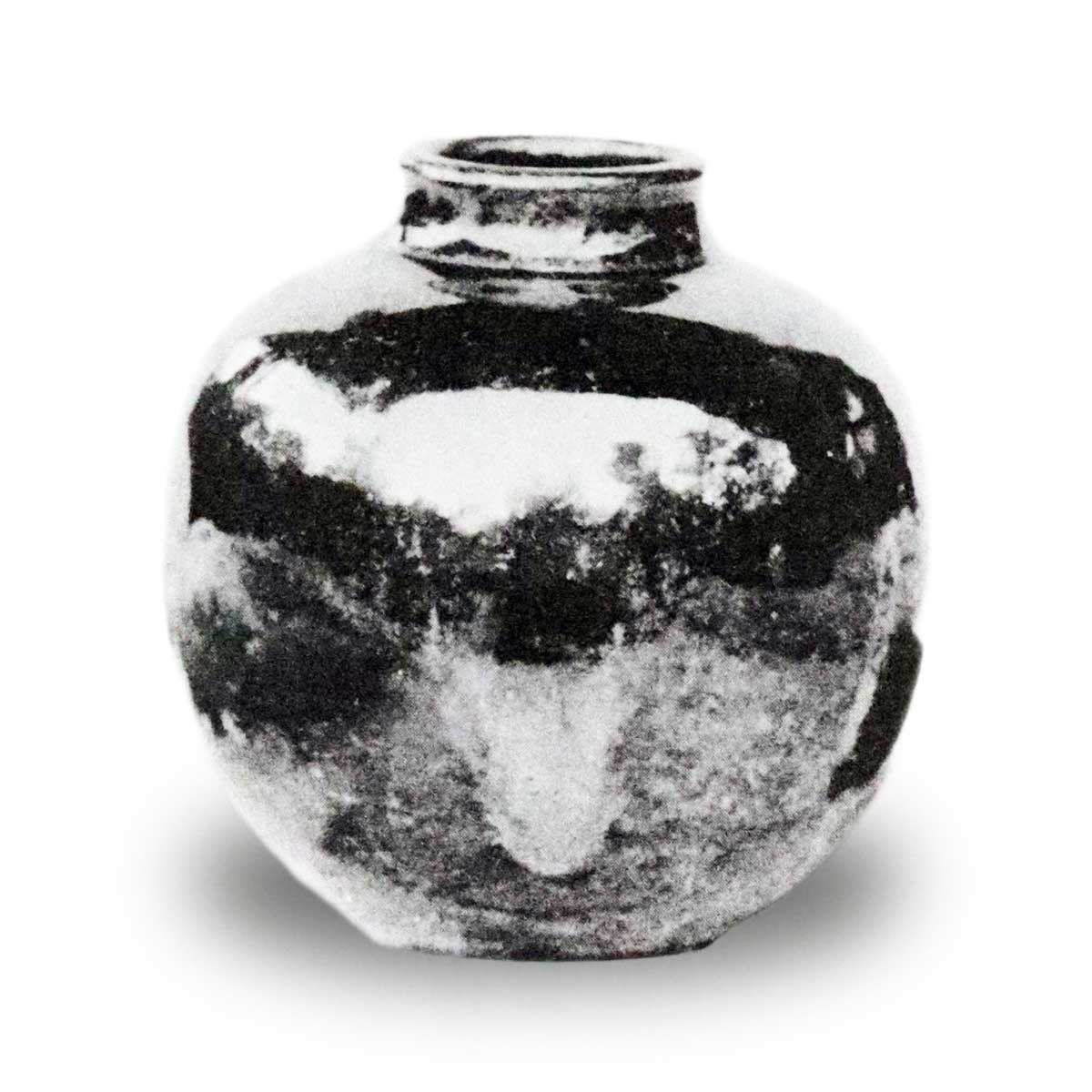
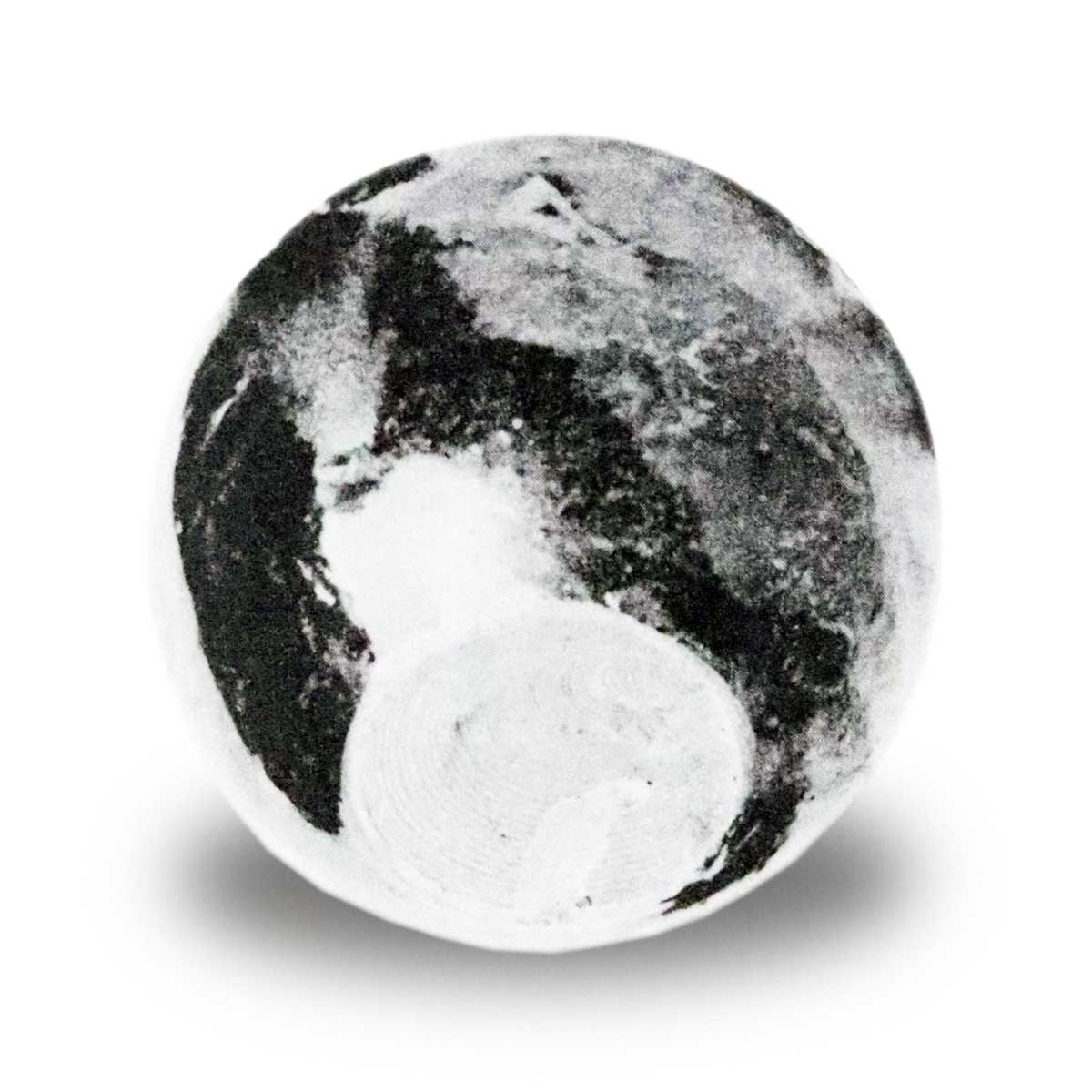
Made in China; Also known as: Kokushi Bunrin; Collection: Baron Sumitomo Kichizaemon
Origin of the Name
A poem by the Minister of the Imperial Household found in the “Spring, Part 1” section of the Shinkokin Wakashū
“Among the young grass on the field’s edge, green in shades both pale and deep, the patches of lingering snow remain visible for a long time.”
This imperial inscription was bestowed by Emperor Go-Yōzei, inspired by the spirit of this poem. It is also known as “Kokushi Bunrin” because it was once owned by Ishin Sōden of Nanzen-ji Temple, also known as Kokushi Hongō.
Dimensions (converted using 1 sun ≈ 3.03 cm and 1 monme ≈ 3.75 g)
Height: Approx. 6.42 cm (2 sun 1 bu 2 rin)
Body diameter: approx. 6.36 cm (2 sun 1 bu)
Mouth diameter: just over approx. 2.27 cm (just over 7 bu 5 rin)
Base diameter: approx. 2.73 cm (9 bu)
Height of the koshiki (rim): approx. 0.67 cm (2 bu 2 rin)
Weight: approx. 80.6 g (21 monme 5 bu)
Accessories
・Lids: 4 pieces (including 1 original lid and 3 replacement lids with indentations. Details are as follows)
Furuta Oribe style (colored)
Kobori Enshū style (with indentation)
Kobori Enshū style (without indentation)
The three lids on the right are stored in a recessed box (kirikomi-bako).
・Storage pouch (for the tea caddy): Striped chirimen (lined with white chirimen; brown cord)
・Cover pouches: 3
Teika satin (lined with iridescent Kai silk; purple cord)
Bamboo-vine pattern satin (lined with iridescent Kai silk; floral-patterned cord)
Nara-zori (lined with iridescent Kai silk, purple cord; newly made)
・Wooden mold: Made of cherry wood; 1 piece (contained in the Nara-zori pouch)
・Pouch box: Made of untreated paulownia wood
Inscription on the front: “Wakakusa, Bunrin-style replacement pouch, in the style of Kobori Sōho (Enshū)”
Inscription on the back: “One: Height approx. 6.36 cm (2 sun 1 bu); One: Body circumference approx. 20.30 cm (6 sun 7 bu); One: Mouth diameter approx. 2.42 cm (8 bu); One: Weight approx. 78.75 g (21 monme)”
・Hikiya (a tube for storing the tea caddy): Made of karin wood; the lid features sunken carvings
“Wakakusa”
The pouch features a Dutch-stripe pattern (the lining is Oribe satin; the cord is purple)
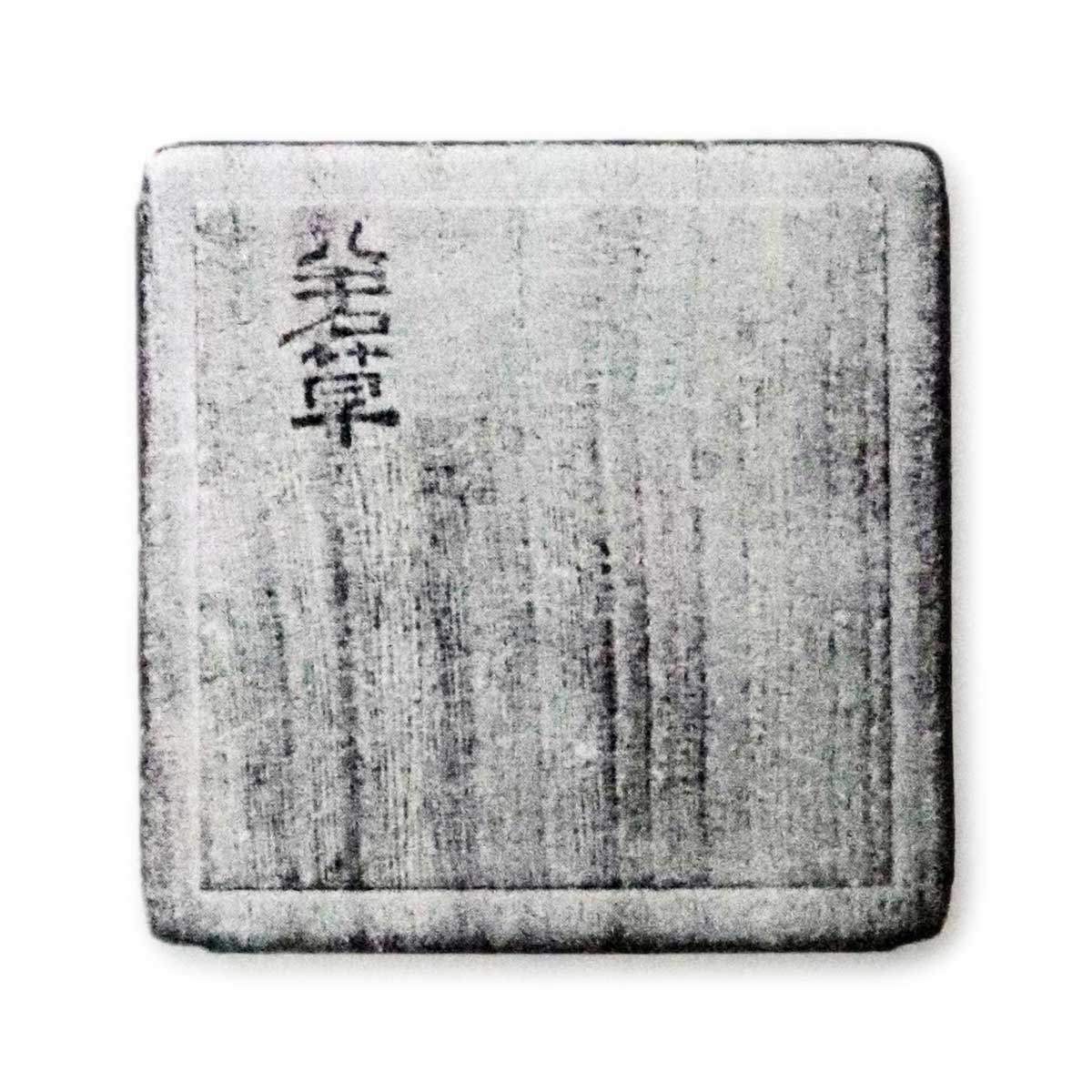
・Inner box: Unfinished wood; bears an inscription by Kobori Enshū
Front: “Wakakusa”
Back: “Bunrin”
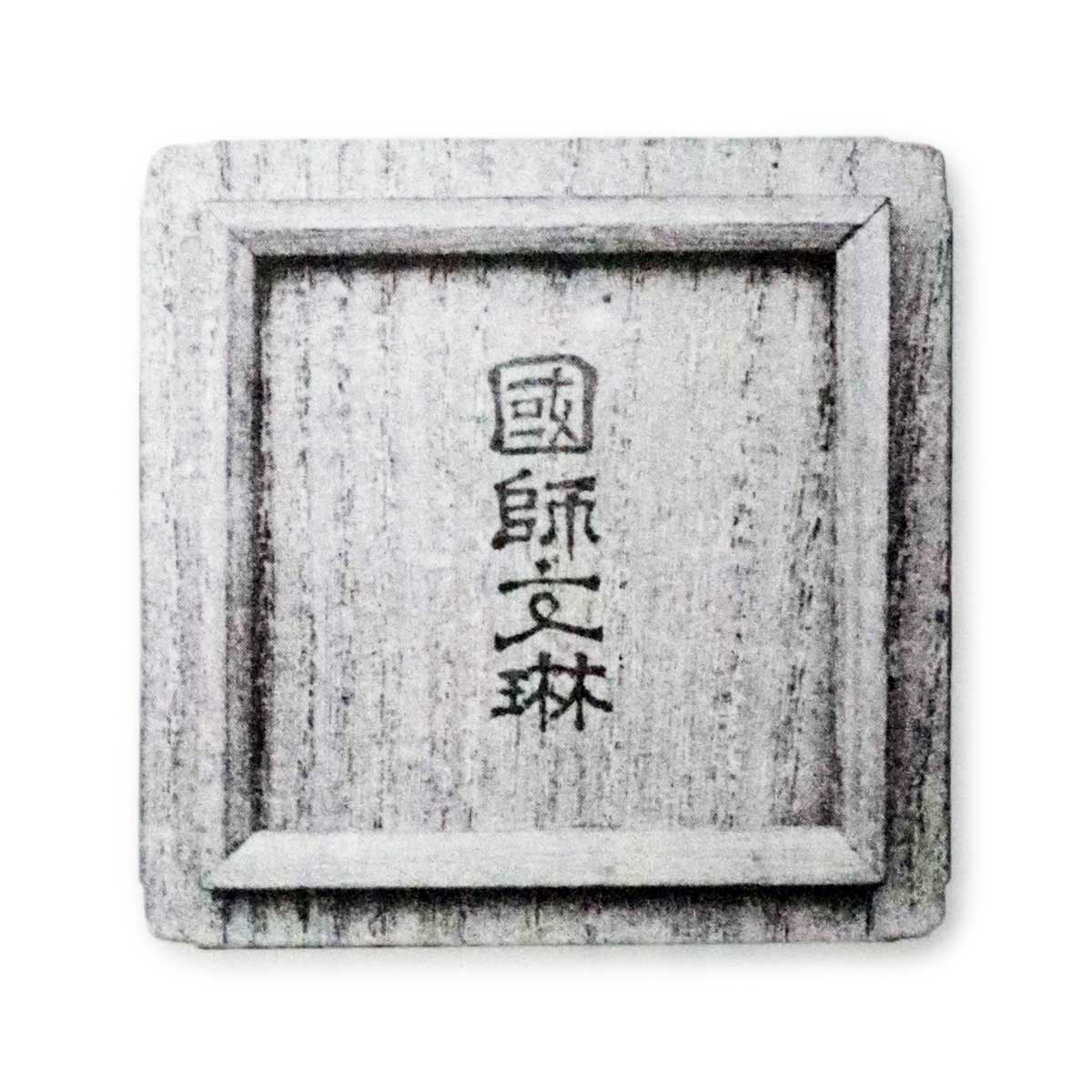
・Outer box: Black lacquered, with a silver lock
There is an inscription in gold powder on the underside of the lid.
“National Preceptor Bunrin. This name stems from the fact that it was once owned by National Preceptor Hongo of Nanzen-ji Temple. Wakakusa. Emperor Go-Yozei viewed it and praised its beautiful, lustrous appearance; he renamed it in reference to the spirit of the Imperial Minister’s poem ‘Thin and Thick.’
The inscriptions on the front and back of the unvarnished inner box were written by Kobori Masakazu (Enshū).”
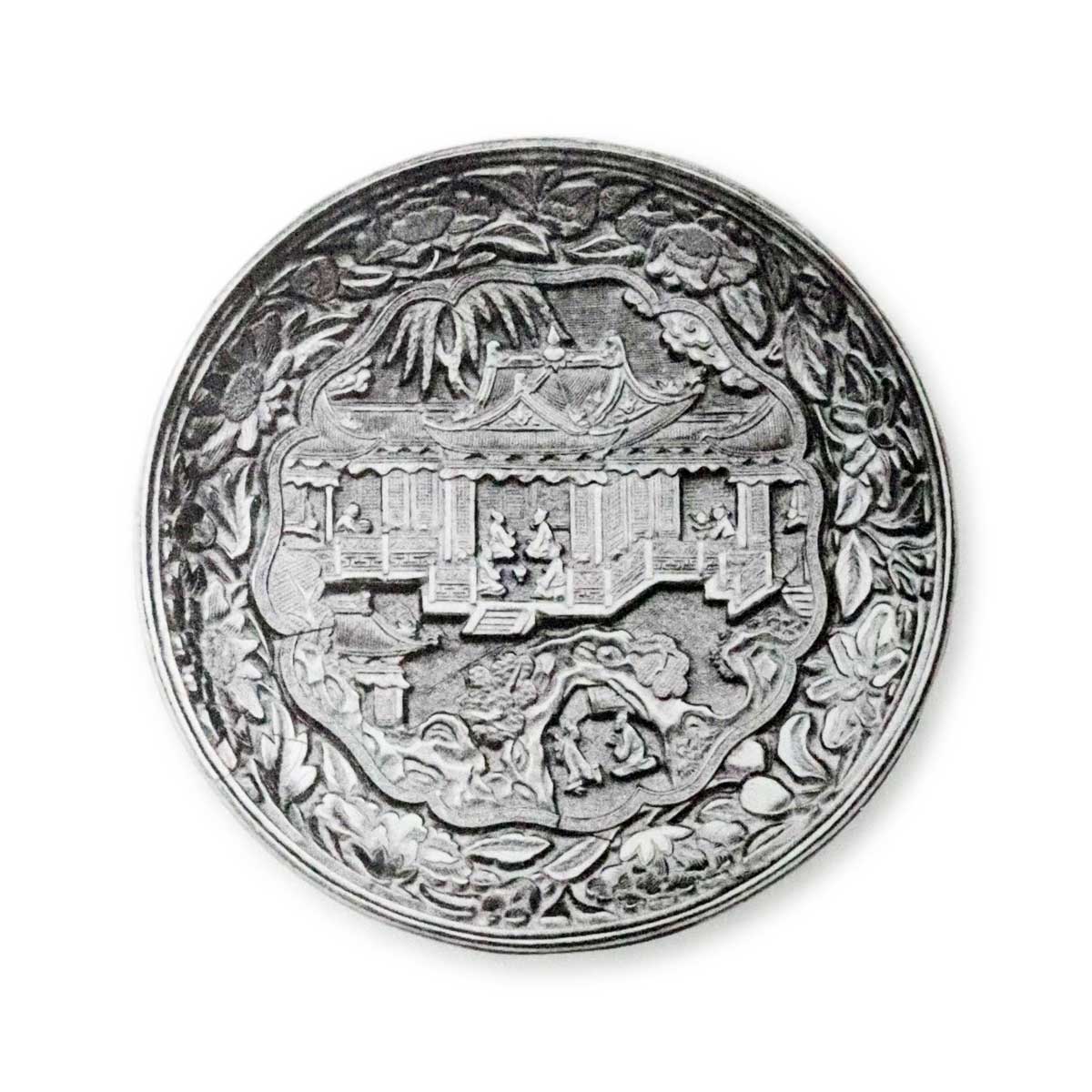
・Accompanying tray: Round tray with tsuishu lacquer
Pouch: Dyed leather (lined with Kai silk; brown cord)
Diameter: Approx. 19.39 cm (6 sun 4 bu); Base diameter: Approx. 12.42 cm (4 sun 1 bu)
Box for the accompanying tray: Made of unvarnished paulownia wood; it bears the following inscription:
“A round tsuishu incense tray. An engraved inscription appears beside the ring of the incense stand, reading, ‘Made by Wang Zhan in the Year of the Dragon (Renchen).’”
・Accompanying hanging scroll: 1 scroll, in the hand of Prince Yukihito of the Arisugawa Palace
“Light and dark—on the green young grass by the wayside, the patches of melted snow are visible even as they fade.”
・Accompanying written note: 1 letter
“Regarding the Tea Caddy Being Sold
- This is the Chinese tea caddy attributed to National Preceptor Bunrin (height approx. 6.51 cm, circumference approx. 20.30 cm) in our possession. On this occasion, through the mediation of Nose Jōhaku and the facilitation of Egawa Zensuke, an agreement was reached for 1,000 pieces of silver. We have received the full payment in silver and have completed the handover of the tea caddy. Regarding this tea caddy, there should be no objections raised from any party in the future, nor should anyone demand its return. I record this as evidence for future reference.
July 28, the Year of the Dragon, Jōkyō 5 (1688)
Kiyobei Hioki (Seal)
Mediator: Tsunehaku Nose (Seal)
Facilitator: Zensuke Egawa (Seal)
Vassal of Kiyobei Hioki: Giemon Shirai (Seal)
To Elder Muneoki Yamawaki”
・Attached scroll: 1 scroll
“The provenance of the tea caddy ‘Wakakusa Bunrin,’ treasured in the home of Oga Yoriyoshi (Jitoku-an Nyoshin).
This Chinese-made Bunrin tea caddy was originally kept in the treasury of Ashikaga Yoshimasa (Higashiyama-dono) and was cherished exclusively by him. It was later donated to Nanzen-ji Temple on Mount Zuiryū.
During the reign of Emperor Go-Yōzei, National Preceptor Hongō (Ishin Sōden) served as the abbot of Nanzen-ji and held the position of Sōroku-shi (the official in charge of overseeing the monks) for the Gozan temples. The National Preceptor cherished this Bunrin teapot; he would often prepare tea to entertain guests and use it as an aid when expounding the Buddhist teachings. In this way, people came to recognize that this Bunrin teapot was exceptionally rare and exquisite, and it thus came to be known as the ‘National Preceptor’s Bunrin.’ One day, while the Emperor was listening to the Kokushi’s Dharma teachings, the topic of Bunrin came up. When the Emperor was shown the vessel for the first time, he smiled with delight and, citing a waka poem
“On the green young grass of the fields, where shades vary from pale to deep, / The patches of snow that were once visible have now vanished”
composed by the Minister of the Imperial Household during the reign of Emperor Go-Toba, remarked, “It seems as though the beautiful scenery of the spring countryside is naturally contained within this small vessel. “Ah, what a rare vessel this is!” he exclaimed in praise. From that time on, it came to be known as “Wakakusa.” At that time, Sen no Rikyū had already passed away, and since Furuta Oribe (Shigeyuki) was the leading authority on the tea ceremony, he had a magnificent lid and pouch made and added them to the original set. After Oribe’s death, Kobori Enshū (Masakazu) became the leading authority, and he, too, had a lid and pouch made and added them. Enshū reasoned as follows: “Although this tea caddy received the Emperor Go-Yozei’s praise and was bestowed the name ‘Wakakusa,’ future generations would surely find it puzzling if they did not know the origin of that name. Therefore, I shall inscribe a waka poem by the Minister of the Imperial Household.” With that, he immediately took up his brush, composed the poem, and wrote the name “Wakakusa” on the lid of the box.
(Omitted)
In Kyoto, there was a renowned family of metal engravers named Goto Chōjō. As they were connoisseurs of tea, they sought out this “Wakakusa” teapot, made it a family treasure, and cherished it throughout their lives. In the port of Hachikaku Island in Chikuzen Province (Fukuoka Prefecture), there lived a man named Ōga Zenbei Yoriyō, who came from a family known throughout the land for its great wealth. His father was named Sōon, and he was a great lover of tea. By the time it came to Yoriyoshi’s generation, he added even more refinement to the art, devoting himself entirely to the enjoyment of the pure tea ceremony. Yoriyoshi often thought, “Although our family possesses many heirlooms, my only regret is that we do not own a single famous tea caddy made in China.” In the early years of the Genroku era (1688), a message arrived from Kyoto stating, “The owner of that ‘Wakakusa’ no longer practices the tea ceremony but merely keeps it hidden away as a treasure. If a connoisseur were to plead earnestly, he might be willing to part with it.” Yuiyo was overjoyed and, wishing to go immediately to acquire it, sought permission from Lord Kuroda Mitsuyuki through his retainer, Tachibana Shigeki. Sensing his enthusiasm, the lord granted his request. He immediately chartered a ship, set sail from Reizei Harbor, and arrived in Kyoto. In the autumn of that same year, on July 28, he was finally able to acquire the Bunrin. As a token of gratitude to its former owner, he sent 10,000 ryō of silver (1,000 ingots). At that time, Lord Mitsuyuki was in Edo, and Shigeki was accompanying him. Yuiyo sent a letter by express messenger to report this. The lord was delighted and conveyed through Shigeki, “This is not merely a treasure for one person, but a treasure for the entire nation.”
While Yoriyoshi was staying in Kyoto, Prince Yukihito of Arisugawa heard that he had acquired the Bunrin and, through his close aide, Kobatake Tōtōmi-no-kami, ordered, “I wish to see the Bunrin.” Yoriyoshi complied with the order and presented it. The prince accepted it and presented it to the Emperor (Emperor Higashiyama) for his viewing. Ah, this was not only a tribute to the vessel itself but also a great honor for Yoriyoshi. When it was returned, the Prince personally composed a waka poem titled “Thin and Thick” and attached it to the vessel.
Tea connoisseurs in Kyoto heard of this and frequently requested, “Please hold a tea gathering so we may see the Bunrin.” Yuiyo held over 20 tea gatherings at his residence in Shijō, inviting a total of more than 60 people to partake in the tea ceremony.
(Later, Yuiyo ceded the family headship to his heir, Zenbei, retired from public life, took monastic vows, and adopted the name Jikei Nyoshin.)
On December 19, Genroku 4 (1691), by order of Prince Mitsuyuki, the Bunrin was brought to his villa in Senga. The Prince bathed and donned formal attire to view it. This was a customary gesture of appreciation for a rare and precious artifact. The lord’s retainers were present to witness the display, and the lord summoned Nyoshinshō to praise the splendor of the Bunrin, expressing his deep admiration for his passion for the tea ceremony on multiple occasions. After Nyoshinshō withdrew, he was graciously entertained with tea confections. On the same day, he was also presented to the lord’s heir, Lord Tsunamasa, who offered words of praise just as the previous lord had done.
On March 19 of the following spring, Lord Tsunamasa again ordered Jushin to prepare tea using the Bunrin. The tea ceremony was held in the Hōsen-shitsu in the North Garden. (Omitted) Retainers of the Kuroda family were present, and the discussion of tea continued into the night. The Lord was greatly pleased and, as a reward, removed the clothes he was wearing and presented them to Jushin.
Jushin frequently devoted himself to Zen, was close to the venerable Koga of Yokumine, and also favored the traditional tea styles of Sen no Rikyū and the venerable Un’an. With each passing year, the essence of Zen and tea became increasingly intertwined. The tea room he named “Jitoku-an” was built specifically for that Bunrin.
(Omitted) As I was close to Jushin and have known the full story of how he acquired Bunrin from the very beginning, I was asked to record the details of the matter. Unable to refuse, I have thus outlined the general course of events.
February, Year 2 of Hōei (1705), Year of the Rooster. Written by Tachibana Shigeki (Abbot of Shōgetsuan, Jitsuzan).”
“According to ancient records of our country, the Way of the Tea Ceremony began in the household of Shogun Ashikaga Takauji, and during its heyday, a layman named Sen no Rikyū (Sōeki) appeared. He did not merely follow in the footsteps of his predecessors but blazed his own unique trail, unbound by convention. Those who love tea invariably cherish small teapots made in China. Because their shape resembles an apple, they are called ‘Bunrin.’ It is said that Kokushi Hongo, who served as the Head of the Monastic Administration at Nanzen-ji Temple, once used a round teapot to serve matcha to his guests. Everyone praised it, and the teapot came to be known as the ‘Kokushi Bunrin,’ a name that resonated throughout the land. Emperor Go-Yozei had it brought to him to examine, and remarked, ‘This vessel is lustrous and beautiful, without equal. It rivals the beauty of the waka poem composed by the Minister of the Imperial Household about the beauty of Wakakusa.” From then on, it came to be known in the world as “Wakakusa Bunrin.”
After the National Preceptor’s death, a certain Goto, a metal engraver from Kyoto, passed it down as a family treasure. Furuta Oribe and Kobori Enshū, who were master tea ceremony instructors at the time, also praised it and each created a lid and a pouch to adorn it splendidly. Enshū thought, “Although this vessel gained a fine reputation after being presented to the Emperor, there is no way to prove its authenticity to future generations other than through oral tradition,” so he wrote the characters for “Wakakusa” on the outer box to clarify its name. Indeed, its value increased tenfold at a single glance from a connoisseur (one who recognizes a fine horse).
Oga Zenbei Yoriyoshi, a prominent merchant from Hakata in Chikuzen Province (Fukuoka Prefecture), had been renowned as a connoisseur of tea since the time of his father, Soen. Although his family treasured many rare vessels, Yoriyoshi lamented the absence of any truly world-famous masterpieces in their collection. In the spring of the first year of the Genroku era (the Year of the Dragon), while in the capital on official business, he was fortunate enough to acquire the “Wakakusa Bunrin.” Overjoyed, he paid one thousand pieces of silver for it. The people of Kyoto marveled at his boldness, and word spread throughout the city. Prince Yukihito of the Arisugawa Palace heard of this and sent one of his close aides, a certain Kobatake, to view the piece. Subsequently, following the precedent set by Emperor Go-Yōzei, it was also presented for the Emperor of Higashiyama’s viewing. The vessel’s beauty and Yuiyo’s fine reputation spread far and wide. When the vessel was returned, the Prince bestowed upon him a waka poem titled “Wakakusa,” written in his own hand.
After completing his official and personal affairs, Yuiyo returned to Chikuzen in the fourth year of Genroku (1691). At that time, Lord Kuroda Mitsuyuki had already retired and withdrawn to Chiga Beach outside Fukuoka Castle. Yuiyo brought the “Bunrin” with him to visit the lord’s villa at Chiga and presented him with tea. Lord Mitsuyuki had taken a bath and was dressed in formal attire when he received him. When Yuiyo prostrated himself in greeting, the lord said, “This vessel is not a treasure for you alone; it is a treasure of the entire province. “No, far from being merely a treasure of a single province, it is a renowned masterpiece of the entire realm. How could I fail to show it the utmost respect?” The retainers present were also deeply moved by these words. That same day, Lord Tsunamasa, the heir apparent, also viewed the vessel and, like his predecessor, expressed his admiration. The following spring, Lord Tsunamasa specially ordered Yuiyo to prepare tea so that he might view the Bunrin once more.
All the retainers were also allowed to view it, and Lord Tsunamasa, overcome with emotion, removed the clothes he was wearing and bestowed them upon Yoriyō.
Although Yoriyō had already achieved distinction and retired, passing the family headship to his successor, Zenbei, he never parted with this famous tea bowl for even a moment, wrapping it in multiple layers of cloth and keeping it in a box in the corner of his room. Should any trouble arise, he intended to carry it on his back and flee; such was the strength of his attachment to it. He asked me to record its history. Although I usually drink more than my share of tea, I do not fully understand the profundities of the tea ceremony, so I was at a loss. However, unable to flatly refuse his request, I have put pen to paper with my clumsy words to fulfill his wish.
(Chinese poem omitted)
Spring, March, Genroku 5 (1692)
“Calligraphy by the late Monk Koai of Sōfuku-ji Temple”
・Scroll case: Unvarnished paulownia wood, with an inscription by Monk Ten’an of Sōfuku-ji Temple
Front: “Wakakusa Bunrin Ki”
Inscription on the underside of the lid: “Sōden of Kinchin-in, courtesy name Ishin, surname Minamoto. Resided at Nanzen-ji Temple, became Head of the Monastic Registry, and was granted the title of National Preceptor Enchō Honkō. He entered nirvana in the first month of the 10th year of Kan’ei.”
The inscription on the unvarnished wood was written by Venerable Ten’an of Sōfuku-ji.
・Outer box: Paulownia wood with Shunkei lacquer finish
Miscellaneous Notes
On March 19, Meiji 45 (1912), a bidding took place at the venue of the Osaka Shōseigumi, the predecessor of the Osaka Art Club. A Chinese-made Wakakusa-mon Bunrin tea caddy (weighing approximately 78.75 g, with three replacement lids) was purchased by Kakuyama Naka (a dealer) for 5,300 yen.
(From Tales of Discovering Calligraphy, Paintings, and Antiques, co-authored by Watanabe Koi and Nakai Shinzaburo)
History
Originally owned by Kinchin-in Sōden (Honkō Kokushi), it was presented to Emperor Go-Yōzei for his viewing, who bestowed upon it the name “Wakakusa-Bunrin.” It subsequently came into the possession of Hioki Seibei, who sold it to Yamawaki Sōkō for 1,000 pieces of silver in July of the 5th year of the Jōkyō era (1688); it then passed to the metal engraver Goto Jōjō. After Chōjō’s death, Ōga Zenbei Yoriyoshi, a wealthy merchant from Chikuzen Province (Fukuoka Prefecture), traveled to the capital on July 28, Genroku 1 (1688), and acquired this tea caddy for 10,000 ryō of silver. Prince Yukihito of the Arisugawa Palace heard of this and personally carried the tea caddy to present it to Emperor Higashiyama. Yoriyoshi regarded this as a great honor and held more than 20 tea ceremonies in Kyoto, inviting over 60 guests to showcase the tea caddy. He subsequently returned home with the tea caddy, presented it to his feudal lord, Kuroda Tsunamasa, and built a new tea room called “Jitoku-an,” where it was treasured by successive generations. It was later passed on to Inagawa An’emon, known as Ibarakiya in Osaka, but during an auction of the Inagawa family’s collection in March of Meiji 45 (1912), it was acquired by the Baron Sumitomo family (Sumitomo Kichizaemon).
Record of Actual Viewing
On May 15, Taisho 9 (1920), I had the privilege of viewing this piece in person at the residence of Baron Kichizaemon Sumitomo in Tennoji Chausuyama, Minami Ward, Osaka City.
The rim is rounded with minimal outward curvature; the neck protrudes slightly; the shoulders are rounded and sloping; and the body is full, tapering toward the base.
Overall, the amber-colored glaze is mixed with yellow; from the tips of the shoulders on the front view, the glaze flows and splits into two branches, stopping at the rim, where the pooled glaze reveals a blue-lapis lazuli hue. The thread-cut pattern on the base is exceptionally intricate and delicate, unlike any other, though a splatter of glaze at one end interrupts the pattern. A single line of black amber glaze runs around the body of the teapot, and the interplay of colors between the yellow and amber glazes is exceptionally varied, making this a teapot with numerous visual highlights. Inside, glaze covers the rim of the spout, while the area below it reveals wheel marks; the center of the base is slightly raised, forming a ring-like shape. For a Chinese-made teapot, it feels somewhat heavy when held in the hand.