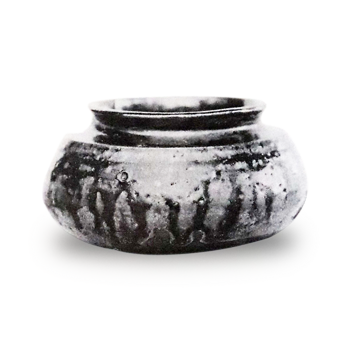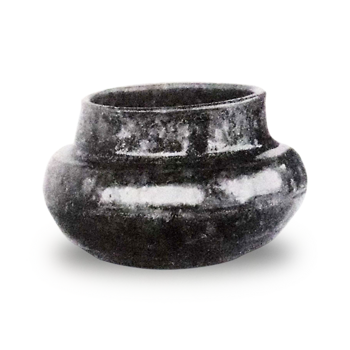
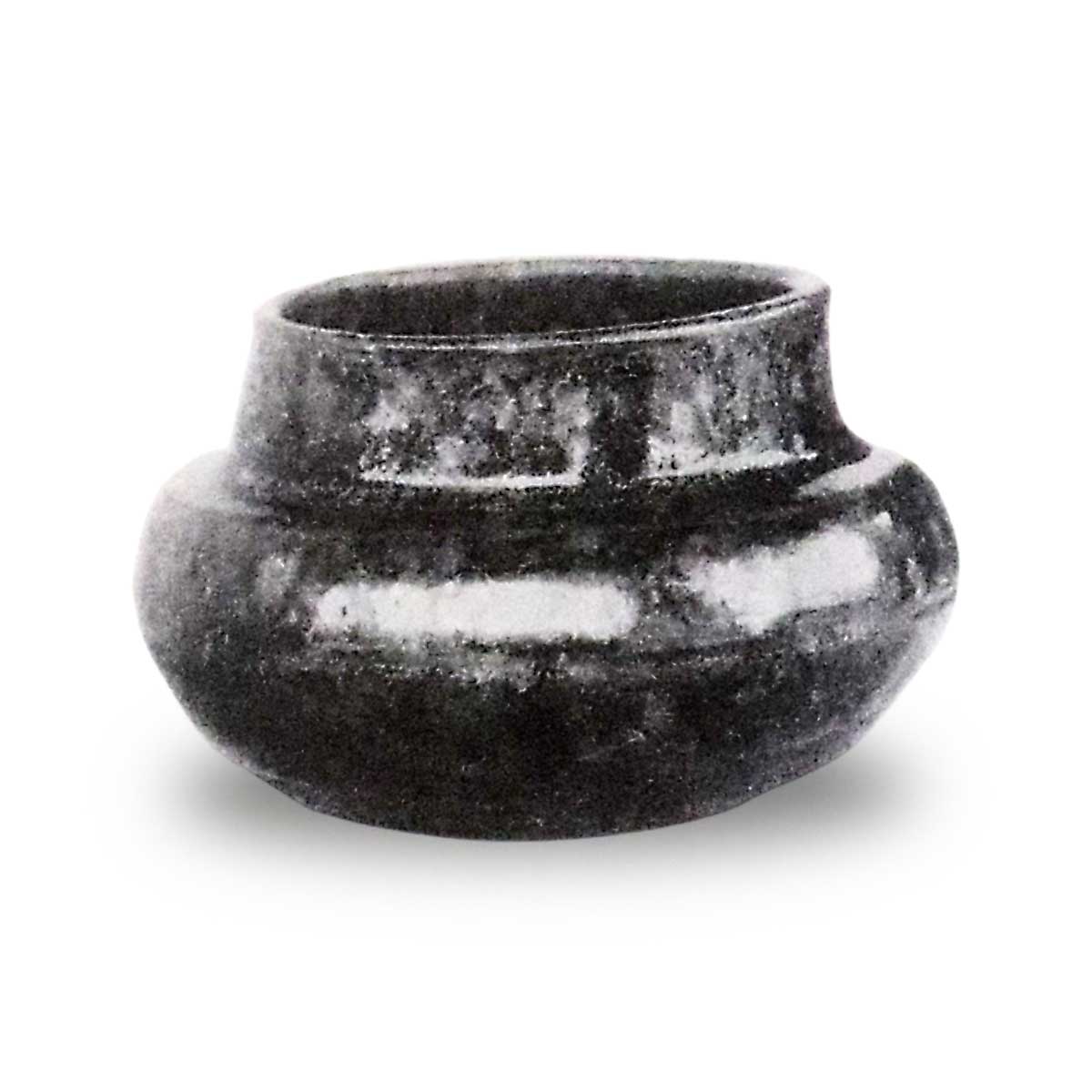
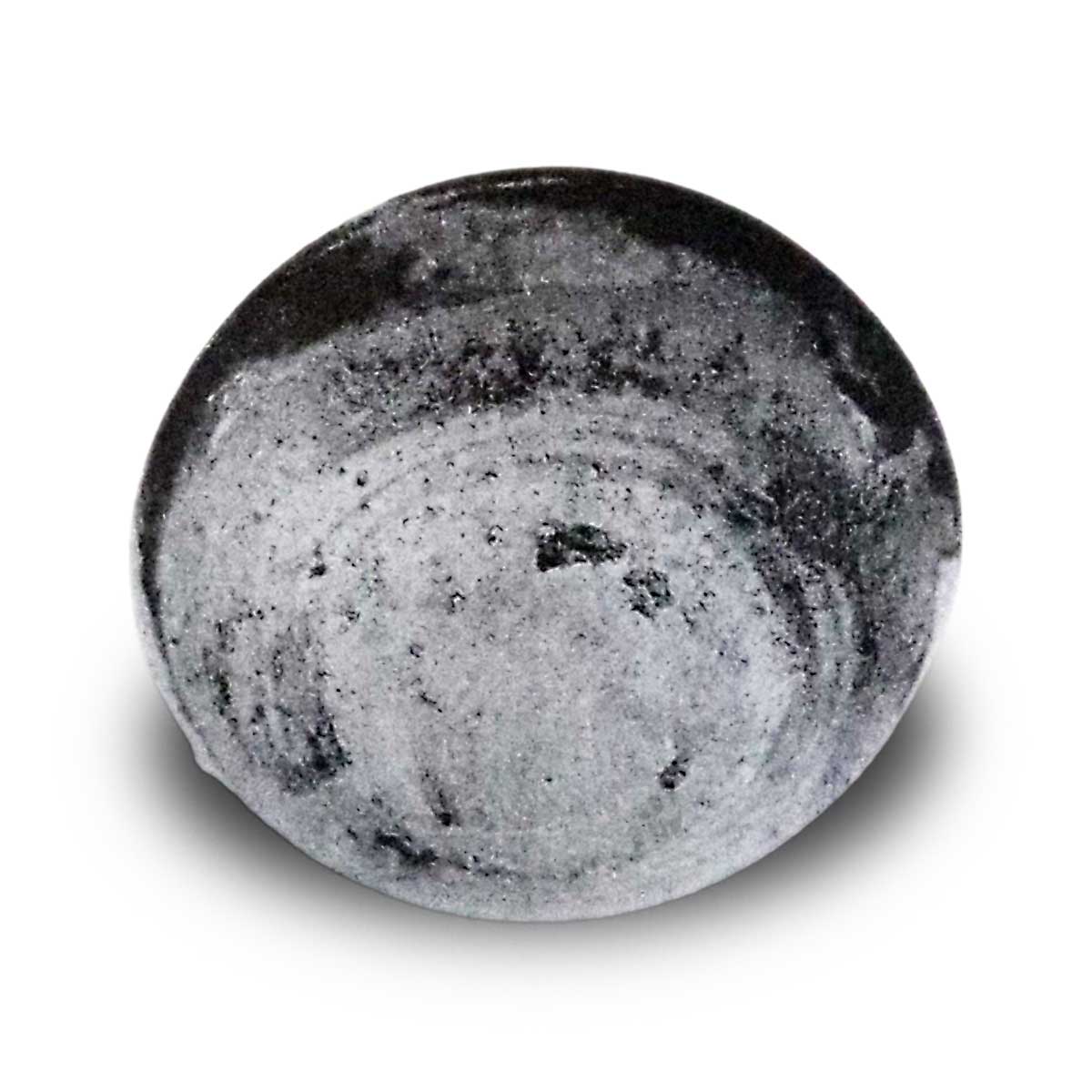
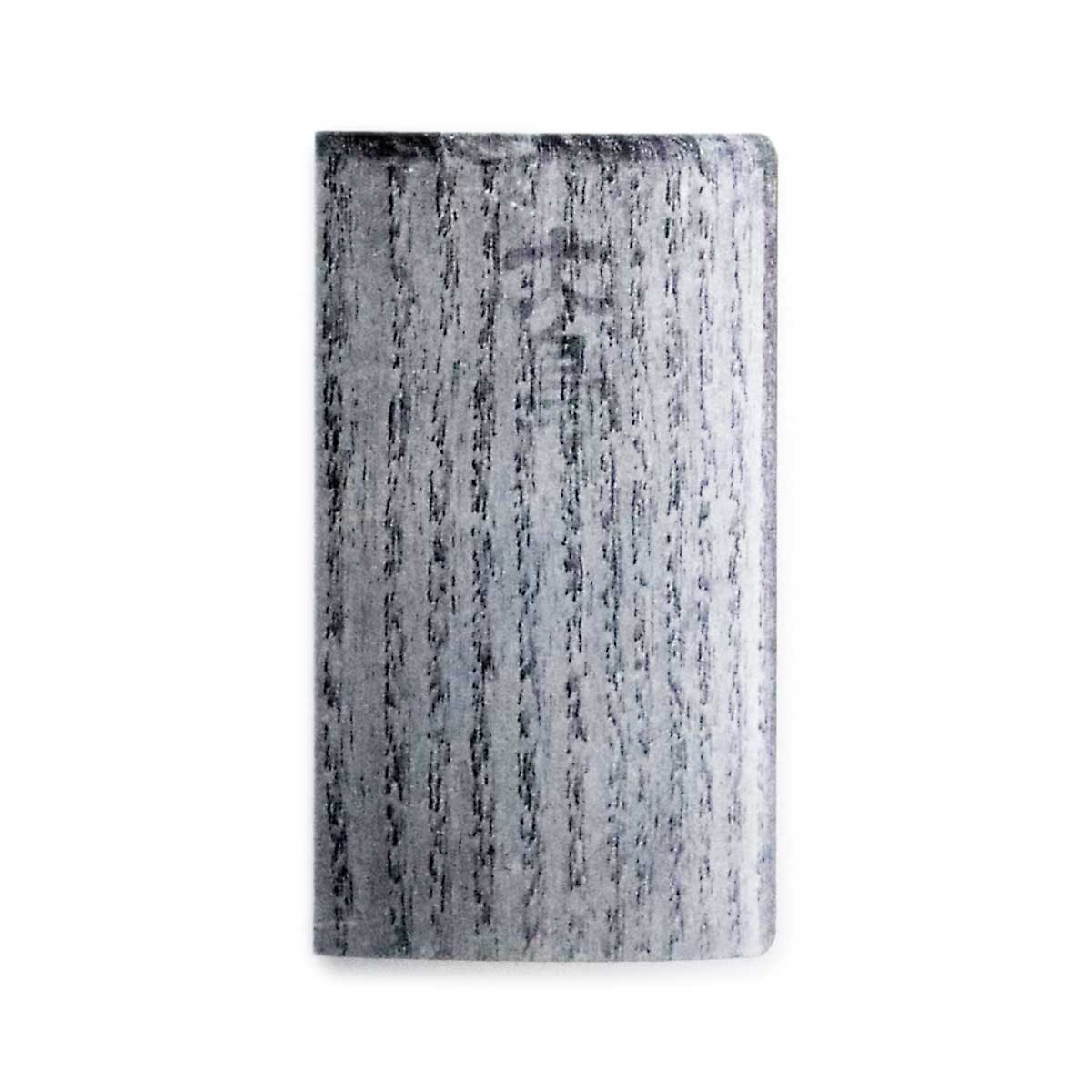
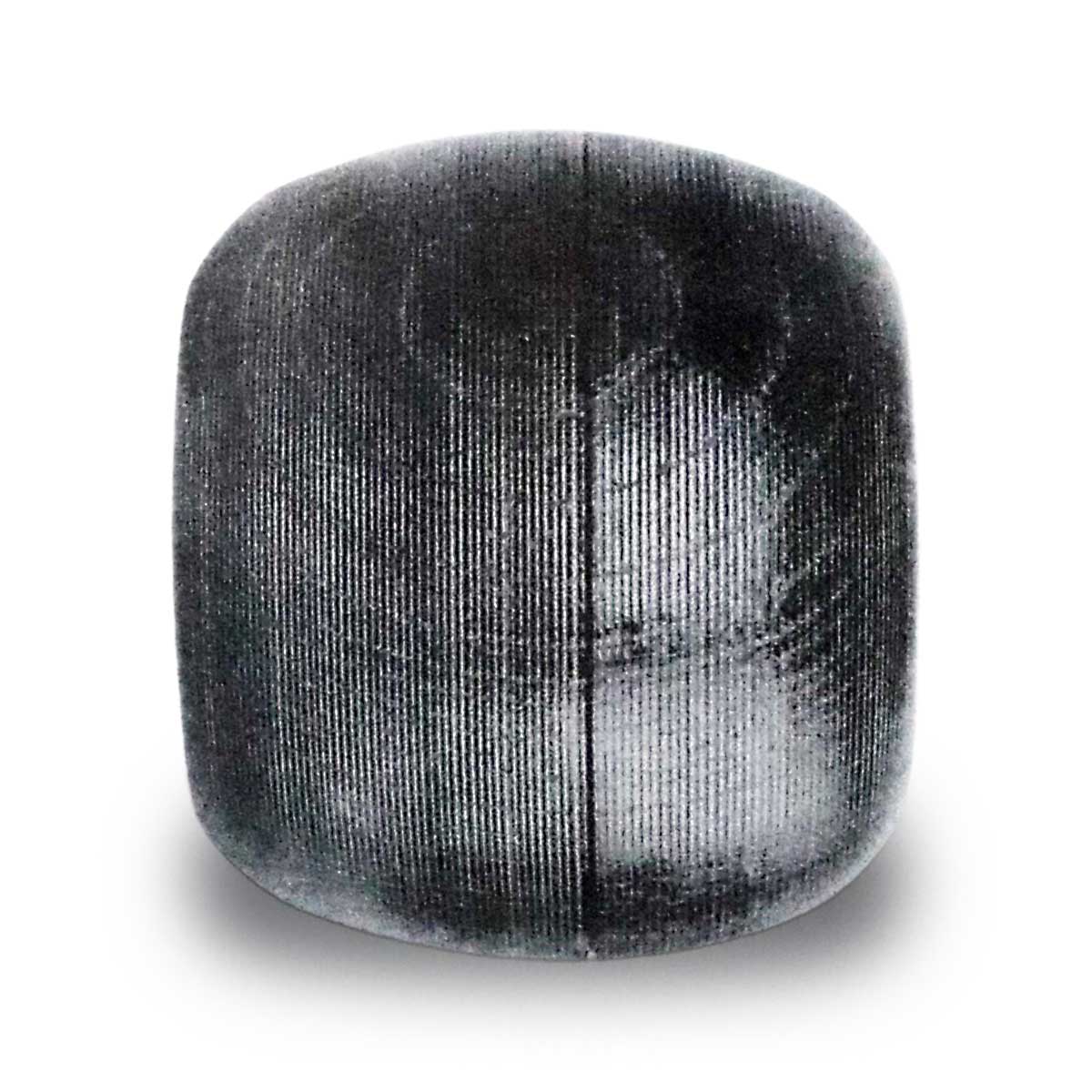
Old Seto, Revival Meibutsu; Collection of Count Matsudaira Naoaki
Commentary:
A note in Meibutsu-ki (Record of Famous Artifacts) by Matsudaira Norimura states, “Since there is no other piece among the Old Seto ware of such superb craftsmanship, it is called ‘Oshima.’” Whether this was indeed Kobori Enshū’s intention in naming it, or whether the name derives from the teapot’s large size, remains a question for the time being; I shall await the scholarly analysis of future experts.
[Dimensions] (*Converted using 1 sun = approx. 3.03 cm, 1 bu = approx. 0.3 cm, 1 rin = approx. 0.03 cm, 1 monme = 3.75 g)
・Height: 1 sun 7 bu 8 rin (approx. 5.39 cm)
・Body diameter: 2 sun 9 bu 5 rin (approx. 8.94 cm)
・Mouth diameter: 2 sun 5 rin (approx. 6.21 cm)
・Base diameter: 1 sun 5 rin or 1 sun 6 bu 5 rin (approx. 4.55 cm to approx. 5.00 cm)
・Neck height: 5 bu (approx. 1.52 cm)
・Shoulder width: 2 bu (approx. 0.61 cm)
・Weight: 46 monme 9 bu (approx. 175.88 g)
[Accessories]
・Cover sheets: 3 sheets (2 of which are small-sized; fit inside the hanging compartment [kake-go] of the pouch box)
・Storage pouch: Brown shōba fabric with pine-needle-dyed komon pattern; cord: brown
・Pouches (cover sheets): 3
- Tomita-giri: Varied yellow-on-yellow pattern with ocean waves; cord: purple
- Shimizu-giri: Varied broken-pattern with ocean waves; cord: wisteria color
- Moegi-ground Kinran: Lining—broken yellow with ocean waves; cord: wisteria color
・Hikiya (Handle): Zelkova (keyaki), Arima-style threaded grain
- The lid features medium-thin T-shaped copper rivets (kasugai fittings) on both the interior and exterior.
- Pouch: Dutch-woven fabric; Lining: Brown sha-aya; Cord: Enshu brown
・Inner box: Paulownia, natural finish (bears an inscription by Matsudaira Fumai) - Wrapping cloth: Floral cloth; Lining: Enshu brown ha-niwa
・Outer box: Paulownia, natural finish - Contents: Kapitan chirimen (crepe), lining: Onado tea-colored ha-ni-bu
(Note) The Illustrated Catalog of Meibutsu Tea Utensils based on Fushimiya’s notes depicts a letter from Kobori Enshū (Izumi-no-kami) addressed to Lord Matsudaira Sakon (Norimura); however, this letter has since been lost.
[Miscellaneous Notes (Records from Various Sources)]
Kokin Meibutsu Ruiju
Oshima, Old Seto, Revival-Period Masterpiece, Collection of Matsudaira Dewa-no-kami
Height: 1 sun 7 bu 8 rin (approx. 5.39 cm), Body: 2 sun 9 bu 5 rin (approx. 8.94 cm), Rim: 2 sun 5 rin (approx. 6.21 cm), Base: 1 sun 5 bu (approx. 4.55 cm). Two lids, three pouches (red ground with cloud-patterned reverse design and sea mist motif; Kiyomizu-style cut with matching trim; cords in purple and wisteria colors. Navy-blue ground with antique Kinran pattern of the same design). Hikiya style with zelkova wood; copper T-shaped rivets on the inside and outside of the lids. Pouches: Dutch-woven fabric; cord fasteners in Enshū brown. Box: Unfinished paulownia wood, with an inscription by Kobori Sōhō reading “Ōshima” (includes an illustration of a tea caddy).
Meibutsu-ki
Oshima, Old Seto. Owned by Kobori Sōho. Around the middle of the period, owned by Kuchiki Iyo-no-kami (also known as Sawaō. Note: This is an error; the correct name is Kuchiki Izumi-no-kami Sawaō). Subsequently, it entered the possession of this family (Matsudaira Sakon-shōgan Norimura). This Hikiya and box had remained in the Kobori family, but it is said that after they entered this family’s possession, Kobori Izumi-no-kami gifted them all to us. It is thinly made in the Chinese style. The twisted rim is magnificent. The clay is lead-based, and the thread marks are faintly visible. A mixture of ground glaze, persimmon glaze, and black glaze covers the entire surface, and the glaze has a lustrous sheen. Because of its superb craftsmanship, which is unparalleled even among ancient Seto ware, it is called “Oshima.” (Dimensions, accessories, and illustration of the tea caddy included)
“Rin-Hō-Kame-Ryū”
Oshima Daikai; formerly owned by Kimi Hotta, and currently by Kimi Unshū (Matsudaira Fumai). The persimmon glaze and black glaze possess a strong metallic luster, making it exceptionally magnificent. The clay has a rough texture resembling the surface of a coin, and the swirls of the “hon-itokiri” technique are on the coarser side. (Dimensions, accessories, and illustration of the tea caddy included)
The Origins of Seto Pottery by Matsudaira Fumai
Oshima: This is an ancient Seto ware. It is contemporary with Hirano-yama, No-i, Ikoma, Tatenosaya, and Hatakeyama. When compared to Enjōbō, the quality of the glaze is comparable to that of the same period, but it lacks a bit of the period’s distinctive character.
Guide to Appraising Tea Utensils
Oshima Daikai—formerly owned by Matsudaira Sakon-shōgan. The base glaze is persimmon glaze, with black glaze applied in spots on top. The clay has coarse, relatively large particles (zanguri) and a rough texture; the main thread lines are fine, and the clay color is dark brown.
Collection of Tea Ware Appraisal Notes
Oshima: Originally owned by Kuchiki Izumi-no-kami; currently owned by Matsudaira Sakon-shōkan. The base persimmon glaze and black glaze are applied thickly, and the workmanship is excellent. The clay of the main thread-cut section is coarse and somewhat rough in texture. The clay color is gray, and the clay type is white-brown clay. The main thread-cut section is magnificent and thick.
Top-Secret Guide to Appraisal
Oshima Daikai: Formerly owned by Kuchiki Sawaō; now in the possession of Lord Matsudaira Sakon-shōgan. The base is covered with persimmon glaze, with black clay glaze appearing in places, creating a coarse, rough texture. The “hon-itokiri” is fine, and the clay color is dark brown.
“Fushimiya Notes: Illustrations of Meibutsu Tea Utensils”
Owned by Ōshima Taikai and Lord Kuchiki Tosa-no-kami (*incorrectly attributed to Lord Tosa-no-kami); passed to Lord Matsudaira Sakon-shōgan around the middle of the period; at that time, it was in the possession of Lord Hotta Sagami-no-kami. It is accompanied by a letter from Lord Kobori Izumi (Enshū) addressed to Lord Sakon-shōgan. It came into the possession of the Lord of Unshū (Fumai) around the Kansei era. As shown in the “Itokiri” diagram, this is a very open-grained, soft-textured “Nezumi-tsuchi” (gray clay). The base persimmon glaze features a metallic luster and black speckles, making it truly magnificent. The glaze extends all the way to the back of the shoulder on the interior. (Dimensions, accessories, and illustration of the tea caddy included)
“Hōki-an Bunko, Series A, No. 9”
Oshima Taikai; a large Seto ware piece. Genuine “Itokiri” style.
“Setsumankō: A Guide to the Mysteries of the Tea Ceremony”
Oshima, Old Seto, Daikai. Formerly owned by Kobori Enshū; it belonged to Lord Shūno (later known as Sawaō Rō; *Note: “After” is a mistake for “Immediately”), the younger brother of Lord Kuchiki Iyo-no-kami; it is now in the possession of Lord Sakon Shōkan. It left the Kobori family and was sent to Lord Mino Shōjirō.
Fushimiya Memoirs
August 9, Shōtoku 4 (1714) — One Oshima tea caddy
To Lord Kuchiki Izumi-no-kami — Payment: 200 ryō
Shōtoku 4 Account Book for the Purchase of Tea Utensils / Record of Lord Fumai’s Meibutsu Tea Gatherings
October 10, Bunka 9 (1812) — Kuchikiri — 4.5-tatami
His Lordship (Lord Fumai’s heir, Lord Gettan), Neto Sōsei, Tanimatsuya Teihachi
・1. Hanging scroll: Higashizaka Take
・1. Tea caddy: Oshima (Pouch: Tomita)
・1. Tea bowl: Mishima Kobuku (Ōsui Ido)
[Provenance]
Originally owned by Kobori Enshū, it was passed down to Mino Yasaburō. In August of Shōtoku 4 (1714), it was purchased by Kuchiki Izumi-no-kami Uematsu (later renamed Shū-no-kami; original name: Noritsuna; pen name: Kyōsawa Ō; died in Kyōhō 11 at the age of 76), the younger brother of Kuchiki Iyo-no-kami Uemasa, lord of Fukuchiyama Castle.
He subsequently transferred it to Matsudaira Sakon-shōgan Norimura. Although the Hikiya (the wooden tube for storing the tea cover) and box for this tea caddy had remained with the Kobori family, it is said that Kobori Izumi-no-kami presented all of these items to Norimura when the tea caddy came into his possession.
It was subsequently passed down to Hotta Sagami-no-kami, lord of the Sakura Domain, and during the Kansei era (circa 1789–1801), through the mediation of Fushimiya Jin’emon, it was acquired by Lord Matsudaira Fumai (Matsudaira Harusato). The statement in the Fushimiya Memorandum that “various items were delivered in a single batch from the main store” is believed to refer to the simultaneous delivery by Fushimiya of the “Somen,” “Ochi-shirabe,” and “Furiko” tea caddies from the Tsuchiya family’s collection, as well as the “Ban’yo-no” tea caddy from the Hotta family’s collection.
[Record of Actual Inspection (Record of viewing and observing the actual object)]
On May 8, Taisho 7 (1918), the object was inspected at the residence of Count Matsudaira Naoaki in Motomachi, Yotsuya Ward, Tokyo City (present-day Yotsuya, Shinjuku Ward, Tokyo).
The rim has no turned-up edge, the neck is tall and flared at the base, and there is one trace of repair (such as kintsuan) on the rim. A single dark, sunken line runs all the way around the body, and black glaze forms a quail-speckled pattern on a purplish persimmon-colored ground. Below the neck, the gray unglazed clay body is exposed, and three wheel marks run around the rim of the base. The base surface is worn, with faint traces of thread-cutting marks visible, and small pitting (minor dents or scratches) can be seen in places.
The interior is glazed up to the rim; below that, the wheel-carved patterns are truly beautiful, forming a swirl in the center of the base. Although there are many signs of wear and file marks overall, given its age, it should be regarded as an outstanding masterpiece in the “O-ta” style—a grand, unpretentious aesthetic—that is unrivaled by any other piece.