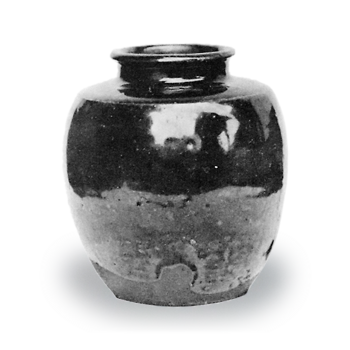
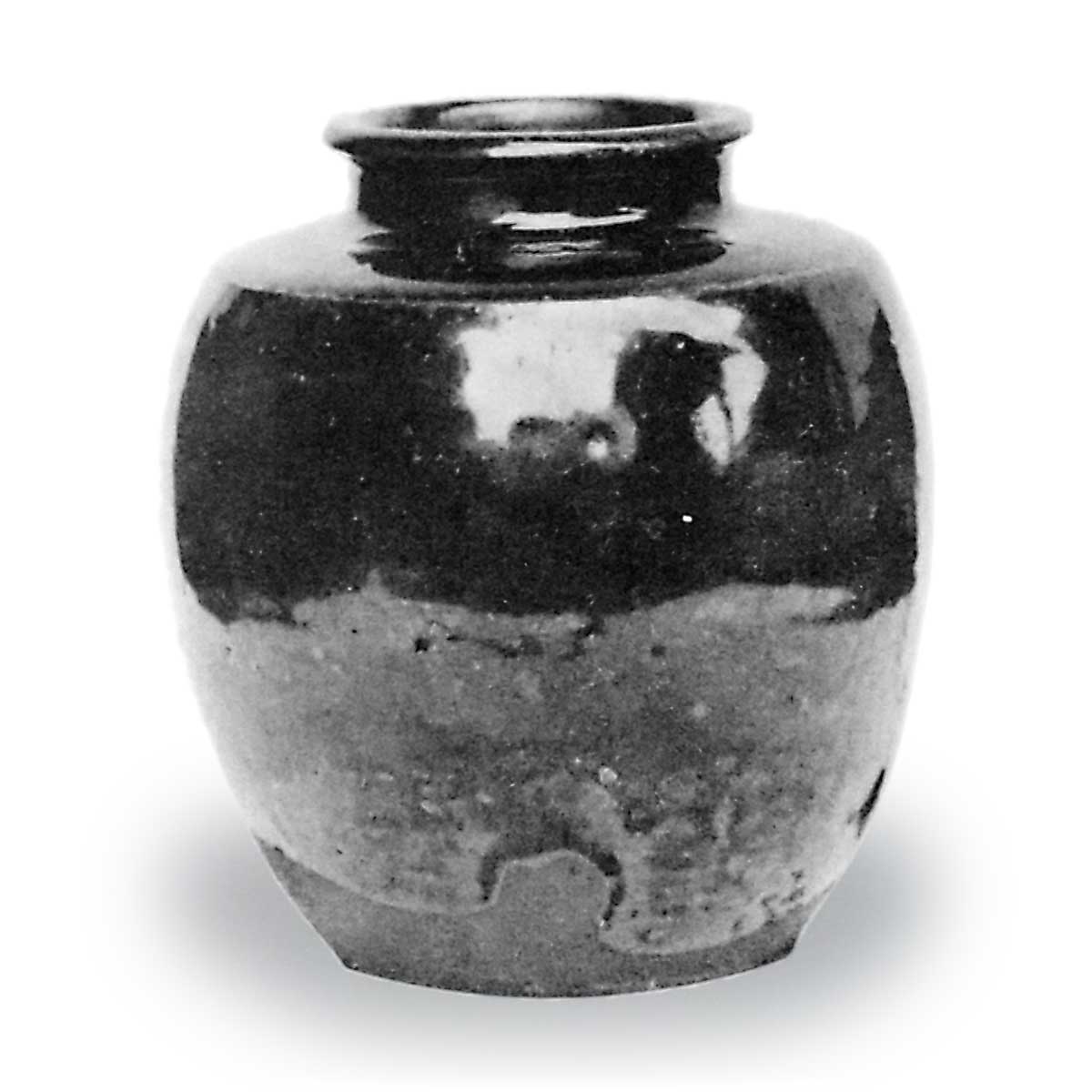
Made in China (Tang-style) | Daimeibutsu | Collection of Marquis Toshiyuki Maeda
[Origin of the Name]
The origin of the name is unclear. However, the Nankai Bunko Hon Asakura Etchūki contains a passage stating, “In mid-September, Lord Oda Nobunaga stationed a man named Hori and another named Atsuji from Ōmi Province at the mountain castle of ‘Kinome’ as castle guardians.” If this is the case, Kinome Castle was originally part of the Asakura clan’s territory, and it is likely that this tea caddy was given this name because it fell into Nobunaga’s hands when the castle was captured. For now, I will record this here and await further research by future scholars.
【Dimensions】
Height: Approx. 8.8 cm (2 sun 9 bu)
Body diameter: Approx. 7.7 cm (2 sun 5 bu 5 rin)
Mouth diameter: approx. 4.2 cm (1 sun 4 bu)
Base diameter: approx. 4.5 cm (1 sun 5 bu)
Neck height: approx. 1.1 cm (3 bu 5 rin)
Shoulder width: approx. 1.4 cm (4 bu 5 rin)
Weight: approx. 136.5 g (36 monme 4 bu)
[Accessories]
・Ivory lid: 1
・Imperial bag (bag for holding the tea caddy): Light brown habutae silk, with brown cord ties
・Covers (bags): 2
- Fabric from the Honno-ji battle (lining is brown kaiki silk, cord is velvet)
- Kantō-ori fabric (lining: brown kaiki silk; cord: brown)
(Note) While the Meibutsu-ki and Kokin Meibutsu Ruiju record that there were three pouches, the oldest of these, the “Yazaemon Kantō” pouch, has been damaged.
・Pouch cases: 2 - Wood-grain patterned pouch with a shoulder strap (katatsuki), satin, Honno-ji interior
- Wood-grain-patterned bag with a cap, Kandou (stripe pattern), with a bird and navy blue fastening
・Wooden mold: Paulownia wood, 1 piece (contained within the Kantō-ori bag)
・Hikiya (wooden container for protecting the tea caddy): Made of ironwood (Tagayasan), lined with satin featuring a wild goose (karigane) pattern.
Bag for the Hikiya: Made of moegi-colored satin, featuring a quince pattern with plum blossoms and small Tang floral motifs (lining is hitaki-colored seaweed fabric; the bottom is rotted. The cord is dark brown).
・Inner box: Unfinished paulownia wood box, with an inscription by Kobori Enshu; a paper label with the inscription is attached to the back.
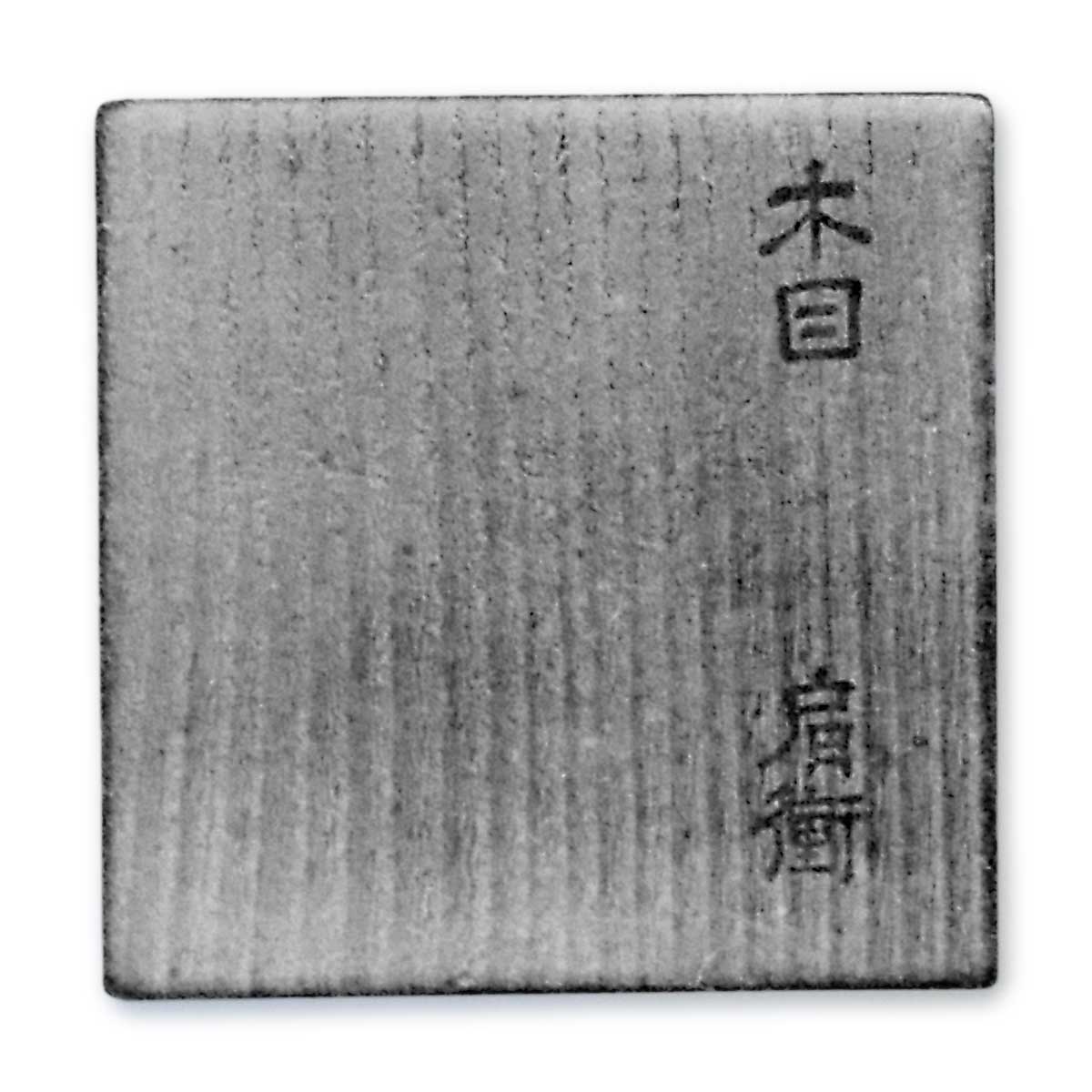
Front: “Woodgrain, Katatsuki”
Back: “Kan-kimome Katatsuki (written in vermilion). From Lord Daito-in (Tokugawa Hidetada), other provenance, received by Lord Myoboin.”
・Outer box: Paulownia box, Shunkei lacquer
・Outermost box: Unfinished paulownia box
Inscribed with “Kimome Katatsuki.”
[Miscellaneous Notes]
Kimome. Owned by Lord Fukushima Saemon-no-taifu (Fukushima Masanori). (From the Higashiyama Gomono Naibetsucho)
[Notes in Literature]
Ganka Meibutsu, Komeibutsu, Rinbō Kiryū: Kinome. Owned by Lord Matsudaira Awaji.
(Note) This Matsudaira Awaji-no-kami is believed to be Toshitsugu, the second son of Maeda Toshitsune, lord of the Kaga Domain.
Kokin Meibutsu Ruiju: Kino-me. Made in China. Daimeibutsu. Owned by Matsudaira Awaji-no-kami. Height: 2 sun 9 bu; body: 2 sun 6 bu 2 rin; shoulder: 2 sun 2 bu 4 rin; mouth: 1 sun 4 bu 8 rin; base: 1 sun 5 bu 2 rin. The glaze pattern also has a notable feature (the first point of interest). The neck (kubi) is 4 bu. Includes one lid and three pouches (Hachizaemon Koto: lining is pale green with a sea mist pattern; cord is Enshu tea. Honnoji-kirimono satin: lining is pale green with a sea mist pattern; cord is velvet. Kantō: Lining is pale yellow sea mist, cord is purple). The Hikiya handle is made of ironwood (Tagayasan), and the interior lining is satin with a wild goose crest. The Hikiya handle pouch features a pale yellow ground with a quince motif and a cherry blossom-angle arabesque pattern (lining is island sea mist, cord is dark brown). The box is made of untreated paulownia wood, and there is a paper label on the underside of the lid inscribed with: “Han-style wood-grain katatsuki; received by Myōbō-in from Lord Daito-in (Hidetada); other provenance details.”
Meibutsu: Wood-grain katatsuki. Made in China. Owned by Matsudaira Iga-no-kami (possibly a mistake for Kaga-no-kami). Includes measurements, accessories, and a diagram of the tea caddy from when it was borrowed and examined on December 10, Genbun 5 (1740).
Kansei Shoshu Shokke-fu: In the 9th year of Kan’ei (1632), Fukushima Masatoshi (son of Fukushima Masanori) presented to Lord Daito-in (Tokugawa Hidetada) a Masamune sword—a memento of his father—a wakizashi by Aoe Kunitsugu, and a “Kino-me Katatsugi.”
“Fukushima Masanori Documents” (Collection of Mr. Bunjiro Takagi): A record of Fukushima Masanori’s personal effects. A “Kino-me Katatsugi” (shoulder ornament), a Masamune katana, and a Aoe Kunitsugu wakizashi. These were presented to the Shogun. Dated July 5, 1624 (Kan’ei 1), with Masanori’s seal.
“Kansei Shūshū Shokke-fu”: In Genna 9 (1623), Maeda Toshitsune presented a sword by Gotō Masamune to the Shogunate as a relic of Taito-in (Tokugawa Hidetada). Prior to this, when Toshitsune traveled to Edo for the sankin-kotai, he received from the Shogun a sword from Gō, a sword from Tomita, a wakizashi by Torikai Kunitsugu, a wakizashi bearing Sadamune’s red seal, wakizashi by Togawa Kunitsugu and Raikuni Kunitsugu, as well as a “Kimen Katatsuki” tea caddy and a colored paper scroll titled “Yaemushi” written by Fujiwara no Teika.
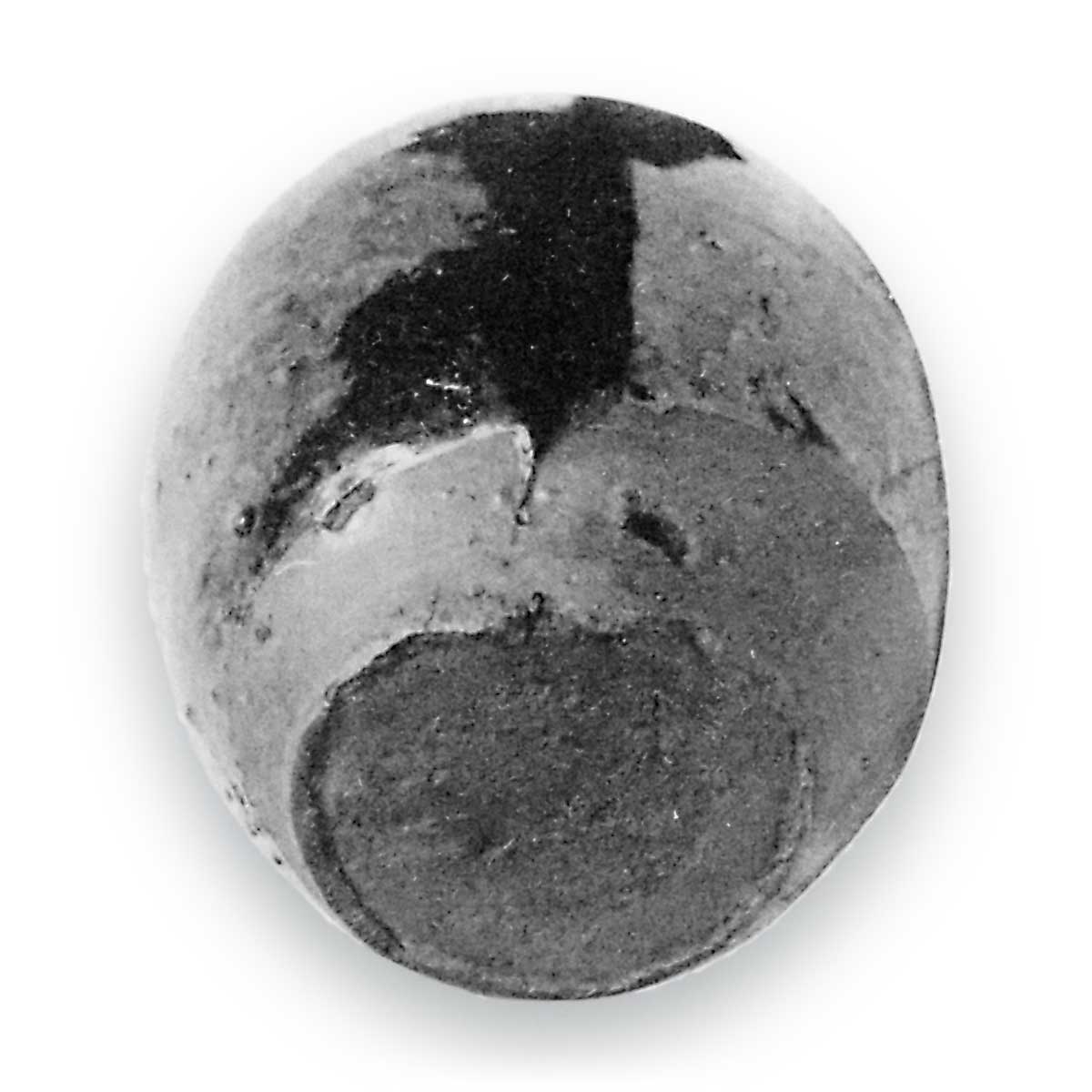
“The Marquess Maeda Family Inventory”: Wood-grain shoulder-striking tea caddy. Made in China. The base glaze is purple, and the overglaze is persimmon-colored. It comes with a tray, which is black. The bottom shows signs of having been cut from a slab (traces of separation from the slab are visible). On the right rear side of the glaze drips, there is a mark where the stone has cracked (spattered), and between them, four bulges of varying sizes are arranged in a row. Two streaks of overglaze, one long and one short, drip down from the interior drips of the tea caddy onto the exterior.
[Provenance]
Originally owned by Masanori Fukushima, it was presented to Shogun Tokugawa Hidetada in 1632 (Kan’ei 9) by his son, Masatoshi, as part of his father’s estate. Hidetada subsequently bestowed it upon Maeda Toshitsune, the lord of the Kaga Domain. It was later passed down through the lineage of Toshitsune’s second son (Matsudaira Toshitsugu), but eventually returned to the possession of the Maeda main family, where it remains today. On July 10, 1915, it was exhibited by the Maeda Marquis family alongside a Sōhan katatsuki during a tea ceremony held at the Art Association in Ueno Park, Tokyo.
[Record of Actual Viewing]
On November 25, 1919, I viewed the actual piece at the residence of Marquis Maeda Toshitame in Honfuji-cho, Hongo Ward, Tokyo.
The rim has a deep fold, and a single line runs around the base of the neck. The entire piece is covered in a dark amber glaze, with patches of light purple glaze appearing here and there; the luster is vivid and so beautiful that objects are reflected in it. A drip of glaze in an even darker shade of amber flows down from the shoulder, converging on the body to form an avalanche-like pattern that stops near the rim. From the rim downward, the unglazed clay body, resembling red clay, is exposed, with two small, wood-grain-like pores.
The base is a slab-cut design (cut from a slab), and while the rim around the base is jagged and irregular, this actually lends it a very elegant charm. There are no signs of wear from human hands, and it is preserved as beautifully as if it had just come out of the kiln—a state of preservation rarely seen among Chinese teapots. Glaze covers the rim of the interior opening, while below that, shallow wheel marks are visible; in the center of the base, there is a circular mark resembling a drop of iron, which is considered one of its most rare characteristics.