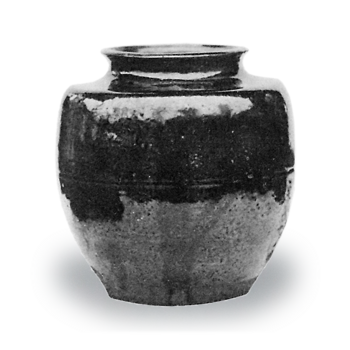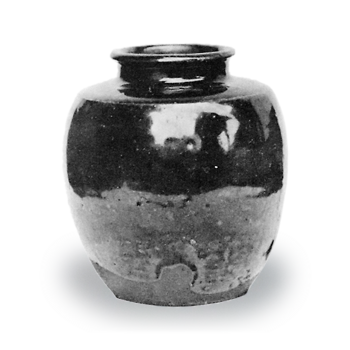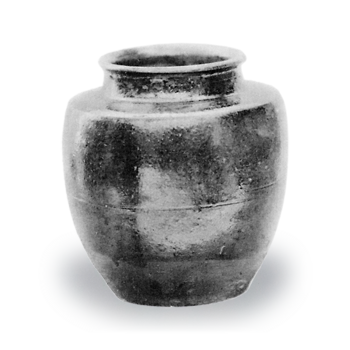
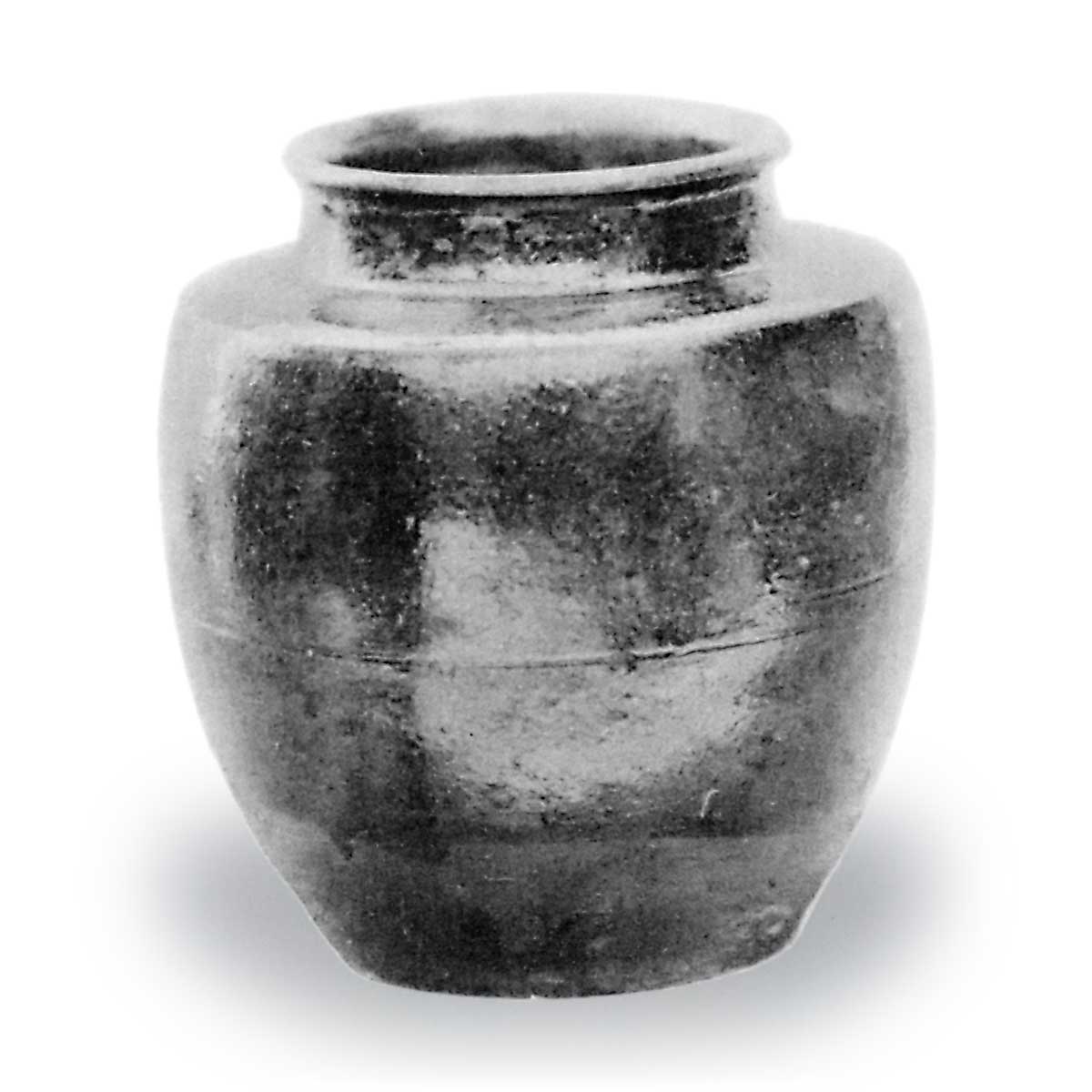
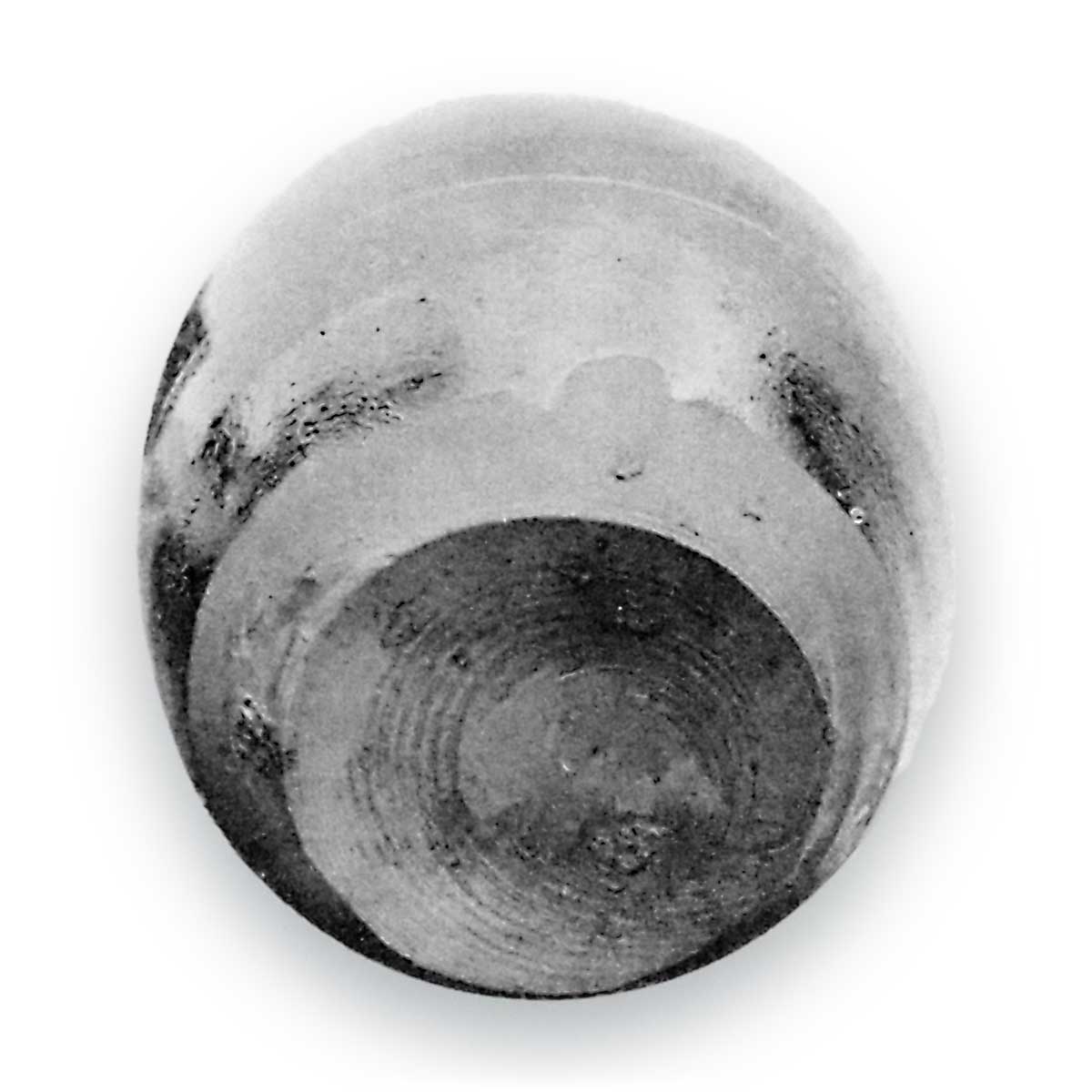
Also known as: Tsukuma Katatsuki; Made in China (Tang ware); Daimeibutsu; Owned by Count Matsudaira Naoaki
[Origin of the Name]
This name originates from the fact that it was owned by Nabeya Doka, a merchant from Sakai, during the Tenshō era (1573–1592). The alternative name “Tsukuma” was likely given because the original name “Nabeya” evoked associations with the “Nabe Festival” held at Tsukuma Shrine in Ōmi Province (present-day Shiga Prefecture).
The Zawashū records the following: “In Ōmi Province, there is a deity known as Chikuma Myōjin. As a vow to this deity, there is a custom whereby women make as many pots as the number of men with whom they have had relations, and offer them on the day of the festival. If a woman with many former partners feels ashamed and tries to cheat by offering fewer pots, she will be struck by the deity’s punishment and fall ill. It is said that if one prays honestly, one will be cured. In the “Miscellaneous Love” section of the Shūi Wakashū, there is an anonymous poem that reads: ‘I wish the Chikuma Festival in Ōmi would come soon. I want to see the number of pots belonging to that cold-hearted man.’”
Presumably, this was intended to admonish women against having multiple husbands, using the anecdote of this festival as a pretext.
[Dimensions]
Height: Approx. 8.3 cm (2 sun 7 bu 5 rin)
Body diameter: Approx. 7.9 cm (2 sun 6 bu)
Mouth diameter: Approx. 5.0 cm (1 sun 6 bu 5 rin)
Base diameter: Approx. 4.8 cm (1 sun 5 bu 7 rin)
Shoulder width: Approx. 7.3 cm (2 sun 4 bu)
[Accessories]
・Ivory lid: 1
・Imperial bag (bag for the tea caddy): White habutae silk, with a white cord knot
・Storage bags (pouch): 2
- Dantsu silk with a wave and plum blossom pattern (lining: pale yellow sea mist, cord: purple) / Contents: White habutae silk, with a tag inscribed by Matsudaira Fumai
- Fabric by Mochizuki Koto (lining: pale green sea-green, cord: Enshu brown) / Wrapping: white ha-ni-bi-e lined with silk, with a tag inscribed by Matsudaira Fumai
・Storage box: Unpainted paulownia wood box with black-tinged metal fittings on the surface. The lid fits into the inner compartment (kake-ko). The lining is purple chirimen with a purple silk lining.
・Hikiya (wooden container for protecting the tea caddy): Black lacquered, cylindrical shape. The bag is made of Dutch cotton (lined with floral-patterned satin, cord in Enshu brown). Includes one small cushion (futon) made of white ha-ni-bi.
・Inner box: Black lacquered with a silver lock. Inscribed with “Nabeya Katatsuki” in gold powder; the reverse side reads “Yodo Kumago Kai.”
・Outer box: Tame-nuri finish with a black kaki-awase-nuri interior. Wrapped in a single-layered striped cotton cloth.
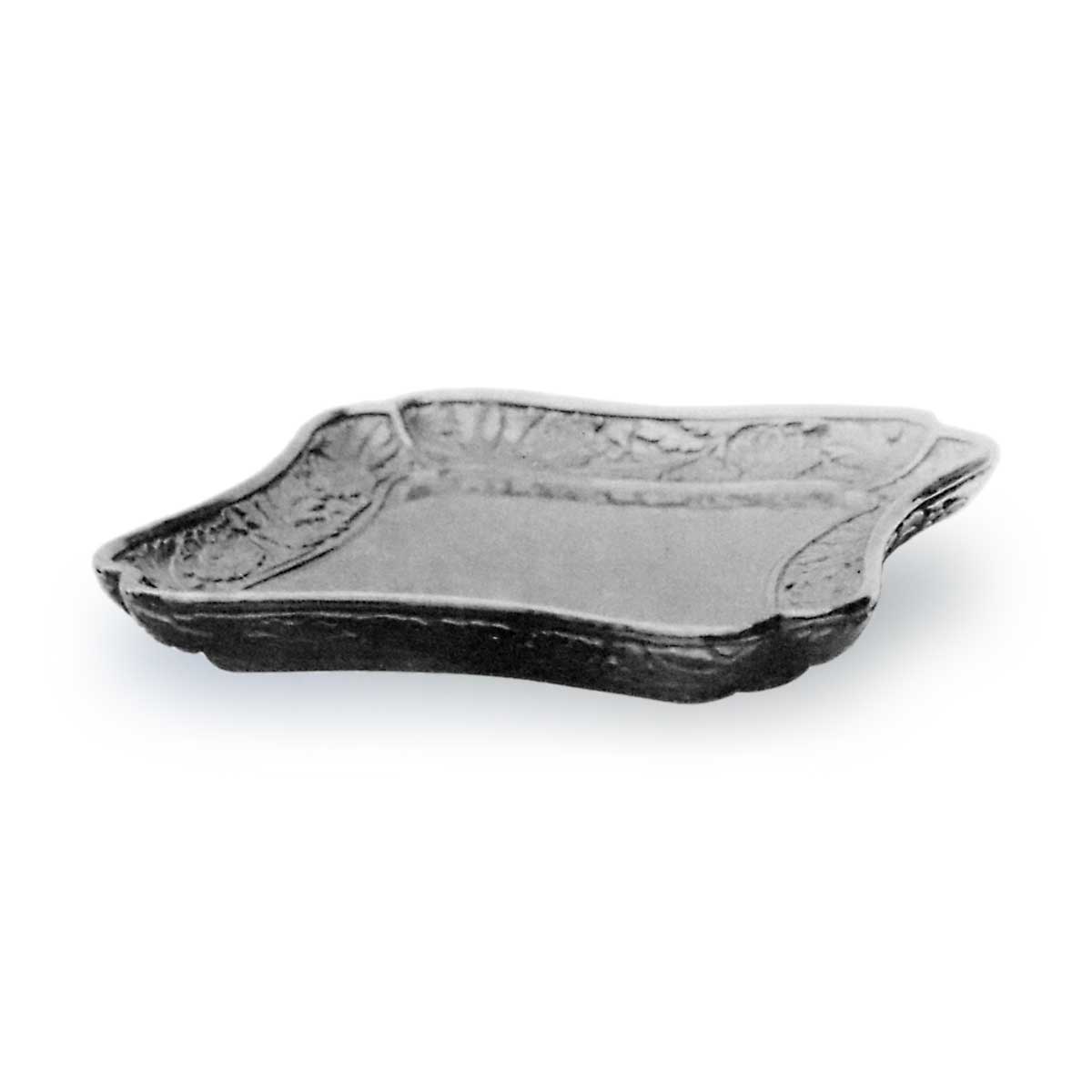
・Accompanying tray: Tsuishu finish with a leaf pattern. The surface diagonal measures approximately 23.6 cm; the base diagonal measures approximately 15 cm. Wrapped in a white ha-ni-bi-e lined kimono. It is housed in a white paulownia wood box and bears an inscription by Fumai. The wrapping is floral cloth, and the lining is a brown ha-ni-bi-e.
[Notes from Literature]
“Higashiyama Go-mono Uchi-betsu-cho”: Nabeya. Owned by Lord Kamio Gyobu.
“Komeibuki”: Nabeya Katatsuki. Owned by Naito Tatewaki.
Originally owned by Ujisato Gamō, it came into the possession of the Naito family and is currently held by Kiheita Fuyuki.
Ganka Meibutsu-ki: Nabeya Katatsuki. A Chinese tea caddy. Owned by Lord Taito Naito; a red inscription states it was owned by Ujisato Gamō. It is said to have passed through the hands of Kai-no-kami Matsudaira, Kiheita Fuyuki, and the Lord of Unshu (Fumai Matsudaira).
Kokin Meibutsu Ruiju: Nabeya Katatsuki. A Chinese katatsuki tea caddy. A Daimeibutsu. Owned by Naito Tatewaki.
Shoke Meiki Shu: Nabeya. Bestowed upon the Naito family from the Shogunate’s imperial collection (treasures), it subsequently passed to the Fuyuki family, Matsudaira Kai-no-kami, and then Matsudaira Dewa-no-kami.
Rikuzan Ichiyu Hoki: The tea caddy “Nabeya Katatsuki,” which has a history of being presented as tea to Shogun Tokugawa Iemitsu by Naito Samaryo.
The poem “At the Tsukuma Festival in Omi, I shall sing of the kokusei / The cold-hearted man’s Nabeya Katatsuki” is inscribed on it.
Minami-Aoi Bunko Edition of Shokke Daihiroku:
The “Nabeya Katatsuki” tea caddy is valued at 1,000 ryō, and the actual item is in the possession of the family of Sanada Izunomori Tatsunori. The reason for this is that Lord Gamō Tadakazu once found himself in urgent need of money and, through an intermediary named Shigeno, borrowed the enormous sum of 10,000 ryō from Sanada Izunomori, the lord of Matsushiro Castle in Shinano Province. As collateral for that loan, he handed this Katatsuki tea caddy over to the Sanada family. Subsequently, the money was never repaid, and before the tea caddy could be returned, the Gamō clan soon became extinct.
However, since a list of the Gamō clan’s treasures had been submitted to the shogunate, when the clan became extinct, an envoy from the shogunate came to Naito Tatewaki, the lord of Iwahara Castle, and requested, “Please return the Nabeya Katatsuki tea caddy.” However, since the item had been handed over as collateral, the Naito family responded, “It would be inappropriate to reclaim the tea caddy without repaying the 10,000 ryō,” and instructed that it be “left in the custody of the original official.” Consequently, it remains in the custody of the Sanada family to this day.
“Secret Teachings of the Snow-Between-Grasses School of Tea Ceremony”:
Nabeya Katatsuki, also known as Chikuma Katatsuki. Height: 2.75 sun; body: 2.6 sun; mouth: 1.65 sun; base: 1.6 sun. The distance from the shoulder to the mouth is 3–4 bu. The interior of the tea caddy also has an uneven texture, and there is a single streak of black glaze on the shoulder. The thread-cutting marks on the base are rough, and the texture of the clay is visible. There is a document stating that it is currently in the possession of Lord Naito Taitō (the original text mistakenly reads “Andō”). It is said that it was subsequently used as collateral for a loan of 10,000 ryō to Lord Sanada Izumino-no-kami and has remained in the Naito family ever since. I had the privilege of viewing it at the residence on May 30th of the Year of the Rabbit. It is a magnificent tea caddy, and there is a detailed illustration of it.
“Matsuya Diary”:
Nabeya (Michika Katatsuki) was a tea caddy with an unusually wide mouth, so Lord Furuta Oribe had the lid remade three times. However, in the end, it became a common, ordinary lid for a Katatsuki-style caddy, and as a result, the shoulder appears even narrower.
Meibutsu Godōki: Nabeya Katatsuki. Owned by Lord Sakai no Miyauchi; formerly owned by Lord Koriyama.
Chaki Zunsenden: Chikuma Katatsuki, also known as Nabeya. Owned by Lord Naito no Bingo-no-kami. Originally owned by Kamio Gohei, and later by Matsudaira no Shimotsuke-no-kami. It has long been accompanied by a Kinran cover (by Kandou).
“Rinpō-kuryū”: Nabeya. Owned by Gamō Tamon; passed through the hands of Naito Tatewaki, Kamio Gohei, Matsudaira Shimotsuke-no-kami, and Fuyuki Kōshū-no-kami; currently owned by Unshū-no-kami (Matsudaira Fumai). The persimmon-colored glaze on the rim is thin, with a slight hint of black.
“Fushimiya Hoki Meibutsu Chaki-zu”: A Katsuraya katatsuki tea caddy. Height: 2 sun 7 bu 5 rin; body: just over 2 sun 6 bu; rim: 1 sun 6 bu. The Hikiya is black-lacquered. The bag is made of red-dyed cotton with small floral stripes on a white background. The storage bag is made of pale yellow ha-ni-bi. The box is black-lacquered and comes with a lock. The characters were originally written in gold powder but were later changed to “Tsukuma.” The outer box is Shunkei-nuri lacquer, and the wrapping cloth is pale yellow floral-patterned cloth. (Omitted: Detailed descriptions of the tea caddy’s shape and glaze based on the drawing follow).
*Fumai’s *Ransho of Seto Pottery*: Nabeya. It is a Chinese-made piece. It was made during the same period as the Crane-Neck tea caddy.
[Regarding its History]
Unshū Hōbutsu Denrai-sho:
Nabeya Katatsuki. During the Tenshō era, it was owned by Nabeya, and later came into the possession of Ujisato Gamō. It was subsequently sent to the Naitō family, and later owned by Kiheiji Fuyuki. Around the Kansei era, it became the property of Lord Matsudaira Kai-no-kami, and in the first year of the Bunka era, it was purchased through the mediation of Motoya Sōkichi. The price was 1,000 gold pieces.
“Record of Lord Ōsaki’s Tools and Expenses”:
Nabeya Katatsuki. Purchased for 450 ryō through the mediation of Honsō (Honya Sōkichi) and Honryō (Honya Ryō).
[Details of its History]
During the Tenshō era, it was owned by Nabeya Michika, a merchant of Sakai, and later passed down to Ujisato Gamō. During the reign of his grandson, Tadachika, he suddenly needed money and borrowed 10,000 ryō from Sanada Izumino-no-kami Nobuyuki, the lord of Matsushiro Castle in Shinano, using this tea caddy as collateral.
However, in August of Kan’ei 11 (1634), Tadayuki died without an heir. When all the Gamo family’s treasures were confiscated by the Tokugawa shogunate, the shogunate—unaware that this tea caddy had been pledged to the Sanada family—gave it to Naito Tadaoki, the lord of Iwajo Castle in Oshu. The Sanada family attempted to return this tea caddy to the Naito family, but the Naito family was reluctant to accept a “tea caddy that served as collateral for a 10,000-ryo debt,” so it is said to have remained in the possession of Sanada Izumino-no-kami Tatsunao for a long time thereafter.
However, the Kiri-yama Ichiyu Nikki records that Naito Samaryo used this Nabeya Katatsuki to serve tea to Shogun Tokugawa Iemitsu. If that is the case, it is unclear today whether the Naito family subsequently formally acquired that tea caddy from the Sanada family or merely borrowed it temporarily.
The ownership then passed through Kamio Gohei, Matsudaira Shimotsukeshi, and Fuyuki Kihachiro, and by the Kansei era (1789–1801), it came into the possession of Matsudaira Kai-no-kami, the lord of Yamato-Koriyama Castle. Then, in the first year of the Bunka era (1804), through the mediation of two dealers, Honya Sokichi and Honya Ryo, it was purchased by Lord Matsudaira Fumai for 450 ryō.
[Record of Actual Inspection (Record of seeing the actual object)]
On May 27, 1918 (the 7th year of the Taisho era), I had the opportunity to view the actual object at the office of the Count Matsudaira Naoaki family in Matsue City.
The main features of this tea caddy are the shallow fold at the rim and a rim diameter that is about two or three millimeters wider than that of other tea caddies of a similar class. A single line runs all the way around the middle of the neck (koshiki), and there is also a single line at the base of the neck (koshiki-saki), though this line is interrupted partway.
While the entire piece is covered in an amber-colored glaze, there are four or five small areas where the persimmon-colored glaze has worn away (revealing the bare clay), and around the neck, there are spots where the glaze appears blackened and scorched. It is a very unusual design in that one end of the recessed line circling the body is offset by two steps.
The bottom section below the rim reveals the raw, mouse-gray clay body; within the worn base, faint traces of fine thread marks (the spiral marks left when the piece is cut from the wheel) are visible, and there are about two spots where burnt glaze has adhered.
Overall, the amber-colored base glaze is thick and dark, so the patterns created by the glaze do not stand out very well. Although the wide mouth gives it a slightly less refined appearance, the unique features, such as the misalignment of the body’s lines, make this an interesting tea caddy.