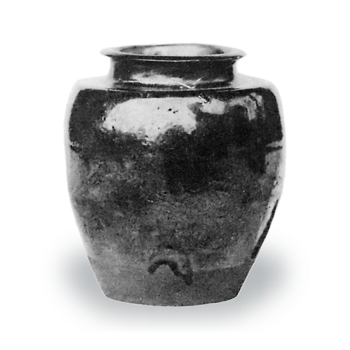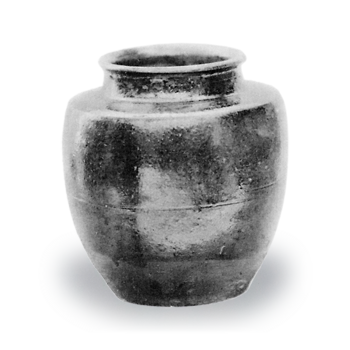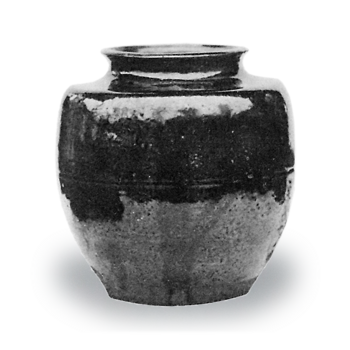
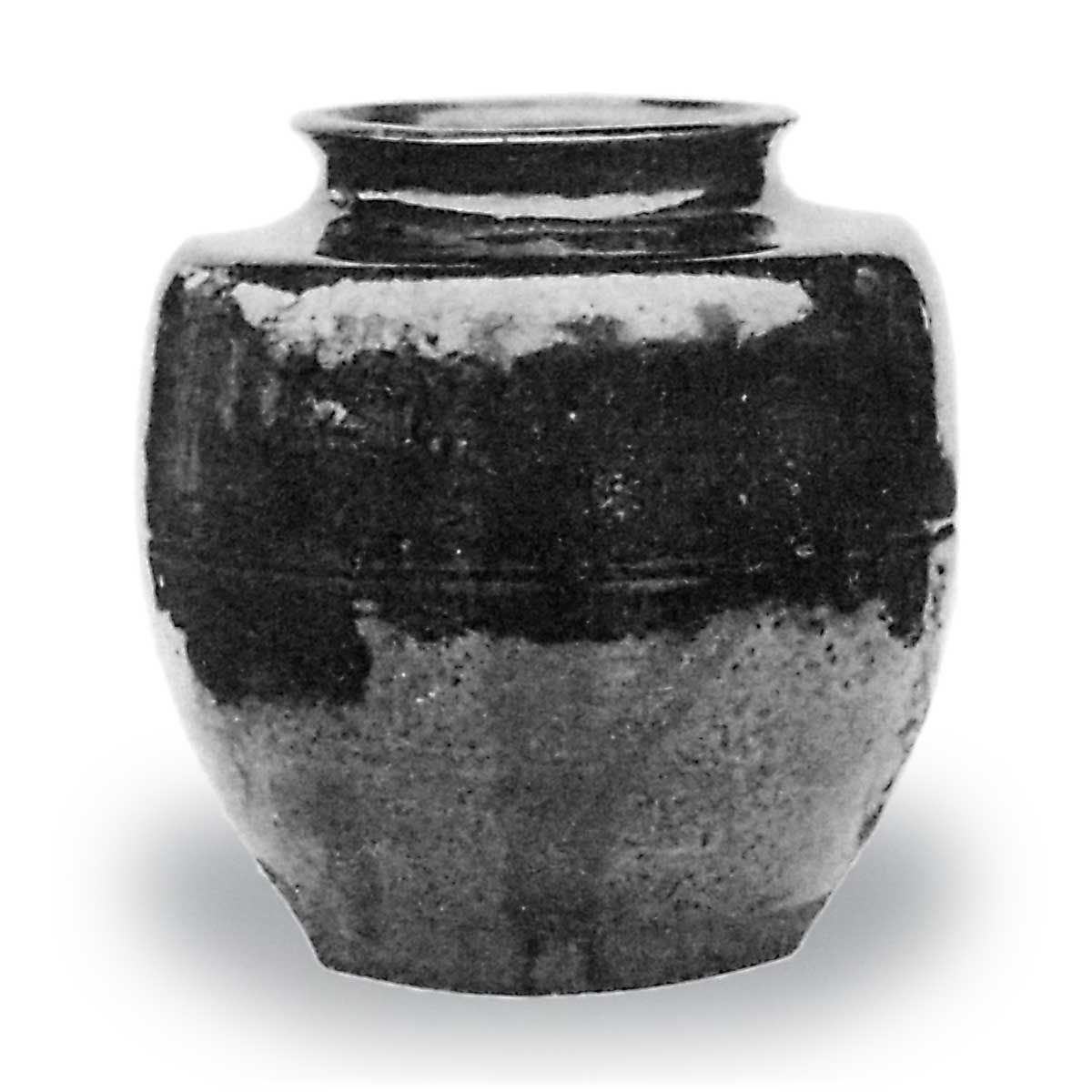
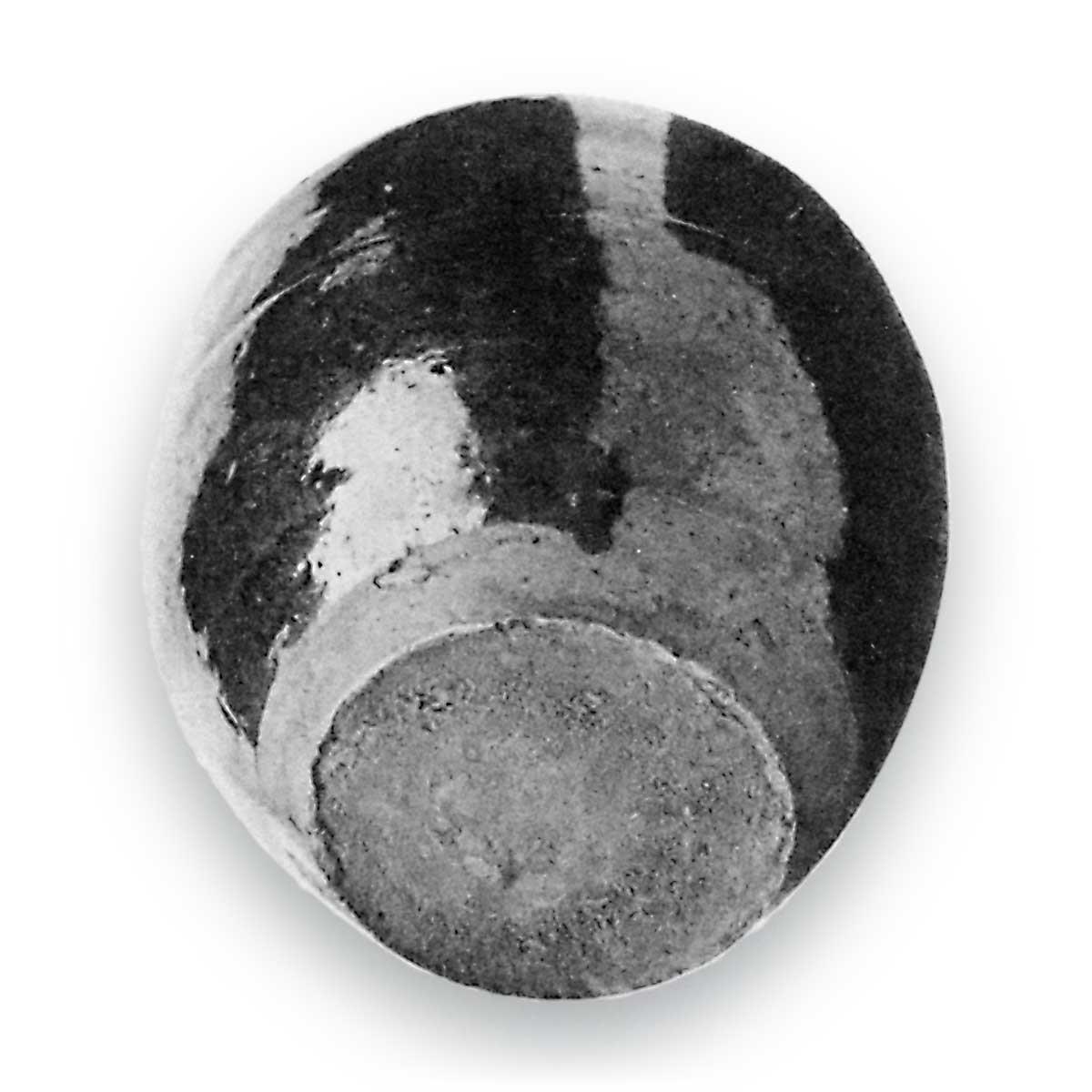
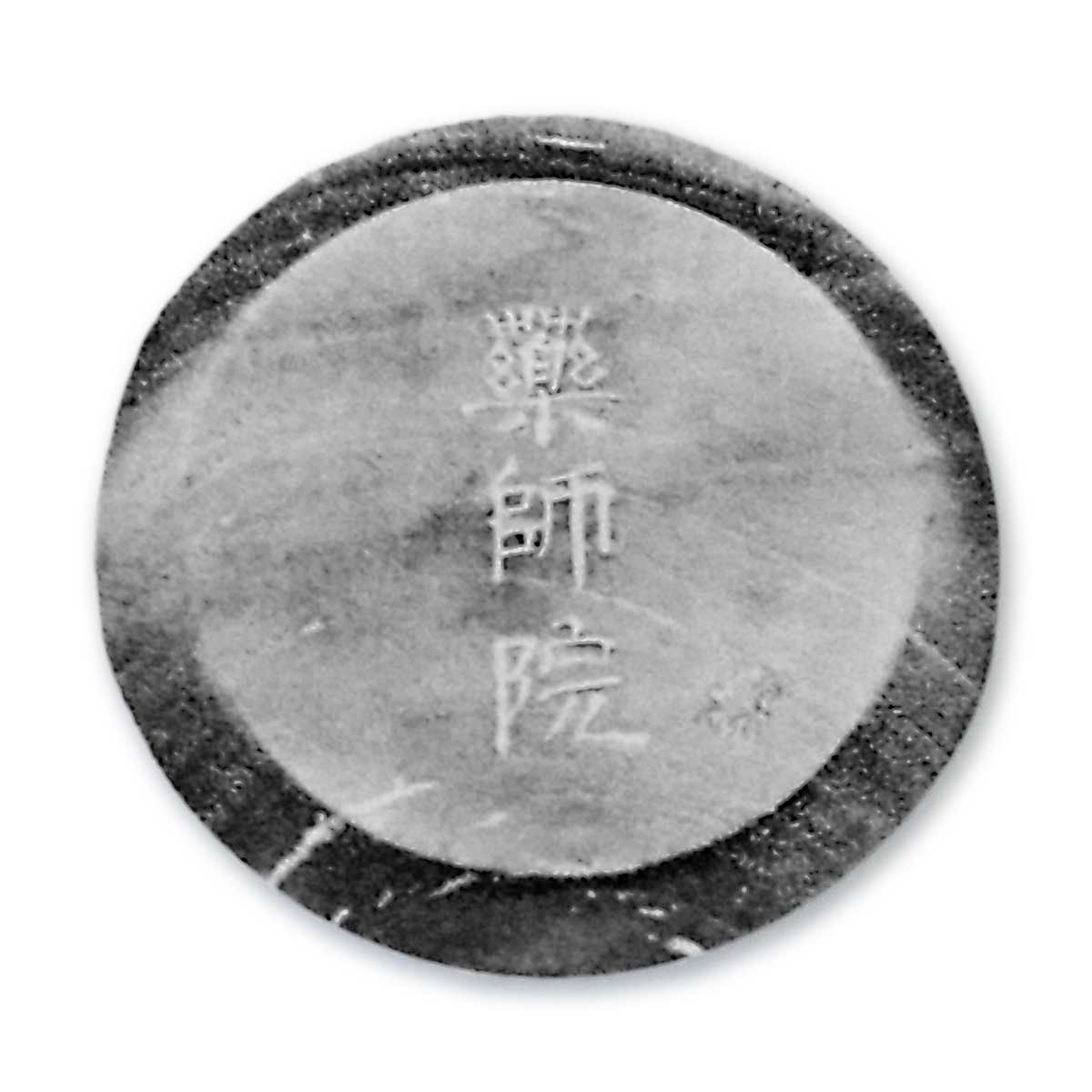
Made in China (Han Dynasty) · Daimeibutsu · Former Name: Hariya Katatsuki · Collection of Viscount Matsudaira Yorikazu
[About the Name]
This name derives from the fact that it was once owned by “Yakushin,” a figure from Sakai. It is also known as the “Yakushiji Katatsuki.” Its former name was “Hariya Katatsuki,” which derives from the fact that a man named “Hariya” in Kyoto owned it before Yakushin acquired it. The Chajin Taikeizu (Comprehensive Genealogy of Tea Masters) states: “Yakushin, a figure from Sakai, once presented a Chinese-made tea caddy (named Komatsushima) to Lord Oda Nobunaga, and also possessed a Chinese-made tea caddy belonging to Hariya. All of these are renowned rarities.” Other historical records (such as the Kobimotsuki and Tsuda Sōyuki’s tea gathering records) also note that this tea caddy passed from Hariya to Yakushin-in.
Regarding the figure “Hariya,” there are no detailed records other than a mention in the Tenshō Meibutsu-ki stating, “It is said to have belonged to Hariya Hikoroku of Kyoto.” “Yakushin-in,” who went by the name Tokunken, was a disciple of the famous tea master Takeno Jōō. He frequently appears in the diaries of Imai Sōkyū and Tsuda Sōyuki. He owned numerous famous tea utensils, including this Yakushin-in Katatsuki, but the exact date of his death is unclear.
[Dimensions]
Height: 2 sun 6 bu
Body diameter: 2 sun 5 bu 5 rin
Mouth diameter: 1 sun 5 bu 5 rin
Base diameter: 1 sun 4 bu 5 rin
Height of the neck: 2 bu 8 rin
Shoulder width: 4 bu
Weight: 33 monme 8 bu
[Accessories]
・Lid: 1 (ivory)
・Storage bag (bag for the tea caddy): White chirimen, with a white cord
・Covers: 2
- Ban-yō-dōshi: Lining is imported mon-ori kaiki (a type of silk fabric), cord is purple
- Cha-ji-zukuri-toko-Kinran: Lining is imported kaiki with a wind pattern, cord is purple
・Box for storing the protective covers: Paulownia wood (with a label affixed reading “Yakushiin Katatsuki with two accompanying pouches, Kinran and Donsu”)
・Hikiya (wooden container): Made of Karin wood, with “Yakushiin” written in gold powder - Pouch for the Hikiya: Dark brown velvet, lined with iridescent silk, with a brown cord
・Outer box: Paulownia wood (with a paper label affixed reading “Yakushiin Katatsuki”)
・Accompanying document: 1 copy
Presented on March 26, 1750 (Kannen 3), along with a hanging scroll by Seisetsu, by Lord Tokugawa Munenori (Daiei-in), the 6th lord of the Kishu Domain.
(Document contents) Among the items listed on the right: celadon kuchiyose (incense burner, etc.), and a tsumizui (water jar)
・Document regarding the tsumizui
・Yakushiin Katatsuki
・Ejin tea bowl
・Tea scoop by Sen no Rikyū (Murui)
・Bronze garuda flower vase
・A bronze flower vase by Aonobu
These 12 items were brought from the Nakayashiki residence by Lord Harusada (His Lordship Kōgon-in), the 9th lord of the Kishū Domain. As they are of great importance, he ordered that they be carefully stored in the treasure repository. The entire set is housed in a nagamochi (storage chest).
July, Hōreki 6 (1756)
[Miscellaneous Notes]
The names of “Haruya Katatsuki” and their owners at the time (such as Haruya Hikoroku of Kyoto and Matsudaira Nagato-no-kami) are also recorded in ancient texts such as the Tenshō Meibutsu-ki and Ganka Meibutsu-ki. The Manpō Zensho includes illustrations along with descriptions of their dimensions at the time and characteristics such as “the clay is bluish-white, and the glaze has both dark and light persimmon-colored areas.”
[From Tsuda Sōyuki’s Tea Ceremony Diary]
・March 22, Eiroku 13 (1570) Morning tea gathering (Hosted by Yakushiin)
A chest was placed in the tokonoma… (omitted) In the hand-washing area, a katatsuki tea caddy was placed on a square tray. The pouch was a moyogi-bag.
This katatsuki has a wide mouth, a thin rim, and a shape that tapers toward the bottom. The quality of the clay and the glaze are both good, but it is slightly on the small side.
I saw this katatsuki for the first time. It has a good shape and looks a little small. The clay is also good. However, the light green glaze has darkened; while it appears to be a good glaze, it has taken on a speckled pattern and is not particularly beautiful. There is a single streak of glaze run, but it is not particularly impressive. The shape seems to curve outward slightly from the waist down, and the base sits a bit too high. There is a single band-like pattern on the body, which is thick and striking. The rim is wide, and the construction appears slightly rough. The twist is weak, and some glaze has run onto the inside of the rim. The shoulders are sloping, and the base appears to have been trimmed away. The glaze run extends all the way to where it meets the base. Overall, it appears rather short, and the widest part is about the size of the Meibutsu “Kitano Katatsuki.” The piece appears to have a slight haze over it, but it is by no means cheap-looking. The bag is Kinran with a pale yellow cord. The lid appeared to be poorly made.
・December 25, Tenshō 5 (1577) Morning Tea Ceremony (Host: Yakushin-in; Guests: Sen no Rikyū, Imai Sōkyū, Yamagami Sōji)
(A description of the tea ceremony’s decorations is recorded. Paintings by Bukei and others were hung, and after the tea was served, a katatsuki placed on a shihō-bon tray was brought out.)
・December 27, 1581
While en route to Kyoto, I met Lord Hashiba Hideyoshi (Lord Hashizuki), and since he was holding a tea ceremony at Ibaraki Castle to unveil the new tea utensils he had recently received, I was invited to attend.
Hanging over the hearth was the “Arare Kama” kettle that Soji Yamagami had received as a gift from His Lordship (Oda Nobunaga), and a painting of sparrows (also a gift) was hung in the tokonoma.
I (Soiku) prepared the tea, placing Yakushiin’s “Haraya Katatsuki” on a square tray, and setting a bamboo tea scoop made by Juko and a Daikaku-ji tenmoku tea bowl on the Amagasaki stand.
・March 18, Tenshō 11 (1583) Afternoon Tea Gathering (Hosted by Tokunken of Yakushiin)
A painting of Daruma (with a colophon by Muju) was hung in the tokonoma. A kanten-style tea caddy was placed on a square tray, and Soiku prepared the tea. The “Shoka” tea caddy, a gift from Lord Chiku (Toyotomi Hideyoshi), was displayed, along with two large tea caddies and a tenmoku tea bowl with a gray glaze. (From Tsuda Soiku’s Tea Ceremony Diary)
・January 11, Tenshō 15 (1587) Morning Tea Gathering (Hosted by Hashiba Mino-no-kami)
The guests were Sōyuki and Sōtan.
(Details of the tea room’s decorations are recorded, and among them, a “Haraya katatsuki” was used.)
This katatsuki is about 2.2 to 2.3 sun in height, and the base of the clay appears to have been scraped away. It is flat like a single character and forms a rim. The clay has both blue-black and red sections and is of very high quality. The body is rounded, with an unglazed section about 3 sun in length. The lines around the rim are distinct and vivid; the glaze on the upper part is blackish, with a single glaze run. (From Sotan’s Diary)
[Records of Owners from Other Sources]
The Daimeibutsu Naibetsuchō and Tenshō Meibutsu-ki record it as “in the possession of Yakushi-in in Sakai,” while the Chaki Meibutsu-shū and Yamagami Sōji-ki record it as “in the possession of Lord Toyotomi Hidenaga of Yamato-Koriyama.”
Later sources (such as the Komeibutsu) summarize its history: after Toyotomi Hidenaga, it passed to Ikeda Musashino-no-kami (Terumasa), then to Matsudaira Shintaro (Ikeda Mitsumasa), and in Genroku 10 (1697), it was bestowed by Lord Tokugawa Tsunayoshi upon the Kishu Tokugawa family, becoming the property of Kishu.
According to the Kansei Shoshu Shokafu, this tea caddy was presented by Toyotomi Hideyori to Ikeda Terumasa in 1591 (Tenshō 19). Subsequently, in 1629 (Kan’ei 6), it was bestowed by the second shogun, Hidetada (Taito-den), upon Ikeda Mitsumasa (Matsudaira Shintarō). Mitsumasa served as the lord of the Okayama domain, and upon his retirement in Kanbun 12 (1672), he returned this “Yakushiji Katatsuki” (or “Yakushin-in Katatsuki”) tea caddy, along with the famous sword “Masamune,” to the Shogunate as a token of gratitude. He also presented a manuscript copy of the Kokin Wakashū (written in the Heikō style) to the shogun’s principal consort (Odaiko). (From Gyokuro Sō)
[Records of Use by the Shogun’s Family]
After being presented to the shogunate by the Ikeda family, it was frequently used at tea ceremonies held by the shogun’s family.
・August 13, Enpō 2 (1674)
The “Yakushin-in” tea caddy was used at a tea gathering where food and tea were served to Nagai Iga-no-kami. (From Sakurayama Ichiyu Nikki)
・March 26, Enpō 4 (1676) At the Kuro-shōin
When tea was served to the Chūnagon of Owari, the “Yakushin-in” tea caddy was prepared as a spare set of tea utensils (kae-godo). (From Tokugawa-ke Ocha-kai no Ki)
・April 11, 1677 (Enpō 5) At the Kuro Shōin
When tea was served to the Lord of the Mito Domain (the Prime Minister), the “Yakushin-in” tea caddy was also prepared as a spare set of utensils. (From Tokugawa-ke Ocha-kai no Ki)
[Bestowal to the Kishu Tokugawa Family]
The name of the tea caddy bestowed upon Tokugawa Mitsusada (pen name: Taizan), the second lord of the Kishu Domain, by the Shogun is “Yakushin-in.” When he first served tea to his vassals using this caddy, Sen Sōsa of the Omotesenke school was in charge of the tea ceremony.
On that occasion, Lord Mitsusada is said to have remarked, “Sōsa, you should also have a look at this tea caddy.” After the tea ceremony was completed, the caddy was displayed in the tokonoma, and Sōsa joined the senior retainers at the lowest seat to view it. (From Kanya Chawa by Ii Naosuke)
On April 11, 1698 (Genroku 11), when the Shogun (Tsunayoshi) paid a visit to the Kishu Domain residence, the “Yakushiin Tea Caddy (valued at 3,000 pieces of silver)” was presented to the Kii Daikan as a gift, along with swords and gold and silver items. (From Godaidai-ki by Toda Shosui)
[History of Transmission]
[Summary of Transmission]
Originally owned by Hariya Hikoroku of Kyoto, it was called the “Hariya Katatsuki.” It later passed to Yakushin-in Tokunken of Sakai and came to be known as the “Yakushin-in Katatsuki.” It is clear from the aforementioned tea ceremony records that it was actually used at tea gatherings hosted by Yakushin-in during the Eiroku to Tenshō periods. It appears that it was subsequently presented by Yakushiin to Toyotomi Hidenaga (Daidaijin of Yamato), and records such as the Yamagami Sōji Ki note that Lord Hidenaga possessed it.
On the other hand, the Kansei Shūshū Shokafu contains a record stating that it was given by Toyotomi Hideyori to Ikeda Terumasa in Tenshō 19 (1591). Although there is a difference between “Hidenaga” and “Hidetsugu,” there is no doubt that Ikeda Terumasa acquired it. It is believed that it was subsequently presented to the shogunate by the Ikeda family, and in 1629 (Kan’ei 6), it was bestowed again by Shogun Iemitsu upon Ikeda Terumasa; however, when Terumasa retired in 1672 (Kanbun 12), it was returned to the shogunate.
From that point on, it became a treasure of the Shogun’s household (Ryūei) and was frequently used at Shogunate tea ceremonies during the Enpō era. In Genroku 11 (1698), when Shogun Tsunayoshi visited the Kishū Domain residence, he personally bestowed this tea caddy upon Tokugawa Mitsusada, the lord of the Kishū Domain. Later, in 1750 (Kanen 3), it was transferred from Tokugawa Munenori, the 6th lord of the Kishu Domain, to the Matsudaira family of the Iyo Saijo Domain, a branch family. The Saijo Matsudaira family was originally a small domain established when Yorizumi, the second son of Yorinobu (the first lord of the Kishu Domain), branched off from the main line. When the branch family was established, Yorinobu reportedly said, “While the main family will likely remain secure, a small branch family may face financial difficulties in the future, so set aside as many Meibutsu as possible as a precaution,” and handed over an entire collection from the treasure vault. Consequently, it is said that although the Saijo Matsudaira family was a small domain, it came to possess numerous magnificent Meibutsu, including paintings by Bokei.
[Record of Viewing the Actual Object (Field Notes)]
On October 23, 1919 (Taisho 8), I viewed the actual object at the residence of Viscount Matsudaira Yorikazu in Iikura Katamachi, Azabu Ward, Tokyo.
The rim features a folded edge and is thin and pointed. A black amber-colored glaze is applied unevenly over a purple base, and the shoulder rim features a persimmon-colored glaze pattern in the shape of a leaf. The glaze flows down widely from the shoulder tip, narrowing as it descends and stopping at the rim of the base. A slightly blue-green hue is visible where the glaze has pooled. The entire shoulder is covered in a thick layer of black amber glaze, and a single thin line runs all the way around the body. From the lower rim down, the grayish-brown clay is visible, and the base is flat and slightly tapered. Inside, glaze covers the rim of the mouth, and there is a single cascade of glaze that reaches all the way to the edge of the base. For a teapot of this type, it has a somewhat compact shape; it is completely free of flaws, and both its form and appearance are superb, making it a masterpiece truly worthy of being called perfect.