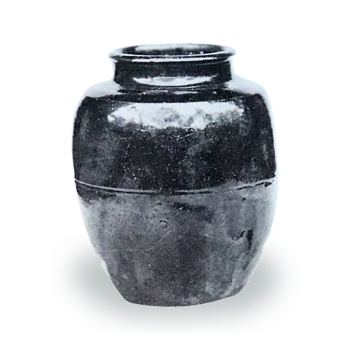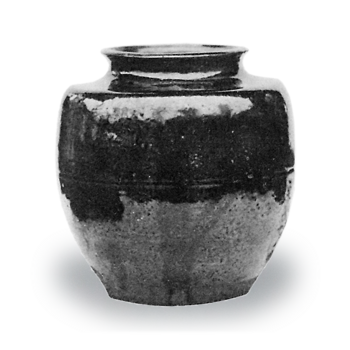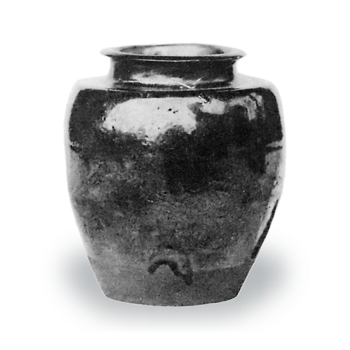
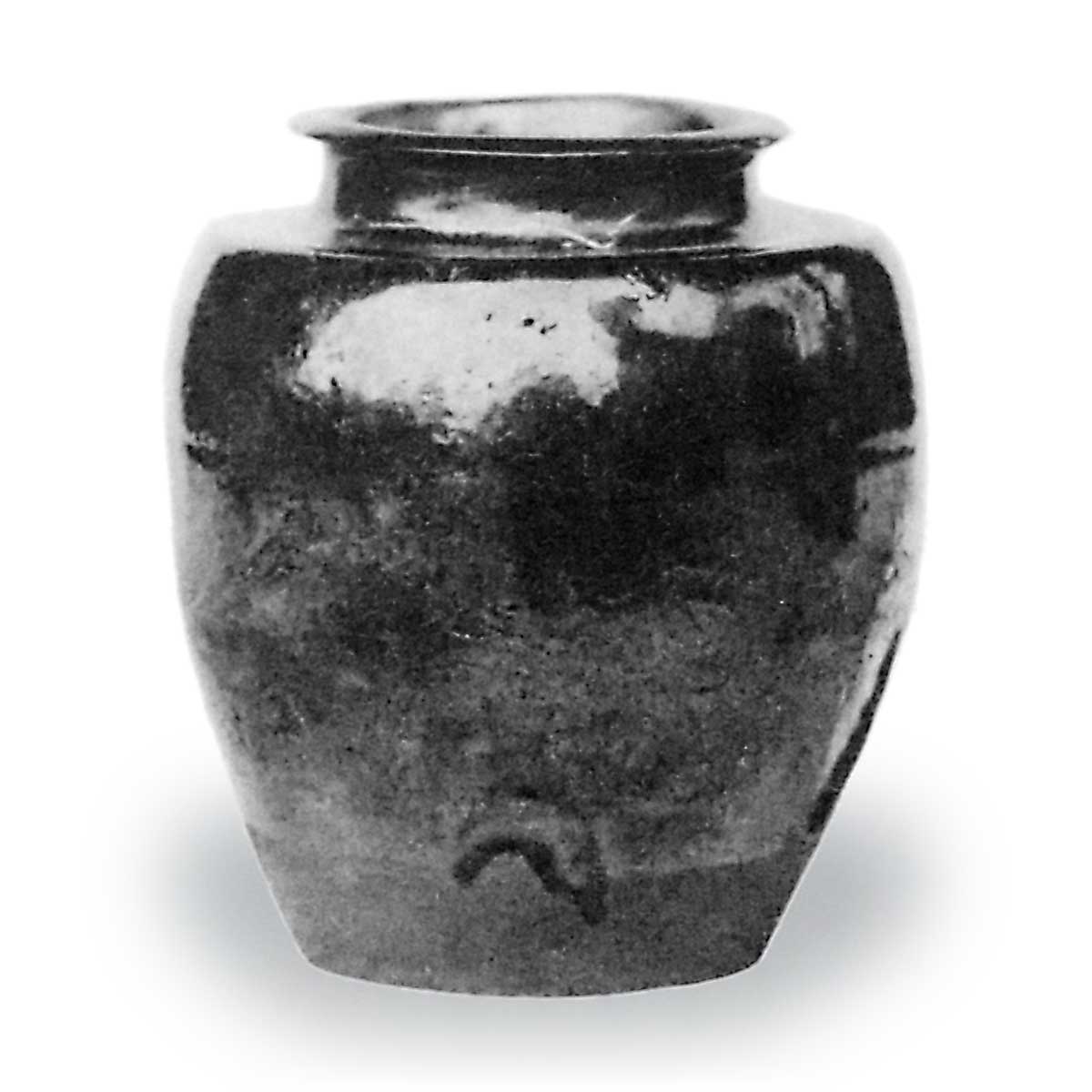
Made in China (Han Dynasty) | Daimeibutsu | Collection of Baron Konoike Zen’emon
[Regarding the Name]
The name “Miso-ya” is believed to be the trade name of a former owner, but details such as the era or address are unknown. This tea caddy is also known as the “Einin Katatsuki.” This is because it was once owned by a man named Kameya Einin. The name “Einin” is written as Ennin, Ennin, Einin, or Einin in various historical texts, and it is unclear which spelling is correct.
[Dimensions]
Height: 2 sun 6 bu
Body diameter: 2 sun 3 bu 5 rin
Mouth diameter: 1 sun 5 bu
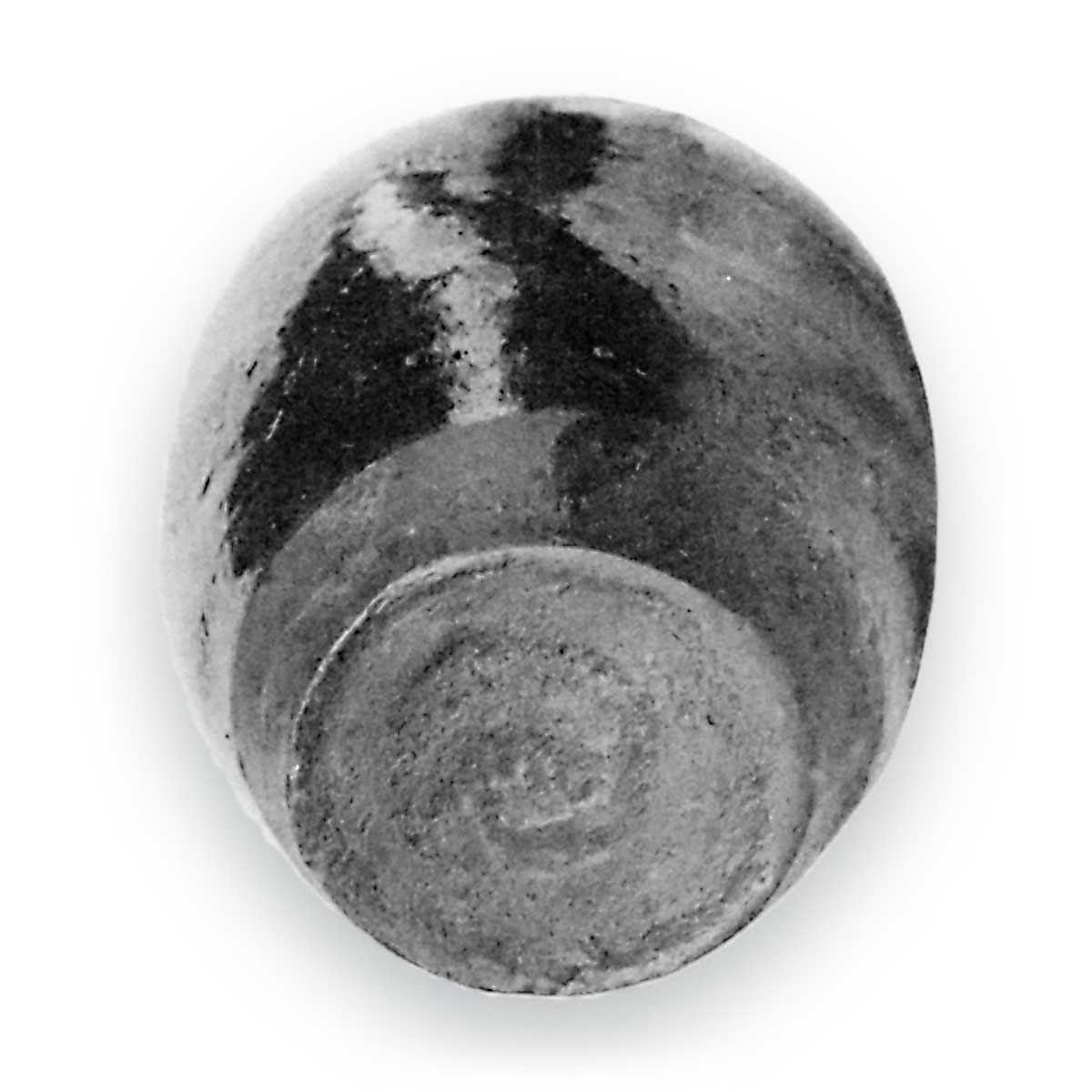
Base diameter: 1 sun 4 bu or 1 sun 5 bu
Shoulder width: 2 sun 7 rin
Height of the rim (the raised edge of the mouth): 3 rin
Weight: 32 monme 2 bu
[Accessories]
・Lid: 1 (ivory)
・Omonobukuro (bag for the tea caddy): White chirimen (crepe silk), with a purple cord
・Shifuku (wrapping bags for the tea caddy): 4 (plus 1 cushion)
- Wavy-patterned treasure-motif satin: Lining in iridescent green, cord in wisteria purple
- Dark blue-ground bamboo-vine satin: Lining in iridescent green, cord in wisteria purple
- Yazaemon Koto: Lining in iridescent green, cord in brown
- White-painted satin: Lining in iridescent green, cord in wisteria purple
・Wooden mold 1 (made of rosewood)
・Box for the cover: Unfinished paulownia wood (with a label reading “Ennin Katatsuki-bukuro”)
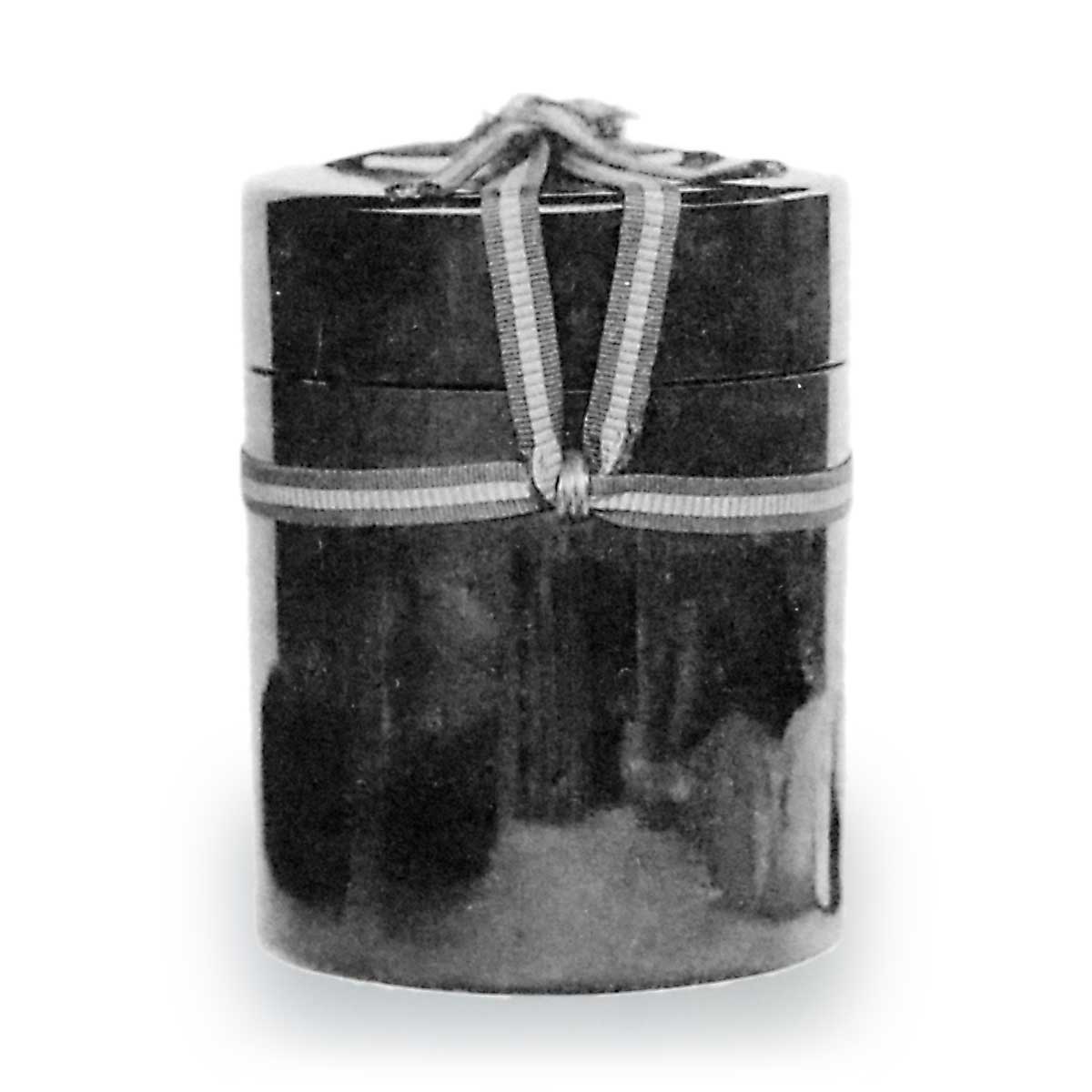
・Hikiya (wooden container for storing the tea caddy): Black lacquered, with a cord
・Inner box: Imported moiré fabric, with a lock; interior lined with brocade featuring a family crest
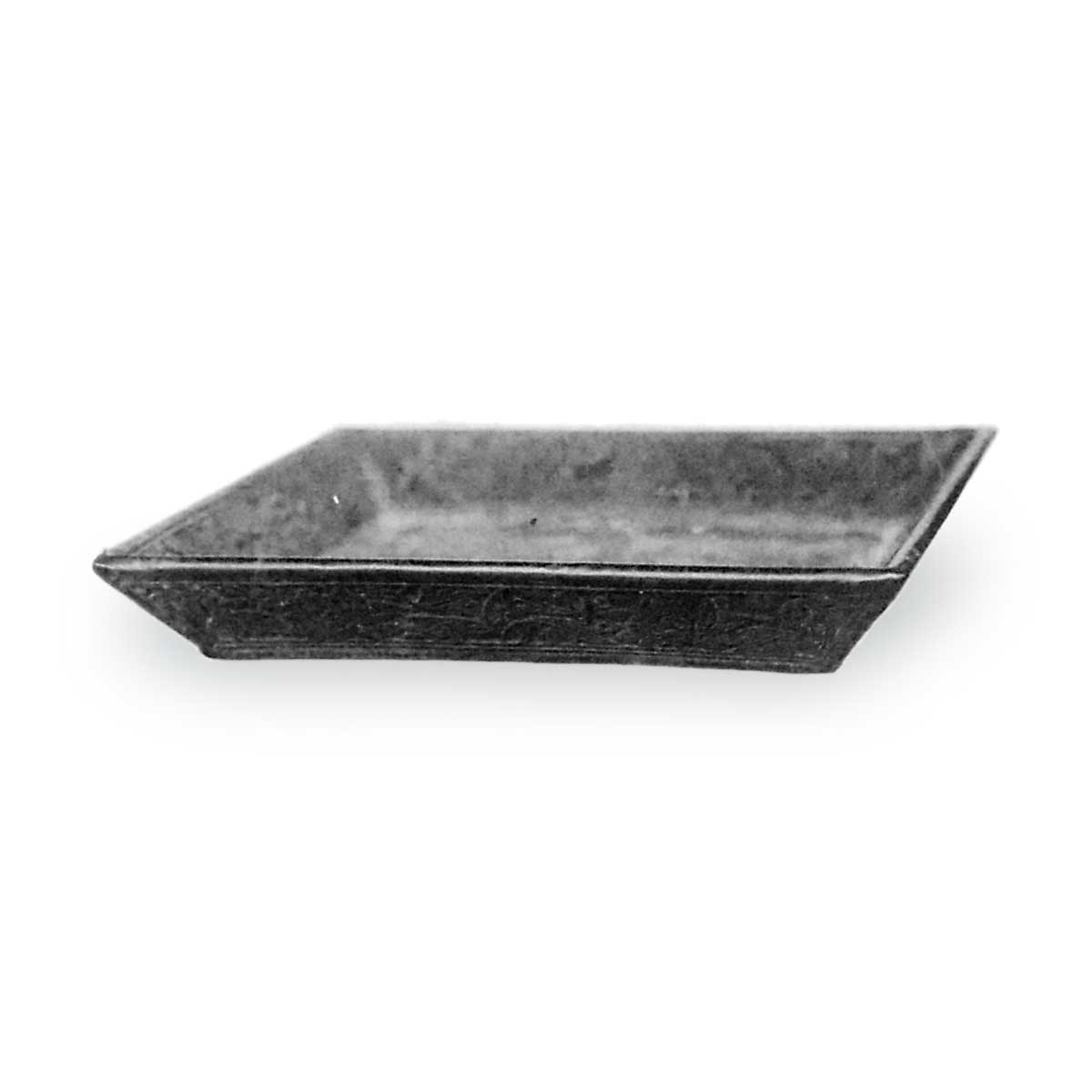
・Accompanying tray: Square tray made by Keishō (dimensions: approx. 6.3 inches square), housed in a zelkova wood box
[Miscellaneous Notes]
Regarding the “Miso-ya Katatsuki.” Itoya Shigezaemon lived in Karasuma Sanjo, Kyoto, and he, too, possessed numerous fine tea utensils. Among them, it is said that he purchased this Miso-ya Katatsuki tea caddy from a certain Kameya for 1,000 gold coins (a vast sum), and paid for it by loading the equivalent amount of silver onto a cart. Even for such a wealthy man, I hear that his family line died out after three generations. This makes one reflect on the terrifying nature of wealthy tea masters (sukishya). (From Chawa Shin’ō)
Itoya Jūemon was originally from Tsuruga Port in Echizen Province (Fukui Prefecture), where he ran a rice wholesaling business. He achieved success every year in the trade of rice shipped to Osaka and later settled in the Karasuma Sanjo-sagaru district of Kyoto. About 70 or 80 years ago, around the same time as Ishikawa Jian, his loans (exchange transactions) to the daimyo of the Western Provinces went into default. After that, he moved to Kyoto and secluded himself in Juraku, and by the time of the third generation, he had gone missing and lost his fortune. The second-generation head, Jūemon, collected and owned numerous fine tea utensils. Among them was a tea caddy known as “Miso-ya Katatsuki” by a certain Kameya. It is said that he purchased this for a vast sum—a thousand large gold coins—and that he loaded the payment onto a cart, paraded it down the street in broad daylight, and completed the transaction. (From Chōnin Kōkenroku by Mitsui Takafusa)
The “Miso-ya Katatsuki” is also known as “Ejin.” It was originally owned by a miso merchant and was later presented to the Edo Shogunate. Subsequently, it was bestowed by Lord Tokugawa Hidetada (Daito-ko) upon Kameya Gentaro. From then on, it was treasured by the Kameya Ejin family for generations, but it later passed into the hands of Itoya Ryozai of Kyoto and is currently in the possession of the Konoike family. (From Sekken-so)
Regarding the “Ennin Katatsuki” (also written as Ennin or Eijin) and the “Hino Katatsuki,” it is said that Hosokawa Sansai-ro remarked that they were tea caddies of very poor quality. (From Sansai Monogatari)
Furthermore, ancient texts such as Ganka Meibutsu, Komeibutsu, Rinbōkiryū, Kōnoike Zōchō, and Chaki Meibutsu Zui also record the succession of owners of this tea caddy (including Kato Fuan, Itoya Ryotei, and Kōnoike) as well as details regarding its accessories, such as the pouch and box.
[Regarding Its History]
It was originally owned by a certain miso merchant and was later presented to the shogunate. The second shogun, Tokugawa Hidetada, gave it to Kameya Gentaro (who went by the name Eiji), but it is said that Itoya Shigezaemon Ryosai (believed to be the same person as Ryotei), a wealthy merchant in Kyoto, purchased it for 1,000 gold coins. While the text Chawa Shin’ō suggests it passed directly from Kameya to Itoya, Kobimotsuki and Rinbōkiryū indicate that there was a period during which a man named Kato Fuan held it. It is unclear exactly when it subsequently came into the possession of the Konoike family.
[Record of Viewing the Actual Object (Jitsukenki)]
On May 4, 1920 (Taisho 9), I viewed the actual object at the villa of Baron Konoike Zen’emon in Kawara-yabashi, Minami Ward, Osaka City.
The rim is deeply flared, with an edge as sharp as a clam shell, so thin it seems it might cut one’s hand. The shoulder line protrudes sharply; the middle of the body bulges slightly, while the lower section is slightly indented. There are traces of repairs to a large crack extending from the rim to the neck (koshiki). Within the black, amber-colored glaze, a dark pattern of the same hue can be seen. While the traces of glaze runoff are not distinct, glaze has pooled at the boundary where the unglazed clay is visible at the rim. A faint, single groove runs around the body, and there are finger-like marks in places. Below the rim, reddish-brown clay is visible; the base is flat, and the rim is slightly worn. Inside, glaze covers the rim of the mouth, and below that, there are faint traces of the potter’s wheel, though they are not distinct. As a Chinese teapot, it possesses a very austere and wabi-sabi aesthetic (daijaku-mono), and with features such as its tapered body, it is a teapot with unique characteristics.