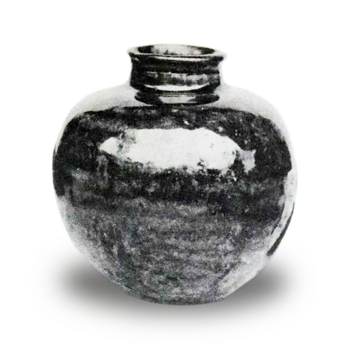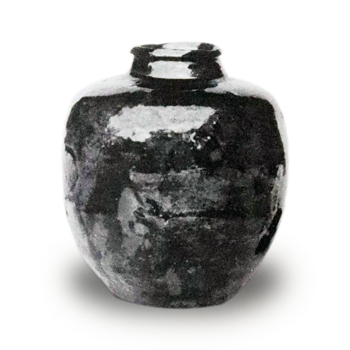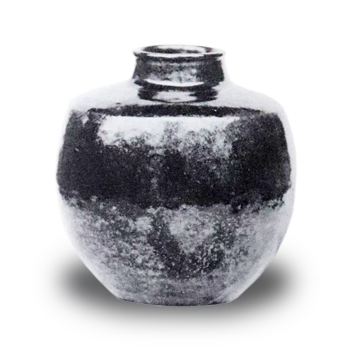


Made in China; Collection of Count Atsushi Matsuura
Origin of the Name
The exact origin of the name “Uji” is unclear, but since the lid of the accompanying tray box bears the inscription “Uchi Bunrin no Hon” (The Book of Uchi Bunrin) in Sen no Rikyū’s handwriting, it is believed to have already been famous during Rikyū’s time. It was likely named after the place name “Uji.”
Dimensions (converted using 1 sun ≈ 3.03 cm and 1 monme ≈ 3.75 g)
Height: Approx. 6.82 cm (2 sun 2 bu 5 rin)
Body diameter: Approx. 6.67 cm (2 sun 2 bu)
Mouth diameter: approx. 2.67 cm (8 bu 8 rin)
Base diameter: approx. 3.33 cm (1 sun 1 bu)
Koshiki (rim) height: approx. 0.82 cm (2 bu 7 rin)
Shoulder width: approx. 1.67 cm (5 bu 5 rin)
Weight: approx. 84.38 g (22 monme 5 bu)
Accessories
・Lids: 3 (all feature a “recess”)
Half-moon lid (in the style of Furuta Oribe)
Lid with beaded rim (in the style of Kobori Enshu)
Lid with chamfered edges and a turtle-shell rim (in the style of Katagiri Sekishu)
・Carrying pouch: Brown ha-ni-bi silk, with white cord
・Storage pouches: 5
Kinran on a light green ground, Higashiyama-style fabric (lining: Kabe-dai, cord: purple): Matsuura Tadamichi style
Light green ground with bamboo vine pattern (lining: mon-patterned Kaiki, cord: purple): Matsuura Tadamichi style
Upper willow, seven-star, and dragon pattern (lining: grayish-brown Kaiki, cord: light green): Furuta Oribe style
Song Dynasty satin (lining: yellow twill weave, cord: light brown): Kobori Enshu style
Guangdong weave (Ito-style) (lining: brown kaiki, cord: purple): Katagiri Sekishu style
・Hikiya (tea caddy case): Made of rosewood
Old pouch: Shu-ren (lining: cloud-patterned satin, cord: brown)
New pouch: White-ground floral and leaf pattern Fursu (lining: brown-ground treasure-motif satin, cord: brown)
・Inner box: Oak with Shunkei lacquer finish
・Outer box: Unfinished paulownia wood. The words “Uji Bunrin Tea Caddy” are inscribed along the grain of the wood.
The inscription on the underside of the outer box lid is as follows:
・Uji Bunrin Tea Caddy: One
Price: 100 gold pieces
In the style of Kobori Enshu
・A lid without color, featuring a beaded border
The pouch is made of light blue satin with a circular lion pattern
In the style of Lord Furuta Oribe
・A colored lid featuring a half-moon pattern on the rim
The pouch features a circular pattern of plum blossoms and dragons
In the style of Katagiri Sekishu
・A colored lid with chamfered edges
The pouch is made of Guangdong-woven fabric with horizontal stripes
Two pouches in the style of (Matsuura Tadanobu)
・A lid with circular stripes
The pouch features a bamboo vine pattern, as well as a pale green ground with Kinran
Sent from Honjo in the 11th month of the Year of the Dog
・Accompanying tray: Green-glazed lacquer, interior vermilion, base black
Dimensions: Approximately 19.39 cm (6 sun 4 bu) or slightly over, or approximately 19.70 cm (6 sun 5 bu). Base dimensions are the same. Rim width is approximately 0.61 cm (2 bu).
・Box for the accompanying tray: Paulownia wood with Shunkei lacquer finish. Includes an inscription in the handwriting of Sen no Rikyū.
“Uchi Furin no Hon”
・Accompanying Letters: 3 letters (with an authentication certificate by the calligraphy expert Ryōchū)
(Omitted) As stated on the underside of the lid of the outer box mentioned above.
A Wakasa tray, a celadon incense burner, a calligraphy scroll of a poem by Fujiwara no Yukinari, etc.
Please kindly accept the items listed above. That is all.
April 6, Year of the Sheep (Hitsuji) Makabe Naokura (Seal)
To Lord Toyoda Kanamono
(Note) Toyoda Kanamono was a retainer of the Matsuura family.
This letter is a receipt received from Fujibayashi Suketoki (pen name: Sogen), a retainer of the Katagiri family, at the time of payment for a Uji Bunrin tea caddy acquired from Lord Katagiri Sekishu (Governor of Iwami). Regarding this, there is a handwritten note by Lord Matsuura Seizan (author of Kōshi Yawa). In September of Bunsei 7 (1824), Lord Matsuura Jūki, Lord Seizan’s son, personally delivered it with the instruction to “attach it to the Uji Bunrin tea caddy,” and it was placed there accordingly.
A single letter is also attached.
The document on the right concerns the payment for the tea utensils; it is a letter submitted by Kawachiya Kihei in the 6th year of Tenmei (1786).
September, the 7th year of Bunsei (1824) Okabe
Memorandum
- The 700 koban are payment for the Uji Bunrin tea caddy.
I have indeed received this payment, which was made as a token of gratitude when it was presented by Iwami-no-kami (Katagiri Sekishū) to Lord Matsuura Tadamichi of Hizen Province. I submit this as proof of receipt (promissory note).
October 10, 1673 (Kanbun 13), Year of the Rat: Fujibayashi Suketoshi (Seal and Signature)
To Lord Kumazawa Kazuma
The note written on the paper wrapping the document above reads as follows:
“Utensils presented to Hirado (the Matsuura family): Uji Bunrin”
Miscellaneous Notes
Among the items passed down in my family, there are several that I particularly treasure and keep in my private collection, and among them is one known as “Uji Bunrin.” I was not originally well-versed in the tea ceremony, and I had simply regarded this vessel as a family heirloom. However, in the sixth year of the Kansei era (1794), I discovered an old document in an ancient chest used to manage the tea room. Upon examining it, I learned that this vessel had been bestowed upon Tenshōin (Lord Matsuura Tadamichi) by the former tea master Katagiri Sekishū (given name Sadamasa, Buddhist name Sōkan). The document reads as follows: (omitted. Content of the aforementioned receipt by Fujibayashi Sukekatsu). This Fujibayashi was a senior retainer of the Katagiri family who later took the name Sōgen and mastered the profound secrets of the tea ceremony. In accordance with Katagiri Sekishū’s last will, Lord Tenshōin (Matsuura Tadamichi) received instruction in the essence of the tea ceremony from this Sōgen. According to the book Chajin Kaōsō, “He held the rank of Junior Fifth Rank, Lower Grade, and the post of Governor of Iwami; his pen name was Sōkan. He was the son of Shuzenshō Sadataka. He studied the tea ceremony under Sen no Rikyū and Kuwayama Sōsen,
After Kobori Enshū’s death, the three families of Taga Sakon, Funakoshi Yoshikatsu, and Katagiri Sadamasa were referred to as the ‘Three Masters’ of the tea ceremony. In November of Kanbun 5 (1665), he served tea to Shogun Tokugawa Ietsuna (Ganyu-in), and he passed away on November 20, Enpō 1 (1673). He was buried at Kōrin-in in Ueno, where a memorial tablet is enshrined, inscribed with the words ‘Sanjaku Sōkan Kōji’.”
According to this, Katagiri Sekishū passed away in November (mid-winter) of Enpō 1 (the Year of the Water Ox), and this tea caddy was presented to him in early winter of the previous year, the Year of the Water Rat (Kanbun 12). The reference to “Kanbun 13” in the original document is likely a typographical error or a mistake made during transcription. Considering that it is recorded as the Year of the Rat, the correct date should be Kanbun 12 (1672).
Just how significant is this “Bunrin” as a tea utensil? I lack knowledge of antique tea utensils, so I cannot say. Therefore, I consulted several tea books I have on hand, and first, Chatō Shūshō states the following (omitted).
“Bunrin refers to pieces coated with a glaze that has a ‘snake and scorpion’ (dakatsu: glaze shrinkage) pattern. Some are round pots with distinctive features. There is a slight difference between the shape known as ‘shiribukura’ and Bunrin, and they can be distinguished by the shape of the rim. There is what is called a ‘Bunrin rim,’ which is a rim that tapers inward from the edge of the neck, much like the rim of a Seikō pot. The base also features a rounded thread-cut edge, rather than the standard straight cut, resembling a scroll of characters. Even if the overall shape is unusual, if the rim is formed as shown on the right and the base bears marks resembling a scroll of characters, and the rim is visible, it is called Bunrin. Therefore, “Bunrin” means “the ring of the pattern.”
Furthermore, looking at the items listed in the Meibutsu Dogushu (Collection of Famous Tea Utensils), the first is
・Imperial Tea Caddy: Jukō Bunrin
Furthermore, the following items are listed as small Chinese-made pots:
・Kii-dono: Tamagaki Bunrin
・Mito-dono: Mokko Bunrin
・Sakai Kawachi-no-kami-dono: Bunrin
・Koide Ise-no-kami-dono: Bunrin
・Nagai Shinano-no-kami-dono: Bunrin
・Granted to Itakura Shūno-no-kami-dono: Karasui Bunrin
・Granted to Lord Hotta of Kaga: Kuki-Bunrin
・Matsudaira Uemon-no-suke’s collection: Hakata-Bunrin
・Kato Fu-an’s collection: Tomoya-Bunrin
・Nakai Yamato’s collection: Honno-ji-Bunrin
・Hasegawa Saburobei’s collection: Hamuro-Bunrin
・Kyomaru-ya Rinsai’s collection: Maruya-Bunrin
・The same, owned by Daimonjiya Sōi: Bunrin
As you can see, there are several types of Bunrin. Just how significant is the “Uji Bunrin” that I have inherited through generations? Considering that it was presented by Sōkan Kōji (Katagiri Sekishū) and received by Lord Tenshōin (Lord Matsuura Tadamichi), it surely cannot be a common, ordinary item (omitted below).
(Excerpt from Kōshi Yawa Zokuhen by Lord Matsuura Seizan)
Uji Bunrin. As stated in the accompanying letter, this tea caddy was a treasured possession of Katagiri Iwami-no-kami Sadamasa (Sōkan), whom Lord Tenshō (Matsuura Tadamichi) revered as his teacher; Lord Tenshō requested and received it from him. Fujibayashi was a senior retainer of the Katagiri family and a master of the tea ceremony, while Kumazawa was a steward of the Matsuura family. One can only imagine how highly prized this item was. For this reason, this tea caddy was traditionally kept in the custody of the stewards as a “gifted item,” and was only taken out of its box once a year for airing out and maintenance. Descendants should cherish it forever and preserve it as a treasure.
(From The Matsura Count Family Inventory)
Uji Bunrin. A tea caddy made in China. The lids include two in the style preferred by Matsura Tadamichi, and three each in the styles preferred by Furuta Oribe, Kobori Enshu, and Katagiri Sekishu. The accompanying tray is a Chinese square tray measuring approximately 19.39 cm on each side, with a blue lacquered rim, a vermilion-lacquered interior, and a black-lacquered bottom.
The nine characters “Uchi Bunrin no Hon” on the paper label affixed to the box are in the handwriting of Sen no Rikyū. It was passed down to Matsuura Tadamichi by his teacher, Katagiri Sekishū, and is accompanied by a letter from Fujibayashi Sukenoki, a senior retainer of the Katagiri family, addressed to Kumazawa Kazuma, a steward of the Matsuura family. (Photo of the tea caddy available)
(From the entry on “Tea Caddy” in the Encyclopedia of Japan)
November 16, 1902 (Meiji 35), Noon: The 77th gathering of the Shingetsuan Hyakukai
Host: Matsuura Sen
Guests: Tōkyū Tōki, Ikeda Kenzai, Ishimura Kyōzō, Kuwahara Heishichi, Seki Tokiko
Almond-shaped alcove decoration: An autograph by the 5th Shogun, Tokugawa Tsunayoshi (copied by Matsuura Tadanobu)
“The winds and clouds tend to fade as they approach humanity, and the years and months are hard to turn back once they have passed into old age.”
・Flower Vase: Single-layered cut (bamboo vase), with burn marks; made by Kan’ō; inscribed “Matsuura.” Flowers: White camellia.
“I once rowed out into the misty waters off Matsuura and saw spring all the way to Tang (China).”
・Tea Jar: Uji Bunrin (made in China). Acquired by Matsuura Tadamichi from Katagiri Sekishū.
Pouch: Of the six pouches, one made of Song Dynasty satin is used.
・Tea Bowl: Haku-an style. The inner box bears the inscription of Furuta Oribe, and the outer box bears that of Kobori Enshu (Sohu).
(From Kokon Chado Shu, co-edited by Yamamoto Bakei and Kimata Sōgi)
History
In the year 1672 (Kanbun 12), the Year of the Rat (Mizunoe-ne), Tenshōin (Matsuura Sadanobu) acquired this item from his tea master, Katagiri Iwami-no-kami Sadamasa (Sekishū), for 700 ryō in gold coins. It is the most important treasure in the Matsuura family.
Record of Actual Viewing
On November 26, 1919 (Taisho 8), I had the privilege of viewing this piece in person at the residence of Count Atsushi Matsuura in Mukoyanagihara-cho, Asakusa Ward, Tokyo.
The body is slender and well-proportioned, with an extremely finely crafted beaded rim. The neck protrudes slightly, and the shoulders are also broad. Within the overall amber-colored glaze, a deeper glaze of the same hue flows down broadly from the tips of the shoulders and merges with it, forming a single streak near the base where it meets the tray, revealing a blue-green color in the areas where the glaze has pooled. Additionally, around the neck, there are three bands of blue-green glaze within the amber-colored glaze, though some parts are interrupted or lack clarity.
Overall, the glaze has a high luster, and the patterns are also interesting. Compared to ordinary Bunrin tea caddies, the shape is unusual (peculiar) due to the significantly flared shoulders. Glaze covers the entire tea caddy, with only the base revealing the grayish-brown clay. The glaze line at the base changes direction in places, resembling rolled-back ripples, and the pattern is extremely distinct. In the center of this, there is a long, horizontal chip in the clay that resembles a leaf eaten by insects.
It is of an ancient period, features numerous decorative elements, possesses a distinctive artistic style, and is crafted with unparalleled precision. Inside, the glaze covers the rim of the bowl, while the area below it reveals wheel marks that converge into a tomoe (swastika) pattern at the center of the base.
Accompanying Tray
A Wakasa shihō-bon (square tray). The interior is lacquered in vermilion, the rim in blue lacquer, and the underside in black lacquer. It features a shape uncommon for Wakasa trays, and the storage box is finished in Shunkei-nuri lacquer. A piece of paper bearing the inscription “Uchifunrin no Hon” is affixed to the lid of the tray’s box; according to the appraisal by the calligraphy expert Ryōchū, this is said to be the handwriting of Sen no Rikyū.