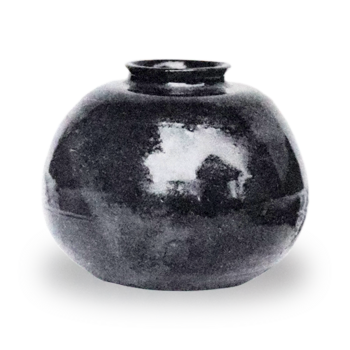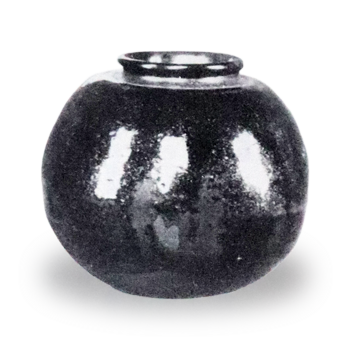
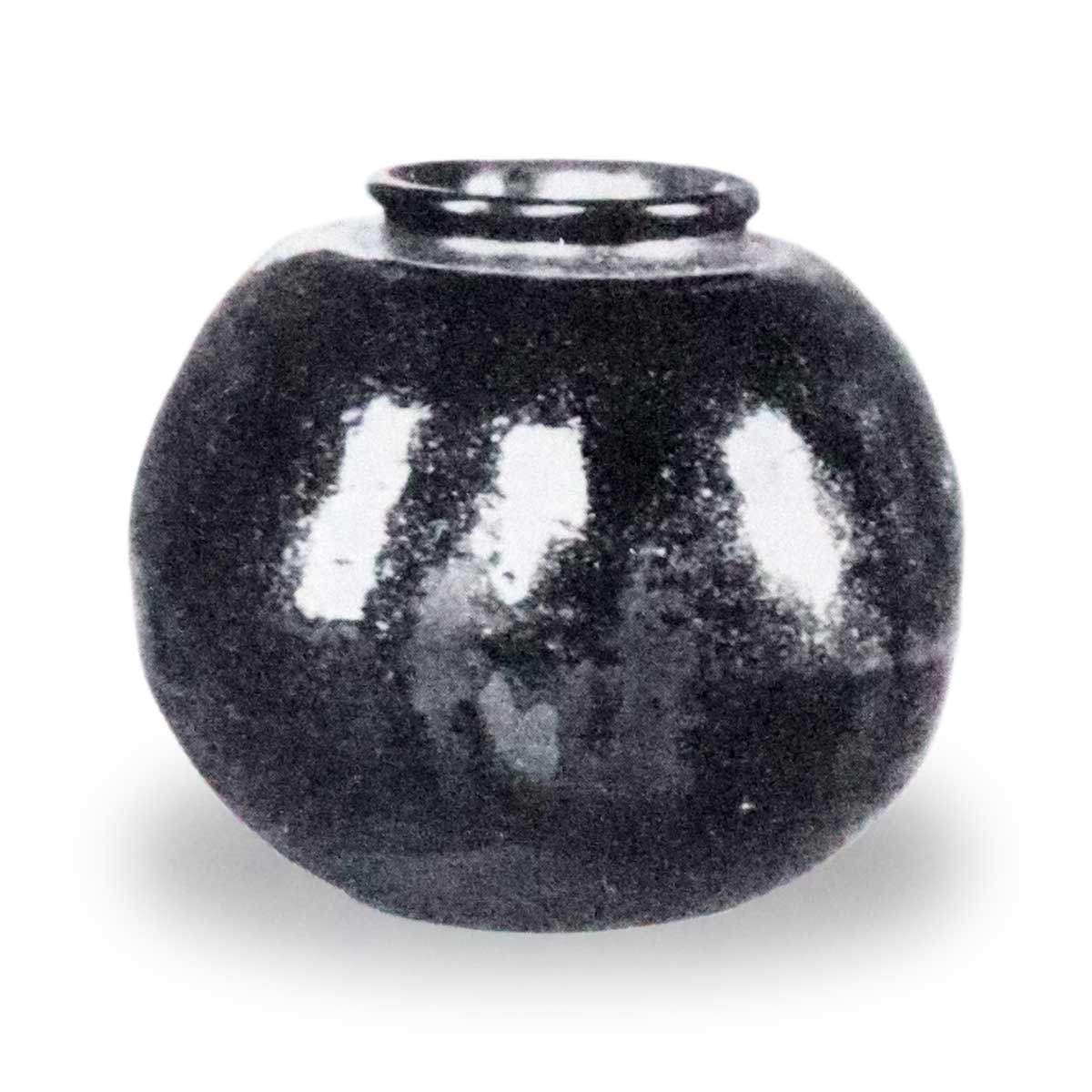
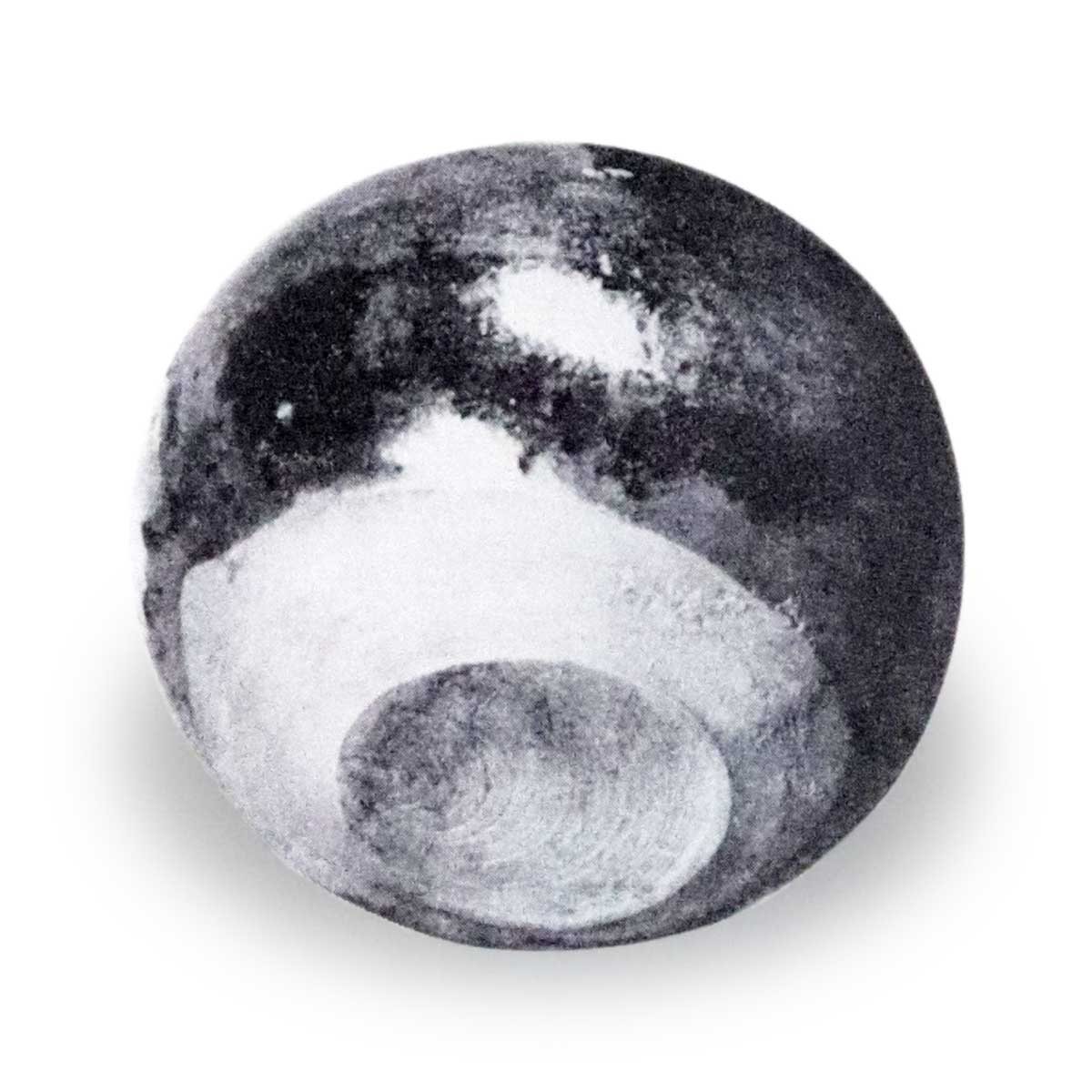
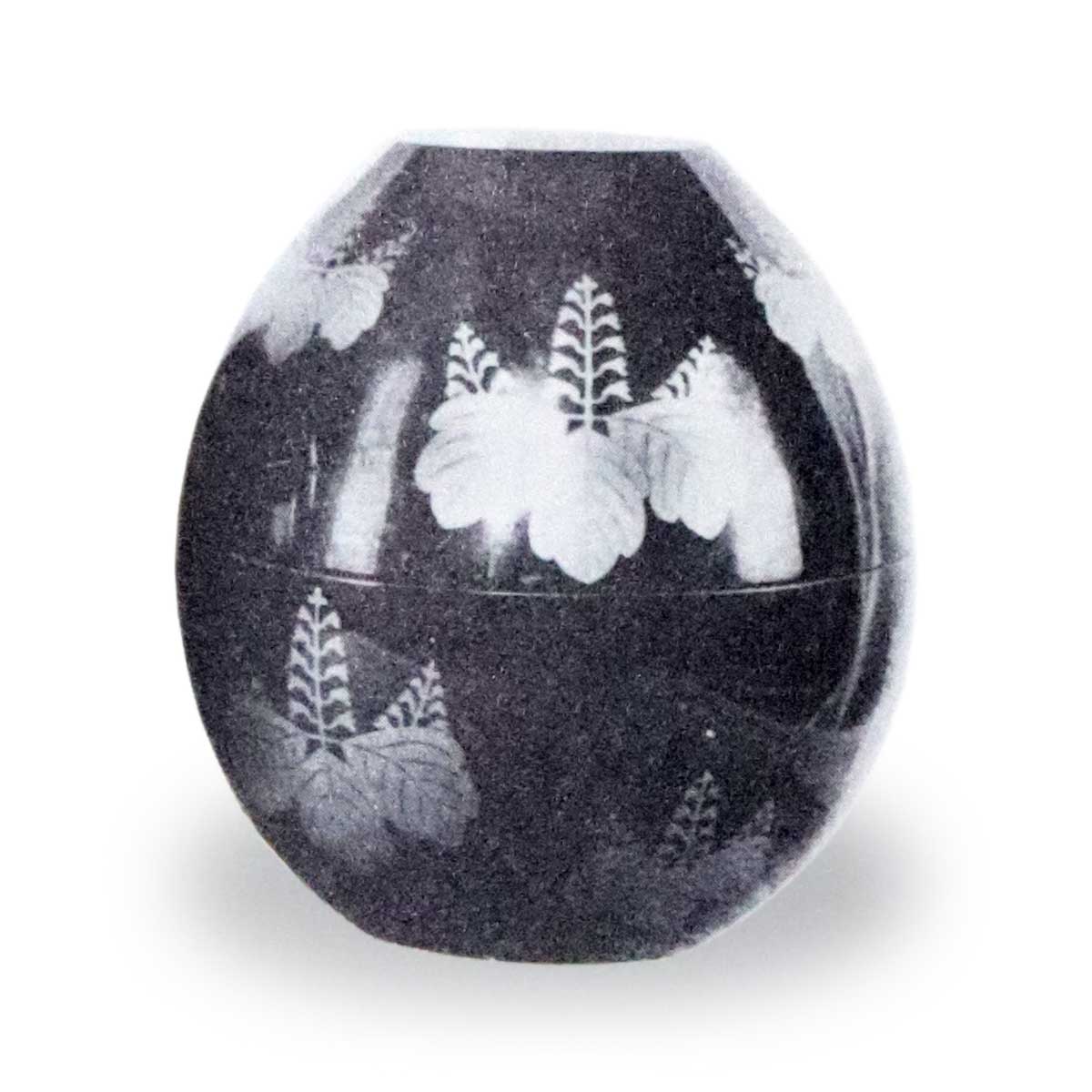
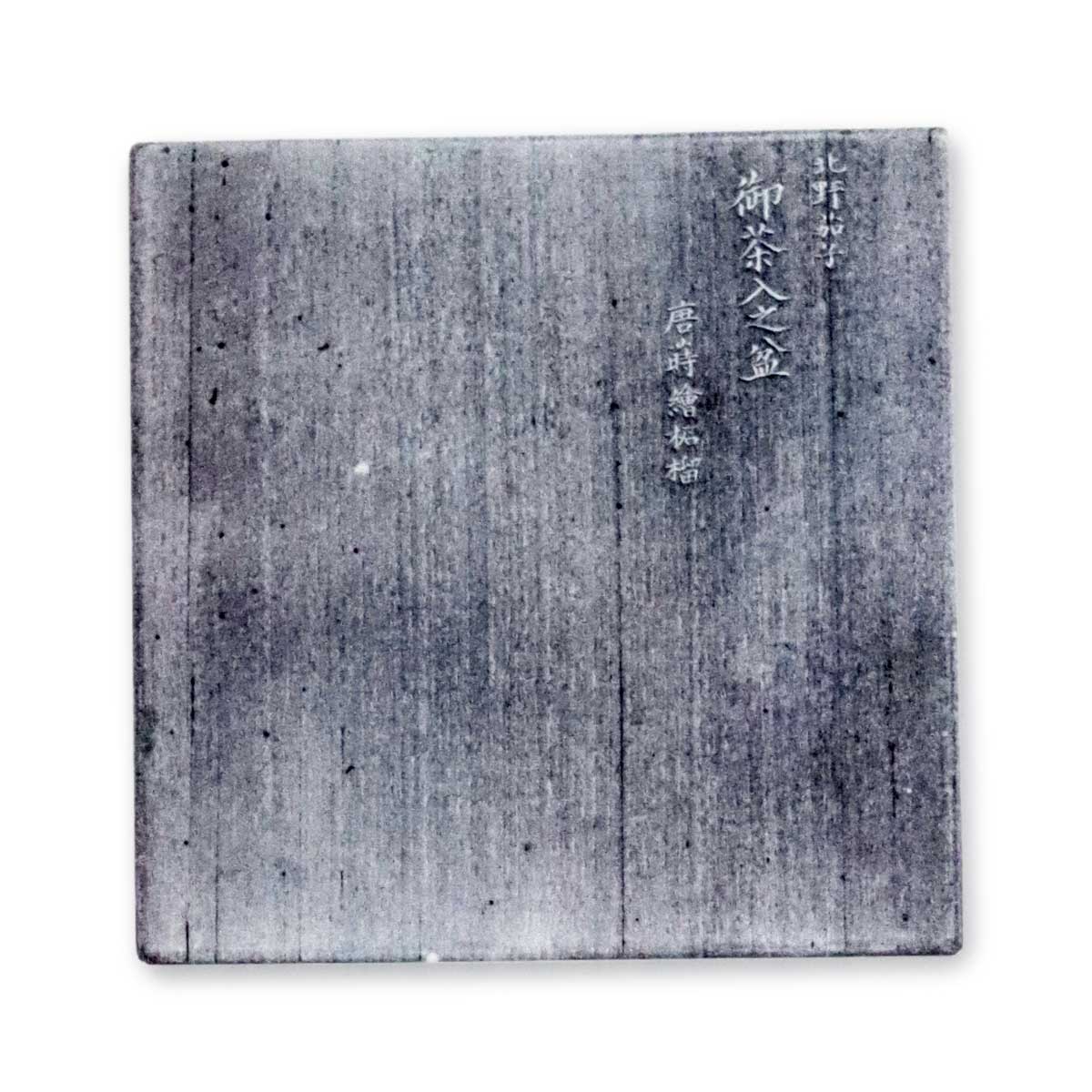
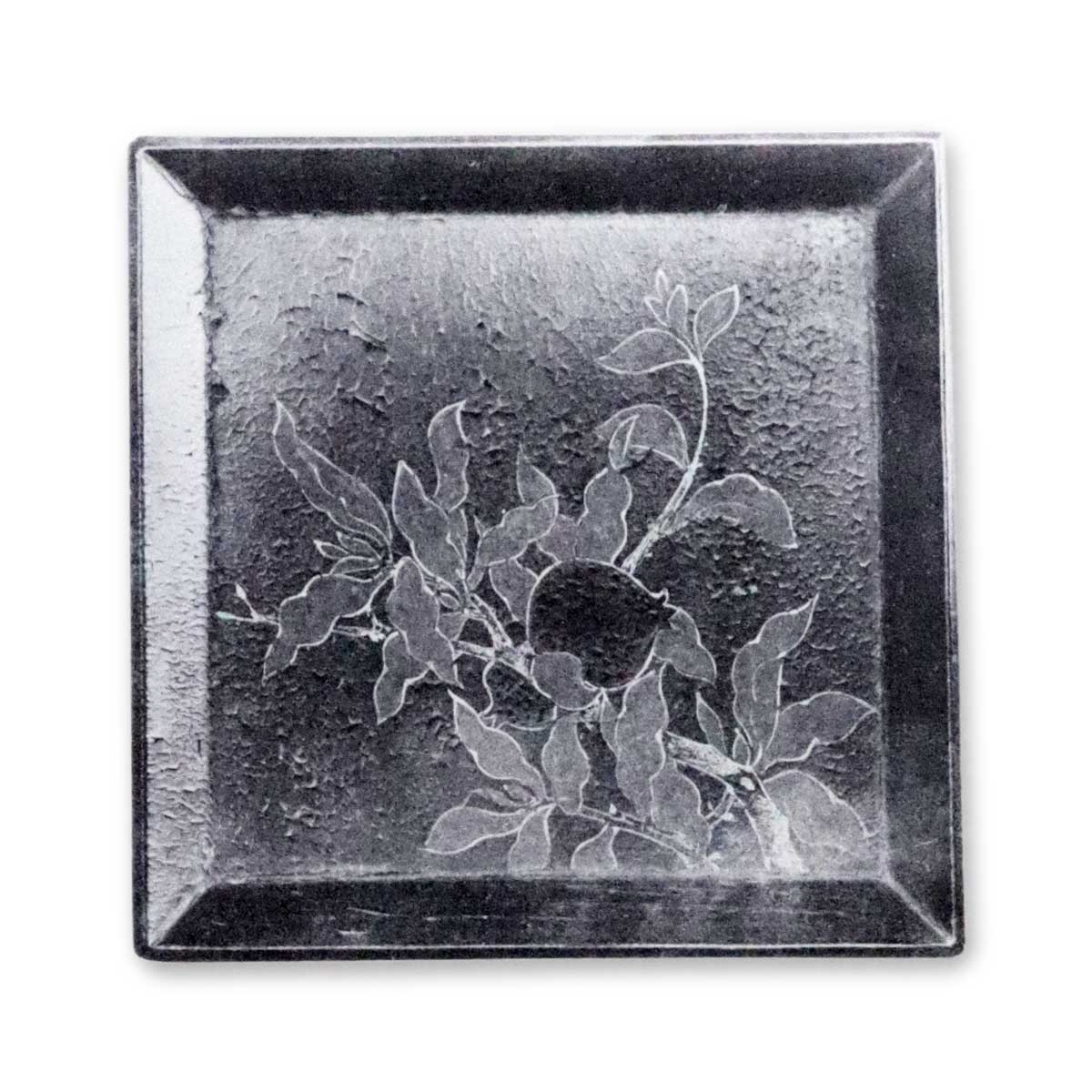
Chinese-made Daimeibutsu; Collection of Duke Tokugawa Ietatsu
Regarding the Name
Its origin is unclear. Since Tsuda Sōyuki’s Chadō Nikki (Tea Ceremony Diary) contains a detailed description of its appearance under the entry for May 26, 1550 (Tenshō 19), referring to it as “the Kitano Nasubi brought by Matsumoto Sōfu,” it is likely that the name “Kitano Nasubi” already existed by the Tenshō era. Alternatively, the name may have been derived from the fact that it was owned by someone living in the Kitano district of Kyoto, but this cannot be verified today.
Dimensions
Height: Just over 1 sun 8 bu 5 rin (approx. 5.6 cm)
Body diameter: 2 sun 1 bu 5 rin (approx. 6.5 cm)
Mouth diameter: Varies from 1 sun to 1 sun 2 bu (approx. 3.0–3.6 cm)
Base diameter: Varies from 1 sun to 9 bu 5 rin (approx. 3.0–2.9 cm)
Height of the rim (koshi): 1 bu 8 rin (approx. 0.5 cm)
Weight: 18 monme (approx. 67.5 g)
Accessories
Lids: 3 pieces, lid shapes (suba)
Rikyu style, Oribe style, Enshu style
The items on the right fit into the inner box (kake-go) of the pouch-style case
One pouch (cover): 3
Purple Ground with Angled Dragons: Lining is flower-patterned sea-green, braided cord is brown
Juko Guangdong: Lining is red sea-green, braided cord is light purple, Rikyu style
Honnoji Donshu: Lining is antique sea-green, braided cord is light purple, Enshu style
Single-lid pouch box: Natural white paulownia wood
Inscribed: “Kitano Nasu Tea Caddy, Lid, 3; Same, Pouch, 3”
Hikiya: Black lacquered, scattered paulownia crest in gold-leaf maki-e; Enshu style
Pouch: Navy blue ground with Dutch stripes
One inner box: Natural paulownia wood, with characters in gold powder
“Tea Caddy, Kitano Nasu”
One outer box: Black lacquer, with characters in gold powder
“Tea caddy: Kitano Nasu”
One accompanying document: Box made of natural paulownia wood, with writing in ink
“Kitano Nasu Tea Caddy History Document”
Place the four letters listed on the left into three separate packages
Kitano Nasu
(Ohtaka vertical paper)
Memoir of the Tea Caddy’s History
The tea caddy known as “Kitano Nasu” was bestowed upon Aburaya Tsuneyori, a resident of Sakai, in exchange for the tea caddy “Aburaya Katatsuki” that he presented to Taiko-sama (Toyotomi Hideyoshi) during the Eiroku era (1558–1570). Along with the caddy, he was granted 300 kan of money. It was subsequently donated to this temple (Myokoku-ji) during the time of the Venerable Nichiko, the founding priest of the temple. On this occasion, we are sending the Kitano Nasu to you for the repair and maintenance of the various halls. That is all.
August 5, Year of the Rat, Kan’ei 1 (1624)
Myokoku-ji
Nishisō Shinrō Nichigen (Seal)
(Half-sheet)
Record
- Kitano Eggplant
Damask bag: Kobori Enshū (Enshū)
Lid: Same as above
Hikiya: Same as above
End
Nichigen
Nishisōshin, Senior Monk, Attended
(Ohtaka half-sheet)
Record
- Kitano Eggplant
Kantō striped bag: Rikyū
Lid: Furuta Oribe
The above
Nichigen
Rev. Nishisōshin, Attended
(Mino vertical paper)
Kaku
- Square tray with pomegranate design, 1 piece
The item on the right is a tray that has traditionally been paired with the Kitano Nasu.
Year of the Rat, December 25, Myokoku-ji
Nichigen (Seal)
Rev. Nishisōshin
Accompanying Tray: Pomegranate in Karamaki-e
Dimensions: Inner diameter 5 sun 1 bu, inner bottom diameter 5 sun 6 bu, outer diameter 6 sun 4 bu, outer bottom diameter 5 sun 9 bu
Interior painted vermilion, exterior and back painted black
The Karamaki-e on the interior of the tray features green leaves, gold branches and trunk, and black pomegranate fruits
Pouch: White chirimen double-layered fabric; white braided cord
Tray box: Unfinished paulownia wood
“Kitano Nasu: Tea Caddy Tray with Karamaki-e Pomegranate”
Miscellaneous Notes
Kitano Nasu, Karamono, Daimeibutsu, formerly owned by Matsudaira Oki-no-kami. Height: 1 sun 8 bu 9 rin; body diameter: 2 sun 1 bu 5 rin; rim diameter: 1 sun; shows faint traces of thread cutting. The lid consists of two pieces, one in the style of Furuta Oribe and the other in the style of Kobori Enshu. Hikiya is double-layered, with the inner surface lacquered black and decorated with a gold-leaf maki-e of the Paulownia crest. The pouch features a navy-blue ground with an oramuta stripe pattern. The outer box is made of paulownia wood with a tsumori lacquer finish, while the interior is lacquered vermilion. The pouch features a ribbed stripe pattern. There are two pouches: one by Kojima Kanto in floral colors, and one by Donshu with waves and plum blossom motifs on a persimmon-colored ground, in the style of Kobori Enshu. The text on the right is the provenance record for the Kitano Nasubi tea caddy. “The Kitano Nasubi tea caddy refers to an item bestowed upon Aburaya Tsuneyori of Sakai in the Eiroku era (1558–1560) as a substitute for the ‘Aburaya Katatsuki’ tea caddy he had presented to the Taiko (Toyotomi Hideyoshi). In exchange, the Taiko granted this Kitano Nasubi and 300 kan of money to Aburaya Tsuneyori. It was subsequently donated to this temple (Myokoku-ji) during the time of the Venerable Nichiko, the founding abbot. On this occasion, the Kitano Nasubi is being sent to you for the repair and maintenance of the various halls. Signed: Myokoku-ji Nichigen, with seal. August 5, the Year of the Rat, Kan’ei 1 (1624), by Seishu Shiro. The tray accompanying the Kitano Nasubi described above measures 6 sun 4 bu square, with a depth (rim width) of 7 bu. The outer rim is coated in blue lacquer; the base measures 5 sun 8 bu square, with a black lacquered exterior and a vermilion-lacquered interior featuring a pomegranate design in the Karamaki-e style. The box is black lacquered and bears no inscription.
(From Kokin Meibutsu Ruiju)
Kitano Nasu: Chinese-made. Owned by Matsudaira Oki-no-kami. September 1, 1714 (Shōtoku 4, Year of the Horse) (Dimensions and details of accessories are the same as in Kokin Meibutsu Ruiju).
(From Meibutsu Ki)
Kitano Nasu: Chinese-made; Daimeibutsu; Imperial Possession (owned by the Shogunate). It has a strong luster of silver and gold (golden sheen) and is extremely beautiful. It bears traces of thread cutting and is made of mouse-colored clay (there are also entries regarding the pouch and tray).
(From Rinpōkiryū)
Kitano Nasu, owned by Yamaguchi. Height 1 sun 8 bu, width slightly over 2 sun 1 bu, circumference slightly over 6 sun 6 bu, base 1 sun, bulge 5 bu. The glaze has areas resembling dark persimmon candy, as well as areas of a light persimmon color. The clay is a vermilion color resembling purple (illustration of the tea caddy included).
(From Manpō Zenshū)
Kitano Nasu: Height 1.8 sun, width 2.1 sun, mouth diameter 1 sun, base diameter 1 sun (illustration of the tea caddy available).
(From Dai-an Cha-ire Ume Hiden Seizushiki)
Kitano Nasu: Presented by Matsudaira Oki-no-kami on December 28, 1720 (Kyōhō 5), the Year of the Rat. Height: 1 sun 8 bu 5 rin; body diameter: 2 sun 1 bu 7 rin; mouth diameter: 1 sun 2 bu; base diameter: 1 sun. The piece is generally thin-walled, with a persimmon-colored body featuring numerous black speckles resembling quail spots. As shown in the illustration, there are unglazed areas (hima), surrounded by black glaze. It is beautifully proportioned and is considered the finest among eggplant-shaped tea caddies (illustration of the tea caddy omitted). It comes with three pouches: one with a purple ground and angular dragon design (lined with floral fabric, with a remnant of light purple cord), one with a pearl-glazed Han-Tō design (by Donshu Junko, lined with high-grade sea-green fabric), and a court-style pouch made of white chirimen silk. It includes three lids: one in the Rikyu style, one in the Oribe style, and one in the Enshu style (Illustrations of the lids omitted). The Hikiya is black lacquered with a scattered paulownia crest design in gold-leaf maki-e. The pouch is made of cotton Guangdong fabric with a lining of Kaiki. The box is of natural paulownia wood, with the words “Ocha-ire Kitano Nasu” written in gold powder on the lid. The outer box is black lacquered with gold-powder lettering. The tray is intended for holding the Kitano Nasu and features only Tame-nuri maki-e. Illustration of the tray omitted. Four accompanying documents: a record of the tea caddy’s provenance on tall, vertical paper (text omitted; as mentioned above), a description of the tray on Mino vertical paper (text omitted), a description of the second half-sheet bag (text omitted), and a description of the second tall, half-sheet bag (text omitted).
(From the Tokugawa Family Catalog of Utensils and Paintings)
An overview of the famous “eggplant” tea caddies known throughout the world as Meibutsu
Kitano Nasu, Daigo Nasu, Bungo Nasu, Sōgo Nasu, Kyōgoku Nasu, Shōō Nasu, Mitsukushi Nasu, Hyōgo Nasu.
(From the Secret Records of Tea Ceremonies)
Accompanying Document for the Kitano Nasu
One Document
- As you have expressed a desire for the Kitano Nasu tea caddy that has been in my family’s possession for generations, I hereby present it to you. This tea caddy is undoubtedly the Meibutsu Kitano Nasu of old. Should there be any discrepancy, please return it at any time. I will refund the 2,100 ryō received for the tea caddy.
- This tea caddy comes with two pouches: one is Rikyu, and the other is Enshu. There are two lids, one to Lord Oribe’s taste and the other to Lord Enshu’s.
- This tea caddy is Lord Hideyoshi’s personal property, known as the Kitano Eggplant. It is undoubtedly the one my ancestor, Nishimune, requested from Myokoku-ji and has possessed ever since. I shall also present the pomegranate-shaped tray, which has been passed down since ancient times, as well as the certificate from Priest Nikken of Myokoku-ji, without retaining any of them for myself. This is all.
June 23, 1679 (Enpō 7, Year of the Go-mi)
Sakai Nishikurōbei (Seal)
(Signature)
Iwatsuya Dōho, on behalf of
The same, Kurōjirō (Signature)
To Lord Okuhira Tōzaemon
(Note) Okuhira Tōzaemon was the steward of the Hisamatsu family. The head of the Hisamatsu family during the Enpō era was Matsudaira Oki-no-kami Sadanori, who had the alternative names Mishima, Tachibana-yama, and Nisshindō, and was posthumously named Dairyū-in.
The box for the hanging scroll on the right is made of untreated paulownia wood, and the inscription on the front of the lid reads as follows.
Certificate Accompanying the Kitano Eggplant Tea Caddy: One Scroll
The eggplant-shaped tea caddy was a gift presented to my grandfather, Lord Sadamichi. In the year Kōho 5 (1720), the year of the Gengzi cycle, upon Lord Sadamichi’s passing, it was offered to the Shogun as part of his estate, along with the tray that had been attached to this tea caddy.
Kitano Eggplant
(Collection of Count Hisamichi Hisamatsu)
(Note) The accompanying scroll for the Kitano Eggplant teapot on the right was left with the Hisamatsu family when the teapot was presented to the Shogunate in the 5th year of Kyōhō.
Kitano Eggplant: In exchange for Aburaya Tsuneyori presenting the Aburaya Katatsuki to Hideyoshi, he was granted 300 kan of money and the Kitano Eggplant. It is currently in the possession of Matsudaira Oki-no-kami.
(From the “Meibutsu Kōjūki”)
Matsudaira Sadahide (Hida-no-kami, later Oki-no-kami; sixth-generation lord of Matsuyama Castle in the Hisamatsu family). Born in Matsuyama in the 9th year of Genroku. (Omitted) On December 11, the 5th year of Kyōhō, he inherited his late father’s domain, and on the 28th, he was appointed Oki-no-kami. On this day, he presented a sword from the Bizen-no-kami family—a heirloom of his father (Sadanori, the fifth Oki-no-kami of the Hisamatsu family)—and a Kitano Nasu tea caddy.
(From the Kansei Revised Genealogies of Various Families)
History of Ownership
Around 1550 (Tenshō 19), it was in the possession of Matsumoto Sōfu; it was subsequently passed down to Yoshimizu Shiro of Kyushu, and later became the property of Hideyoshi. By chance, Tsuneyori Aburaya—father of Priest Nichō, the founder of Myokoku-ji Temple in Sakai—presented the “Aburaya Katatsuki” sword he owned to Hideyoshi. In exchange, he received this Kitano Nasu sword and 300 kan of money from Hideyoshi. In August of the first year of the Kan’ei era (1624), the fifth head priest of Myokoku-ji, Nichigen, sold it to the Sakai merchant Nishimune for 45 kan and 400 mon of silver to fund the repair and maintenance of the temple buildings. In 1679 (Enpō 7), Kurobe, a descendant of Munemasa, sold it to Okudaira Tōzaemon, a samurai of the Matsuyama Domain in Iyo, for 2,100 ryō of gold, and Tōzaemon subsequently presented it to his lord, Matsudaira Oki-no-kami Sadanori. On December 28, 1720 (Kyōhō 5), his son, Sadahide, presented it to the shogunate as a memento of his father, Sadanao, in gratitude for inheriting the family headship; since then, it has been a treasure of the Tokugawa main clan to this day.
Kitano Nasubi
An overview of the famous “eggplant-shaped Meibutsu” known throughout the world
Sōgo Nasubi, Kitano Nasubi, Daigo Nasubi, Bungo Nasubi, Mitsukushi Nasubi, Shōō Nasubi, Kyōgoku Nasubi, Hyōgo Nasubi
(From Chayū Kojidan)
On May 26, 1550 (Tenshō 19, Year of the Rat), Matsumoto Sōfu brought it.
Kitano Nasubi
The shape is sleek, and the base is plump and charming. It is slightly small, with a ribbed waist that slopes down slightly. The rim is wide, and the turned-up edge is beautiful. The glaze has a “snake-scorpion” (dakat: a pattern resembling the scales of snakes or lizards) texture, and there is additional snake-scorpion glaze along the rim. The underglaze is also well-applied, and the glaze adheres nicely. It presents a scene where the glaze appears to have spread out. There are glaze gaps (ishima) on both the front and back, with the gap on the right serving as the front face. The body color is a deep pale yellow, with no black or vermilion areas. Distinct brushstrokes are visible on the clay. Both the character of the glaze and the fineness of the clay are excellent. The bag features a Guangdong-style horizontal stripe pattern and is pale yellow. The lining is brown northern silk. It was sewn by a man named Shikoichi, and bears the family crest of his household. Matsumoto Sōfu remarked that the overall shape of this teapot, including the rim, resembles the “Tsukumogami” eggplant, and he is absolutely correct. The body is about the width of a finger, and this teapot is said to be small.
(From Tsuda Sōyuki’s Tea Ceremony Diary)
Kitano Nasubi: The one found in the Western Provinces. Yoshimizu Shiro.
(From the Tenshō Meibutsu Ki)
Kitano Nasubi: Yoshimizu Shiro.
(From Ōtomo Kōhaiki)
Kitano Nasubi: Western Provinces. Yoshimizu Shiro.
(From Higashiyama Go-mono Uchi Betsuchō)
Kitano Nasubi: Sakai. Nishimune Nobuyoshi.
(From Ganka Meibutsu)
Kitano Nasubi: Okudaira Tōzaemon, a retainer of Lord Matsudaira Oki-no-kami.
(From Meiki Kiroku)
Aburaya Tsuneza was a native of Sakai in the Senshu region and a disciple of Rikyu. He possessed a katatsuki, which was commonly known as the “Aburaya Katatsuki.” During the reign of Tsuneharu (Tsuneyori), he presented it to Hideyoshi and received the Kitano Eggplant in return. It is said that he later donated it to Myokoku-ji Temple, and that Achiko Munenai purchased it during the Kanei era to fund the construction of various halls, bringing it back into the public eye.
(From Rikyu Hyakukai Kai)
Myokoku-ji Temple was established in 1562 (Eiroku 5) on a site spanning two chō from east to west, donated by Miyoshi Jikkyū, and its various halls were constructed in 1568 (Eiroku 11). The founding abbot, Venerable Nisshō of Busshin-in, passed away at the age of 67 on August 27, 1598 (Keichō 3), the year of the Earth Dog. The temple’s register of the deceased records: “Dharma name: Butsushokō-in Jōgen Nichi’i; passed away on the first day of the 10th month of the Year of the Ox, Eiroku 8 (1565); aged 77” and “Dharma name: Butshin’gyō-in Jōyū Nitchoku; passed away on the 4th day of the 7th month of the Year of the Rabbit, Tenshō 7 (1579); a major patron of this temple.” Venerable Nichigen was the fifth head priest of this temple and passed away on April 4, Kan’ei 10 (1633), at the age of 50. A disciple of Master Nichiko, his courtesy name was Eishun, and he was born in Sakai, Settsu, in the 12th year of Tenshō. After the Genna Fire, reconstruction had stalled for many years; he sold a tea caddy called “Kitano Nasu” that was in the temple’s possession for 45 kan of silver and used the proceeds to rebuild the main hall. Among the hanging scrolls held by this temple is one containing the following text:
Record of the Tea Caddy’s History
The “Kitano Nasu” tea caddy was bestowed upon Aburaya Tsuneyori by the Taiko in the Eiroku era as a substitute for the “Aburaya Katatsuki” tea caddy he had presented to the Taiko, along with 300 kan of money. It was subsequently donated during the time of the temple’s founder, the Venerable Nikō, who held the rank of Gon-sōjō. On this occasion, we are sending the Kitano Nasu to you for the repair and maintenance of the various temple halls. That is all.
August 5, Year of the Rat, Kan’ei 1 (1624) Myokoku-ji, Nichigen, Seal
Nishimune
Regarding the Kitano Nasu Tea Jar Purchased
The price for the above is 45 kan and 400 mon of silver.
The silver has indeed been paid in full. It is clear that it was received along with the tea jar. I record this for future reference.
October 18, 1624 (Sōshin, seal)
To Myōkoku-ji
(From the Myōkoku-ji documents)
Kitano Nasu
(Note) The attached record of the tea caddy’s provenance and the Myōkoku-ji documents state, “During the Eiroku era, Aburaya Tsuneyori was granted the Kitano Nasu in exchange for presenting the Aburaya Katatsuki to the Taikō (Hideyoshi).” However, documents of the Matsudaira family of Izumo state that “around the beginning of the Keichō era, Aburaya Jōyū (the same person as Tsuneyuki) presented the Aburaya Katatsuki to the Taikō,” which does not align with the timeline. Considering that the Otomo Kōhaiki records “Kitano Nasu: Yoshimizu Shiro,” it is believed that the Kitano Nasu was presented to the Taikō by Yoshimizu. The Taiko’s connection to Kyushu began after the 13th year of Tenshō (1585), when the “Nitta Katatsuki”—which had been in the possession of that Otomo Sōrin—was presented to him; therefore, this Kitano Nasu likely came into the Taiko’s possession around that same time. If so, the reference to the “Eiroku era” seems highly questionable. Furthermore, while the Manpō Zensho states “Kitano Eggplant, owned by Yamaguchi,” it is unclear exactly who this refers to. The Kokon Chajin Keifu lists a Yamaguchi Sōko, and the Rikyū Hyakue mentions a Yamaguchi Sōji of Suō, so it may be one of these individuals. Additionally, the Rikyū Hyakue Kai states that it was purchased by Achi Sōnai, but it is also unclear who this person is.
Record of Actual Viewing
On November 8, 1918 (Taisho 7), I had the opportunity to view this piece in person at the residence of Duke Tokugawa Ietatsu in Sendagaya, Tokyo Prefecture.
I had also seen it once last year when it was exhibited by the Duke’s family at the Art Association in Ueno; the more I look at it, the more impressive this Chinese tea caddy becomes. True to its name, it is shaped like an eggplant; the intermingling of purple and black glazes creates a beautiful luster, and the shifting hues defy description. There is a fire mark (an unglazed spot) slightly below the center of the body, and while there are slight traces of restoration along the rim, the rounded rim is smooth and exquisitely crafted. The grayish-brown clay is visible below the rim, the thread-cutting marks are very fine, and part of the base has been worn flat.
The accompanying Chinese-style maki-e pomegranate-patterned square tray is also a rare piece; while the maki-e may appear somewhat lively (flashy), given its age, it pairs well with the tea caddy. However, I could not help but feel that if this were a plain tray, the luster of the tea caddy would stand out even more. Hikiya is black lacquered with a protruding body and gold maki-e on paulownia wood, and from every angle, it felt like an item associated with the Taiko (Hideyoshi).