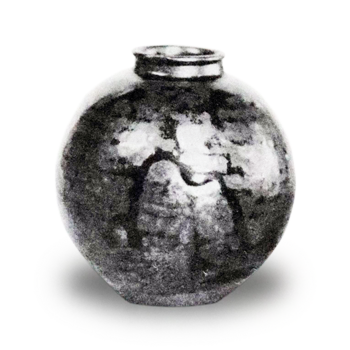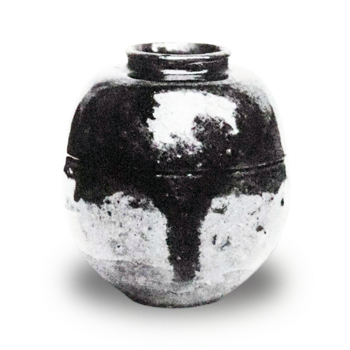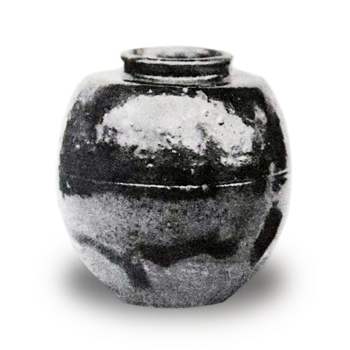
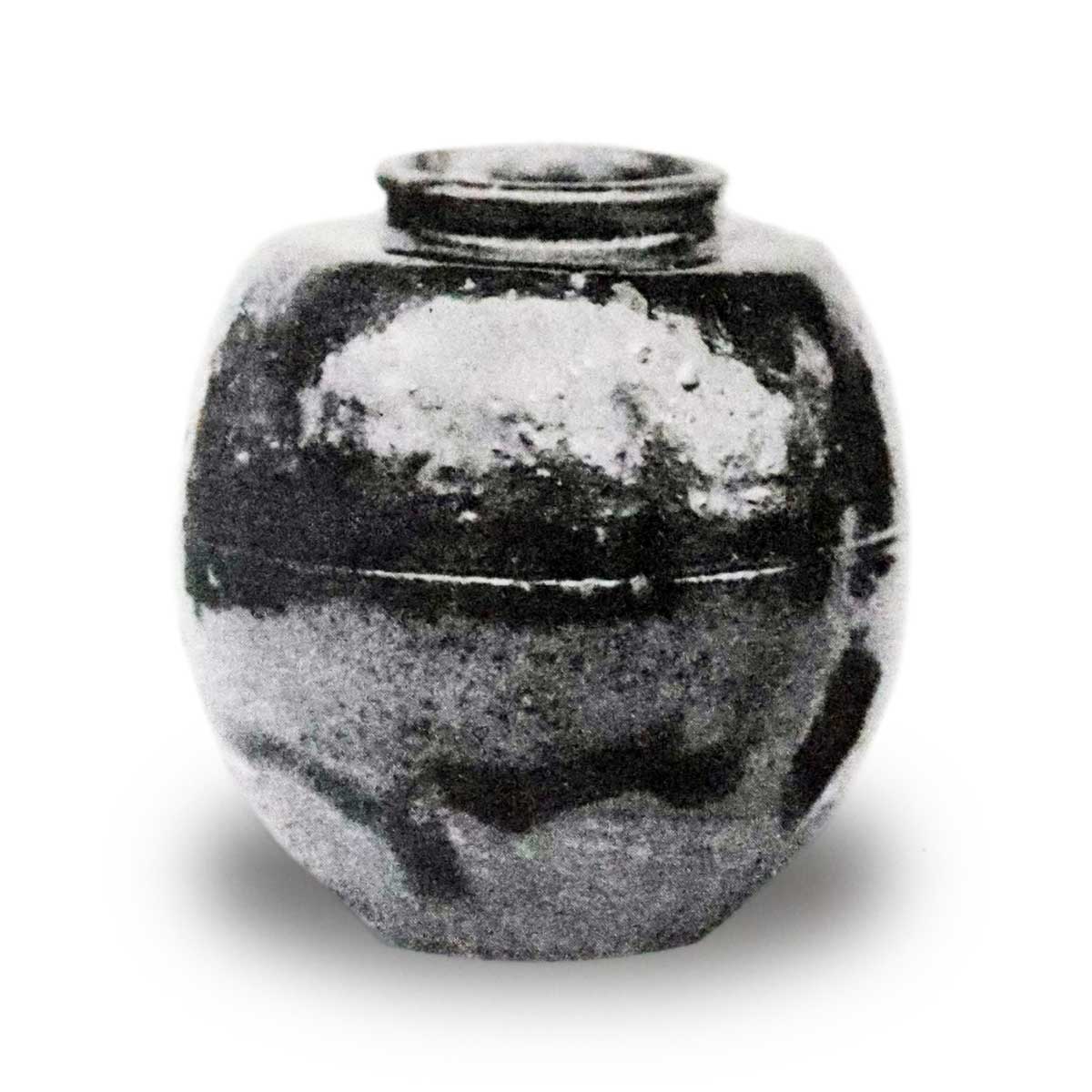
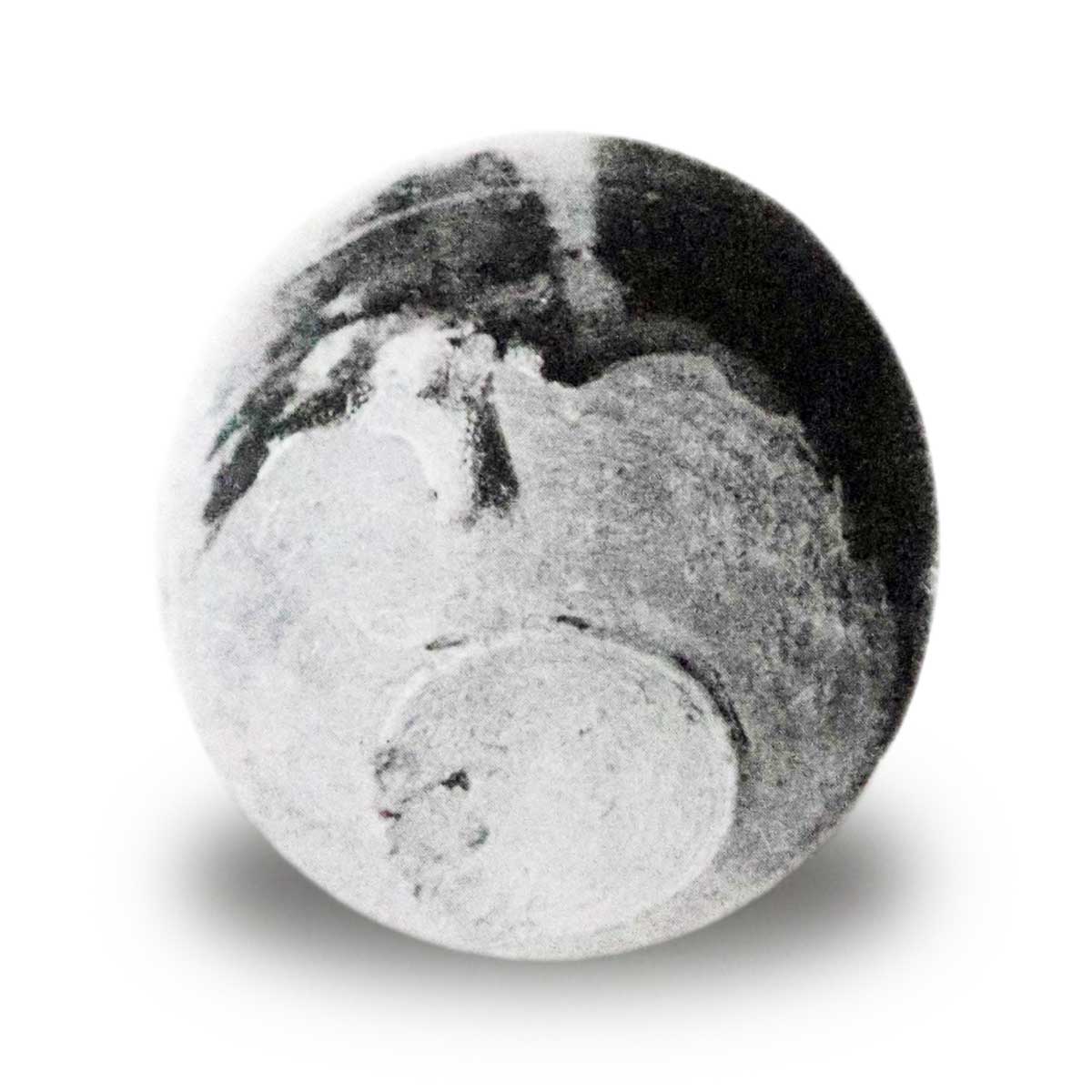
Made in China; Daimeibutsu; Collection of Teruhisa Komatsu, Marquis
Origin of the Name
This name was given because it is a Bunrin tea caddy that was once owned by Kuki Yoshitaka.
Dimensions (converted at 1 sun ≈ 3.03 cm)
Height: Approx. 6.67 cm (2 sun 2 bu)
Body diameter: Approx. 6.42 cm (2 sun 1 bu 2 rin)
Mouth diameter: Approx. 2.88 cm (9 bu 5 rin)
Base diameter: Approx. 2.73 cm (9 bu)
Koshiki height: Approx. 0.48 cm (1 bu 6 rin)
Shoulder width: approx. 0.79 cm (2 bu 6 rin)
Weight: 76.5 g (20 monme 4 rin *1 monme = 3.75 g)
Accessories
・Lid: 1 (no indentation)
・Storage pouch (bag for the tea caddy): white chirimen silk, with a brown cord
・Two protective covers (pouch)
Guangdong-style woven fabric (lining: light green Fursu weave, cord: pale yellow)
Satin with a nine-dragon pattern in a sashiko design (lining: crimson-ground Nanako weave, cord: purple)
・Pouch box: Made of natural paulownia wood. Inscriptions reading “Shōshin” and “Kuki Bunrin” are present.
・Hikiya (cylinder for storing the tea caddy): Made of ivory
Bag: Satin with vertical stripes and gold thread (lining: brocade; cord: brown)
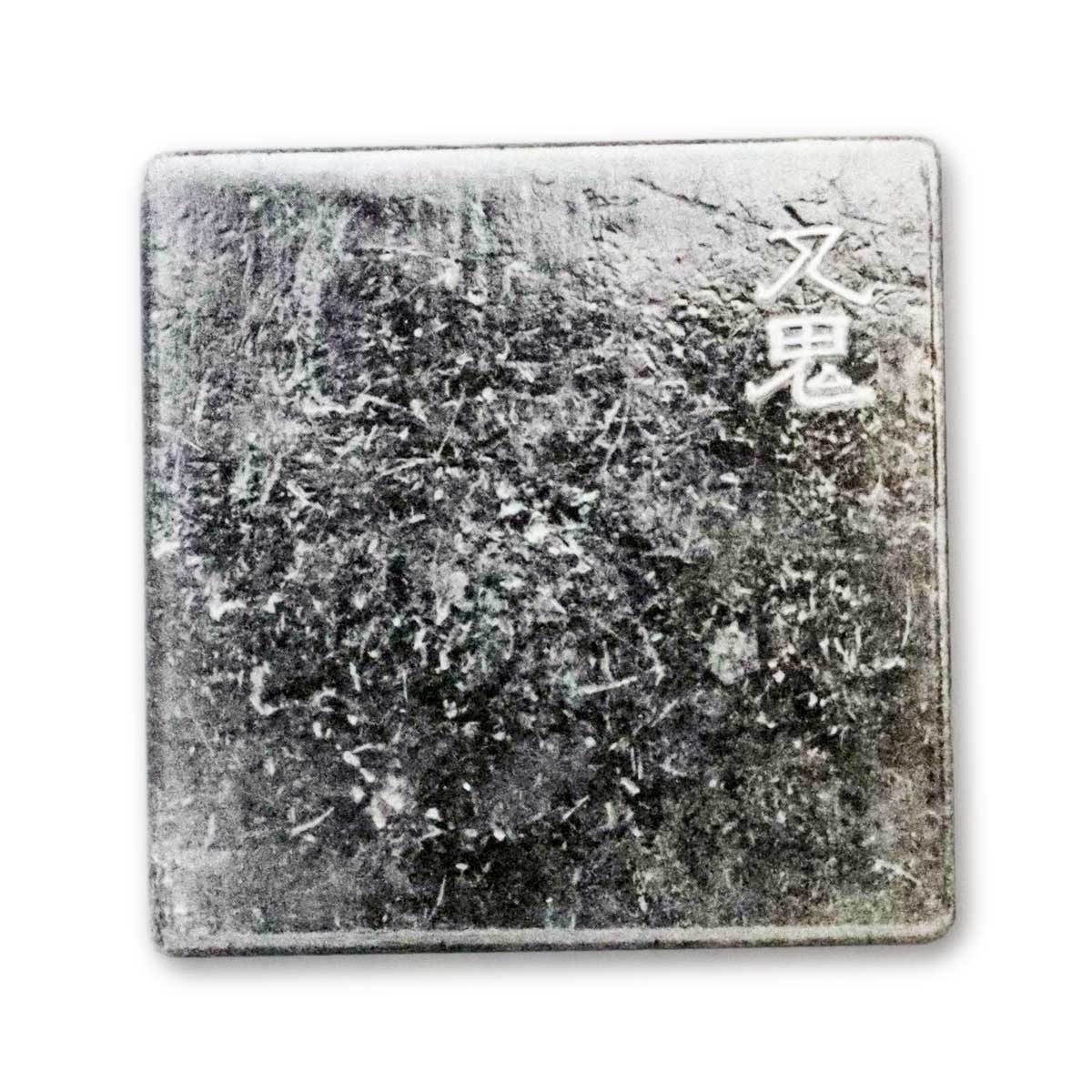
・Box: Paulownia wood with Shunkei lacquer finish. The lid’s exterior bears the inscription “Kuki” in silver powder.
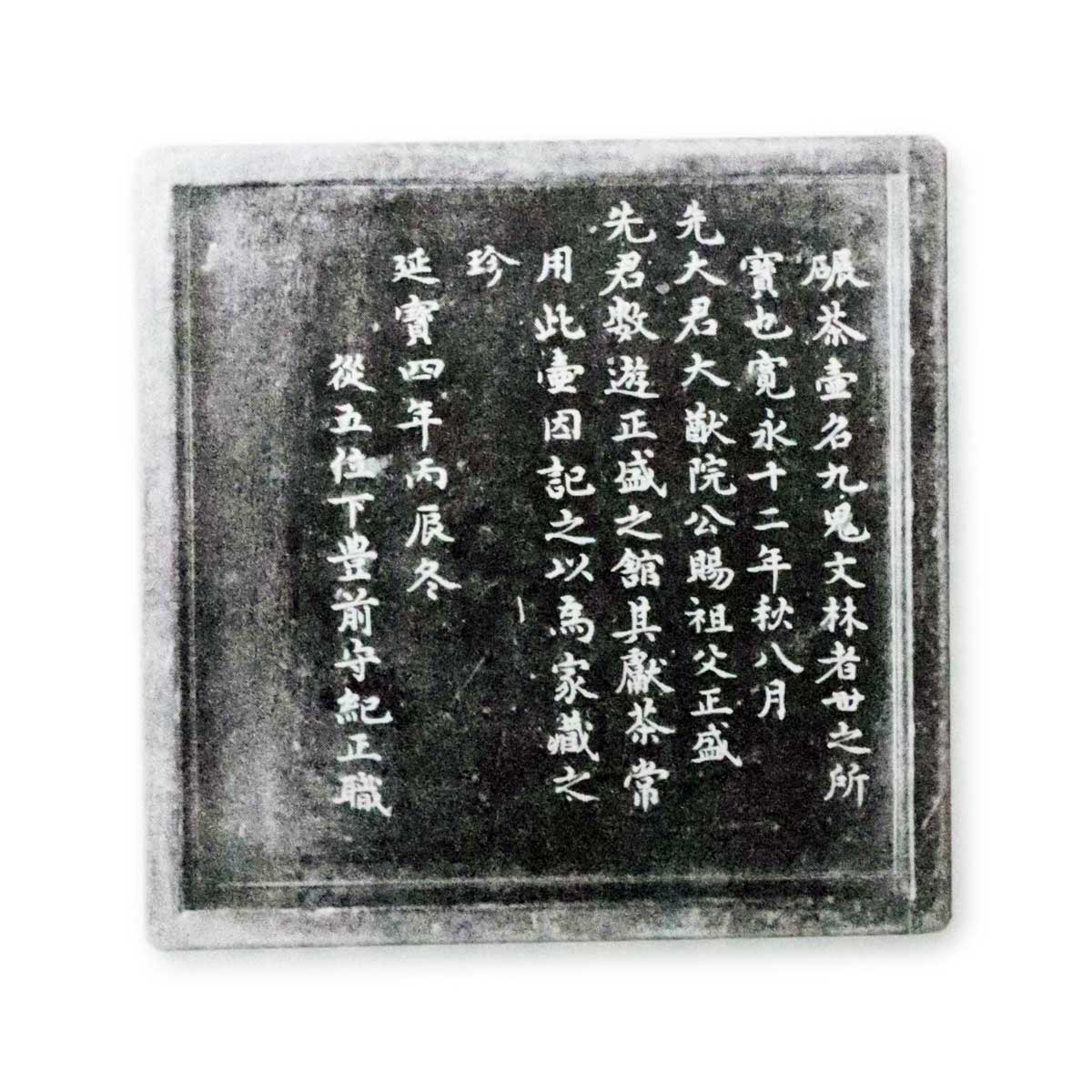
The inscription in red lacquer on the underside of the lid reads as follows:
“This tencha jar (tea caddy) is by Kuki Bunrin (Bunrin) and is a treasure of the world. In the eighth month of autumn, the 12th year of Kan’ei (1635), His Imperial Highness Daio-in (Tokugawa Iemitsu), the late Grand Prince, bestowed it upon my grandfather, Hotta Masamori. My late father frequently visited Masamori’s residence and always used this vessel when offering tea. For this reason, I record this here to cherish it as a family treasure. In the winter of the Year of the Fire Dragon (1676), the 4th year of the Enpō era, by Kiki Masatada, Junior Fifth Rank, Lower Grade, Governor of Buzen.
・Outer Box: Made of untreated cedar. A piece of paper bearing the inscription “Kuki Bunrin” is affixed to it.
・Accompanying Scroll: One scroll, written by Hayashi Dōshun (Razan).
(Note: Kun’yomi marks have been added for ease of reading.)
“Among the famous tea caddies in our country is Bunrin (Bunrin). In the early modern period, Lord Jishō (Ashikaga Yoshimasa) devoted himself to the Way of Tea, delved deeply into books, established standards for the taste of tea utensils, collected them, and used them as the occasion demanded. How flourishing it was! Afterward, merchants traveled back and forth between Japan and China, peddling tea utensils in the streets, and the practice spread throughout the country. Eventually, the prices of tea utensils reached tens, hundreds, or even tens of thousands of gold pieces. People would invest hundreds or thousands of gold pieces in a single tea jar without batting an eye, without suspicion, and without a second thought. The use of tea jars reached its peak at this point.
“The Kuki Bunrin (or Bunrin) is also one of the small pots used for ground tea. It was presented by Kuki Osumi-no-kami (Yoritaka), passed down through the former Daishogun (Ieyasu), and bestowed by the Shogun (Iemitsu) upon the Governor of Kaga (Hotta Masamori). It is held in the governor’s collection, and it is hoped that it will be treasured as a family heirloom. Its shape resembles that of a bunrin (a type of apple). Therefore, due to its origin and similar shape, it was named ‘Kuki Bunrin.’
It is common for objects to be given such names. The sword ‘Ganjiang,’ the sake ‘Tokō,’ the medicinal herb ‘Ryūkinu,’ the vegetable ‘Genshū,’ and the musical instrument ‘Ruan Xian’—are they not all named after their origins? The “Hibiscus Peak,” the “Peach Blossom Horse,” the “Lotus Leaf Cup,” and the “Water Lily Mirror”—are they not all named for their resemblance to those forms? If that is the case, how could the names “Kuki” and “Bunrin” possibly be deemed implausible?
I have heard that when naming teapots, one sometimes uses the names of plants or objects to describe their resemblance in shape, while other times one employs colloquial terms to describe the protrusions and indentations of the clay, the fullness or sharpness of the top and bottom, and the thickness or thinness of the surface. This is something tea masters are well aware of; why should I need to add anything further?
To begin with, “Bunrin” refers to the apple. I have heard that this fruit grows near the Bohai Sea (the sea of China), and that its trees float down the river. A man named Bunrin-rō picked up the seeds and planted them, and thus the fruit was named after him. Alternatively, I have heard that people in the south call it “quince.” Alternatively, it is said that during the reign of Emperor Gaozong of the Tang Dynasty, Prince Ji, Li Shen, obtained a five-colored apple and presented it to the emperor. The emperor was greatly pleased and conferred upon Li Shen the title of “Wenlin Lang.” Consequently, it is said that people began to call the apple “the fruit of Wenlin Lang.” The fruit is beautiful and delicious. Quinces are somewhat larger and misshapen; they are found in the Guanzhong region but are entirely absent in the regions south and north of the Yangtze River. According to this, it is the apple that is the “Wenlin Lang,” not the quince.
The apple is a masterpiece among fruits. Reading Wang Xizhi’s calligraphy reveals its beauty; viewing Fan Zhi’s poetry makes one realize the strangeness of the tree’s knots; consulting the records of Zen masters reveals methods for living apart from the mundane world; and reciting Su Shi’s verses adds a sense of elegance and refinement. Its quality, form, and character are scattered throughout many books.
An apple is also known by the alternate name “Raikin” (Coming Birds). Why is it called Raikin? This fruit is sweet, and it often attracts many birds (kin) to the tree (rai). Hence, it has the names “apple” and “Raikin.” Ah, though this word is small, it can serve as a metaphor for great things. If we speak of a nation, the country is the “forest,” and the officials and people are the “flock of birds.” When the ruler offers comfort, the officials and people all embrace his teachings and submit to him. Is this not also the meaning of “Raikin”?
That may be so, but the reason apples can attract so many birds is merely due to their temporary flavor. Once they rot and fall, the birds will fly away. Only when those who govern the country govern themselves with integrity and treat the common people with benevolence will the people submit wholeheartedly. One cannot be careless in the art of governing the country and managing the household.
All the more so now, this single small pot holds tea buds in the height of spring, contains the snow of Sen in its mouth, and draws the dew of three calamities in its flavor. The branches of the literary forest will flourish eternally, passed down without decaying. How could it be the same as the flowers blooming and falling in the garden grove? It can be said to be priceless.
If, in your leisure, you invite guests, draw fresh water, and prepare tea, it will surely wash away the troubles of your heart. Moreover, considering the depth of this gracious gift, is it not only natural that the Governor should cherish it? Since the Governor requested that I write this, I could not refuse and decided to comply with his request. I have merely borrowed slightly from the teachings of Laiqin to convey a subtle meaning through my pen.
I borrow the path of the Prefect of Hakushu and add a Chinese poem. This, too, is in response to his request. (Chinese poem omitted)
Mid-June, Shōhō 3 (1646) At Yūgan-chō Written by Dōshun (Hayashi Razan)
・Box for accompanying scroll: Unfinished paulownia wood (inscribed with “Dōshun’s Record of Kuki Bunrin”)
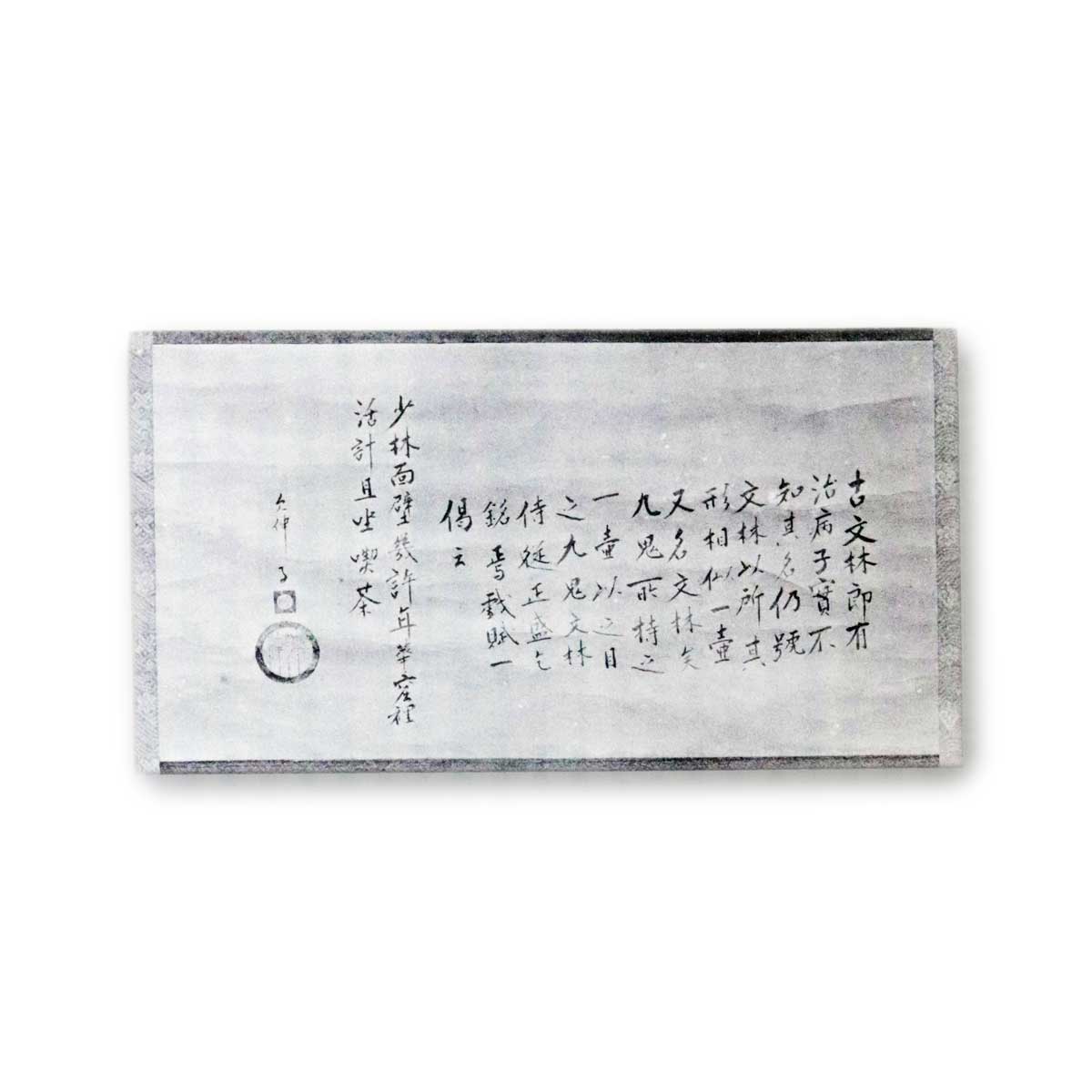
・Accompanying hanging scroll: 1 scroll Written by Priest Kōgetsu
“The ancient Bunrin (apple) bears fruit that cures illness, yet its name is unknown. Because of the similarity in shape, I named a certain vase ‘Bunrin.’ A vase that Kuki possessed was also called Kuki Bunrin after seeing this. When Chamberlain Masamori (Hotta Masamori) requested an inscription, I composed a verse (Chinese poem) in jest and said:
Facing the wall at Shaolin, how many years have passed? Living in the cave, for now, sit and drink tea.
Kusenko (seal)”
Mounting: The inner lining is a blue-ground satin with a wave-and-flower treasure pattern; the outer lining is a satin with a chrysanthemum-patterned design
Top and bottom: Northern silk
Scroll ends: Ivory
Scroll case: Unfinished paulownia wood (inscribed with “Record of Kuki Bunrin by Venerable Kogetsu”)
Miscellaneous Notes
Kuki Bunrin. A gift from the court. Owned by Lord Hotta of Kaga.
(From Ganka Meibutsu Ki)
Kuki Bunrin. Made in China. Owned by Hotta Kaga-no-kami.
(From Komeibutsu Ki)
Kuki Bunrin. Daimeibutsu. A small jar made in China. Owned by Hotta Kaga-no-kami.
(From Kokin Meibutsu Ruiju)
Hotta Masamori (Dewa-no-kami). Born in Keichō 13 (1608). In August of Kan’ei 12 (1635), he received a Kuki Bunrin tea caddy from the Shogun, accompanied by an inscription by Hayashi Dōshun (Rasan) and a verse by the monk Kōgetsu. He was transferred from the Matsumoto Domain to the Sakura Domain in Shimōsa and received an increase of 10,000 koku, bringing his total holdings to 110,000 koku. On April 20, Keian 4 (1651), he committed ritual suicide following the death of Daio-in-den (Tokugawa Iemitsu). He was 44 years old.
(From Kansei Shūshū Shokafu)
History
Originally owned by Kuki Osumi-no-kami Yoshitaka, who presented it to Shogun Tokugawa Hidetada. Subsequently, in August of the 12th year of the Kan’ei era (1635), Shogun Tokugawa Iemitsu bestowed it upon Hotta Kaga-no-kami Masamori, and it has been a treasured possession of the Hotta family ever since. However, during the time of Masachika Hotta, due to certain circumstances, the family fell into severe financial hardship, and this tea caddy was pawned. Masateru Hotta, lord of Sakura Castle and a branch family member, learned of this fact only after requesting to view the tea caddy. He then invested a large sum of money to redeem it from the pawnshop. “A treasured artifact has no meaning if it is not in its rightful place. It should not be kept in a branch family when it belongs to the main family,” and after seeing it just once, he immediately returned it to the head of the main family, the Kaga-no-kami. (According to records such as Hotta-ke Kashi Shinsensan-shi).
Later, in May 1883 (Meiji 16), Viscount Masayasu Hotta presented it to His Imperial Highness Prince Akihito of Komatsu.
Record of Actual Viewing
On May 10, 1921, I had the opportunity to view the item in person at the residence of Marquis Teruhisa Komatsu in Hashiba-cho, Asakusa Ward, Tokyo.
The rim is round, with no outward curve, and the edge of the neck is slightly indented. A single sunken groove runs around the body, and the clay beneath the rim is exposed. There are several fingerprints on the surface of the clay, and the thread marks on the bottom are fine; within them are traces of kiln adhesion or spatula marks, which are not clearly visible. The rim of the base is slightly circular (flat and round).
Overall, the design appears on a chestnut-brown ground with a black amber glaze, and there are scattered areas of glaze loss (unglazed spots) on the tips of the shoulders and other parts. The entire surface of the kettle is covered in dark amber glaze, and from the area around the ridges on the body, the black glaze flows down in broad, stepped layers; in one spot, it has flowed down to the point where the clay is visible. It feels light in the hand, and the form is “plump”; the texture of the black glaze around the rim is so evocative that it defies description.
Inside, the glaze covers the rim, while below that, coarse wheel marks spiral down, forming a swirl pattern at the center of the base. There is a single spot near the rim where black glaze has splattered. Both the shape and the glaze color are superb; this teapot is in perfect condition, with absolutely no chips or flaws.