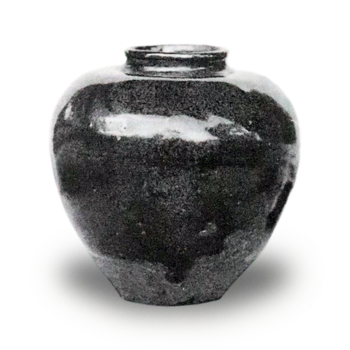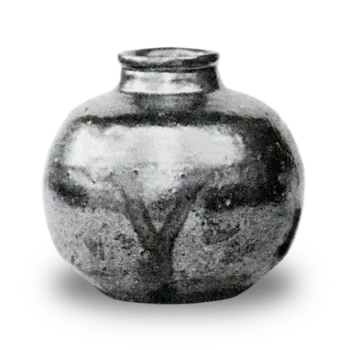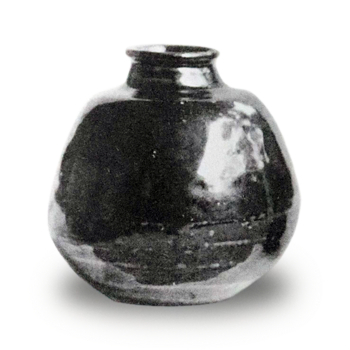


Made in China; Collection: Mr. Ichiro Tamura, Kobe
Origin of the Name
Because this Bunrin tea caddy was passed down through the Satake Marquis family, lords of Akita Castle.
Dimensions (Converted using 1 sun ≈ 3.03 cm and 1 monme ≈ 3.75 g)
Height: Approx. 6.30 cm (2 sun 8 rin)
Body Diameter: Approx. 6.48 cm (2 sun 1 bu 4 rin)
Mouth Diameter: Approx. 2.42 cm (8 bu)
Base Diameter: Approx. 2.73 cm (9 bu)
Koshiki Height: Approx. 0.91 cm (3 bu)
Shoulder Width: Approx. 0.61 cm (2 bu)
Weight: Approx. 68.6 g (18 monme 3 bu)
Accessories
・Lid: 1 (with a recess)
・Wrapping cloth: Purple fukusa
・Storage pouches: 2
Shōō shu-tsu (lining: umi-ki; cord: onado-iro)
Dragon-patterned shu-tsu (lining: iridescent Kai silk; cord: purple)
・Storage box: Unvarnished paulownia wood
“Satake Bunrin Replacement Pouches, Set of Two
Shōō Shūshi
Dragon-Patterned Shūshi”
Inscribed with “Satake Bunrin.”
・Hikiya (cylinder for storing the tea caddy): True lacquer finish
The pouch is made of crumpled leather; the cord is brown.
・Box: Paulownia wood with Tame-nuri (translucent lacquer) finish; decorated with gold powder
“Satake Bunrin”
History
This was a treasure of the Satake family, lords of Akita Castle, but the current owner acquired it at an auction of the family’s collection held on November 5, Taisho 6 (1917).
Record of Actual Inspection
On May 19, Taisho 10 (1921), I had the opportunity to view this item in person at the residence of Mr. Ichiro Tamura in Okudaira, Kobe City.
The mouth is tight with a rounded rim, and the neck is flared. There is a ribbed pattern at the tips of the shoulders, and fine wheel marks run from the body downward. The waist is flared, and the unglazed, mouse-gray clay is visible from the hem downward. The wheel marks form steps on the unglazed clay; the thread-cutting is rough, with misalignments at the starting points, and the rim of the base is slightly worn.
Overall, the yellow glaze and amber-colored glaze are intermingled. From the tip of the shoulder on the front view, a single streak of bluish glaze flows down through the yellow glaze and stops around the waist. The lustrous, dark amber sheen where the glaze has pooled is magnificent. Below the shoulder, there are two spots where the yellow glaze has been left unglazed, resembling drifting clouds, and there is one similar unglazed area (where the clay is exposed) near the body.
Overall, it possesses a beautiful luster and an exquisite appearance, with a level of craftsmanship that is unparalleled. Inside, the glaze covers the rim; below that, the wheel marks are fine and even, and the center of the base forms a swirl pattern.