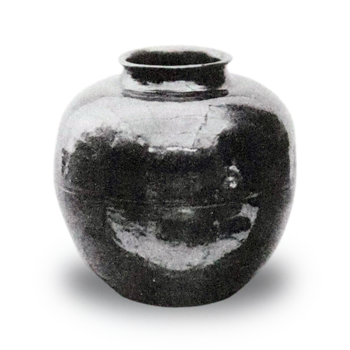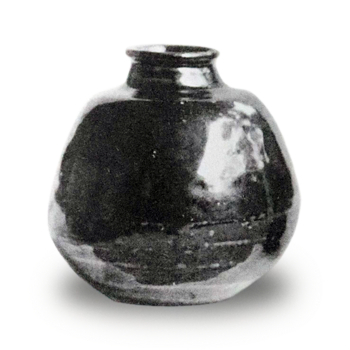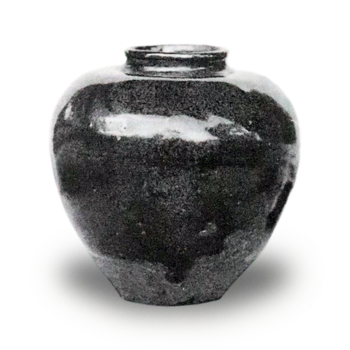


Made in China; Collection of Baron Takayasu Mitsui
Origin of the Name
It is believed that this was originally a Bunrin tea caddy owned by a member of the Oda clan, but the identity of that individual remains unclear.
Dimensions (Converted using 1 sun ≈ 3.03 cm and 1 monme ≈ 3.75 g)
Height: Approx. 6.36 cm (2 sun 1 bu)
Body diameter: approx. 6.36 cm (2 sun 1 bu)
Mouth diameter: approx. 2.73 cm (9 bu)
Base diameter: approx. 2.73 cm (9 bu)
Height of the koshiki (rim): approx. 0.48 cm (1 bu 6 rin)
Weight: approx. 62.6 g (16 monme 7 bu)
Accessories
・Lids: 2 (with indentations)
・Storage pouches: 2
Old Kinran silk with a large peony pattern on a light green ground (lining: Kai silk with a family crest, cord: purple)
Moyō shu-tsu silk (lining: iridescent Kai silk, cord: purple)
・Pouch box: Made of untreated paulownia wood, with a paper label affixed reading “Oda Bunrin Pouch.”
The inner box contains one spare lid.
Box inscription: “Oda Bunrin”
・Hikiya (cylinder for storing the tea caddy): Made of tagayasan wood, with characters in gold powder. Includes a handwritten note by Konoe Yorakuin.
“Bunrin”
The pouch is made of brocade with a Chinese floral pattern on a tea-colored background (the lining is red-and-white vertical-striped satin; the cord is wisteria-colored)
・Box: Made of natural-finished paulownia wood, with a paper inscription affixed to the front in the handwriting of Konoe Yorakuin.
Front: “Oda Bunrin”
Back: A paper label with the vermilion seal “Yomei” is affixed.
Provenance
On June 4, Taishō 7 (1918), it passed into the hands of the current owner (Mr. Takayasu Mitsui) during the first auction of the Konoe Ducal Household’s collection.
Record of Actual Inspection
On June 28, Taishō 9 (1920), I had the opportunity to view the item in person at the residence of Baron Takayasu Mitsui in Kami-Nibanchō, Kōjimachi Ward, Tokyo.
The rim is rounded, with the neck slightly recessed and the shoulders rounded and flared. A single sunken groove runs around the body; from this line downward, the vessel gradually tapers to the base, which rests on a tray (tray-mounted). On the rim, there are traces of repairs from a large crack that extended across one-third of the teapot’s circumference.
Overall, the black amber glaze is uniformly overlaid with a pear-skin color (yellowish brown), and there are areas where the glaze has not adhered—specifically at the tips of the shoulders and near the groove on the body. On the front view, the glaze of the same color flows down to the point where the clay is exposed at the hem and stops there. There is one small instance of “ishi-haze” (small stones visible on the surface) around the waist; from the rim downward, the red-brown clay is exposed, and there are two instances of “hitsuki” (marks where the piece adhered to other vessels inside the kiln). The thread-cut finish is fine and irregular, with a glaze splatter in one corner.
Inside, the glaze covers the rim of the mouth; below that, the wheel marks spiral inward, forming a swirl at the center of the base. The quality of the glaze bears a striking resemblance to Tenmoku glaze in some areas. It feels light in the hand, and given both its shape and glaze color, it can be considered a unique variation among Chinese Bunrin tea caddies.