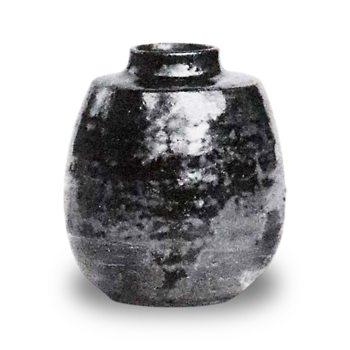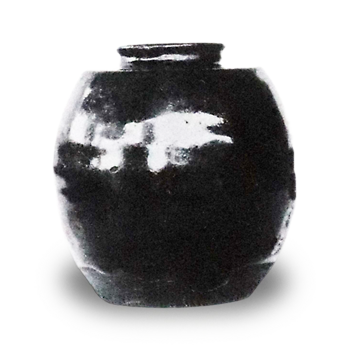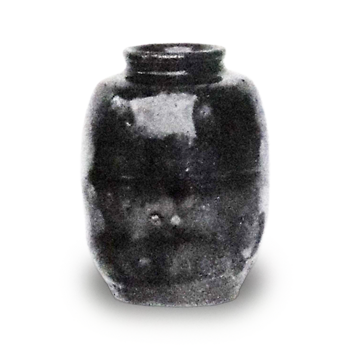


Old Seto, Revival Meibutsu; Collection of Marquis Katsunosuke Inoue
Origin of the Name
It is believed that Kobori Enshū chose this name as a fitting title for this small teapot, which possesses a feminine aura.
Dimensions (in centimeters and grams)
Height: approx. 6.61 cm
Body Diameter: approx. 5.15 cm
Mouth Diameter: approx. 2.76 cm
Base Diameter: approx. 3.33 cm
Koshidaka (Height of the Rim): approx. 0.55 cm
Shoulder Width: approx. 0.67 cm or 0.61 cm
Weight: approx. 93.0 g
Accessories
・Lid: 1 piece (nest-shaped)
・Lid box: Unfinished paulownia wood box, bearing an inscription by Matsudaira Fumai
(Front) “Lady’s Flower” Lid
・Storage pouches: 2
- White ground, single-layer vine-patterned Kinran; lining is “Kaiki”; cord fasteners are purple
Inscription: “Lady’s Flower” - Cantonese horizontal striped interlaced pattern; cord fasteners are wisteria-colored
・Pouch box: Unfinished paulownia wood box, with an inscription by Matsudaira Fumai
“Lady’s Flower Pouch”
・Hikiya: Made of tagayasan wood, with green patina applied to the sunken carving; calligraphy by Kobori Enshū
“Lady’s Flower”
・Inner box: Unfinished paulownia wood box; author of the inscription unknown
Cover: Satin-woven fabric; cord fastener is brown
“Lady’s Flower, Small Shoulder-Rest”
・Outer box: Folding screen-style, lacquered vermilion, with an inscription by Matsudaira Fumai
“Lady’s Flower”
・Main Box: Unfinished paulownia wood box
(Front) Lady’s Flower Tea Jar
・Content of the inscription on the back:
This “Lady’s Flower” tea jar was originally owned by Honda Iyo-no-kami (Lord of Kobe Castle); it was subsequently held by Matsudaira Dewa-no-kami (Fumai), then passed on to Okada Ise-no-kami, and later became a Go-mono (an item belonging to the Imperial Household or the Shogun’s family).
The pouch is made of single-layered white vine-patterned Kinran; the lining is “Tamamushi Kaiki”; and the cord fastener is purple.
Accompanying Letter: One
Record from the 5th month of the Year of the Rat, Tenpō 11 (1840)
The spare pouch (backup cover) is made of Guangdong satin; the lining is “Tamamushi Kaiki”; and the cord fastener is brown.
“Thank you for your hard work today in the rain. I have just finally placed the ‘Higanbana’ tea caddy into a double box; as it was delivered by Mr. Okada, I will immediately hand it over to Mr. Muto’s messenger for delivery to your address. Once you have received it, please pass it on to the appropriate person. The inscription on the box is in the handwriting of Lord Fumai himself, and Mr. Okada has also conveyed this to me. I am writing only the essentials for now. I will explain the details I could not include here in full when we meet. Respectfully yours.
Received on May 26 at the Hour of the Goat (around 2:00 p.m.) and dispatched at an auspicious time. Yoshimura Kan’a (Witness) “Onna-rōka” with attached tassel. To Den’emon-sama”
Deed of Transfer: One Copy
Deed of Transfer
One: The Meibutsu “Lady’s Flower, Small Shoulder-Strike” tea caddy
I have long treasured and carefully preserved the above item, but I am now transferring it to you upon your request.
On an auspicious day in October. On behalf of the Ōtani family: Chizan Yoshiaki (Seal); Toda Yakiri (Intermediary)
To Mr. Heitarō Fujita
Miscellaneous Notes (Various Records)
・Joroka: Old Seto, Revival-Period Meibutsu (formerly owned by Matsudaira Dewa-no-kami): Height 6.61 cm, Body Diameter 5.15 cm, Mouth Diameter 2.76 cm, Base Diameter 3.33 cm. One lid (with a recess). One pouch (white ground, single-layer vine pattern in old-style Kinran, with a “Umi-ki” design on the reverse, and a purple cord). . Hikiya, with amber-colored engraved decoration (“Lady’s Flower”). The pouch is made of satin weave, with the character for “tea” on the lining. The box is made of untreated paulownia wood; the author of the accompanying inscription is unknown. (Includes a diagram of the tea caddy)
・Lady’s Flower Small Katatsuki, Old Seto: A piece passed down from Honda Yoshu-no-kami (Honda Iyo-no-kami). The description of the accessories is the same as in Kokin Meibutsu Ruiju. No diagram of the tea caddy is available. (Meibutsu-ki, Ki Meibutsu Zui by Kusama Waraku)
・Explanation of Ko-Seto: The general term is “Ko-Seto.” It is said that the classifications “O-Seto” and “Ko-Seto” originated from this Ko-Seto. Although these two terms are sometimes distinguished based on shape, this tea caddy is described as “Kose-to” despite its small size. Generally, pieces with a large-scale style that resemble Ko-se-to are called O-se-to. This is due to their antiquity; the “Enjōbō Katatsuki” is an O-se-to and is considered the oldest and highest-grade example. This “Orihime Ko-katatsuki” is similarly classified as an O-se-to. (Yamasumike-hon Chairi-kō)
・Characteristics: Fine specks of black glaze are scattered throughout the surface; the clay texture is coarse, and the “hon-ito-kiri” (traces of thread-cutting) on the bottom are also coarse. Black glaze and amber-colored glaze from the “okigata” (glaze drips) are slightly visible through the gaps. The rim has a plump, rounded shape. (Dan’an Bunko, Volume A, No. 9)
・Inaugural Tea Ceremony on October 6, Bunka 3 (1806) (at Komagura-an; Host: Matsudaira Fumai)
Guests: Gettan-kō (Lord Fumai’s eldest son), Iseya Gonpei, Izumidera Yasaburō
Tokonoma: Calligraphy by Kido
Flower Vase: Antique bronze with handles; inscribed by Kobori Enshū; arranged with camellia blossoms
Tea Jar: Antique Seto “Himehana”; named by Lord Kobori Enshū; a “Meibutsu” (famous tea utensil). Bag: Antique Kinran brocade with small peony pattern
Tea Bowl: Daitoku-ji Wu ware (“Daien-an Tea Gathering Record”)
・Lady’s Thistle, O-Seto: Listed as the first item in the “Meibutsu-nami (Near-Meibutsu)” section.
Since this item is comparable to the “Revival Meibutsu,” it was designated as “Meibutsu-nami.” It is an item worthy of being treasured.
September of the Year of the Goat, Bunka 8 (1811) — Fumai (Unshū Matsudaira Family Utensil Register)
(Note) Although it was listed as a “Kose-to Revival Meibutsu” in the Kokin Meibutsu Ruiju (Compendium of Famous Tea Utensils Through the Ages), written during the Kansei era, it is classified under the “Meibutsu-nami” section in Lord Fumai’s tea utensil transfer register from Bunka 8.
・November 8, Taisho 5 (1916) — Tea Ceremony in Memory of Seigai (Kaoru Inoue) (Hassō-an)
Hanging Scroll: Colored paper by Lord Fujiwara no Toshiyori
Flower Vase: Sutra Case (inscribed with the name of Fujiwara no Toyonari)
Tea Caddy: “Jorōbana”—a Revival-Period Meibutsu
Tea Bowl: “Gantori” by Chōjirō (from Tōto Chakai-ki, Vol. 4, Part 2)
History of Ownership
Originally owned by Honda Iyo-no-kami, lord of Kanbe in Ise Province, it was later passed down to Matsudaira Fumai. Records indicate it was used at a tea ceremony held at Komaku-an on October 6, Bunka 3. It was subsequently transferred to Okada Ise-no-kami and later became part of the collection (shimono) of Higashi Hongan-ji Temple in Kyoto. In Taishō 2 (1913), during an auction of the temple’s collection, the item was reclaimed by a relative (either repurchased or taken by a family member), and was subsequently transferred to Baron Heitarō Fujita of Osaka. It was presented by Baron Fujita to Lord Inoue (Katsunosuke Inoue) on the occasion of his 80th birthday (or possibly to celebrate the birthday of his predecessor, Kaoru).
Field Notes (Record of Actual Observation)
Record of an actual observation made on October 22, Taisho 8 (1919), at the residence of Marquis Katsunosuke Inoue in Miyamura-cho, Azabu Ward, Tokyo.
“Orihime” (Characteristics of the Tea Jar):
The rim is thick, and the fold (kare-gaeshi) is extremely shallow. There is one spot on the rim where it has been repaired with lacquer (kintsugi and lacquer repair). The body is slightly bulging, and around the lower rim, approximately half of the teapot’s circumference is sharply constricted (tapered). Below the lower rim, clay containing iron (iron-rich clay) is visible. There is a firing crack on the base. The glaze has a metallic rust color with a hint of persimmon, tinged slightly with purple, and black glaze appears here and there like flowing clouds. A single black streak runs all the way around the middle of the body. The shoulder area is particularly rich in black glaze, giving it a very beautiful luster. Overall, it has a “compact” appearance and a very refined form. Inside, the glaze covers only the rim of the neck; below that, wheel marks are visible all around. Toward the center of the base, the wheel marks form a Tomoe-style swirl.