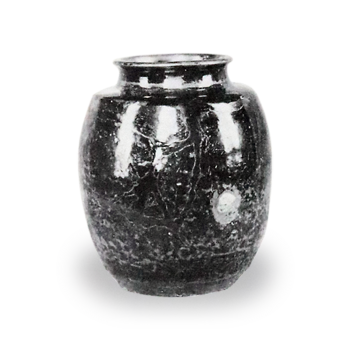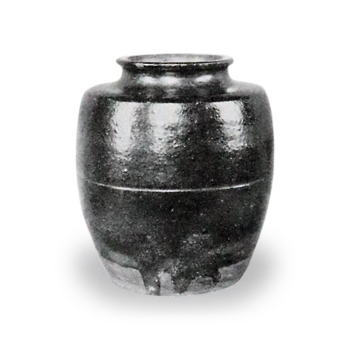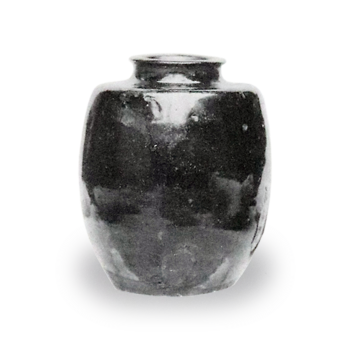
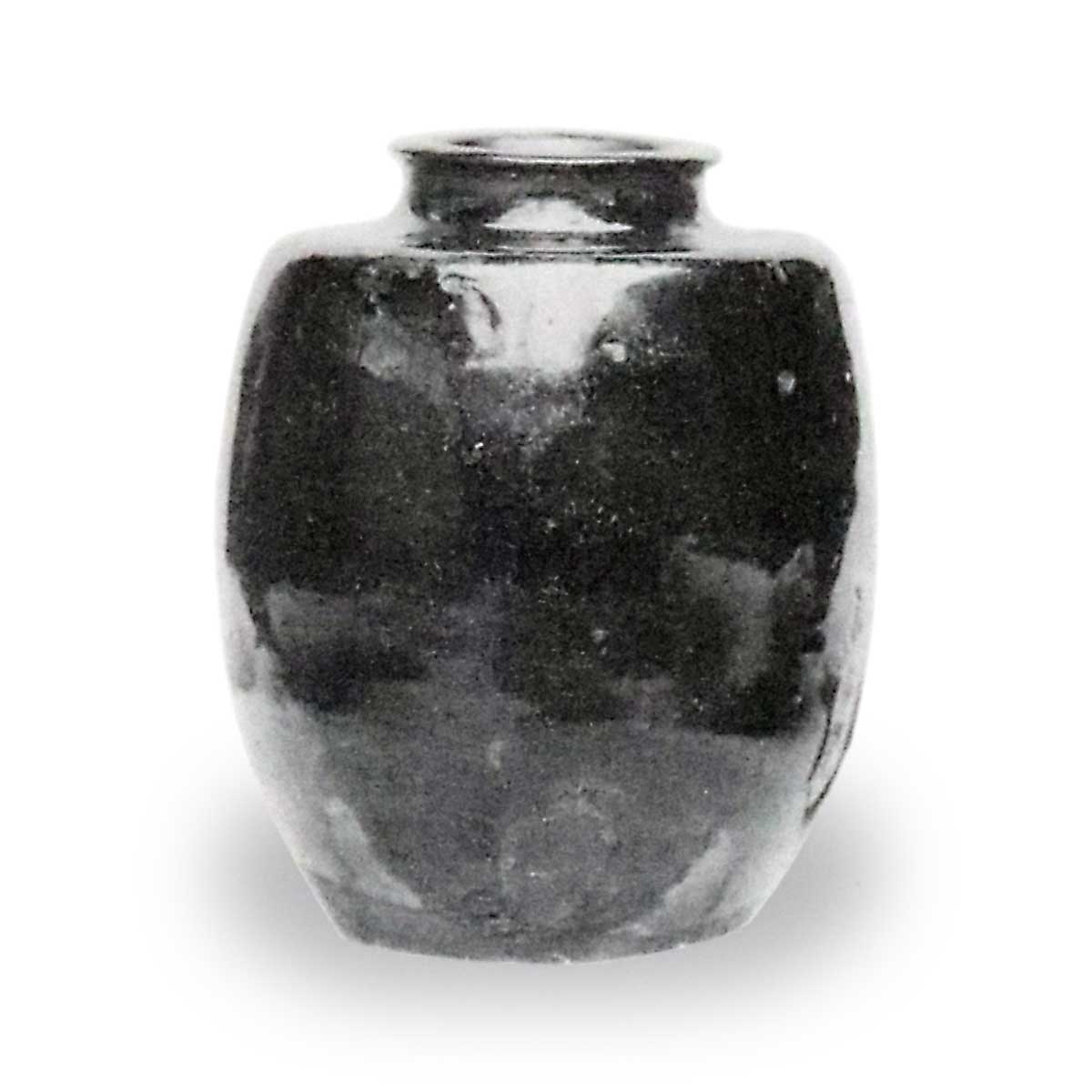
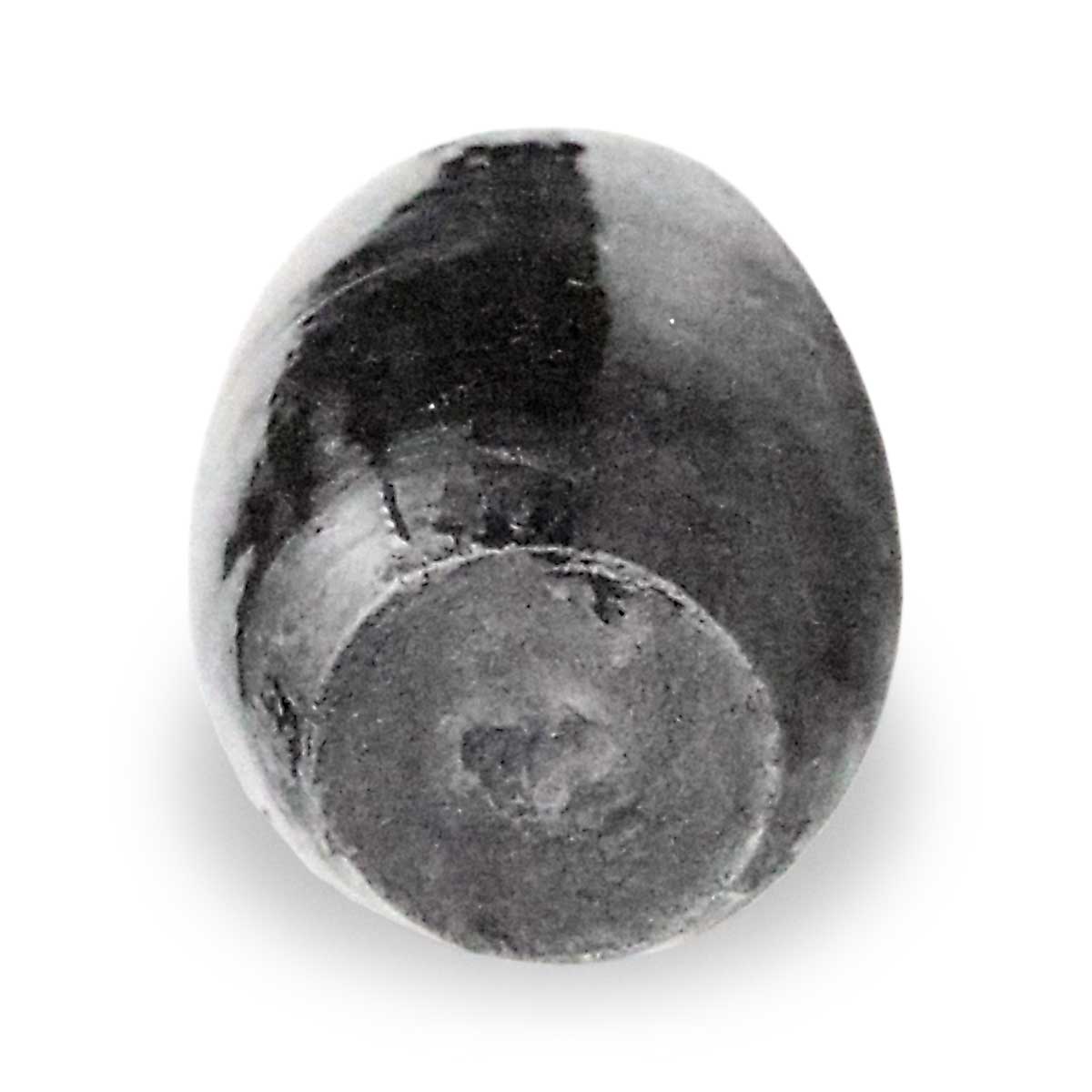
A Daimeibutsu tea caddy made in China (Han-saku), currently held in the collection of Higashi Honganji Temple in Kyoto.
Origin of the Name
This tea caddy is said to be the “Higashi Monzeki Katatsuki” mentioned in historical records of antique tea utensils such as the Ganka Meibutsu Ki and Kokon Meibutsu Ruiju. For the compilation of this illustrated catalog, we have decided to refer to it as the “Honganji Katatsuki.”
Modern Equivalents of Dimensions and Weight
Height: Approx. 8.5 cm (2 sun 8 bu)
Body Diameter: Approx. 7.1 cm (2 sun 3 bu 5 rin)
Mouth Diameter: Approx. 3.3 cm (1 sun 1 bu)
Base diameter: approx. 4.5 cm to 4.2 cm (1 sun 5 bu or 1 sun 4 bu)
Rim height: approx. 0.8 cm (2 bu 5 rin)
Shoulder width: approx. 1.1 cm to just over 1.1 cm (3 bu 5 rin or 3 bu 7 rin)
Weight: approx. 115.5 g (30 monme 8 bu)
List of Accessories
There is one lid. Regarding the storage pouches, the two original pouches are missing, and there are currently two newly made pouches.
The box for storing the pouches is a white paulownia wood box; this is the box that originally contained the old pouches. The box is inscribed with “O-katatsuki-bukuro: Rikyu-style, two without lids.”
The Hikiya is coated in black lacquer and features silver butterfly-shaped fittings. The bag that holds the Hikiya is made of tanned leather and has a long, flower-colored (blue) cord attached. (Note: It is said that the cord attached to this leather bag is very thick and long so that it can be hung around the neck for carrying.)
The box that houses the tea caddy is a plain paulownia wood box with a piece of paper affixed to it bearing the characters “Kata-tsuki.”
Accompanying Letter from Kanamori Sōwa
A letter from Kanamori Sōwa, a tea master of the early Edo period, addressed to Junkei-ji Temple is included. The contents are as follows:
“Dear Sir. Will you be accompanying me to Edo? I received your letter the day before yesterday, for which I am deeply grateful. I was away and was unable to receive it. Now, regarding the tea caddy bag, I brought it over on the 2nd. I have even had a lid made for it. I do not know if it will be to your liking. I am deeply anxious about this. If it does not meet your approval, please let me know, and I will send another. I have placed one wooden mold for the tea caddy and one bag in one box, and the lid in another, and I hereby present them to you. I offer this with the utmost humility.
March 5th, Sōwa (seal)
To Junkei-ji Temple”
The unvarnished paulownia box containing this letter bears the following inscription:
“Katanuki Tea Caddy
July 25, 1783 (Tenmei 3)
To be placed alongside the Tsuru-kubi Tea Caddy, as ordered by His Highness.
A letter from Kanamori Sōwa accompanying the two tea caddies mentioned above”
Entries in Historical Records
The Gankō Meibutsu-ki records it as “Kata-tsuki: Higashimonzeki.”
Furthermore, the Kokin Meibutsu Ruiju records it as “Kata-tsuki: Tang-style Kata-tsuki; Daimeibutsu: Higashimonzeki.”
History of Acquisition and a Meiji-Era Anecdote
It is said that the entry “Katatsuki: Higashimonzeki” in the two books mentioned above likely refers to this tea caddy. It has long been a treasured artifact (shimono) of Higashi Hongan-ji.
In the early Meiji era, when a large-scale auction of items held by Higashi Hongan-ji was held, this Katatsuki tea caddy was also nearly sold.
However, a touching anecdote remains: upon learning of this, the faithful gathered, ascertained the highest bid, purchased it themselves, and immediately returned it to the head temple (Higashi Hongan-ji), thereby preventing its loss.
Academic Inspection Record (Appraisal Record) from the Taisho Era
On May 19, 1920 (Taisho 9), this tea caddy was physically examined at Higashi Hongan-ji in Shichijo, Shimogyo Ward, Kyoto City.
The rim is of the “ryōsogi” style; while the twist is not particularly deep, like the edge of a clam shell, the tip is so sharp it seems it could cut one’s hand. The area below the koshiki (flange) protrudes, the shoulder is slightly chamfered, and the waist is also flared. The base is of the “itaokoshi” construction, with glaze splatter along its rim.
The overall color is dark amber, with a hint of blue-green appearing around the koshiki, and patches of yellow glaze visible in places. The horizontal groove running around the body is partially interrupted; there are areas above and below this groove where the glaze has not adhered (glaze breaks), and similar glaze breaks are also present at the base near the clay surface. The clay body below the rim is vermilion in color.
Inside, the rim is glazed, while below that, coarse wheel marks run across a thin glaze. The base features a “mirror dip” (where the center is slightly sunken).
This is a magnificent tea caddy in pristine condition, free of any flaws. It features an interesting texture, a beautiful luster, and a very well-proportioned appearance.