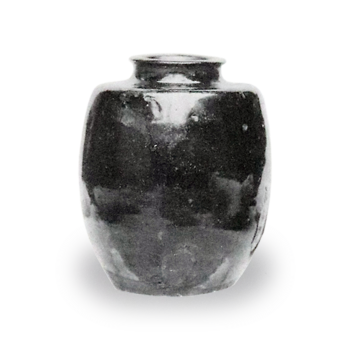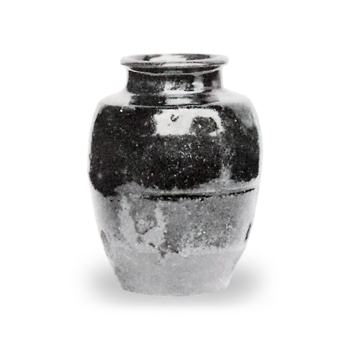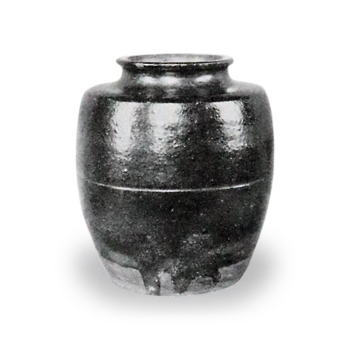
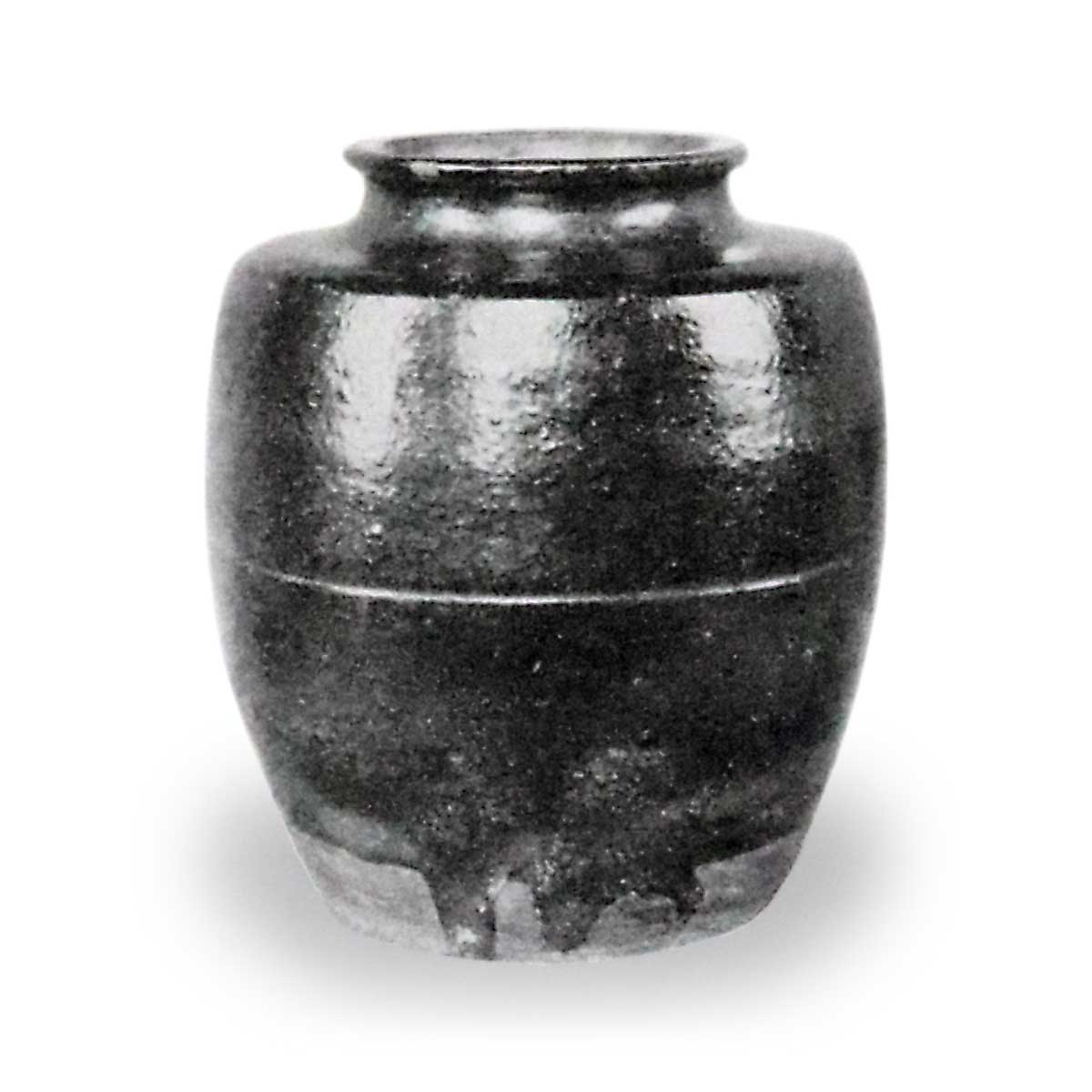
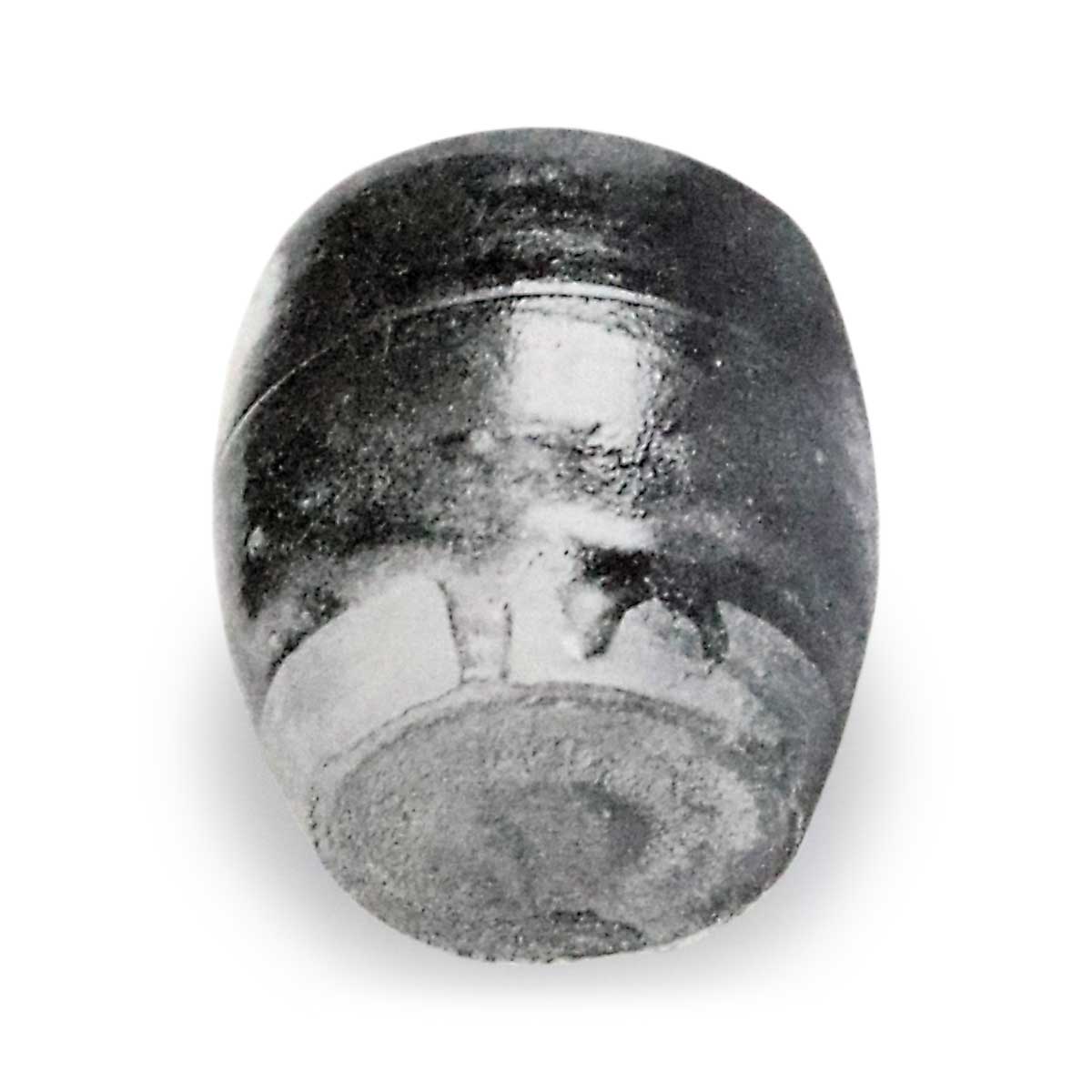

A Daimeibutsu tea caddy made in China (Han-saku), currently in the collection of Duke Tokugawa Ietatsu.
Origin of the Name
It was named after Kasahara Sōzen Wabisuke, a tea master from Sakai, who owned it. A book titled Biographies of Tea Masters (author unknown) states: “Kasahara Jurozaemon Nyudo Sozen lived in Sakai and went by the name Sesshoken Wabisuke. Because he owned this tea caddy, it came to be called ‘Wabisuke.’”
Modern Equivalents of Dimensions and Weight
Height: Approx. 8.2 cm (2 sun 7 bu)
Body Diameter: Approx. 7.1 cm (2 sun 3 bu 5 rin)
Mouth Diameter: Approx. 4.2 cm (1 sun 3 bu 8 rin)
Base Diameter: Approx. 5 cm (1 sun 6 bu 5 rin)
Koshiki Height: Approx. 0.8 cm (2 bu 5 rin)
Shoulder Width: Approx. 1.4 cm (4.5 mm)
Weight: Approx. 133.1 g (35 monme 5 bu)
List of Accessories
The set includes one lid with a recess (kako). The storage pouch is made of white habutae silk.
There are two types of protective covers (bags): “Shiro Donshu” and “Shima Kanton.”
Hikiya is made of chamfered ivory, and the top of the lid is engraved with “Tasuke” and inlaid with verdigris. The pouch for Hikiya is made of Hosokawa Donshu silk.
It comes with an inner box made of untreated paulownia wood and an outer box coated in black lacquer with gold-leaf lettering.
Notes
According to the Meibutsu-ki, the piece weighs approximately 134g (35 monme 8 bu), stands about 7.7cm tall, measures about 7.1cm in width (body), and has a mouth diameter of about 4.2cm. An amber-colored glaze with a mottled pattern pools in places across the surface; the bottom is scraped with a spatula, and a belt-like ridge runs around the middle.
Rinpō-kuryū states: “A Daimeibutsu and a possession of the Shogun’s family. Presented by Matsudaira Mutsu-no-kami (of the Date clan). It has the same shape as a vermilion robe (presumably referring to a bag) with subdued tones. There are pools of persimmon-colored glaze that are yellowish and translucent, with a slightly grainy texture.”
Another record states: “On May 12, Kanbun 9 (1669), Hoshina Higo-no-kami (Masayuki Hoshina) presented it to the Shogunate upon his retirement.” The cover includes two types of fabric: “Donshu” and “Kantō Oriru.” The lid is made of chamfered ivory, and an inscription on the lid’s top suggests, “Since I have received Watasuke, I am immediately presenting Watasuke.”
Characteristics and Origin of the “Watasuke Katatsuki” as Seen in Various Records
According to the Tokugawa family’s catalog, the ivory handle is engraved with the name “Watasuke”; the paulownia wood base box bears no inscription, while the name is written in gold powder on the outer black lacquered box. The base (with a tray) is made of raised wood, and the entire piece is coated with a subdued glaze, with brown glaze pooling where the glaze stops at the waist.
According to the records of Yamagami Sōji, a disciple of Sen no Rikyū (Yamagami Sōji Ki), and the Chaki Meibutsu Shū, it is written that “the Watasuke Katatsuki is currently in the possession of Takayama Ukon (mistakenly written as Sakon), but in the past, it was owned by a tea master named Inseki.”
According to Chajin-den, it was called “Wasuke” because it was owned by Kasahara Sōzen Wasuke (a contemporary of Shōō and Rikyū), who lived in Sakai. It later passed to Takayama Ukon, a Christian daimyō and tea master, then to Matsudaira Mutsu-no-kami (of the Date clan), and was eventually presented to the Shogunate (as an imperial treasure).
It is also introduced in Tenshō Meibutsu-ki and Chajin Taikeizu as a katatsuki once owned by Kasahara Sōzen of Sakai; however, since it had no specific name of its own, it is speculated that it came to be called “Wasuke” after its owner’s name.
The Appearance of the “Wasuke Katatsuki” in Tea Ceremony Records
This tea caddy appears frequently in tea ceremony records spanning the Warring States period through the Azuchi-Momoyama period.
1544 (Tenshō 13): Records indicate that Hisamasa Matsuya and others were invited to a tea gathering hosted by Wasuke Sōzen (Matsuya Hikki).
In the 2nd year of the Kōji era (1556) and the 3rd year of the Eiroku era (1560): According to the diary of Tsuda Sōyuki, a wealthy merchant from Sakai, this “Katatsuki (Watasuke)” was displayed at a tea gathering hosted by Sōzen, who lived in Shinmei-chō.
Eiroku 10 (1567): Tsuda Sōyuki viewed this tea caddy at a tea gathering hosted by Kasahara Sōzen and recorded its appearance in detail. “The shape is fine, and the shoulders are sloping. The size is perhaps a little small. The glaze is black and appears slightly coarse. The clay (body) is white. There is a distinct, single band (line) around the waist. The glaze has seeped slightly onto the inside of the rim, and there is a great deal of glaze run. The glaze on the upper part appears to be the same color as that on the lower part. The pouch is a small-patterned red (vermilion) fabric.”
In 1572 (Genki 3) and 1578 (Tenshō 6), this tea caddy, housed in a bag with a crumpled Kinran-style pattern, was displayed at tea ceremonies hosted by Tasuke Sōzen, to which Tsuda Sōyuki and others were invited.
The Higashiyama Gomono Naibetsuchō also records that there was a period when this tea caddy was in the possession of “Goto Shōzaburō” (a merchant appointed to supply the Edo Shogunate’s Mint).
The Exchange Between Shogun Iemitsu and Date Masamune, and the Gift of “Watasuke”
Numerous accounts in tea ceremony records and historical documents from January of the 12th year of the Kan’ei era (1635) describe the episode in which this “Watasuke Katatsuki” was bestowed by the Shogun upon Date Masamune.
It was either the 21st or the 28th of January. In the tea room (sukiya) located in the Ninomaru of Edo Castle, Date Masamune (Chunagon), the lord of the Sendai domain, hosted a tea ceremony for the third shogun, Tokugawa Iemitsu (Daiju, Daio-ko).
After the meal (gosen) served to the Shogun, the tea utensils were displayed as usual, and Masamune personally prepared tea for the Shogun.
On this day, Shogun Iemitsu bestowed upon Masamune a tea caddy known as “Watasuke” (or “Watasuke”), a Meibutsu. Masamune used this newly received “Watasuke” to prepare tea and entertain the Shogun.
In attendance at this tea ceremony were Shirakawa Nagashige, Niwa Nagahide (Saemon-gorō), Mōri Hidemoto, and the physician Dōsan Hōin. Paintings of the “Two Great Characters” and the “Two Great Warriors” were hung in the tokonoma, a celadon vase was used for the flowers, and “Yoshino” tea bowls were served.
After the tea ceremony, Masamune presented the Shogun with a small wakizashi and a katana from the famous “Hisakuni” series as a token of gratitude.
(Multiple records, including Yamamoto Dōku Kokusho, Kinshin Genkōroku, Date-ke Chika Kiroku, and Kansei Shūshū Shokafu, describe the events of this day.)
Subsequent History (From the Date Clan to the Shogunate, and Then to Hoshina Masayuki)
Thus, the sword “Watasuke” came into the possession of Date Masamune (Matsudaira Mutsu-no-kami), but when Masamune’s grandson, Date Tsunamune, succeeded to the family headship in the first year of Manji (1658), he presented this “Wasuke” tea caddy—along with the famous sword “Tama”—to the Shogunate as a memento of his father (Tadamune), and it once again became a treasured possession of the Shogunate ( Sekkenso Chadō Wakugei, Ganka Meibutsu Ki, Kansei Shūshū Shokafu).
Later, in the 4th year of Kanbun (1664), the 4th Shogun, Tokugawa Ietsuna, personally bestowed this “Wasuke Katatsuki” upon Hoshina Masayuki (Matsudaira Higo-no-kami, Iemitsu’s half-brother), the Lord of the Aizu Domain and a renowned statesman who served as an advisor to the Shogun.
However, in Kanbun 9 (1669), when Hoshina Masayuki was granted permission to retire—a long-cherished wish of his—he returned (presented) this “Wasuke” tea caddy, which he had once received, to the Shogunate along with the famous sword “Raikokumitsu” and a document written in Minamoto no Yoshitsune’s own hand as a token of gratitude (Kansei Shūshū Shokafu).
Masayuki Hoshina demonstrated a scrupulous attitude, stating, “It is precisely because I received ‘Tasuke’ that I am returning it to the shogunate upon my retirement.”
Details of the Return (Presentation) by Masayuki Hoshina
On May 12, 1669 (Kanbun 9), Masayuki Hoshina’s son, Masayasu, presented a tachi sword and gold to the shogun as a token of gratitude for inheriting the family headship.
On the same day, Hoshina Masayuki (Higo-no-kami), who had been granted permission to retire, also presented a tachi sword and kimonos to the Shogun as a token of gratitude. Additionally, he returned (presented) the famous sword “Kokuko,” a document written in the hand of Minamoto no Yoshitsune, and this “Watasuke” tea caddy, which he had previously received from the Shogun.
The biography of Hoshina Masayuki, Hatsu Gyōjō (written by Yamazaki Kama (Anzai)), records the following:
“Lord Masayuki was the son of the Second Shogun, Hidetada, the younger brother of the Third Shogun, Iemitsu, and the uncle of the Fourth Shogun, Ietsuna. When Lord Iemitsu passed away and the young Lord Ietsuna became shogun, Lord Masayuki assisted him and made important decisions regarding the nation’s governance. The shogunate held Lord Masayuki in special favor, and the shogun himself would sometimes prepare tea to express his appreciation for his efforts. On one occasion, the Shogun personally bestowed upon him the “Tosuke Katatsuki.” This is the finest piece among tea utensils, renowned throughout the land for its prestige and value.”
Use at Shogunate Tea Ceremonies
After returning to the Shogunate’s treasury, the “Tosuke” was used at important Shogunate tea ceremonies.
March 28, 1673 (Kanbun 13): It was used at a tea ceremony held in the Seiko Room of the Kuro-shoin at Edo Castle to entertain the Kii Chūnagon (of the Kishū Tokugawa family). On this occasion, Ii Naozumi (Sōbe-no-kami) and Sakai Tadakiyo (Gagaku-no-kami) were in attendance, and the Shogun himself arranged flowers in the garden (Gosen) and prepared the tea. Tasuke’s tea caddy was accompanied by a “Shiraki Donshu” pouch, and a “Mishima Hake-me” tea bowl was used.
March 26, 1676 (Enpō 4): It was used at a tea ceremony held in the same Kuro-shōin to entertain the Chūnagon of Owari (Owari Tokugawa family). On this occasion, the hanging scroll was “Hakujon Dan-ko,” the flower vase was a celadon “Kinzashi,” and the tea bowl was a Goryeo “Myojo.”
Summary of its History
The “Yamagami Soji Ki” states, “It is now in the possession of Takayama Ukon, but in the past it belonged to Inshaku.” Later, it became the property of Kasahara Sōzen Tasuke of Sakai, and became widely known by the name “Tasuke Katatsuki.”
After that, it appears to have been passed down to Takayama Ukon and then to Goto Shōzaburō, a merchant who amassed a vast fortune after being entrusted with the Edo Shogunate’s Kanza (coin mint). Since Shōzaburō was on such good terms with Tokugawa Ieyasu that he was frequently granted tea by him, it was likely presented to the shogunate by him.
In 1635 (Kan’ei 12), when Date Masamune entertained Shogun Iemitsu and prepared tea for him, with Nawa Nagahide and Mōri Hidemoto in attendance, Masamune received this “Tasuke Katatsuki” as a gift from the shogun.
However, in the first year of Manji (1658), Masamune’s grandson, Date Tsunamune, presented it once again to the shogunate as a memento of his father (Tadamune).
Later, in the fourth year of Kanbun (1664), the fourth shogun, Tokugawa Ietsuna, personally presented it to the renowned statesman Hoshina Masayuki; however, when Masayuki retired in the ninth year of Kanbun (1669), it was returned to the shogunate. This is why the Tokugawa family’s inventory records state that “Hoshina Higo-no-kami presented it upon his retirement.”
Thereafter, it was used in important tea ceremonies when Shogun Ietsuna entertained the Kishu Tokugawa and Owari Tokugawa families. Since then, it has been passed down within the Tokugawa family without ever leaving the shogunate’s treasury, and remains in the family to this day (the Taisho era).
Academic Inspection Report (Appraisal Record) from the Taisho Era
On November 8, 1918 (Taisho 7), this tea caddy was physically examined at the residence of Duke Ietatsu Tokugawa in Sendagaya, Tokyo.
As a Chinese-made “Hansaku” katatsuki tea caddy, it falls into the slightly smaller category. The shoulders are not overly pronounced, and the lower section (base) does not taper excessively.
The exterior is entirely a deep, subdued persimmon color, with areas of a clear, blackish hue within it. A single sunken horizontal line (shimuki) runs all the way around the center of the body. Near the hem of the front (the focal point), there is an area where a grayish-white glaze spreads unevenly. The base is made with a raised-plate construction, but it is worn down in places.
Overall, there are few striking visual features, and the areas around the base where the clay has flaked off, giving it a slightly worn and aged appearance, are truly befitting of the simple and unassuming name “Wabisuke.”
At first glance, it appears plump and unassuming, evoking a sense of warmth and calm, as if one were meeting a simple, honest, and down-to-earth elderly countryman. This is arguably the most distinctive feature of this tea caddy.
Inside, the overall dark-colored glaze has lost its luster.