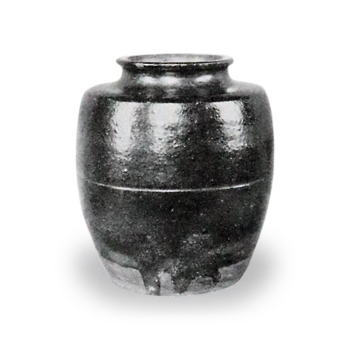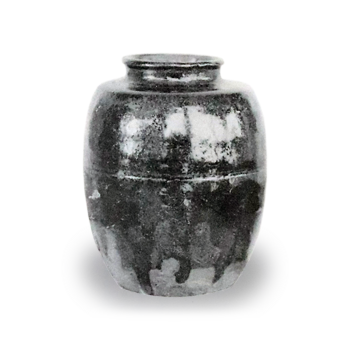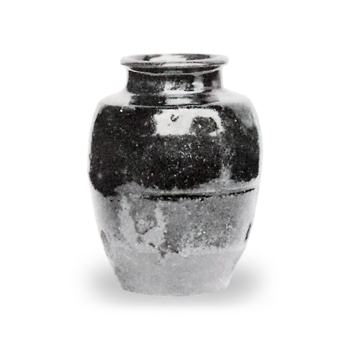


A Daimeibutsu tea caddy made in China (Han-saku), currently in the collection of Marquis Maeda Toshiyuki.
Origin of the Name
This tea caddy was once owned by a man named Nakagawa Sohan and was also known as the “Nakagawa Katatsuki.” It is said that when Sen no Rikyū owned it, it was called “Hotaru” (Firefly), a name attributed to the reddish hue on the bottom of the caddy. Nakagawa Sōhan was a senior retainer of the Lord of the Kaga Domain, Marquis Maeda (Maeda Toshiie), who achieved numerous military exploits; it is said that his wife was Toshiie’s daughter.
Modern Equivalents of Dimensions and Weight
Height: Approx. 8.5 cm (2 sun 8 bu)
Body Diameter: Approx. 6.5 cm (2 sun 1 bu 6 rin)
Mouth diameter: approx. 3.9 cm (1 sun 3 bu)
Base diameter: approx. 3.9 cm – 4.1 cm (1 sun 3 bu or 1 sun 3 bu 5 rin)
Koshiki (rim) height: approx. 1.1 cm (3 bu 8 rin)
Shoulder width: approx. 1.1 cm (3 bu 5 rin)
Weight: approx. 118.5 g (31 monme 6 bu)
List of Accessories
There are three lids, and a nest (kago) is included. The storage pouch is made of brown silk, and the cord is also brown.
There are four types of protective covers (pouches).
・Flower-patterned Donshu fabric with a double carp crest (Shiraki-donsu): The lining is damaged, and the cord is an extremely rare item.
・Donshu fabric with a two-crane crest on a Donshu ground (Sho-o Donshu): The lining is kaiki (silk fabric), and the cord is purple.
・Aoki Kantō: The lining is damaged, and the cord is purple.
・Kantō-ori-dome: The lining is brown kaiki, and the cord is yellow.
In addition to these, there is a storage bag (daikeitō Kinran) for wrapping the tea caddy. The black lacquered box containing the bag features characters written in gold powder.
Hikiya is made of black persimmon wood, with a glossy lacquer finish on the inside and a gold-inlaid ground on the rim and bottom. The characters “Sōhan” are carved in relief and inlaid with gold. The bag containing Hikiya is made of striped shusu silk.
The inner box is made of untreated paulownia wood. A piece of paper affixed to the underside of the lid reads: “Made in China. Sōhan Katatsuki (written in red). Formerly owned by Mahekado; reportedly once owned by Nakagawa Sōhan; other provenance details exist.” (Note: “Mahekado” is a dialect term from the Kaga region meaning “former” or “original.”)
The outer box is also made of untreated paulownia wood.
Miscellaneous Notes
Regarding the Sōhan Katatsuki. Made in China (Han-do). The lower glaze is a persimmon color with a reddish tint, and the upper glaze is black. The base (with a tray) shows traces of thread cutting in the opposite direction. On the display side (the front, which is the focal point), a faint “Jakat (scaly kiln change)” pattern can be seen extending from the right shoulder to the body. The base features a section where the red glaze appears to have been “washed out” (akano nuke), and the body has a single, incomplete horizontal band (obi). The portion where this band is clearly visible is 3.9 sun (approx. 11.8 cm) in length. The rim shows traces of a spatula on the inside, and the counter-clockwise thread-cutting marks (traces of where it was cut from the wheel) are exquisite. It is a tall, sleek (tsuki-takaki) piece.
When it was in the possession of Sen no Rikyū, it was called “Hotaru” (Firefly). (From The Maeda Marquis Family’s Inventory of Utensils and The Maeda Family’s Record of Stored Treasures)
Records in Other Ancient Tea Books
・Ganka Meibutsu Ki: Owned by Nakagawa Sōhan. A red inscription states, “Owned by Honda Awa, a retainer of Matsudaira Inuchiyo (a descendant of Maeda Toshiie).”
・Kokin Meibutsu Ruiju: A Daimeibutsu (Chinese import). Owned by Matsudaira Kaga-no-kami (of the Maeda family). Records include its height, body dimensions, a Han-dong bag, and a Kurokaki-style Hikiya.
・Enshu Hisho Dogu Teikan: The base is an amber-colored glaze, over which a “Jakatuyu” (snake-scorpion glaze) is applied. “Jakatsu” refers to a glaze that changes color in a bubbly pattern. The clay body has a purplish hue, and traces of thread-cutting are characteristic of Sōhan’s katatsuki ware. It features a single cascading pattern known as “Ichitasuki Nadare.” All of these pieces are counted among the “Senmai-dōgu” (tools worth a thousand ryō or a thousand pieces).
Historical Background Regarding Nakagawa Sōhan
The Nankai Bunko Edition of the Chronicles of Various Families contains a passage suggesting that Nakagawa Sōhan plotted a rebellion at Daishōji Castle, which was ruled by the Maeda brothers. “Nakagawa Sōhan, a cousin of Maeda Toshikatsu, had been on friendly terms with Ōtani Yoshitsugu for some time. To meet with Yoshitsugu and assure him of his loyalty, he traveled all the way to the capital and then down to Echizen to visit Ōtani’s camp. However, Otani Yoshitsugu intended to exploit this situation; he captured Nakagawa Sōhan and forced him to write a false letter (a treasonous document) addressed to the Maeda brothers’ camp.” This account records a tense incident from the Warring States period.
The Transmission of Secret Tea Ceremony Teachings and Meibutsu Tea Utensils
The Kissa Yoroku contains a record regarding the transmission of the “Shin no Daisu,” the ultimate secret teaching of the tea ceremony. This was passed down from Murata Jukō to Furuichi Harima-no-kami, and then to the ancestors of the Matsuya family. Because the Kaga Chūnagon (the Maeda family) desired this secret teaching, in March of Keian 4 (1651), Matsuya Hisashige traveled to Kaga. Records indicate that the transmission took place in a solemn setting: he was served tea in a two-mat tea room where a calligraphy scroll by Fujiwara no Teika hung in the tokonoma, and items such as the Sōhan Katatsuki were displayed.
Transmission and Modern Exhibitions
Originally owned by Nakagawa Sōhan, a retainer of the Maeda family, it was presented to the feudal lord (the Maeda family) and has since been carefully preserved as a treasure (shimono) of the Maeda family.
In April 1902 (Meiji 35), it was exhibited at a special exhibition held by the Art Association in Ueno Park, Tokyo. Furthermore, on July 10, 1915, it was displayed alongside another Meibutsu, the “Kime Katatsuki,” at a tea ceremony held in the “Chikurin-an” tea room within the Art Association.
On November 25, 1919, this tea caddy was examined in person at the residence of Marquis Toshiyuki Maeda in Hongo Ward, Tokyo.
The rim is wide and thickly constructed, with a shallow flared edge. Unlike other tea caddies of a similar type, the body does not protrude very roundly; instead, it is slender and has a slightly barrel-like shape (barrel form). A single line runs around the boundary of the “koshi” (the section where the rim meets the body).
The entire piece is covered in a dark amber glaze, but within this, “jakatsu-yu” (a beautiful, scaly kiln change) appears here and there, drifting from the shoulder to the body, and its luster is exceptionally beautiful and exquisite.
The sun-suji (a horizontally indented line) in the center of the body runs around approximately half of the teapot’s circumference. From the lower rim downward, the reddish-brown clay body is visible, and fine thread-cutting marks are present. In the center of the base, there is a spot that is particularly reddish; this is likely the reason why this tea caddy was given the elegant name “Firefly” (Hotaru) when it was in the possession of Sen no Rikyū.
Additionally, at the base near the clay (the boundary between the glaze and the clay), there are two areas of “hima” (unglazed sections where the clay is visible) where persimmon-colored and metallic luster (a metallic sheen) blend with the dark amber glaze.
Inside, the rim is glazed, while the area below features coarse wheel marks, and the center of the base has a ring-like shape.
As a Chinese “Han-style” tea caddy, it falls into the slightly slender category and possesses a great many distinctive features, making it a rare tea caddy with a style unlike any other.