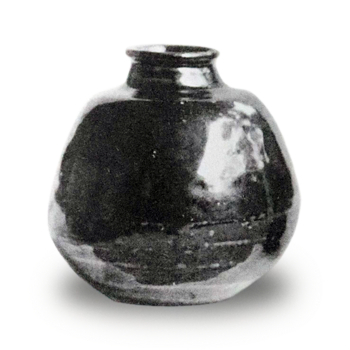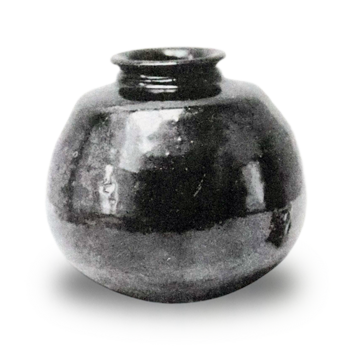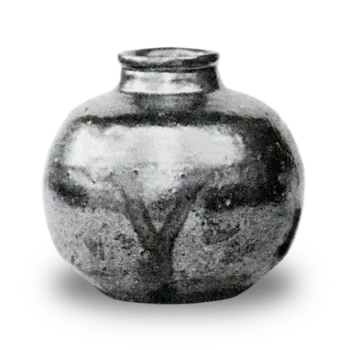


Made in China; Collection: Ryuko-in, Kyoto
Origin of the Name
This tea caddy was originally located in Tsukushi (Kyushu), which is why it was given this name.
Dimensions (Converted using 1 sun ≈ 3.03 cm and 1 monme ≈ 3.75 g)
Height: Approx. 6.06 cm (2 sun)
Body Diameter: Approx. 6.42 cm (2 sun 1 bu 2 rin)
Mouth Diameter: Approx. 2.42 cm (8 bu)
Base Diameter: Approx. 2.73 cm (9 bu) or Approx. 2.58 cm (8 bu 5 rin)
Koshiki Height: Approx. 0.82 cm (2 bu 7 rin)
Weight: 63.0 g (16 monme 8 bu)
Accessories
・Lid: 1 (with a recessed center)
・Storage pouch: Light green “Treasure Motif” satin (lining has a heavily worn appearance; cord is purple)
・Box: Unvarnished paulownia wood, with an inscription by Monk Suigan
“Chikushi Bunrin”
“Pouch: Light Green ‘Treasure Motif’ Satin”
“Daitō-an”
・Accompanying note: 1
“Chikushi Bunrin”
Made in China; Bunrin tea caddy
Inscription by Monk Suigan Sōmin on the lid of the box
“Chikushi Bunrin”
“Pouch: Treasure-motif satin on a pale green ground”
“Daitō-an” (Daitō-an is the hermitage name of Tsuda Sōtatsu, the father of Tsuda Sōyuki)
・Accompanying tray: Black-lacquered, rounded-rimmed tray with a wheel-flower and diamond-shaped design
Approx. 15.45 cm (5 sun 1 bu) in height, approx. 21.82 cm (7 sun 2 bu) in width; base measures approx. 17.27 cm (5 sun 7 bu) in height and approx. 11.21 cm (3 sun 7 bu) in width
・Tray Case: Paulownia wood with Shunkei lacquer finish
Miscellaneous Notes
Chikushi Bunrin: A treasure of Ryukō-in Temple. The lid of the case bears an inscription by Priest Suiganmin that reads: “Chikushi Bunrin; pouch made of moegi-colored ‘treasure-filled’ satin; Dōtsū-an.” Dōtsū-an is the hermitage name of Tsuda Sōtatsu, the father of Tsuda Sōyuki.
(From Tōrin-sen Meishō Zue)
Chikushi Bunrin: A treasured artifact passed down from his founding master, Monk Kogetsu, and currently in his possession.
(From Meikiryoku)
On September 25, Tenmei 8 (1788), I went on a tour of Daitoku-ji. I climbed the mountain at 4:30, went to Zui-gen-in, and then, guided by the Chief Monk Ken, toured the various temples within the mountain precincts. At Ryuko-in, a tea ceremony was held with a hanging scroll by Mikian on display, and after the ceremony, I was shown the tea utensils. They were as follows:
Ido chawan, Yōhen tenmoku, Yuteki tenmoku, Aogai tennichi-dai, Sōyuki’s nine teapots, Chikushi Bunrin, Tsuru no Kubi (flower vase), Shunkei-lacquered gourd, diamond-shaped tray, tray with a red interior, Yamawari tray, and a tea scoop by Sōyuki.
A total of 12 items.
(From Yōkō Nikki by Sakai Gagaku-no-kami Sōga)
Provenance
The inscription “Daitō-an” on the box by Priest Suigan is said to be the hermitage name of Tsuda Sōtatsu. In other words, this tea caddy was originally owned by Sōtatsu, passed down from him to Priest Kōgetsu, and eventually became a treasure of Ryūkō-in.
The Yōkō Nikki records that in September of Tenmei 8 (1788), Sakai Gakudō Muneyoshi, the lord of the Himeji Domain, viewed this item along with other renowned tea utensils at Ryūkō-in.
(Note) While the generally accepted theory is that Sōtatsu was the father of Tsuda Sōyuki, an entry dated May 11, Eiroku 9 (1566) in the Imai Sōkyū Nikki states: “On April 11 of this year, Sōtatsu changed his name to Sōkyū (possibly a mistake for Sōyuki).” If this is the case, “Sōtatsu” may have been Sōyuki’s former name; however, as there is no clear evidence to support this, I have included it here for reference only.
Firsthand Account (Record of Actual Observation)
On May 16, Taisho 9 (1920), I viewed this piece in person at Ryukō-in, Daitoku-ji Temple, in Murasaki-no, Kamigyō-ku, Kyoto.
The rim is rounded with a shallow outward curve; the neck protrudes slightly, the shoulders are gently sloping, the body is full, and it tapers toward the base. The form is exceptionally beautiful for a Bunrin piece. The clay beneath the rim is exposed in a vermilion-brown hue; part of the rim at the base is worn down, and the thread-cutting marks are fine and very distinct.
Shallow wheel marks run around the body, and near the rim there are horizontal spatula marks shaped like bamboo leaves. There are also spatula marks around the base, and the craftsmanship is extremely skillful.
The overall color is persimmon-hued with a metallic luster (kinki). Two streams of black, amber-colored glaze flow down—one from the tip of the shoulder and the other from the body—converging at the rim and stopping where the bowl meets the tray. The luster of the areas where the glaze has pooled is exceptionally beautiful. There is also a similar glaze splatter on the tip of the opposite shoulder.
Inside, the glaze covers the rim of the mouth, while below that, the wheel marks spiral inward, forming a swirl at the center of the base. Overall, it has an interesting, soft and supple form with smooth undulations, and with details such as the horizontal spatula marks around the rim, this tea caddy fully embodies the aesthetic of the tea ceremony.