

From the collection of Baron Takashi Masuda, an island-based collector
Name
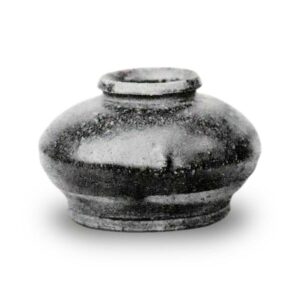
It is said to have been named because the shape of the tea caddy resembles a turtle.
Dimensions
*Height: approx. 6.0 cm (1 sun 9 bu 8 rin)
*Body diameter: approx. 9.4 cm (3 sun 1 bu)
*Mouth diameter: approx. 3.9 cm (1 sun 3 bu)
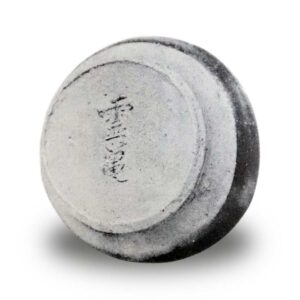
*Base diameter: approx. 6.1 cm (2 sun 1 rin) *The two characters “Reiki” are written in vermilion lacquer on the base
*Height of the koshiki (stand): approx. 1.0 cm (3 bu 2 rin)
*Weight: approx. 139.9 g (37 monme 3 bu)
Accessories
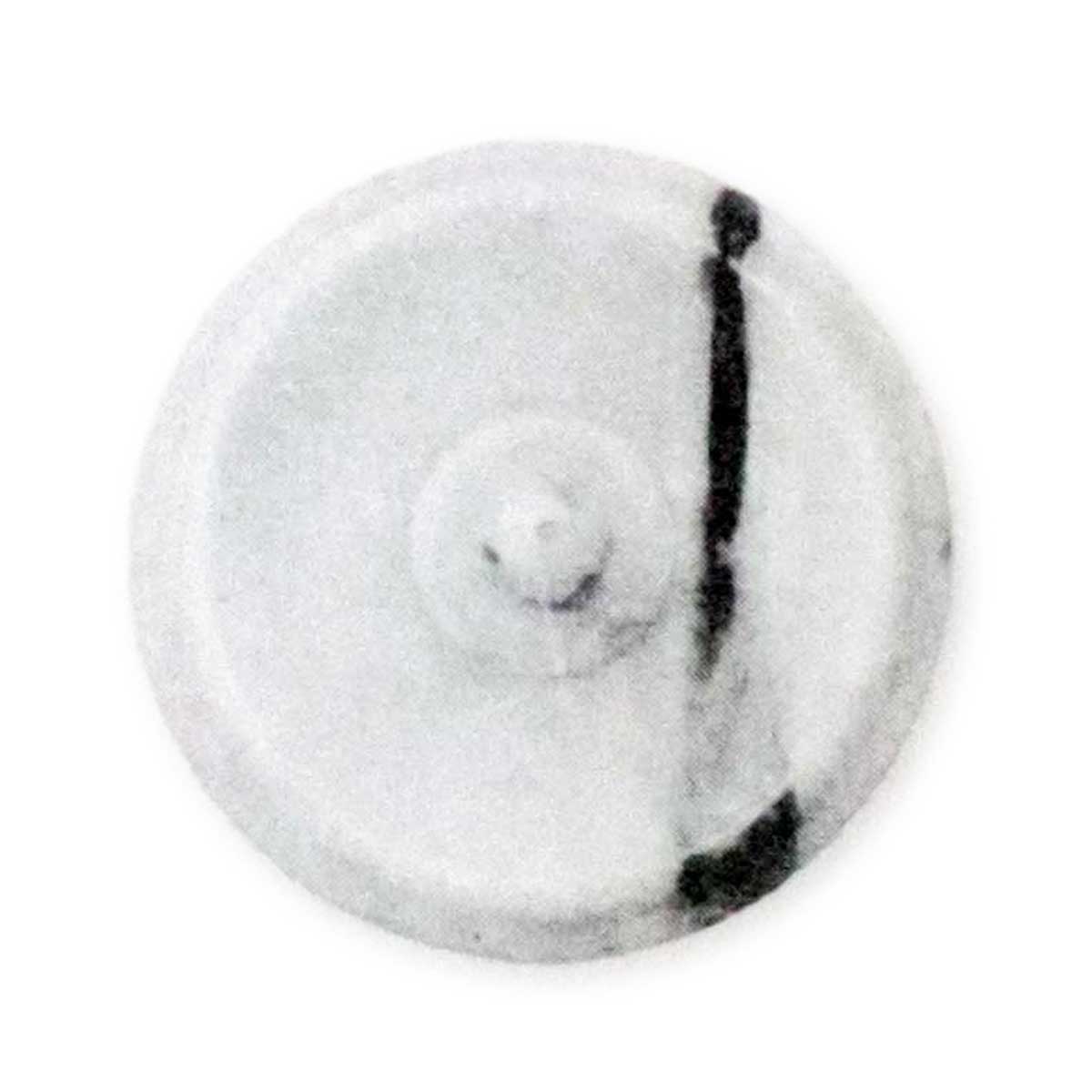
*Lid: 1 (with a recess)
*Pouches: 4
Tortoiseshell-patterned Donshu pouch (brown Hoku-silk lining, wisteria-colored tie cord)
Brown-ground tortoiseshell-patterned Shu-chin pouch (iridescent lining, purple tie cord)
Plum-bowl-patterned Donshu pouch (light brown tie cord)
Purple-thread mesh pouch (purple tie cord)
*Pouch boxes: Paulownia, natural finish, 2 pieces
“Pouch” “Spirit Tortoise”
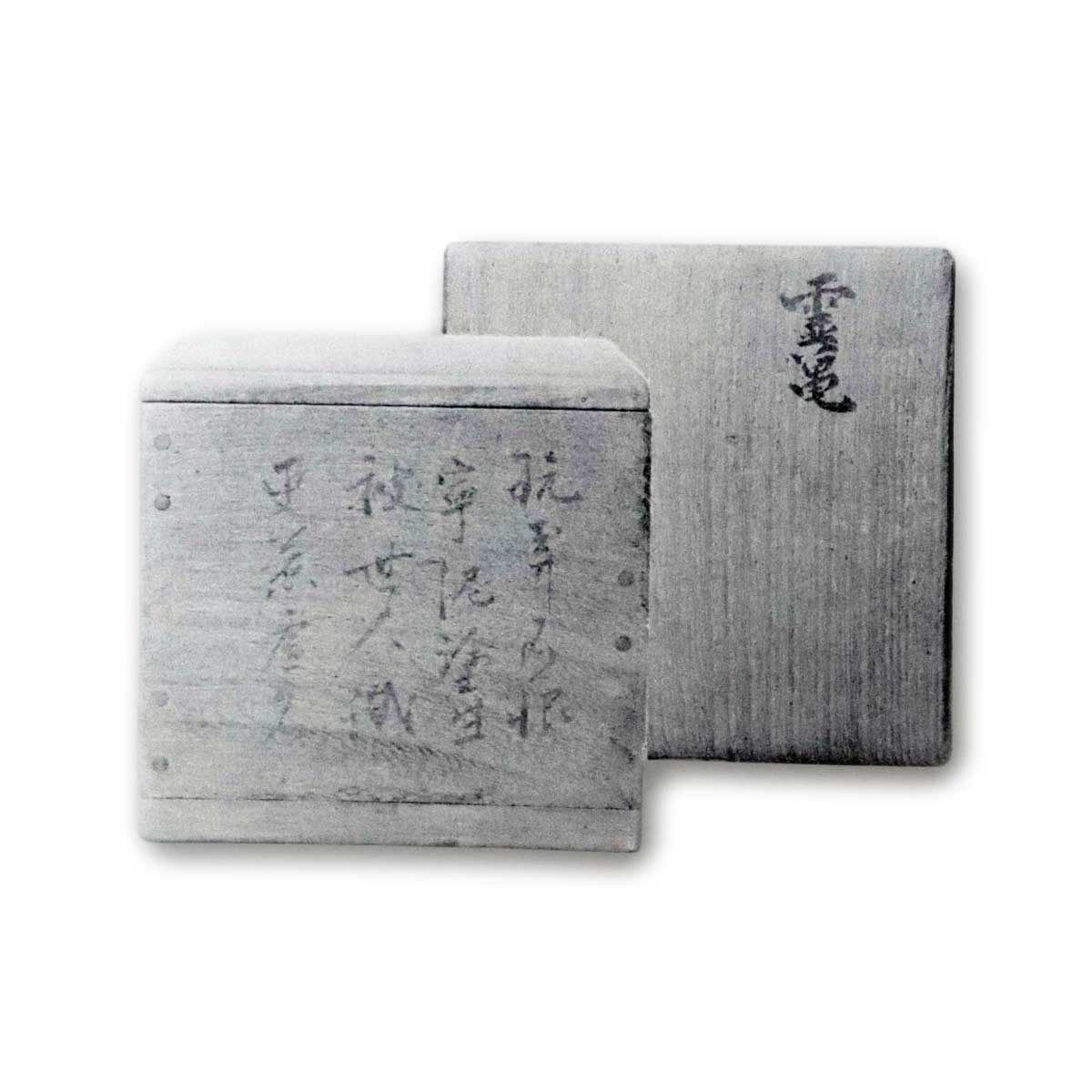
*Box: Paulownia, natural finish, with iron lock
“Spirit Tortoise”
The following inscription appears on all four sides of the box’s body (written by Monk Kogetsu)
“A certain person kept a jar in secret and named it ‘Spirit Tortoise.’ When I asked why, he replied that it was because its shape resembled a tortoise. I said, ‘When the King of Chu summoned Zhuangzi, Zhuangzi remarked, “It is said that in Chu there is a divine tortoise. Though it has been dead for three thousand years, the King keeps it in a box and stores it in the ancestral hall. Which would this tortoise prefer: to be revered after death, leaving only its bones behind, or to live, dragging its tail through the mud?”’ The messenger replied, ‘It would surely prefer to live, dragging its tail through the mud.’ Zhuangzi said, “I, too, shall choose to drag my tail in the mud (live freely rather than serve in official capacity).” He composed a short poem, also titled “Dragging the Tail.”
“It is resented to be toyed with. I would rather live in the mud. If I were known to the world, it would only bring about even more hollow fame.”
*Supplementary Scroll: Written by Hayashi Dōshun (Rōzan)
“The elderly Mr. Kobori Sōfu (Enshū) goes by the literary name Da-yu. One day, he told me, ‘I have a teapot for grinding tea. Its shape is plump and resembles a turtle (Zōroku), so I named its back “Spirit Turtle.” This is taken from the “Divine Turtle of the King of Chu” mentioned by Zhuangzi. Unless this Spirit Turtle encounters someone with a discerning eye, is it not like a turtle dragging its tail through the mud? But once it has encountered a connoisseur, is it not like something wrapped in cloth, placed in a box, and enshrined in a hall? If one caresses and admires it, and takes a liking to it, is it not like piercing a hole in the tortoise shell with an awl, scorching it with fire, and using it for divination? This is the reason for the name. Please write an inscription for this purpose.” I replied, “The sword spirit of Toyoshi only attained fame as a renowned sword after encountering Lei Huan. The wood left unburned beneath the hearth only became the Jiaowei zither after Cai Yong came along. Now, might the encounter between the Spirit Tortoise and Da You (of Yuanzhou) also fall into this category? After all, a shell must crack to yield a pearl; a rough stone must be split to produce a jade disc; a mountain tree must be felled to become a great beam; and bamboo from Kunlun must be cut to produce the sound of the phoenix. Without destruction, how could there be creation? If there were no loss, how could there be gain? Which is better: to hide oneself among water and stones, or to become a vessel of treasure that benefits the world? Which is better: to rot away in the depths alongside nameless grasses, or to become fine timber that builds a nation? Yet, in the course of being put to use, there is always a turning point in one’s fate. Ah, is it a matter of time and fate? That is why the sages of old lamented the burning of fine timber as torches and pitied its waste. Truly, there is good reason for this. All things are like this. The Spirit Tortoise is no exception. When Zang Wenzhong kept it, it became nothing more than an empty vessel and was condemned by the sages. When the Grand Diviner held it, it became a divine instrument, capable of resolving doubts regarding fortune and misfortune. Whether it achieves success and brings benefit depends solely on how people use it. Da You (of Enshu) emerged from the scholarly circles and, together with Lu Yu, Lu Tong, Ding Wei, and Cai Xiang—the masters of tea—used it to engage in tea competitions. Behind it lies Xuanwu (the guardian deity of the north, taking the form of a tortoise and a snake); its military strategy is modeled after the constellations. The “Three Arrangements”—the timing of Heaven, the advantage of Earth, and the harmony of Man—are contained within it. Resting while encircling the tortoise signifies that the military camp is situated in Gaoyang. The “Nine Terrains” (various types of terrain) are present within it. Everyone admires it—this is the harmony and joy of human affairs. Commands are issued from within it. Here, the three elements—the right time, the advantage of the terrain, and the harmony of the people—are all in place. If one brews with flowing water, attacks with a lively fire, gathers at the pool of hot water, and tests with spear-shaped tea leaves, victory in the battle of tea is assured. And one cannot help but realize this by analogy. This is most desirable. I cannot help but reflect: if this is so, then even though its name is borrowed from the words of Zhuangzi, is it not truly wonderful that this rare vessel is, in reality, treasured as a jewel of the tea ceremony? Stories like that of Mount Penglai on the back of a soft-shelled turtle belong to the realm of immortals beyond the mundane world and are not matters to be discussed here and now.”
Summer of Kan’ei Hei-shi (Kan’ei 13, 1636)
Written by Chōdō Dōshun (Hayashi Razan)
(Seal) (Seal)
Miscellaneous Notes
Record of the Spirit Tortoise, Kan’ei 13, Hayashi Nobukatsu (Razan)
The elderly Kobori Sōho, whose literary name was Daiyū, told me: “I have a tea-grinding jar. Its shape is rounded and resembles a tortoise (Zōroku), so I named its back ‘Spirit Tortoise.’ (The rest is omitted. As per the previous appendix.)”
(From Rōzan Bunsū and Jijitsu Bunhen)
Reikyū—Island-style piece—owned by Kobori Izumi-no-kami (Enshū). Height: approx. 6.0 cm (approx. 2.7 cm in some places); body diameter: approx. 9.2 cm (approx. 2.4 cm in some places); mouth diameter: approx. 3.9 cm; lid height: approx. 0.9 cm; base diameter: approx. 7.0 cm. The characters “Reiki” are written in vermilion on the bottom of the tea caddy. There are inscriptions on all four sides of the box, in the handwriting of Priest Kōgetsu (the inscriptions are omitted here). A note in vermilion states: “This inscription does not appear to be in the handwriting of Priest Kōgetsu; it looks like the handwriting of the person who copied it, but I have transcribed it as is.”
(From Tōan Bunko, No. 13, Series A)
Reiki: Inscribed on the box in the handwriting of Monk Kōgetsu.
(Year unknown) Morning of June 19
(From Edo Otsukura Kizai-sha and Enshū Zōchō)
Guests: Kira Wakasa, Itakura Suō, Arima Genba, Igarashi Sōrin
*Hanging scroll: “Quail” by Makkei; landscape by Sesshū
*Flower vase: “Yoshino Mountain” (for orchids)
*Tea caddy: “Reiki”
*Tea bowl: “Cloud-patterned blue-and-white”
(From Enshū Chado Hyakukai)
Reiki: Three Imperial Chests
(From Kamio Storehouse Ledger)
Reiki: Luzon (Luzon). Copy of the inventory of the Kashima family’s collection in Fukagawa, dated July 2, Meiji 35 (1902).
(From Tsurezure no Tomo by Matsuyama Seika)
December 2, Meiji 41 (1908) — First
Tea Ceremony for Masuda Takashi’s 60th Birthday
[First Session]
*Hanging Scroll: A small Ogura-style paper scroll by Teika, passed down from the retainers of Honda Sado-no-kami (Maeda of Kaga)
[Second Session]
*Flower Vase: A single-layered cut vase by Enshū; flowers: camellia
*Tea Caddy: Reiki; the box bears a poem by Kogetsu. The pouch is made of ran-kinu silk; accompanied by a scroll by Hayashi Razan.
*Tea Bowl: Handmade “Dontaro” by Genso
(From the same source)
Provenance
Originally owned by Kobori Enshu, it was passed down to Kamio Wakasa-no-kami. It subsequently became part of the collection of Kashima Seizaemon of Kiba, Fukagawa, Edo, and was transferred directly from the Kashima family to the Masuda family around Meiji 35 (1902).
Record of Actual Inspection
On July 18, Taisho 9 (1920), I inspected the item in person at the residence of Baron Takao Masuda in Gotenyama, Shinagawa, Tokyo Prefecture.
The rim is shaped like a rain-sliced edge; the neck is extremely short; the shoulders are broad and gently sloping; and the body tapers downward from the shoulders. The base is circular, and in the center of the flat bottom are the two characters “Reiki” (霊亀) written in vermilion lacquer by the brush of Priest Kogetsu. The overall matte black glaze is dotted with white specks resembling grains of sand. From the rim downward, the pale gray clay is exposed, and a band of spatula marks encircles the circular base. Inside, the glaze covers only the rim; below that, coarse wheel marks are visible. It is what is known as “island ware” (produced in Southeast Asia and other regions) and possesses the rustic charm of coarse clay typical of Luzon pots. Named for its resemblance to a turtle, it was elevated to the ranks of Meibutsu through the combined efforts of Kobori Enshū, Priest Kōgetsu, and Hayashi Dōshun (Razan), and can be described as a unique and rare piece.

