

Meibutsu of the Revival Period: From the Collection of Marquis Teruhisa Komatsu
Name
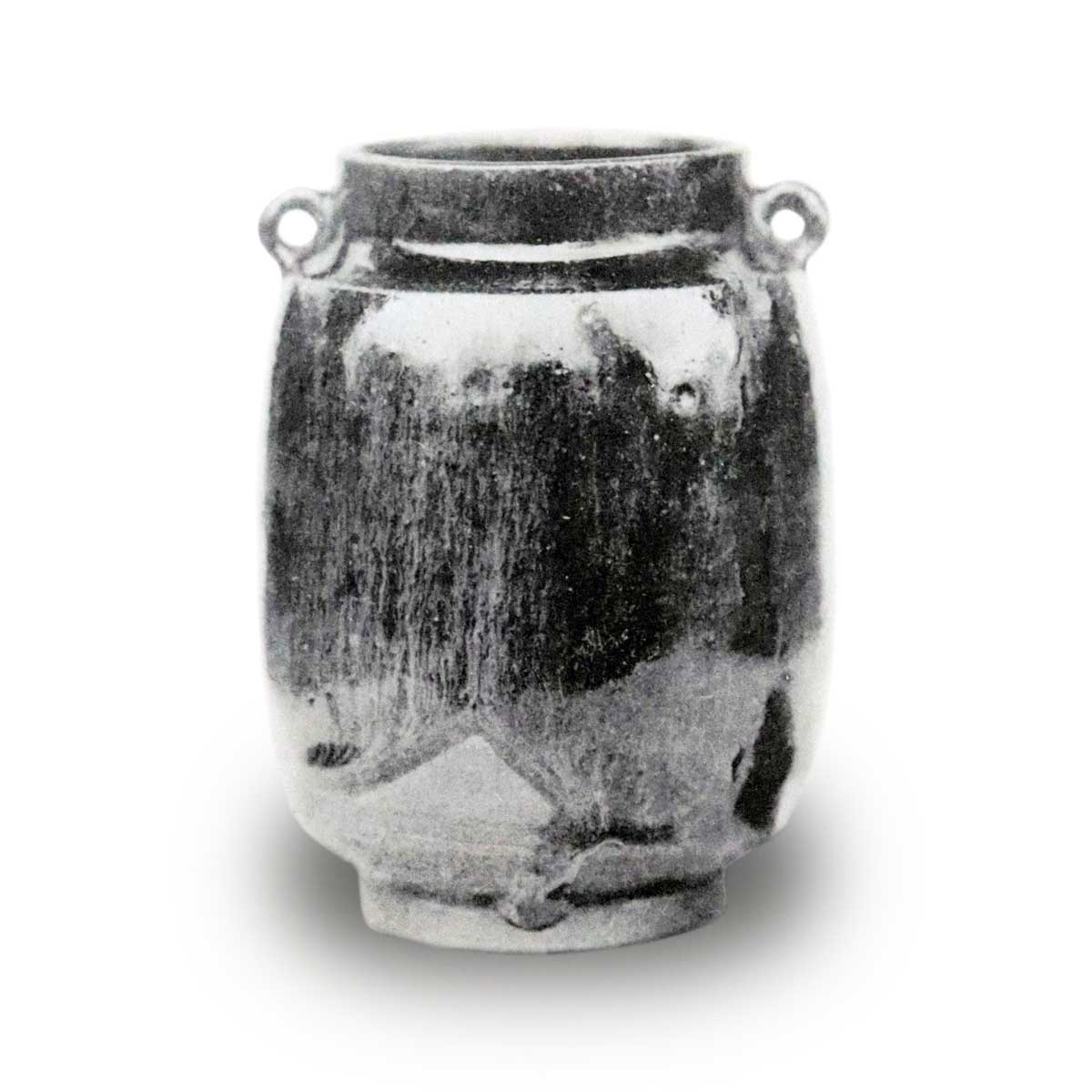
Since ancient times, tea masters have referred to pottery originating from southern China, the South Seas Islands, or the Indian subcontinent—whose exact place of origin cannot be clearly identified—as “Shimamono.” This pottery is characterized by coarse, brittle clay and a dull, muted glaze. Since items whose true nature is unclear are generally classified under the “Shimamono” category, the variety is vast, and some pieces are quite irregular in form. This Shimamono Pot with Ears, for example, has a beautiful glaze color and luster that sets it apart from ordinary Shimamono pieces; however, it was likely regarded as a type of Shimamono simply because its place of origin is unknown.
Dimensions
Height: Approx. 9.5 cm (3 sun 1 bu 5 rin)
Body diameter: approx. 7.4 cm (2 sun 4 bu 3 rin)
Mouth diameter: approx. 5.2 cm (1 sun 7 bu)
Base diameter: approx. 4.5 cm (1 sun 5 bu)
Height of the neck: approx. 1.1 cm (3 bu 5 rin)
Shoulder width: approx. 0.7 cm (2 bu 2 rin)
Weight: Approx. 208.9 g (55 monme 7 bu)
Accessories
・Lid: 1 piece, with a “su” (pattern)
・Storage pouch: Peach-colored chirimen (crepe silk); tying cord is pale yellow
・Pouches: 2
Ozaka Shokkin (lining is pale yellow “Kaiki”; tying cord is purple)
Ishidatami Donshu (lined with iridescent “kaiki” silk; purple drawstring)
・Storage boxes: Paulownia wood, natural finish—2 pieces
(Bordered text) “Shima-mimi-tsuki Bag”
One of the storage boxes contains the two bags shown on the right; the other storage box contains no bags
・Hikiya (cylinder for storing the tea caddy): Tagayasan wood
Pouch: Champa (Cochin) (Lining: light yellow ground with Donshu arabesque pattern; cord: purple)
・Inner Box: Paulownia, black “kaki-awase-nuri” lacquer with gold-powder lettering
(Bordered) “Shima-mimi-tsuki”
・Outer Box: Paulownia, blue lacquer with chamfered vermilion edges
(Bordered) “Shima-mono, Mimi-tsuki, Tea Jar”
Miscellaneous Notes
Shima-mimi-tsuki—formerly owned by Kobori Enshū. Height including circular base: approx. 9.5 cm (3 sun 1 bu 3 rin); body: approx. 7.3 cm (2 sun 4 bu); mouth diameter: approx. 5.1 cm (1 sun 6 bu 9 rin); base diameter: approx. 4.7 cm (1 sun 5 bu 4 rin); height of circular base: approx. 0.8 cm (2 bu 5 rin). The lid is a single piece with a depression. It comes with one pouch, a round ha-ni-bi-e pouch with a two-tone design of white and peach on opposite sides (the tying cord is flower-colored). Hikiya is made of ironwood, and the pouch is made of champa (the tying cord is purple). The box is made of paulownia wood with black-scraped lacquer, inscribed with “Shima-mimi-tsuki” in gold powder. A single vertical streak of black glaze runs around the vessel. (Illustration of the tea caddy available)
(From Meibutsu-ki)
Shima-mimi-tsuki: A Revival-Period Masterpiece (The descriptions of dimensions and accessories are the same as in Meibutsu-ki. It is listed at the end of the section on later kiln-fired national ware.)
(From Kokon Meibutsu Ruiju)
Shima-mimi-tsuki: Currently in the possession of Prince Komatsu.
(From Shoke Meiki Shū)
History of Ownership
Originally owned by Kobori Enshū, it was passed down within the same family for a long time, but in Meiji 18 (1885), it was presented to the Komatsu Palace by Yamamura Kanenori.
Record of Actual Observation
On May 10, Taishō 10 (1921), I viewed the actual piece at the residence of Marquis Teruhisa Komatsu in Hashiba-chō, Asakusa Ward, Tokyo City.
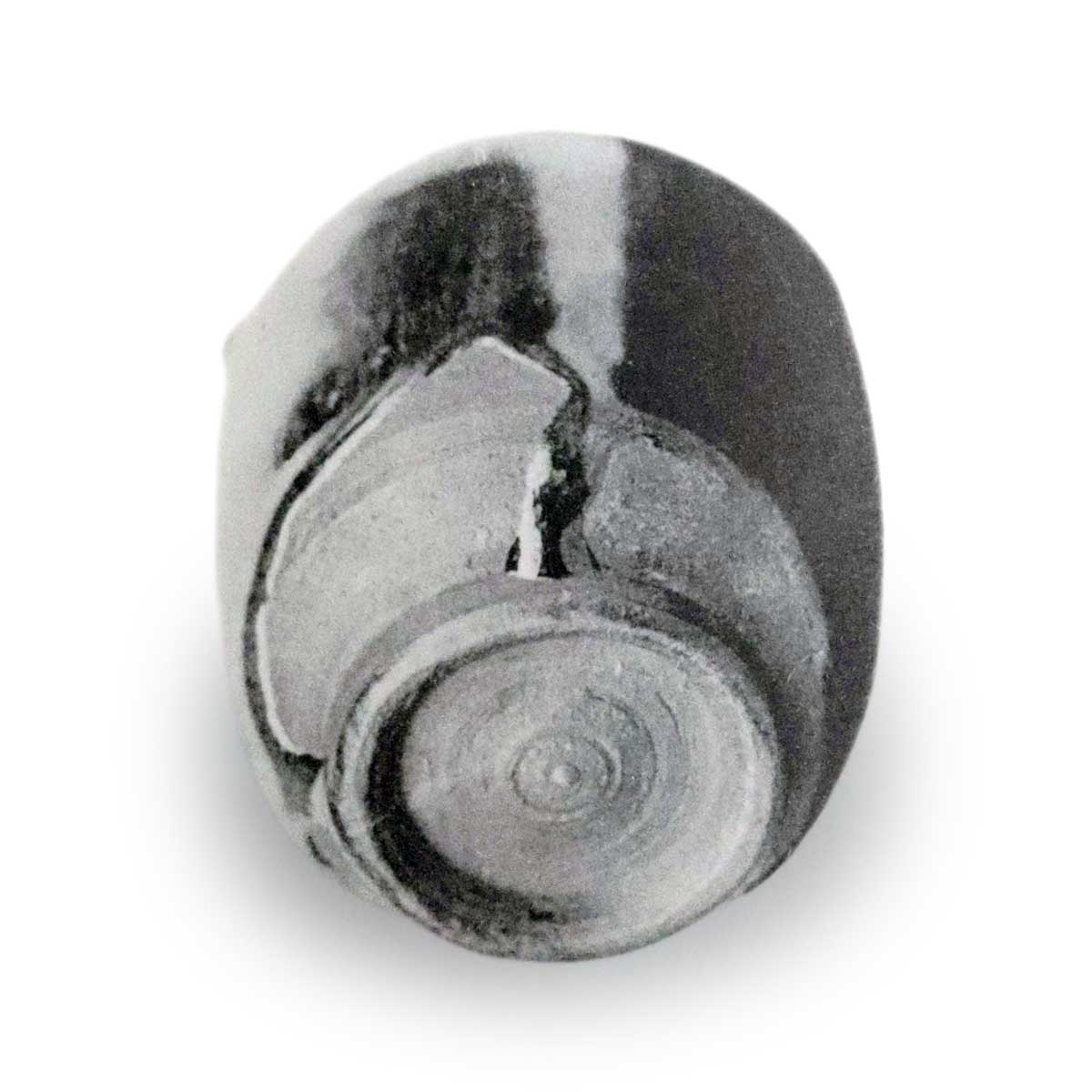
The rim is flat and thin, with small, round loop-shaped handles attached opposite each other at the edge of the bowl. The shoulders protrude sharply (katatsuki), and the waist is slightly flared; the clay, covered with a reddish water glaze (a thin glaze), appears irregularly around the base. The base is circular with a rounded rim; the inner surface features a ring-shaped thread mark, and the center is slightly raised.
Against an overall yellowish amber background, bluish vertical stripes—similar to those seen in Karatsu ware—appear across the entire surface. The glaze stops are slightly thick around the rim, and in two places the glaze has cascaded down to the edge of the base, where it stops; the color and luster of the glaze are truly magnificent.
Shallow wheel marks run around the body, and there is a large repair where the piece was split in two between the two handles and then rejoined. The interior is entirely glazed, just like the exterior; the wheel marks are extremely shallow, the center of the base is slightly sunken, and it features two concentric rings of yellow glaze. For a Shima-mono piece, it exhibits an unusually rich glaze color and luster; combined with the hard, dense quality of the clay and the fact that the entire interior is glazed, it appears to be a truly unique piece.

