
Island Ware (from Southeast Asia) — Collection of Mr. Kyohei Umakoshi, Tokyo
Name
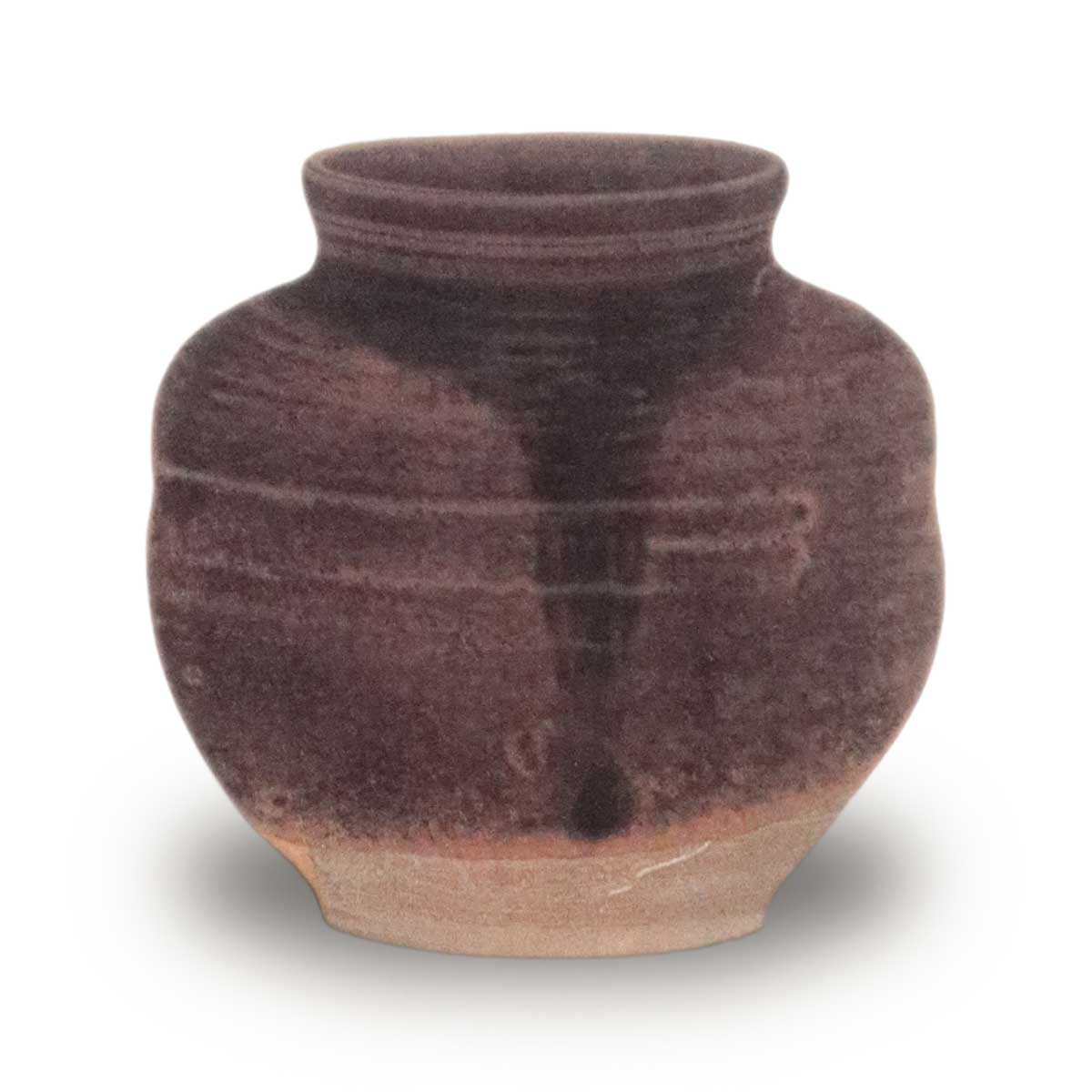
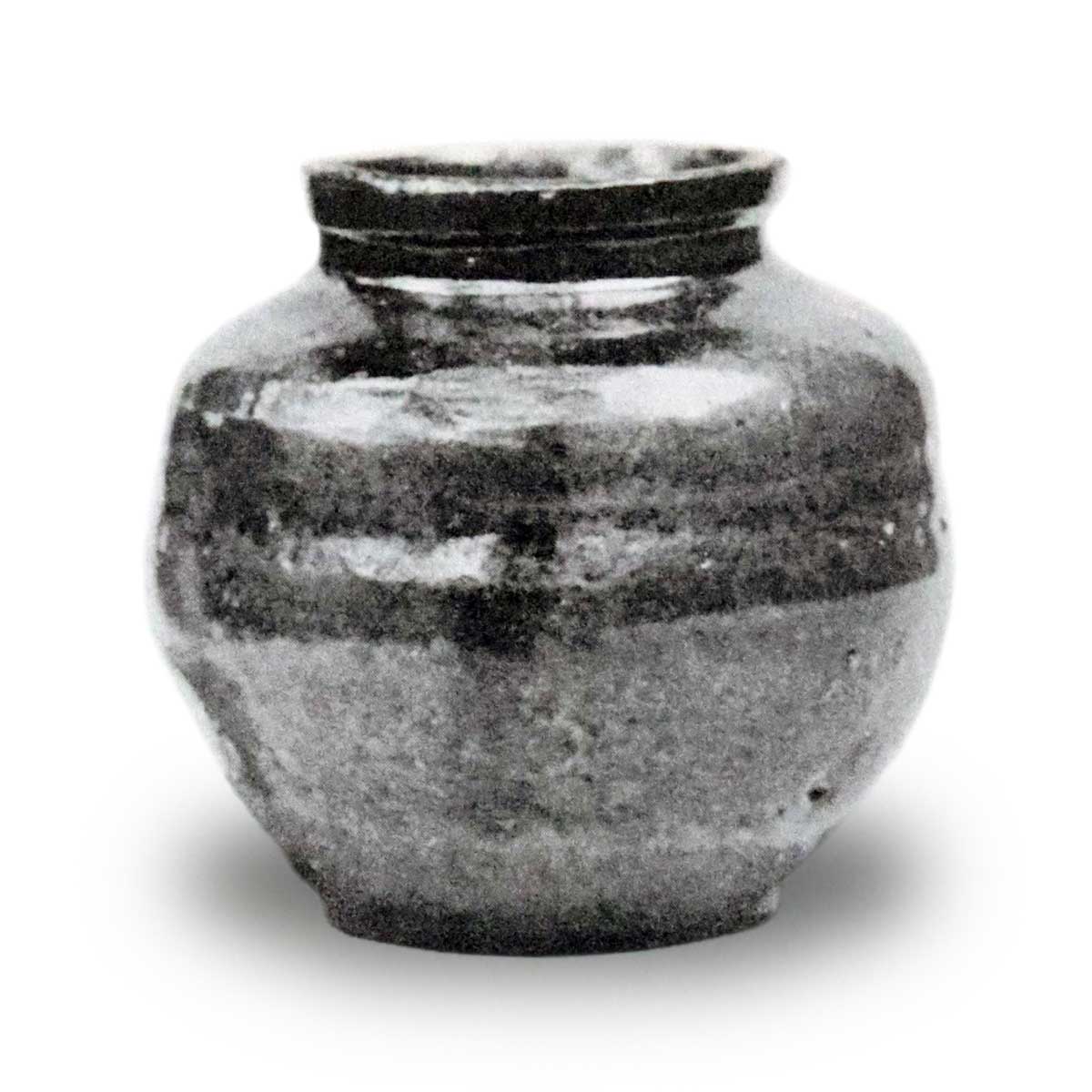
Named for the tea caddy’s tall, protruding body.
Dimensions
Height: Approx. 6.5 cm (2 sun 1 bu 6 rin) or Approx. 6.6 cm (2 sun 1 bu 9 rin)
Body diameter: Approx. 6.8 cm (2 sun 2 bu 5 rin) at the waist
Mouth diameter: Approx. 4.1 cm (1 sun 3 bu 5 rin)
Base diameter: approx. 3.9 cm (1 sun 3 bu)
Height of the neck (koshiki): approx. 1.0 cm (3 bu 2 rin) or approx. 0.9 cm (3 bu)
Weight: approx. 87.6 g (23 monme 3 bu 5 rin)
Accessories
・Lid: 1, with a pattern (su)
・Pouches: 2
Striped Guangdong (lining: “Kaiki” with family crest; tying cord: purple)
Light yellow ground with Donshu floral pattern (lining: iridescent; tying cord: purple)
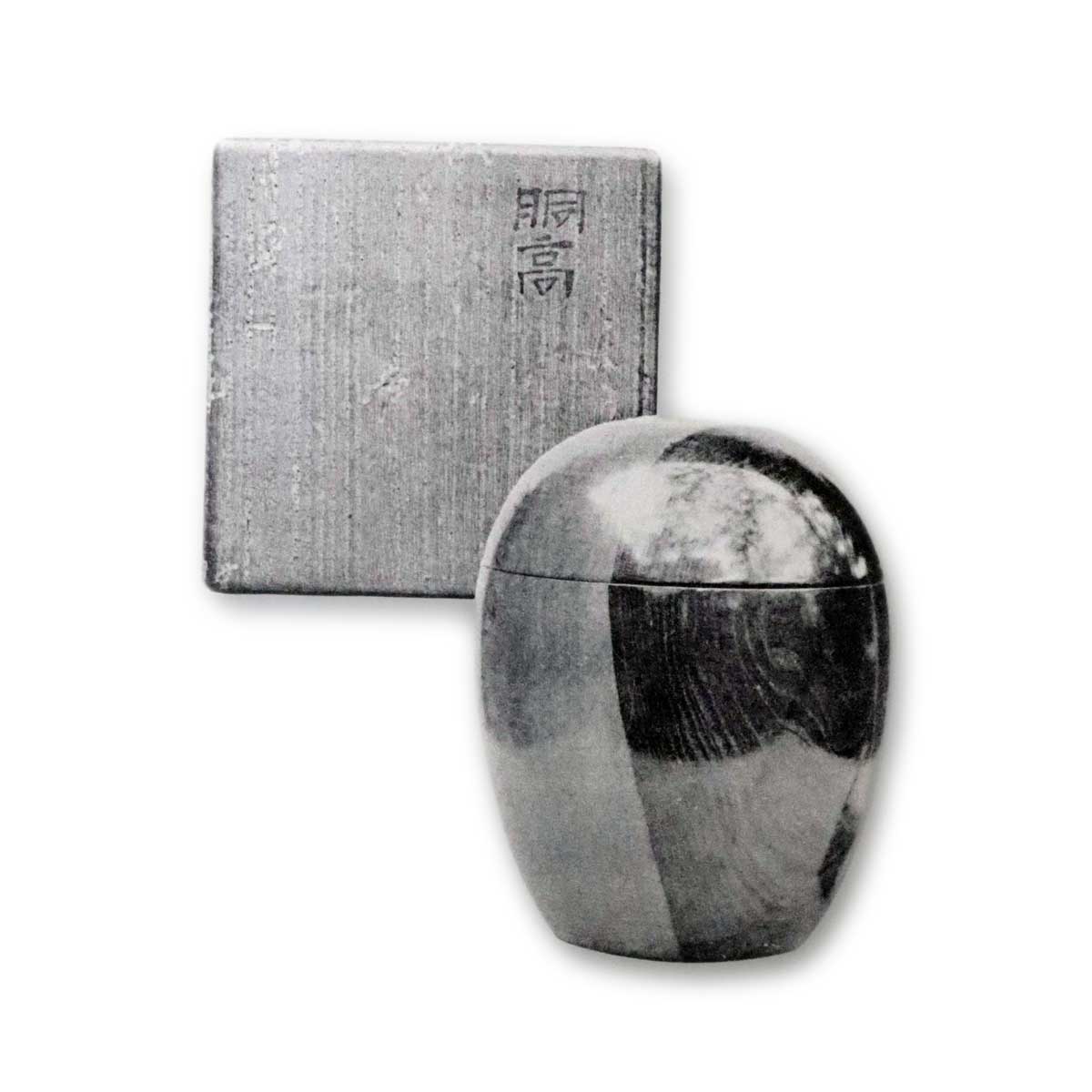
・Pouch boxes: Paulownia, natural wood, 2 pieces (each holds one pouch)
(Boxed text, front)
Tall-bodied tea caddy pouch
(Boxed text, back)
Tall-bodied pouch
・Hikiya (cylinder for storing the tea caddy): Japanese hornbeam (Isunoki); the surface and body have black sections
“Tōtak”
Pouch: Navy-blue ground with a rain-dragon pattern (lining: striped Kaiki; tying cord: purple)
・Inner box: Paulownia, natural wood; inscription by Kobori Sōkei
“Tall-Bodied”
The inscription on the paper lining the underside of the lid reads as follows. Written by Kashima Seibei
(Bordered)
“Tall-Bodied
This is a piece formerly owned by the founder of the school
The inscription on the box
is in the hand of Lord Sōkei”
・Outer box: Paulownia, natural wood; inscription by Kawakami Sōjun
(Bordered)
“Shima (Shima-mono)
Tall-Bodied”
・Accompanying Document: Deed of Transfer, 1 copy
“1. Dōtaka tea caddy (with an inscription by Masayuki)
I had been in possession of the item above, but as you have expressed such a strong desire for it on this occasion, I hereby transfer it to you. I hope you will treasure it for many years to come. Sincerely.
October of the first year of Kaei (1848), the Year of the Monkey
Yōgu-an Sōrō (Seal)”
Miscellaneous Notes
Dōtaka—In the hand of Lord Sōkei
(From Enshū Zōki Zai-sha)
Dōtaka—In the hand of Lord Sōjitsu
(From Enshū Zōchō: Fushimiya Shōnyū)
On December 11, Enpō 6 (1678), an item requested by Lord Tsuchiya Tajima-no-kami.
Takirami, Aoyama, Tamakashiwa, Otsu, Tsurugubi, Aoyagi, Hashihime, Koyoroi, Dōtaka, Totoya
(From Sakurayama Ichiyu’s Notes)
Dōtaka: The Dōtaka listed in the inventory register; owned by the Kashima family of Fukagawa.
(From A Companion for Leisure by Matsuyama Seika)
Noon, March 2, Meiji 35 (1902) — Tea gathering hosted by Mr. Kyohei Umakoshi
Guests: Mr. Korekiyo Takahashi, myself (Seika Matsuyama), Hirayama, Yamazumi
・Hanging scroll on the tokonoma: One waka poem composed by Lord Ietaka Fujiwara
・Flower vase: Antique bronze gourd-shaped; flowers: white Wabisuke and red Boke
・Tea caddy: “Dōtaka” from the inventory register; box inscribed by Lord Kobori Daizen; handle made of black persimmon wood; pouch by Teika (Kinran)
・Tea bowl: Kirigoki ware
(From Tsurezure no Tomo by Seika Matsuyama)
History of Ownership
Originally owned by Kobori Sōfu (Enshū), it was passed down to Tsuchiya Tajima-no-kami. After changing hands several times, it came into the possession of Kiyobei Kashima of Tokyo, and in Meiji 35 (1902), it was transferred directly from the Kashima family to its current owner, Kyōhei Umakoshi.
Record of Actual Viewing
On October 29, Taisho 9 (1920), I viewed the actual object at the residence of Mr. Kyohei Umakoshi in Sakuragawa-cho, Shiba Ward, Tokyo.
The mouth is wide, with the upper edge slightly flared, and there is a single raised ridge around the rim. The shoulders are rounded, and the middle section of the body is stepped and tapered, with the sections above and below it projecting prominently. This is the reason for its name, “Takatō” (High-Bodied). There is also a slight indentation around the waist. From the lower rim down, the grayish-brown clay is exposed; the rim of the base is slightly raised, forming a circular seat, and the flat bottom shows signs of wear along its edge. In the center of the base, there is a “chip” and a single short line of firing crack (a crack formed during firing). It is a so-called “island piece” (from Southeast Asia) and has a very austere, wabi-style design. Against a generally blue-gray background, a black glaze with a slight hint of pale yellow creates the pattern. The design features glaze that has cascaded down from around the neck, forming a single stream that runs from the shoulder to the unglazed edge at the rim. Overall, the (continued on next page)
Page 206
This is a very wabi-sabi-style round teapot with a soft, supple glaze and clay; there are scattered spots where the glaze has broken around the rim. Inside, the glaze covers the rim, while below that, a thin glaze coats the entire surface, overlaid with shallow wheel marks; the center of the swirl at the bottom protrudes slightly. Whereas other tall-bodied tea caddies have high protrusions between the vertical ridges, this one has higher sections above and below the horizontal ridges, and its form is exceptionally well-defined. It differs greatly in character from the run-of-the-mill tall-bodied tea jars commonly found, and is a rare piece that is compact and possesses a rich sense of wabi-sabi.