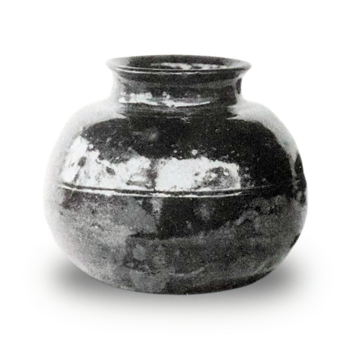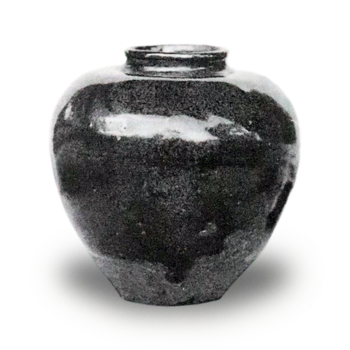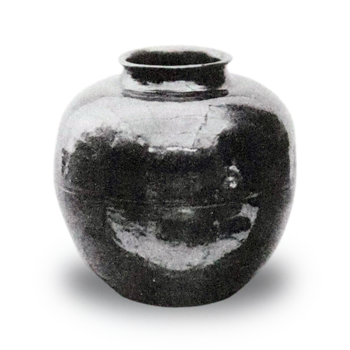


Made in China; Daimeibutsu; Also known as: Hamuro Bunrin; Owned by: Count Matsudaira Naoaki
Origin of the Name
This name derives from the fact that it was once owned by Hasegawa Saburō. In the entry for August 20, Keichō 16 (1611) in Goto Shōzaburō’s book Sunpu Seijiroku (Records of Sunpu Administration), it states: “Hasegawa Saburō-no-jo Fujihiro, the Nagasaki Magistrate, paid a visit to Sunpu. Over 80 merchant ships from Ming China and Nanban (Europe, etc.) had arrived, and because he promptly submitted a report on the trade, the Great Shogun (Ieyasu) commended him.” From this, there is no doubt that he was a merchant involved in trade during the early Tokugawa period, but the details of his background remain unclear. It is also unclear whether he is the same person as Hasegawa Ubee, a disciple of Sen no Rikyū, who is mentioned in the Kokin Chajin Keifu and in unofficial historical records (historical texts other than the official histories). Considering that this tea caddy is listed in the Kokin Meibutsu Ruiju as “Hamuro Bunrin,” it may have once been owned by the Hamuro Dainagon family, but there are no documents to prove this either.
Dimensions (converted using 1 sun ≈ 3.03 cm and 1 monme ≈ 3.75 g)
Height: Approx. 6.51 cm (2 sun 1 bu 5 rin)
Body diameter: Approx. 6.51 cm (2 sun 1 bu 5 rin)
Mouth diameter: Approx. 3.18 cm (1 sun 5 rin)
Base diameter: Approx. 2.73 cm (9 bu)
Weight: Approx. 49.9 g (13 monme 3 bu)
Accessories
・Lid: 1 (with a recess)
・Lid box: Made of natural paulownia wood, with an inscription by Matsudaira Fumai
“Nagakawa Bunrin, Lid”
・Storage pouch (bag for the tea caddy): Brown habutae silk, with a brown cord
・Covers (pouches): 2
Honno-ji satin (lining: pale green kaiki, cord: brown)
Shimotsuma satin (lining: kaiki with family crest, cord: purple)
・Pouch box: Made of natural-finished paulownia wood, with an inscription by Matsudaira Fumai
“Hasegawa Pouch”
Wrapping cloth: Purple chirimen
・Hikiya (cylinder for storing the tea caddy): Black lacquered with a gold-powder inscription
“Bunrin” (author unknown)
The pouch is made of shujin (lined with pale yellow kaiki, purple cord)
・Inner box: Paulownia wood with Shunkei lacquer finish and a “kichōmen” (chamfered corners) finish. Includes a label with an inscription and a lock with a “nibukuro” (boiled black) finish.
“Hasegawa” (author unknown)
Wrapping cloth: Floral-patterned fabric (backing: light green habutae silk)
・Outer box: Paulownia wood with black “kaki-ai” lacquer finish (a lacquer technique). The edges (side cuts) feature black persimmon wood with chinkin carving (a technique where patterns are carved into lacquer and filled with gold powder). It bears an inscription in silver powder, written by Matsudaira Fumai.
“Hasegawa,” “Bunrin”
・Accompanying tray
Wrapping Cloth: Floral-patterned cloth (backed with Onado-brown habutae silk)
Five-leaf tray with Taisu lacquer
Diameter: Just under approx. 21.21 cm (7 sun), Base diameter: Just under approx. 16.97 cm (5 sun 6 bu)
Pouch: Floral-patterned satin (both sides)
Box: Unfinished paulownia wood
Wrapping Cloth: Floral-patterned cloth (backed with Onado-brown habutae silk)
Miscellaneous Notes
Hamuro Bunrin; Made in China; Daimeibutsu. Owned by Matsudaira Dewa-no-kami. Height: approx. 6.51 cm (2 sun 1 bu 5 rin); Body diameter: approx. 6.51 cm (2 sun 1 bu 5 rin); Mouth diameter: approx. 3.18 cm (1 sun 5 rin); Tray (base diameter): approx. 2.73 cm (9 bu); Weight: approx. 49.9 g (13 monme 3 bu). The storage pouch is made of brown habutae silk and includes one lid. Hikiya uses a black-lacquered “nakatsugi” style; it is inscribed with “Bunrin” in gold powder, though the artist is unknown. The pouch is made of itochimu (a type of woven fabric; the lining is pale green, and the cord is purple). The box is a Shunkei-lacquered kichōmen (with beveled corners), with a paper label reading “Hasegawa” affixed to it. The dimensions of the tea caddy are inscribed on the underside of the lid. The wrapping cloth is sarasa. It comes with one pouch made of Honno-ji satin (with a brown cord and a sea-green lining). The box is finished in Tame-nuri (translucent lacquer), and the wrapping cloth is sarasa. (Illustration of the tea caddy included)
(From Kokin Meibutsu Ruiju)
Hamuro Bunrin. Owned by Hasegawa Saburō.
(From Komeibutsu-ki)
Hamuro Bunrin. Owned by Hasegawa Saburō (Saburō).
(From Ganka Meibutsu-ki)
Hasegawa Bunrin—Made in China—A Daimeibutsu. Also known as Hamuro. Owned by Lord Matsudaira Fumai (Lord Unshu). Black glaze flows down a persimmon-colored ground, exhibiting a strong metallic luster (kinki). The clay is grayish-brown, retains its natural thread-like texture, and is coarse. The pouch is made of Honno-ji satin.
(From Rinpō-kiryū)
Hasegawa Bunrin is of Chinese origin. It was produced during the same period as Hasegawa Bunrin, Rikyu Shiri-hō, Shino Maru-tsubo, and Fukiage Bunrin.
(From The Origins of Seto Pottery by Matsudaira Fumai)
Hasegawa Bunrin—made in China. The overall body is a vivid persimmon color, with some “dakatatsu” (glaze crackling). The clay has a grayish-brown base with coarse thread-like cracks. The front is coated with black glaze; the rim is thin and well-formed. Beneath the decorative scene, there is a fluttering pattern of black glaze. The pouch is Honno-ji. (Illustration of the tea caddy included)
(From Chairi Meibutsu-ki)
Hamuro Bunrin. Formerly owned by Lord Hasegawa Saburō, it is now in the possession of Fuyuki Kodajiro. It is a Bunrin made in China. The bag depicts Honno-ji.
(From Meibutsu Dōgu-zu)
Hasegawa Bunrin. The overall persimmon-colored base is vivid, and a hint of amber color shows through the black glaze on the front. The clay appears to be lead-colored. The thread-cut pattern is coarse, and black glaze flutters beneath the bands (stripes). The rim is thin, and black glaze covers it. It is a splendid piece, featuring a counter-clockwise thread-cut pattern, a smooth vermilion clay body, and bands on the body. (Description of accessories included)
(From the Makuan Bunko, Series A, No. 9)
Hamuro Bunrin. Made in China. Owned by Matsudaira Dewa-no-kami. Sold to Lord Matsudaira Fumai (Lord of Unshū) by the second-generation Jinbei, son of the Kyoto tea utensil merchant Fushimiya Jin’emon. It is impossible that this is a complete forgery. (The dimensions and description of the accessories are the same as in Kokin Meibutsu Ruiju. Includes an illustration of the tea caddy.)
(From Shokke Meiki Shū)
Hasegawa Bunrin. According to the same source (Fushimiya Memoirs), it was purchased from Sumiya Shōsai, a townsperson in Edo, for 200 ryō. It is accompanied by a five-leaf tray with tsuishu lacquer.
(From Fushimiya Memoirs)
An’ei 7 (1778) Jin (Possibly a transaction between Fushimiya Jinbei and Kawachiya Kibei)
Hamuro Bunrin: 200 ryō
(From Osaki-sama’s Record of Utensil Expenses)
April 21, Bunka 14 (1817), noon, in a slightly larger-than-three-tatami-mat tea room
Host: Ohyō-sama (Getsutan, son of Lord Matsudaira Fumai)
Guests: Nedō Sōsei, Motoya Sōkichi, Kiriya Hachizō
・Hanging Scroll: Calligraphy by Wen Ruzhong (a Chinese Zen monk)
・Flower Vase: Wide-mouthed antique bronze; flowers: irises (kakitsubata)
・Tea Caddy: By Hasegawa Bunrin; tray: a five-leaf tray with tsuishu lacquer
・Tea Bowl: An old, sturdy tea bowl; inscribed with “Tanabata”
(From Daien-an Tea Gathering Record)
History of Ownership
Originally owned by Hasegawa Saburō, the set was later passed down to Fuyuki Kodajiro, a wealthy merchant of Fukagawa, Edo. In An’ei 7 (1778), Lord Matsudaira Fumai purchased the set for 200 ryō in gold through the mediation of two Kyoto tea utensil dealers, Fushimiya Jinbei and Kawachiya Kibei.
Record of Actual Viewing
On May 17, Taisho 7 (1918), I had the privilege of viewing this piece in person at the office of the household of Count Matsudaira Naoaki in Matsue City.
As a Bunrin tea caddy made in China, it has a short neck and rounded, plump shoulders, giving it a charming shape. The craftsmanship is extremely delicate; the interior is unglazed, and the wheel marks form a ring that spirals into a swirl at the center of the base.
Overall, it has a deep reddish persimmon color, with a single sunken line running around the middle of the body. From the rim downward, the grayish-brown clay is exposed, and the thread-cut pattern on the base resembles a peach pit. It feels very light when held in the hand.