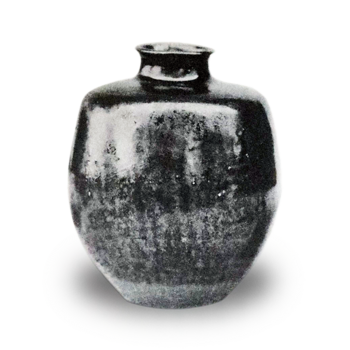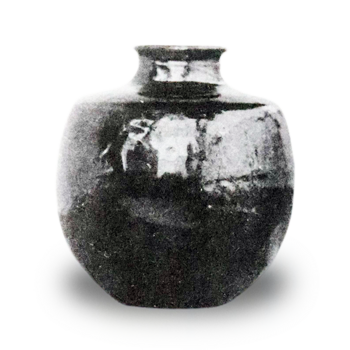
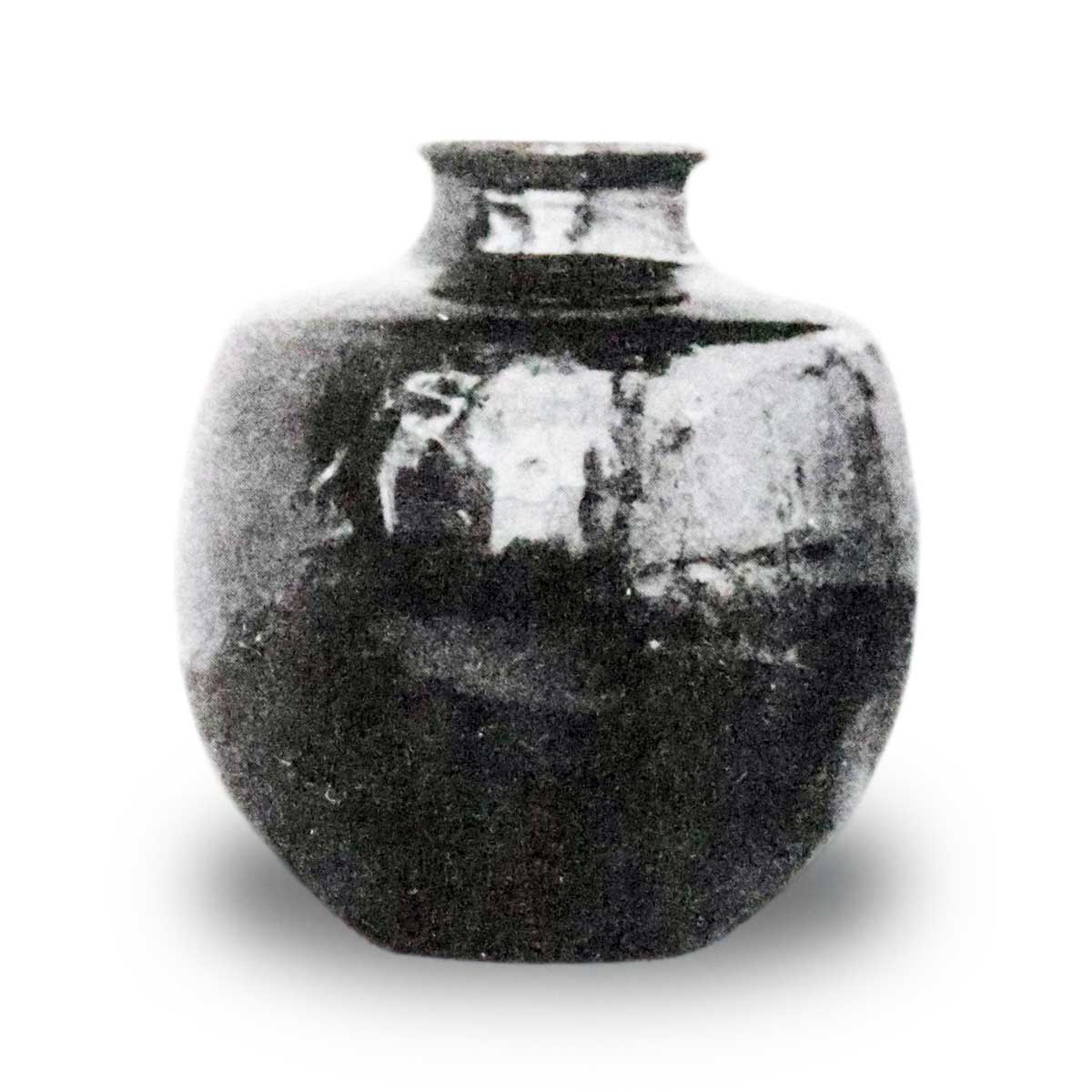
Made in China; Daimeibutsu; Also known as: Asakura Bunrin or Mikazuki Bunrin; Owned by: Count Matsudaira Naoaki
Origin of the Name
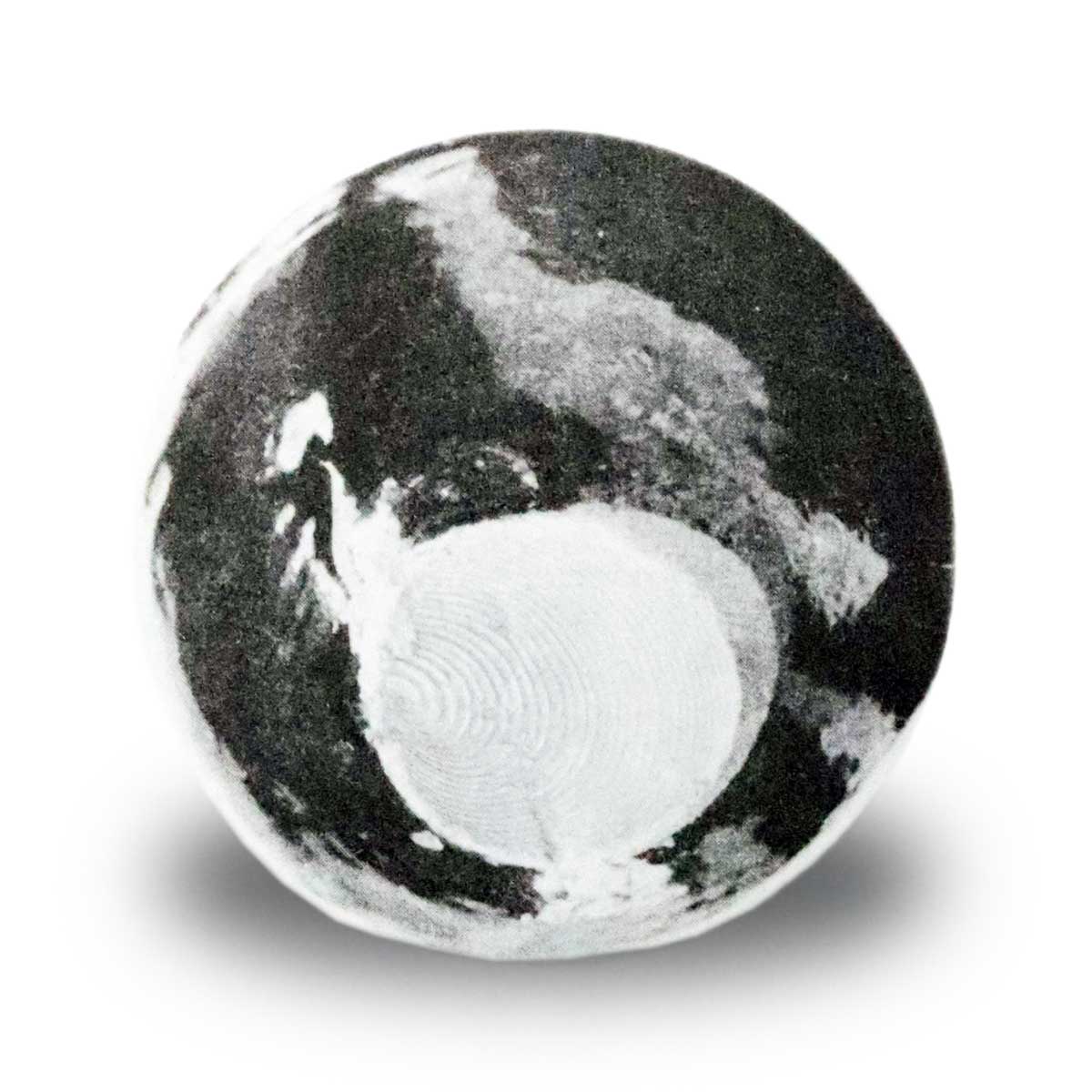
It is called “Honno-ji Bunrin” because Oda Nobunaga donated it to Honno-ji Temple, and it is also known as “Asakura Bunrin” because it was previously owned by Asakura Yoshikage. The tea book Fushimiya Kokusho from the Bakuan Bunko collection also states, “Honnōji Bunrin, also known as Asakura Bunrin. It was once owned by Asakura Yoshikage.” It is also called “Mikazuki Bunrin,” though the origin of this name is unclear; it is thought to have been named because the unglazed portion resembles a crescent moon (a waning moon).
Dimensions (converted at 1 sun ≈ 3.03 cm)
Height: Approx. 7.27 cm (2 sun 4 bu)
Body diameter: Approx. 6.88 cm (2 sun 2 bu 7 rin)
Mouth diameter: Approx. 2.42 cm (8 bu)
Base diameter: Approx. 2.97 cm (9 bu 8 rin)
Koshiki height: Approx. 0.97 cm (3 bu 2 rin)
Shoulder width: approx. 1.67 cm (5 bu 5 rin)
Weight: approx. 87.38 g (23 monme 3 bu *1 monme = 3.75 g)
Accessories
・Lids: 6 (5 concave lids, 1 old lid)
・Lid box: Unfinished paulownia wood, with an inscription by Matsudaira Fumai (“Honnoji Bunrin Lid”)
・Gomono-bukuro (bag for the tea caddy): Striped twill pattern, with a light green cord
・7 protective covers (bags)
Satin with waterfowl pattern (lining in woven-colored sea mist, cord in light green): A bag from long ago
Tsukuritsuchi satin (lining: iridescent blue-green, cord: purple): Kobori Enshu style
Asakura Koto weave (lining: sky-blue, cord: purple): Kobori Enshu style
Shijira Koto weave (lining: purple, cord: purple): Kobori Enshu style
Vertical-striped satin (lining: iridescent sea-green, cord: purple): Kobori Enshu style
Vertical-striped satin with family crest (lining: pale yellow sea-green, cord: purple): Kobori Enshu style
Shokkin (lining: Tang-yellow sea-green with family crest, cord: Enshu brown): Kobori Enshu style
・Wooden molds: 6 pieces (one in each of the bags for Zotsu-jyunshi and below)
・Bag boxes: 4 (all made of natural paulownia wood)
Each bears an inscription by Matsudaira Fumai and contains a bag.
・Master box for bags (box containing the bag boxes): Made of natural paulownia wood, with an inscription by Matsudaira Fumai (“Honnoji Bunrin Bags”)
・Hikiya (cylinder for holding the tea caddy): Made of ivory
Bag: Ichigo-zori (strawberry-patterned fabric; lining is striped umi-ki; cord is purple)
・Inner box: Made of natural paulownia wood. Contains two Okushima-patterned futons.
・Outer box: Black-lacquered with mitered corners, featuring a ring and a lock.
Wrapping cloth: Red striped pattern (back is light green with a wave pattern)
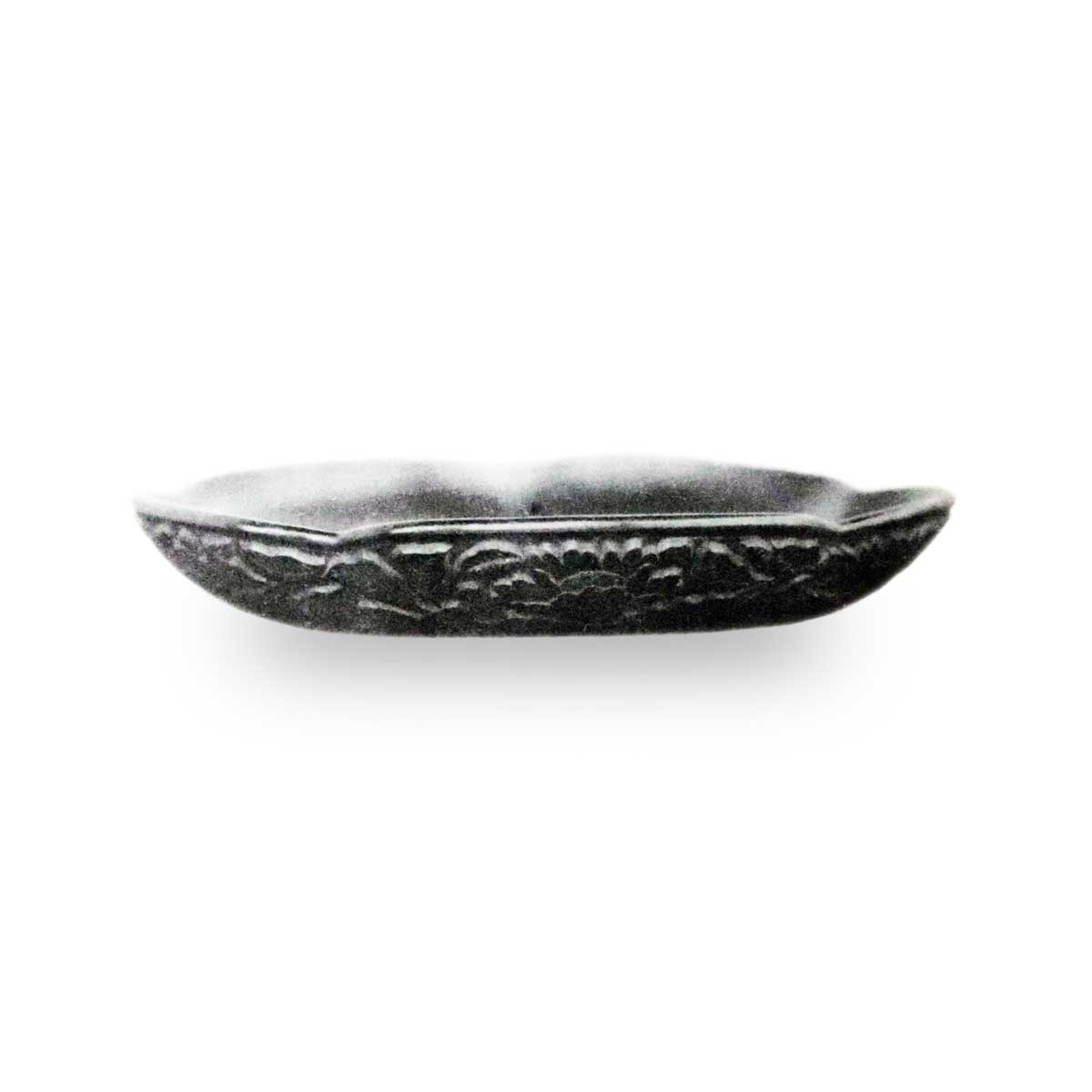
・Accompanying tray: Five-leaf tray in tsuishu lacquer, made by Zhang Cheng (a Chinese lacquer artisan).
The interior has a red border, the exterior features tsuishu carvings, and the bottom is black lacquer with “Zhang Cheng” carved into it.
Dimensions: Diameter approx. 18.48 cm (6 sun 1 bu), diameter of the mirror (central indentation) approx. 13.03 cm (4 sun 3 bu), diameter of the base approx. 13.64 cm (4 sun 5 bu), height approx. 2.42 cm (8 bu).
Pouch: White habutae silk; cord is white.
Box: Unvarnished paulownia wood; bears an inscription by Matsudaira Fumai (“Five-Leaf Tray, made by Haruaki”).
Wrapping cloth: Floral-patterned fabric (backing is brown habutae silk).
・Accompanying documents: 2 letters
Memorandum (Letter from Nakai Motosui to Kobori Ningeemon)
“In the second year of Shōhō (1645), when Lord Kobori Enshū was in Fushimi, my elderly mother paid him a courtesy call. On that occasion, a messenger conveyed that Lord Kyōgoku Tango-no-kami wished to purchase this Asakura Bunrin for 750 gold pieces. When I asked Lord Enshū what I should do, he replied, ‘You need not sell it. When you travel to Edo next year, bring it with you and sell it for 1,000 pieces of gold. It seems he desires a Meibutsu tea caddy, but I have heard that Tango-no-kami is unfamiliar with the tea ceremony,” he said, and ordered me to convey this exactly to my elderly mother. However, since Lord Enshū passed away in the spring of Shōhō 3, the matter never came to fruition.
I swear by the gods of Japan that the above is true and contains no falsehood.
Now, some time ago, Lord Sōchō kindly lent me some silver. Of course, he did not ask for interest, but although I have long wished to repay him and express my gratitude, I have been unable to raise the funds and have thus been unable to repay the debt for a long time. Therefore, I am presenting this Asakura Bunrin as a substitute. Please cherish it for many years to come. I am writing this down for the record. That is all.”
On an auspicious day in December, Nakai Monosuke (seal)
To Lord Kobori Niiemon
(Another note)
Regarding the Bunrin tea caddy
“Mikazuki”: An ancient name
“Asakura”: A name from a slightly earlier period
“Honno-ji”: A name derived from Oda Nobunaga’s donation to Honno-ji Temple.
It comes with six pouches. Among these, the satin pouch featuring waterfowl has been in use since ancient times.
There are four lids. These are to the liking of Lord Kobori Enshū.
When His Imperial Highness Taito-in (Tokugawa Hidetada) viewed this tea caddy, it was presented as the “Asakura Bunrin” (with Lord Aoyama Ōkura acting as intermediary).
When His Imperial Highness Daio-in (Tokugawa Iemitsu) viewed it, it was also presented as the “Asakura Bunrin” (with Lord Inaba Tango-no-kami acting as intermediary).
That is all.
Miscellaneous Notes
Honnoji Bunrin. Daimeibutsu. Owned by Matsudaira Dewa-no-kami. Height approx. 7.30 cm, mouth diameter approx. 2.73 cm, body diameter approx. 6.82 cm, diameter of the thread-cut section at the bottom approx. 2.88 cm. Six lids. The ivory-inlaid case is made of Echigo cloth. The box is unfinished wood with a wrapping cloth. The outer box is a black-lacquered, mitered-edge box, and the wrapping cloth has vertical stripes. There are six pouches (waterfowl satin, Zōdo satin, Asakura Kōtō weave, white-striped Kōtō weave, vertical-striped satin, and crested-striped satin). The pouch boxes consist of three plain paulownia wood boxes. The outer box is made of plain paulownia wood, and the wrapping cloth features an Okushima pattern. (Illustration of the tea caddy included)
(From Kokin Meibutsu Ruiju)
Honnoji Bunrin. A Daimeibutsu made in China. Also known as “Asakura” or “Mikazuki.” Owned by Lord Matsudaira Fumai (Lord Unshu). A persimmon-tannin brown glaze flows down over an amber-colored base. The clay is vermilion, with fine, original thread-like cracks; when placed, the surface shows slight black patches.
(Includes descriptions of the pouch and tray, and an illustration of the tea caddy)
(From Rinpō-kiryū)
Honnoji Bunrin. Made in China, it dates from the same period as the Terasawa Maru-tsubo. When compared to Meibutsu such as Nitta, Setaka, and Fudō, its artistic style feels slightly less distinctive for its era, despite being from the same period.
(From Seto Tōki Ranshō by Matsudaira Fumai)
Honnoji Bunrin. Within the yellow amber hue, there is a clear, black-like pattern, and the local glaze has a blackish tint. (Illustration of the tea caddy included)
(From Meibutsu-shu)
Honnoji Bunrin. Also known as Honnoji Bunrin (as per the original text). The overall surface has a translucent lacquer-like quality, with translucent amber-colored areas around the shoulder. The rim is well-formed overall, and there are ridges on the neck. The thread marks on the bottom are fine, the vermilion clay appears coarse, the appearance when placed is amber-colored, and the exposed clay areas are low. (Description of the bag included)
(From the Makuan Bunko, Series A, No. 9)
Asakura Bunrin, known by the pseudonym Honnoji Bunrin. The overall surface has a persimmon-colored tone, with ridges on the neck; the clay is coarse, and the thread-cut is fine. The exposed clay is minimal. When placed, it presents an amber-glazed appearance with prominent shoulders, making it a truly magnificent tea vessel. (Description on the bag; illustration of the tea caddy included)
(From Chairi Meibutsu-ki)
Honnoji. Height approx. 7.27 cm, body diameter approx. 6.82 cm, mouth diameter approx. 2.58 cm, base diameter slightly over 2.73 cm. (Description from the bag; includes an illustration of the tea caddy)
(From Shoke Meiki Shu)
Bunrin Honnoji. (Handwritten note) Currently in the possession of Nakai Yamato.
(From the Kizuka edition of Koori Daimeibutsu)
Honnoji Bunrin, a small Chinese-made jar. Owned by Nakai Yamato.
(From Ganka Meibutsu-ki)
Honnoji Bunrin. Owned by Nakai Yamato-no-kami. (Inscription) Currently owned by Matsudaira Dewa-no-kami.
(From Komeibutsu-ki)
Honnoji Bunrin. Also known as “Mikazuki” or “Honnoji.” Owned by Nakai Yamato-no-kami; currently owned by Matsudaira Dewa-no-kami. The glaze on the body is persimmon-colored and black, with a strong metallic luster (kinki). The clay has a purplish tint and retains its original thread-cut texture. There are two ridges between the neck and body. (Dimensions, accessories, and illustration of the tea caddy included)
(From Chaki Meibutsu Zui by Kusama Waraku)
Honno-ji Bunrin. A Daimeibutsu made in China. “Mikazuki” is an ancient name, while “Asakura” is a name from the Middle Ages. It is called Honno-ji Bunrin because it was donated to Honno-ji by Oda Nobunaga. When Lord Hidetada viewed it, it was presented as “Asakura Bunrin.” Similarly, when Lord Iemitsu viewed it, it was also presented as “Asakura Bunrin.”
(From the documents of the Unshu Matsudaira family)
Honnoji Bunrin. A Daimeibutsu made in China. Also known as Asakura Bunrin. It was once owned by Asakura Yoshikage, and later by a merchant in Kyoto.
Purchased from Yamakoshi Rihei. The lacquer tray is a five-leaf tray with raised red lacquer (taishu), made by Haruaki.
(From Fushimiya Memoirs, Vol. 3, Series B, of the Bakuan Bunko)
An’ei 7 (1778) Yamakoshi
Honnoji Bunrin: 550 ryō
(From Oosaki-sama Goudou-dai Gote-koro)
January 20, Bunka 4 (1807), in a slightly larger-than-three-mat tea room. The host was Matsudaira Fumai.
The guests were Nedo Sosei, Kouchiji Itsusai, and Yoshimura Kanna.
In the tokonoma hung a calligraphic work by Shunmei, bearing his signature.
The flower vase was celadon, and the flowers were plum blossoms.
The tea caddy was by Honnoji Bunrin, and the tray was a go-ya-bon.
The tea bowl was a Furuido tea bowl.
(From Daien-an Chakai-ki)
History
Originally owned by Asakura Yoshikage, it was later passed down to Oda Nobunaga. Nobunaga donated it to Honnō-ji Temple in Kyoto, and it later came into the possession of Nakai Yamato-no-kami. In 1645 (Shōhō 2), Kyōgoku Tango-no-kami expressed a desire to purchase this tea caddy for a high price (750 gold pieces). When the owner consulted Kobori Enshū, Enshū reportedly replied, “You need not sell it. You should wait until you can sell it for 1,000 gold pieces. There is an anecdote that Enshu replied, ‘I hear that Tango-no-kami does not understand the Way of Tea.’” This tea caddy was once presented for the viewing of the second shogun, Tokugawa Hidetada, and the third shogun, Tokugawa Iemitsu. Later, as Nakai Yamato-no-kami found it difficult to repay his debts, he transferred this tea caddy to Kobori Ninsuke in lieu of payment; however, the details of its subsequent history are unclear.
In 1778 (An’ei 7), through the mediation of Yamakoshi Rihei, a Kyoto dealer in tea utensils, it passed into the hands of Lord Matsudaira Fumai (Lord Unshu) for 550 ryō, and there is a record of its use at Lord Fumai’s tea ceremony in 1807 (Bunka 4). In June 1901 (Meiji 34), it was exhibited at the Art Association in Ueno, Tokyo, and on April 23, 1916 (Taisho 5), it was also displayed at the grand tea ceremony commemorating the 100th anniversary of Fumai’s death, held at the residence of Count Matsudaira in Yotsuya, Tokyo.
Record of Actual Viewing
On May 6, 1918, I had the opportunity to view this piece in person at the residence of Count Matsudaira Naoaki in Motomachi, Yotsuya Ward, Tokyo.
The mouth is tight with a rounded rim, and the flaring (curvature) is shallow. The neck is narrow in the middle and flares out toward the bottom; a very fine raised line runs all the way around the middle and the rim of the neck, a feature not found on other tea caddies. The shoulders protrude plumply, the body is slightly flared, and the base is small, giving the impression of looking at a beautiful woman depicted in a Chinese painting.
The entire piece is covered in a dark amber glaze, and the craftsmanship is exceptionally delicate and exquisitely refined. When viewed from the front, two distinct streams of amber glaze flow down from the left and right, converging and stopping just before reaching the base (near the bottom), creating a particularly beautiful sight. There are small repair marks on the rim and on the lower part of the body, but overall it is in nearly perfect condition, and the beauty of its luster is beyond words.
The entire piece is covered in glaze, with only a slight hint of vermilion-colored (reddish-brown) clay visible around the outer edge of the thread-cut rim. The thread-cut is fine, extremely delicate, and beautiful. Inside, the glaze covers the neck, and the wheel marks are not visible below that point. The center of the base is indented, with a few splashes of black glaze.
Its shape and style are feminine in every respect, supple and graceful. It would be no exaggeration to praise this teapot as the “Yang Guifei of Chinese teapots.”