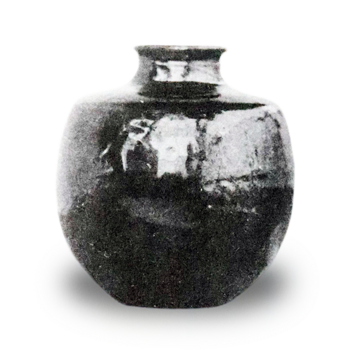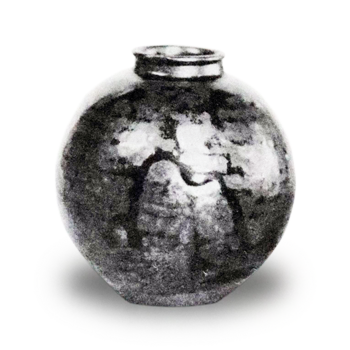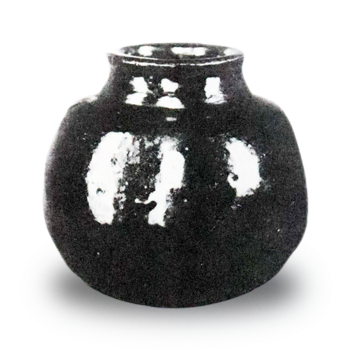


Made in China; Daimeibutsu; Owned by: Tokugawa Ietatsu, Duke
Origin of the Name
In a book titled Chaden Kiroku (Records of the Tea Tradition), whose author and date of composition are unknown, it is written: “Perhaps it is called by this name because it originated in Ise.”
According to this theory, it is believed that this tea caddy was named after the Tamagaki (the fence surrounding the shrine) of Ise Grand Shrine.
Dimensions (converted at 1 sun ≈ 3.03 cm)
Height: Approx. 5.97 cm (1 sun 9 bu 7 rin)
Body diameter: Approx. 6.67 cm (2 sun 2 bu)
Mouth diameter: approx. 3.33 cm (1 sun 1 bu)
Base diameter: approx. 3.03 cm (1 sun)
Koshiki (rim) height: approx. 0.76 cm (2 bu 5 rin)
Shoulder width: approx. 0.61 cm (2 bu)
Weight: 54 g (14 monme 4 bu *1 monme = 3.75 g)
Accessories
・Lid: 1 (with a recess)
・Storage bag (for the tea caddy): White ha-ni-ju
・Covering bags (pouch): 2
White premium satin (lining: Jodai Kaiki, cord: purple)
Satin with cloud and crane pattern (lining: Shinkai Ki, cord: purple)
・Storage boxes: 2
Box inscription “Tamagaki Bunrin”
Inner box: Natural paulownia wood (marked “Tamagaki Bunrin Bag No. 2”)
Outer box: Black lacquer with gold-leaf lettering (marked “Tamagaki Bunrin Bag No. 2”)
・Hikiya (tea caddy): Black lacquer
Bag: Yakikiri (lining: Kaiki, cord: white) with a heavily worn appearance.
・Inner box: Unfinished paulownia wood
Inscription on box: “Tamagaki Bunrin”
・Outer box: Black lacquer with gold-leaf lettering
Inscription on box: “Tamagaki Bunrin”
Miscellaneous Notes
Tamagaki Bunrin. Located in Sakai, owned by Yucho Munemi.
Tamagaki Bunrin. Owned by Munemi, a resident of Sakai.
(From Higashiyama Gomono Naibetsucho and Tensho Meibutsu)
Tamagaki Bunrin. The surface texture is slightly rough, and it rests on a square tray. Perhaps it was given this name because it originated from Ise. It is owned by Tomonaga Yotaro of Sakai. The two pots on the right (Tamagaki Bunrin and Shukō Bunrin) are Meibutsu rivaling the Eggplant Tea Jar. However, the clay and glaze used differ from those of the Eggplant Tea Jar. There are oral traditions regarding how to appraise them, and further oral traditions regarding how to prepare tea.
(From Chaden Kiroku)
Tamagaki Bunrin
Tamagaki Bunrin. It is in the possession of Yūchō Yotaro of Sakai. Sōji (Yamagami Sōji) has not yet had the opportunity to view this Bunrin. It is accompanied by a square tray. The two small pots on the right (the Shukō Bunrin and the Tamagaki Bunrin) are Meibutsu rivaling the Eggplant Tea Jar in fame.
(From Yamagami Sōji Ki)
It is called Bunrin Tamagaki. It sits on a shihō-bon. It is owned by Yūchō Yotarō of Sakai. Sōji has not yet had the opportunity to view this Bunrin. The two small pots on the right (Sōyuki Bunrin and Tamagaki Bunrin) are Meibutsu on par with the Eggplant Tea Caddy.
(From the Gunshū Ruijū edition of Collection of Famous Tea Utensils)
The Tamagaki Bunrin, the Jukō Bunrin, and the Hamuro Bunrin—these three are the most renowned Bunrin in the land.
(From Matsuya Nikki)
It is called the Bunrin Tamagaki. It sits on a square tray. This Bunrin is owned by Yotaro. The two small pots on the right (along with the Sōyuki Bunrin) are Meibutsu comparable to the Eggplant Tea Jar. Both the clay and the glaze used to make them are highly unusual. There are strict, secret oral traditions regarding how to appraise them, and there are further oral traditions regarding how to prepare tea with them. I shall explain these to you when we meet in person.
(From Yamagami Sōji’s Discussions on Tea)
Morning of October 7, Tenshō 9 (1581) — Tea Gathering Hosted by Yūchō Sōmi
Guests: Miyauchi-kyō Hōin, Tsuda Sōyuki
In the tokonoma, cold chrysanthemums were arranged in a long, rounded tray, and a navy-blue Kinran pouch with a gold-threaded pattern was placed on a square tray positioned at shoulder height (omitted). Before preparing the thin tea, he brought out a Tamakaki (Tamagaki) Bunrin. It was housed in a pot-shaped Hikiya; the pouch was white Kinran with a large crest on a gold background, featuring a double vine pattern, and the cord was crimson. The words “Tamakaki” were written on the underside of the Hikiya’s lid.
This was the first time I had seen this Tamagaki-Bunrin on the right. Its shape appears bulbous at the bottom; perhaps it is smaller than the Hatsuhana katatsuki and others. However, unlike the Hatsuhana, the top is not flat. It seems to hold about one serving less tea than the Munenori-Bunrin and others.
(From Tsuda Munenori’s Tea Ceremony Diary)
June 16, 1612 (Keichō 17), Noon: Oda Yūraku’s Tea Gathering
Guests: Nagano Naokatsu, Ohori Samasuke, Saji Yokuro
One: The hanging scroll depicted the Four Sleeping Figures. One: The flower vase was made in Kyoto and held white lotus flowers.
One: The tea caddy was a Bunrin-mon Rin, placed on a tray with a red interior. One: The water jar was a Murui.
One: The tea bowl was an Ido tea bowl.
(From Yurakutei Chado Nikki by Mr. Kizuka Sōgi)
On November 19, Keichō 17 (1612), Lord Toyotomi Hideyori paid a visit to the residence of Yurakusai (Oda Yuraku).
The hanging scroll was a calligraphic work by Yōsō Kan-kōji; beside the scroll, a Kusabe Katatsuki tea caddy, housed in a Kantō-woven bag, was placed on a square tray, and so on. Lord Hideyori bestowed upon Yuraku 50 gold ingots and 20 sets of clothing. Yuraku presented the following to Lord Hideyori’s entourage: 30 silver ingots and 5 sets of clothing (for Lord Hideyori’s primary wife); 5 sets of clothing (for his secondary wife); and 300 silver ingots (for all his retainers). Items presented by Yuraku to Lord Hideyori himself included 200 pieces of silver, 3 nightgowns, and a Bunrin tea caddy. 500 pieces of silver and 5 kosode (for Lord Hideyori’s birth mother, Lady Yodo). 1 piece of gold to Ōno Harunaga (Minister of the Treasury). 50 pieces of silver and 5 kosode (for the Princess). 300 kan of money for official use (for all the ladies-in-waiting) .
(From Mr. Miki Sōgi’s Yurakutei Chayū Nikki)
Regarding the donation of famous tea utensils. On May 28, 1615 (Genna 1), the lacquer artisans Fujishige Fujimoto and his son Fujigen were summoned to Nijō Castle and ordered, “There must be famous tea utensils that survived the fire among the ruins (of Osaka Castle), so go there and search thoroughly.” Consequently, they traveled down by boat that night and dug through the dirt and ashes day and night without rest; sure enough, they discovered five Meibutsu tea caddies. They first performed emergency temporary repairs and brought them to Kyoto on June 12. These tea caddies included the Nitta Katatsuki, Tamakaki Bunrin, Ko-katatsuki, and Oshiri-hari. As a reward, they were granted 100 koku of rice and stipends for 20 people.
(From Shosho Taikoki)
May 28, Genna 1 (1615) (omitted) I traveled to Osaka by boat at night and, for several days, dug through the dirt and ashes day and night without rest. Sure enough, I hurriedly found the famous tea caddies and other broken items, made temporary repairs to them, and brought them to Kyoto on June 12. Among those tea caddies were: one Nitta Katatsuki; one Shiki (Koshiba) Katatsuki; one Tamakaki Bunrin (Tamagaki Bunrin);
one Ko-katatsuki; and one Ōjiri-hari.
I brought these five Meibutsu to Nijo Castle and presented them through Lord Honda Uezan. When Tokugawa Ieyasu viewed them, he was exceptionally impressed. He immediately summoned Fujimoto and Fujigen to his presence and had them appear before him. “It is truly miraculous how you managed to track down these Meibutsu,” he said, offering unprecedented praise, and stood before him in high spirits. Then, as a reward, Lord Honda Uezumori, acting as magistrate, granted us 100 koku of rice and stipends for 20 people. He remarked that there could be no greater honor or happiness for our family.
(From Tsukumo Nasu Fuzoku Emaki, held by the Iwasaki family)
Tamagaki Bunrin. Suruga Bunbutsu (an item from Ieyasu’s estate that was passed to Tokugawa Yorinobu of Suruga).
(From Kishū-ke Monjo)
January 23, 1624 (Kan’ei 1) Kii Clan Tea Ceremony
Shogun Tokugawa Hidetada attended. Attendees: Mito Saishō (Tokugawa Yorifusa), Niwa Gorōzaemon
Decorations in the Sukiya (tea room)
One: A calligraphy piece by Kyodo in the tokonoma.
One: A flower vase with metal handles. The flowers are red plum blossoms.
One: A tea caddy called “Shu no Koromo.” It is housed in a Kanto-ori cloth bag.
One tea bowl: “Niimi.”
Decorations in the connecting corridor
One tea caddy: Tamakakifurin (Tamagaki Bunrin). It is housed in a Guangdong-woven bag.
One ash-covered Tenmoku tea bowl. It is placed on an Amagasaki stand.
Decorations in the main hall: A large sea-motif tea caddy, with an inner cloud pattern.
(From Kishū-ke Bunshō)
Tamakaki Bunrin. Made in China. Owned by the Kii family.
(From Komeibuki)
Tamakaki Bunrin. A small Chinese jar. Owned by Lord Kii.
(From Gankō Meibutsu)
Jade-Kaki Bunrin. A small Chinese jar listed in the Meibutsu-ki. Owned by Lord Kii.
(From Kokin Meibutsu Ruiju)
Tamakaki Bunrin. A Daimeibutsu. Its black glaze resembles that of “Shimamono” (pottery from Southeast Asia and other regions) and possesses a metallic luster (kinki).
(From Rinpō-kiryū)
Tamagaki Bunrin. Presented to the Kii family when the Shogun visited in February of Genroku 14 (1701). Height: approx. 6.00 cm (1 sun 9 bu 8 rin); body diameter: approx. 6.51 cm (2 sun 1 bu 5 rin).
(From Kishū-ke Bunsho)
Tamagaki Bunrin. Presented to the Shogun by the Kii Chūnagon on March 18, Genroku 14 (1701, Year of the Snake). Includes two pouches (one in satin with a cloud-and-crane pattern, lined with Jōdai Kaiki; the other in the finest white satin, lined with Shinkai-ki). One lid.
The tea caddy was presented at the residence when the Shogun paid a visit.
(From Jōgodo)
Tamagaki Bunrin. Presented by the Kii Dainagon on March 18, Genroku 14 (Year of the Snake). Height approx. 6.06 cm (2 sun), body diameter approx. 6.67 cm (2 sun 2 bu), mouth diameter approx. 3.42 cm (1 sun 1 bu 3 rin), shoulder diameter approx. 5.36 cm (1 sun 7 bu 7 rin), base diameter approx. 3.03 cm (1 sun). Overall, it features a persimmon-colored ground with a black glaze pattern resembling quail speckles. The surface often displays numerous horizontal striations, giving it the charm of ancient Japanese Seto ware, for which it is highly regarded. It comes with two pouches (one made of white, top-quality satin with a mother-of-pearl-colored Kai silk lining and a purple cord; the other made of satin with a cloud-and-crane pattern, a kakishiro lining, and a purple cord). The storage bag is made of white ha-niji silk. The lid is ivory. Hikiya is lacquered black; the bag is made of Fursu fabric, and the cord is white. The box is made of natural paulownia wood. The outer box is lacquered black with gold-leaf lettering. (Images of the tea caddy’s front and back are available)
(From the Tokugawa Family Collection, Catalog of Tea Utensils and Paintings)
Provenance
It was originally owned by Yūchō Munemi, a resident of Sakai, and Tsuda Sōyuki’s “Tea Ceremony Diary” records that it was used at Munemi’s tea gathering in October of Tenshō 9 (1581). It subsequently came into the possession of Oda Yūraku and was presented to Toyotomi Hideyori when he visited Yūraku’s residence on November 19, Keichō 17 (1612). After the fall of Osaka Castle—specifically on May 28, 1615—lacquer artisans Fujishige Fujimoto and Fujigen, acting on the orders of Tokugawa Ieyasu, traveled to Osaka together and dug this item out from the ashes and ruins to present it to Ieyasu. Subsequently, Tokugawa Yorinobu, the founder of the Kishū Domain, received this item as a gift, and as recorded in the Kishū-ke Bunshō (Documents of the Kishū Family), he used this tea caddy at a tea ceremony in the first month of the first year of the Kan’ei era (1624). It remained a treasure of the Kishū family for a long time thereafter, but on March 18, 1701 (Genroku 14), when Shogun Tokugawa Tsunayoshi visited the Kii residence, Kii Chūnagon Mitsusada presented it to the Shogunate, and it has been housed in the treasure vault of the Tokugawa main family ever since.
Record of Actual Observation
On November 8, 1918, I had the opportunity to view this piece in person at the residence of Duke Tokugawa Ietatsu in Sendagaya, Tokyo Prefecture.
The rim is thick, the flaring (curvature) is shallow, and it feels extremely light when held. For a Bunrin tea caddy, the rim is wide, the base of the neck is flared, and there is a single black line running around it. The overall body has a deep persimmon-colored base, with areas of glaze loss (unglazed sections) in a pale persimmon hue on the body. Just below this, near the rim, there is a single spot of exposed clay (hima). The area between the shoulder and the body is heavily coated with black glaze, creating an interesting effect as flashes of persimmon color peek through.
The luster is beautiful, and the overall texture is supple (with smooth undulations); its lack of meticulousness (being overly neat) lends it a unique charm. Near the base (where it rests on a tray), a slightly darker grayish-brown clay is visible, and the entire base shows signs of wear, with faint traces of thread-like cracks appearing. From the rim to the shoulders, body, and base, there are no sharp angles; the infinite charm found within its irregularity is the defining feature of this tea caddy, and it is something that tea masters who appreciate wabi-sabi should greatly admire and treasure.