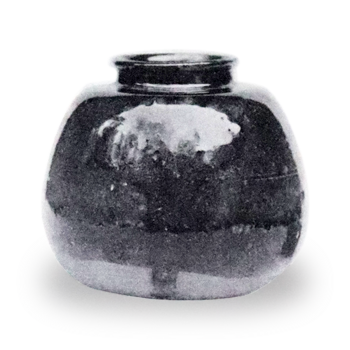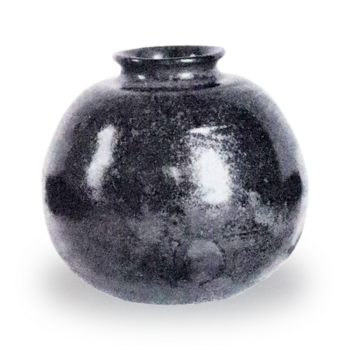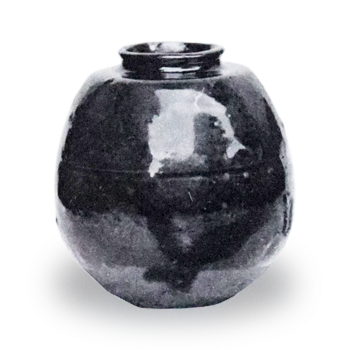


Chinese-made (Tang-style) Daimeibutsu; Collection of Marquis Toshiyuki Maeda
Name
The calligraphic inscription of the two characters “Tanabata” on the bottom of this tea caddy is said to be in the hand of Soami. Since the Higashiyama-den Kashiki-no-ki records, “One small jar by Hariya Shinzaemon: Eggplant, Tanabata, July of the 2nd year of the Daiei era…,” this inscription likely dates from the Higashiyama period. A tea text in the Kōan Bunko, No. 9, states: “Tanabata Imo is a name from the Jukō era. It is said to signify the tying of a bond through tea,” suggesting that other tea utensils of the time may also have borne the name “Tanabata.” Another tea text states: “Kobori Enshū admired the Imo-no-ko tea caddy owned by Shokado, saying, ‘Such a masterfully inscribed vessel should be brought out only once a year. ‘Whenever I travel to Kyoto once a year, I wish to partake of tea from this Imo-no-ko tea caddy on that occasion.’ It is said that because they met only once a year, he named that Imo-no-ko tea caddy ‘Tanabata.’” While this is another theory regarding the origin of the name “Tanabata,” the question of what this eggplant-shaped tea caddy was named after should remain open for the time being.
Dimensions
Height: 2 sun 5 rin (approx. 6.2 cm)
Body diameter: 1 sun 9 bu 5 rin (approx. 5.9 cm)
Mouth diameter: 8 bu 5 rin (approx. 2.6 cm)
Base diameter: 9 bu (approx. 2.7 cm)
Height of the koshiki (ring): 1 bu 5 rin (approx. 0.5 cm)
Shoulder width: 1 sun 8 rin (approx. 0.5 cm)
Weight: 15 monme (approx. 56.3 g)
Accessories
Lid: 1 piece, ivory
Imperial bag: Yellow silk; cord ends in Enshu brown
Bag: 1
Guangdong weave; cord ends in purple
Severely damaged; stored in wrapping paper
Hikiya (Rosewood):
Lid front: Double-carved “Weaving Maiden” motif; rim accented with blue
Lid back: Double-carved “Eggplant” motif
Pouch: Antique-style Kontereki; lining is solid-striped Tōzan; cord fasteners are pale yellow
Inner box: Paulownia, natural wood; inscription on lining paper
“Tanabata Eggplant”—Inscription by Kobori Enshū
(Contents of the inscription on the box)
Wataru Tanabata Eggplant (written in red)
Presented by Tachibana-ya Sogen. It is said that it was once owned by Lord Higashiyama (Ashikaga Yoshimasa).
There are other accounts of its origin.
Outer box: Paulownia, natural wood, new
“Tanabata Eggplant”
Miscellaneous Notes
Tanabata Eggplant
A small jar by Hariya Shinzaemon containing one Tanabata eggplant. This is a note on an origami from July 24, 1522 (Daiei 2).
(From Aiai’s Record of Lord Higashiyama’s Decorations: Illustrated Compendium of Meibutsu)
Tanabata Eggplant: Chinese ware. Owned by Matsudaira Kaga-no-kami. Viewed on December 10, 1740 (Genbun 5), the Year of the Monkey. Height: 2 sun 5 rin (approx. 6.2 cm); body: 1 sun 9 bu 8 rin (approx. 6.0 cm); mouth: 8 bu 7 rin (approx. 2.6 cm), with some parts measuring 9 rin (approx. 0.3 cm); base: 2 bu (approx. 0.6 cm); shoulder: 1 sun 2 bu 5 rin (approx. 3.8 cm), base: 8 bu 5 rin (approx. 2.6 cm); the base is inscribed with “Tanabata” in ink as shown. The lid is a single piece of ivory. The pouch is a single piece of Guangdong-woven fabric, with a pale green lining and purple cord ends. The handle is made of rosewood and is carved with the characters “Orihime” as shown here; the underside of the lid is carved with the character “Nasu” as shown here. The pouch is made of five-colored striped Kinran, with a striped lining and pale green cord ends. The box is made of unpainted paulownia wood and bears the inscription “Tanabata Eggplant”; on the underside of the lid, a label is affixed with the following text: “Han Tanabata Eggplant, presented by Tachibana-ya Sogen. It is said to have once belonged to Lord Higashiyama (Ashikaga Yoshimasa). There are other accounts of its provenance” (an illustration of the tea caddy is included).
(From Meibutsu-ki)
Tanabata Eggplant: The clay is mouse-gray, and the underglaze appears persimmon-colored. The top glaze is black; the thread cut on the base (bottom) is reversed, and inside the base are the two characters “Tanabata” and a signature. According to tradition, the artist is said to be Soami. The design hangs down to the bottom, with glaze splatter; there are two irregular brush marks beneath the band to the left of the design.
(From The Maeda Marquis Family Inventory)
Tanabata Eggplant: Reportedly owned by Lord Higashiyama (Yoshimasa Ashikaga). The handle is made of Hikiya rosewood, with “Orihime” on the front and “Eggplant” on the back. The pouch is made of kontereki fabric, with a white Guangdong-woven fabric with horizontal stripes on top of the pouch. The outer box bears the inscription “Tanabata Eggplant” in the handwriting of Kobori Enshu.
(From Shimadome: Treasures of the Maeda Family)
Provenance
It is said to have been passed down from the Higashiyama Imperial Collection, and was owned by Hariya Shinzaemon, then by Tachibana-ya Sogen, before being presented to the Kaga Marquis (the Maeda family). Sogen, commonly known as Chōbei, studied tea ceremony and calligraphy under Kobori Enshū, and it is said that he was always close to him and entrusted with the management of his tea house. A brief biography of him appears in Zoku Chajin Kaō Yabu.
Record of Actual Viewing
On November 25, 1919 (Taisho 8), I viewed this item at the residence of Marquis Toshiyuki Maeda in Honfuji-chō, Hongō Ward, Tokyo.
The rim is thin, the flaring is shallow, and the shape of the rim area is somewhat reminiscent of a rice chest, giving it a very elegant charm. Overall, there is a pattern created by black glaze on a pale purple ground; in places, there are raised areas resembling rice crackers; a single line of indentations runs around the body; and the black glaze is applied thickly over half of the area around the base. Furthermore, below the ridge on the body, the black glaze has run down from both sides, cascading onto the inner surface of the foot rim in places, and there are two opposing marks from a spatula around the foot rim.
Both the purple and black glazes are beautiful, and the form is exceptionally vivid. The section below the rim reveals vermilion-colored clay; the thread marks are fine, and there are glaze spatters extending toward the rim of the base. There is also a slightly raised brushstroke mark on the inside of the base. The horizontal calligraphic inscription beneath the two characters “Tanabata” is said to be in Soami’s own hand. Inside, the glaze covers the rim, with one streak flowing down to the middle of the body; the wheel marks run shallowly around the interior, forming a tomoe (swastika) pattern at the center of the base. The overall quality of the glaze is very similar to that of the “Shōya Bunrin” tea caddy, and the overall appearance also bears a striking resemblance. It is likely a work from the same period, created using the same techniques.