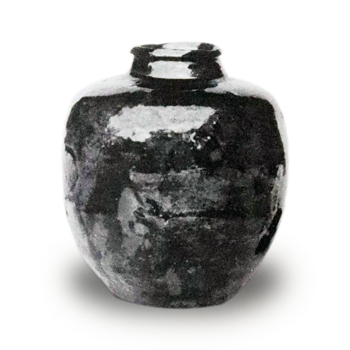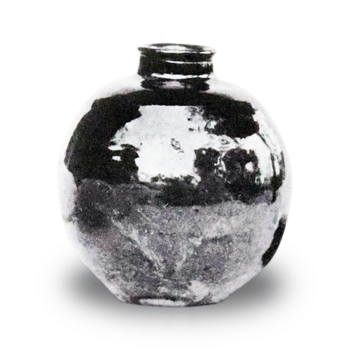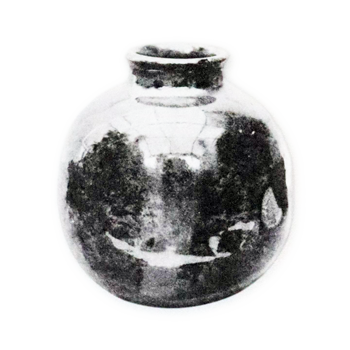
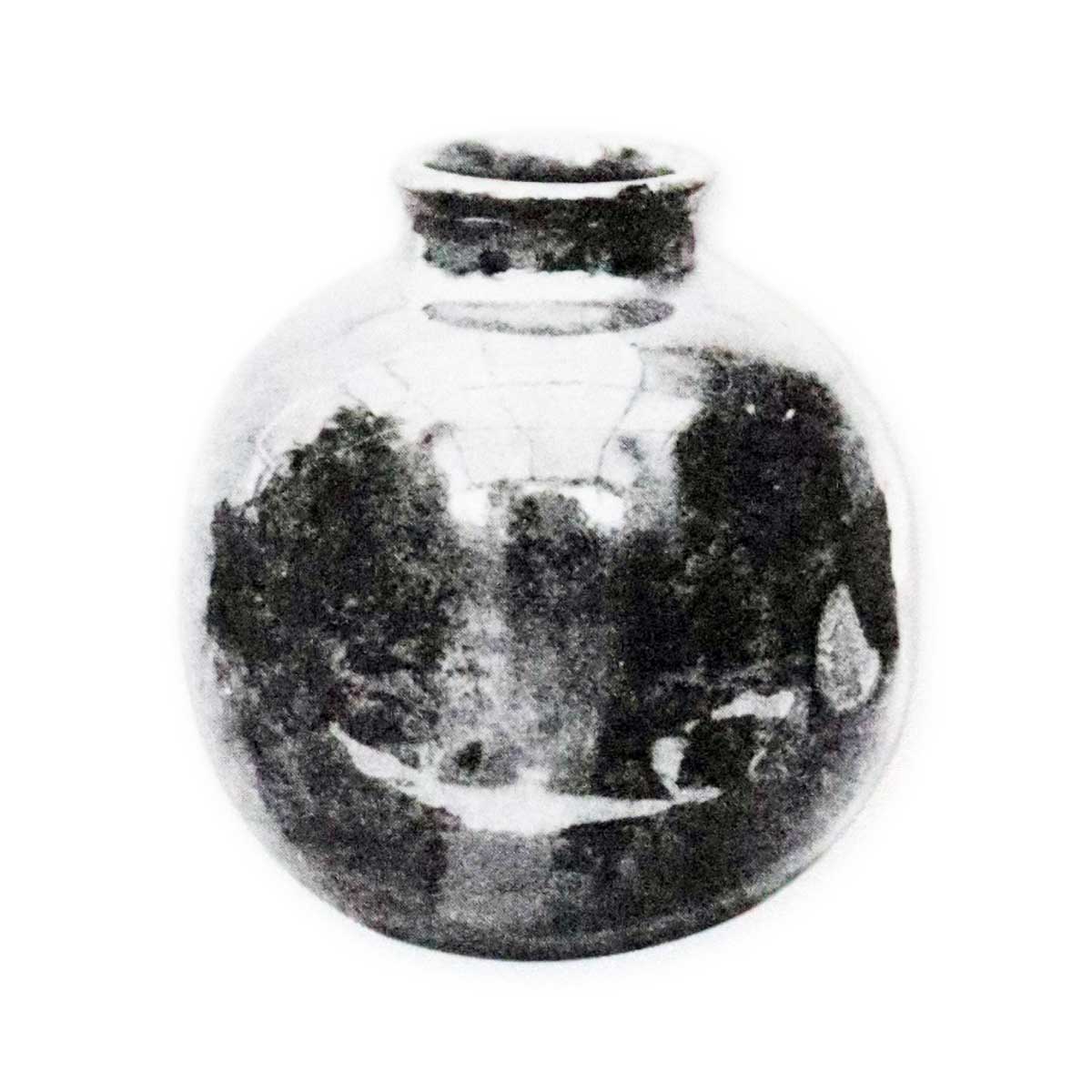
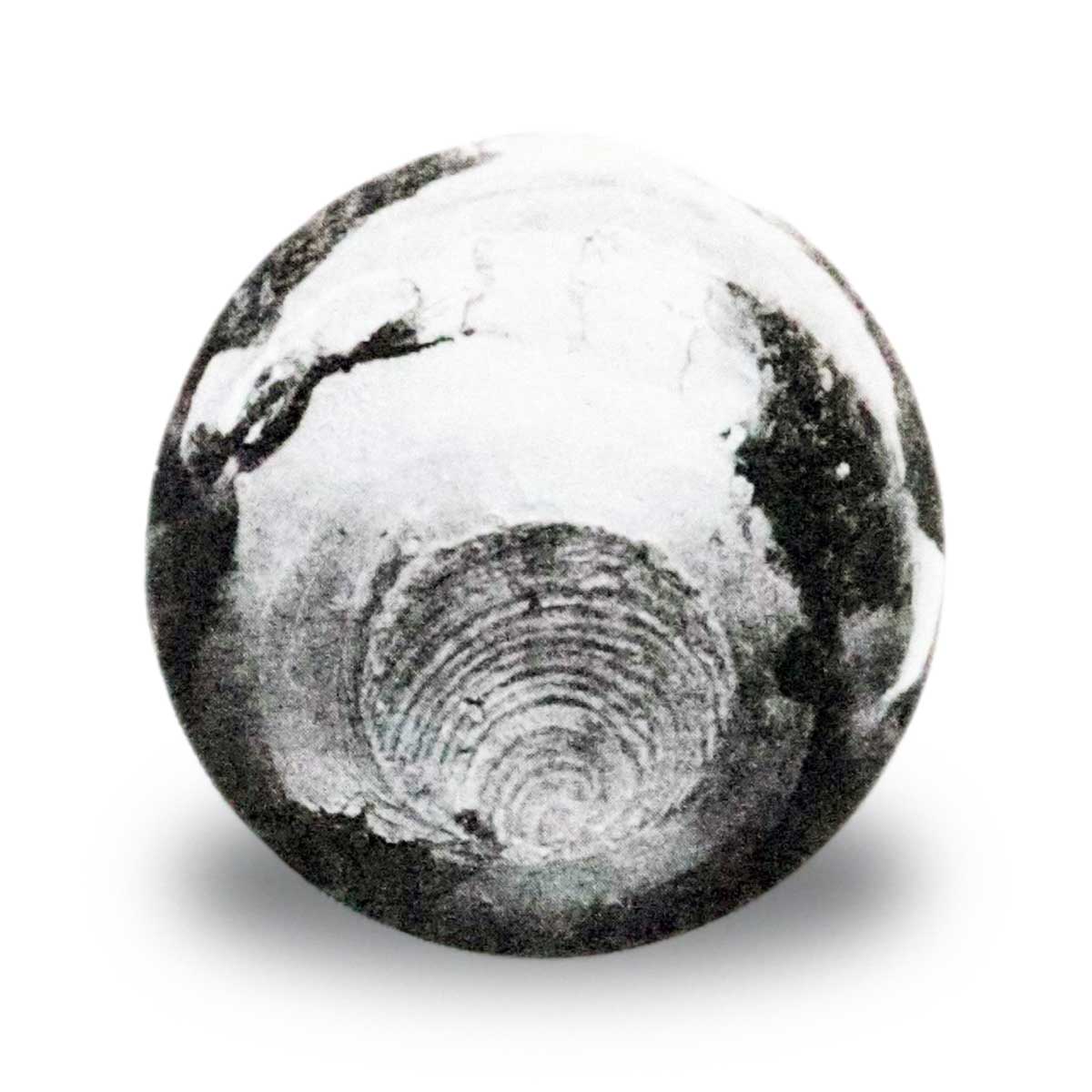
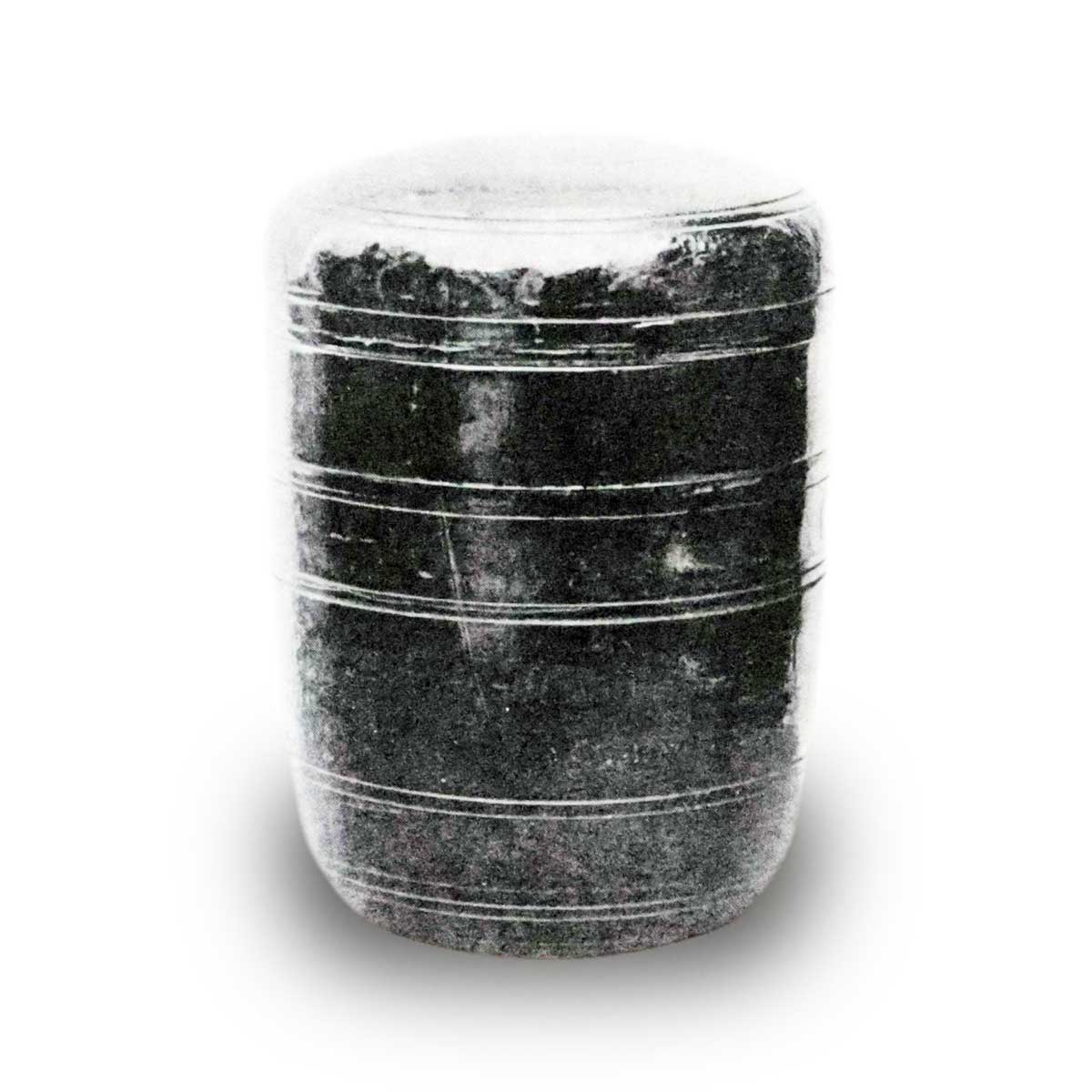
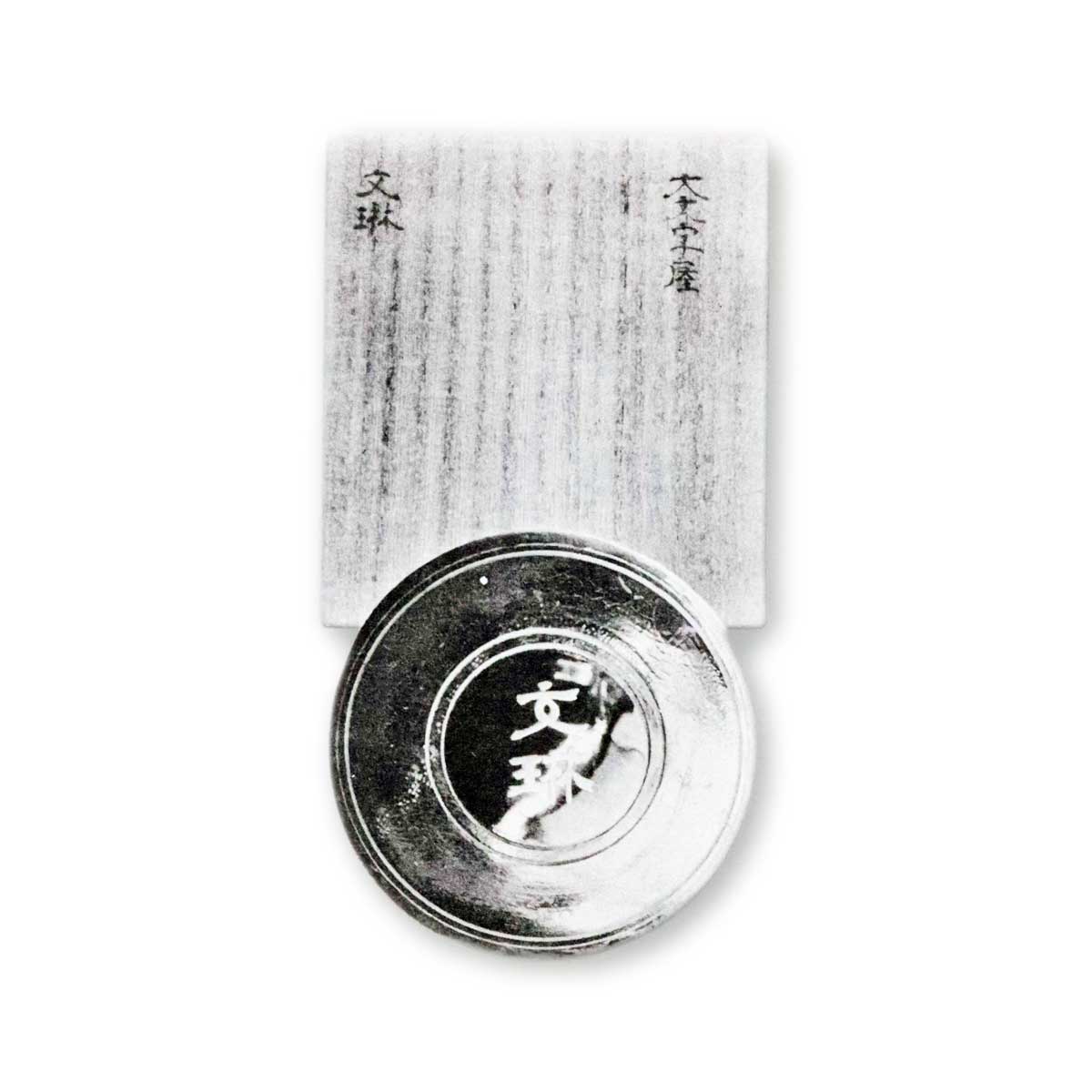
Made in China; Daimeibutsu; Collection of Count Matsudaira Naoaki
Origin of the Name
This tea caddy is named after the Chinese-made Bunrin tea caddy that was once owned by Hikida Soi, known as Daimonjiya in Kyoto.
Dimensions (Converted at 1 sun ≈ 3.03 cm)
Height: Approx. 6.06 cm (2 sun)
Body Diameter: Approx. 5.30 cm (1 sun 7 bu 5 rin)
Mouth Diameter: Approx. 2.42 cm (8 bu)
Base Diameter: Approx. 2.42 cm (8 bu)
Accessories
・Lid: 1 (with a slight indentation). Stored in the tea caddy’s inner box.
・Carrying bag (for the tea caddy): White ha-nubiki silk, with a Enshu brown cord
・Covering bags (for the carrying bag): 2
Floral-patterned satin (lining: light green haiki, cord: purple)
Bamboo vine-patterned satin (lining: dark brown Enshu haiki, cord: Enshu brown)
・Bag box: Unfinished paulownia wood, with an inscription by Matsudaira Fumai
“Bunrin Bag”
Wrapping cloth: Floral cloth (lining: Onado brown habutae)
・Hikiya (cylinder for storing the tea caddy): Made by Komatsu. The lid features an inscription in gold powder.
“Bunrin” — On the outer side of the inscription on the lid, there is a red and black spinning top pattern.
Pouch: Arisugawa pattern (lining: striped umi-ki, cord: purple)
・Inner box: Black lacquered, with iron lock
Wrapping cloth: Floral cloth (lining: Onado-brown ha-ni-bi)
・Outer box: Natural-finish paulownia wood, with an inscription by Matsudaira Fumai
“Daimonji-ya Bunrin”
Wrapping cloth: Floral cloth (lining: Onado-brown ha-ni-bi)
Miscellaneous Notes
Bunrin, owned by Ōmonjiya Sōei.
(From Kobutsu-ki)
Bunrin, owned by Ōmonjiya Sōei of Kyoto.
(From Ganka-butsu-ki)
Ōmonji Bunrin: A Daimeibutsu, a famous Chinese artifact. Owned by Ōmonjiya, a merchant of Kyoto. Purchased from Tanimatsuya Teihachi, a Kyoto merchant, around the Bunsei era (by imperial decree).
(From Fushimiya Memoirs)
Daimoniya Bunrin: Made in China. Around the Bunsei era, it was recorded as having cost about 300 ryō through Tanimatsuya’s brokerage, as noted above (Fushimiya Memoirs).
(From Fushimiya Notes)
Ōmonjiya Bunrin: Daimeibutsu. 200 ryō. Presented by Tanimatsuya Teihachi.
(From Osaki-sama’s Record of Tool Expenses)
History
Originally owned by Ōmonjiya Sōei of Kyoto, it was purchased (acquired) by Lord Matsudaira Fumai for 200 ryō during the Bunsei era through the mediation of Tanimatsuya Teihachi (Toda Sōshio), a Kyoto tool merchant.
(Note) Ōmonjiya Hikita Sōkan was the owner of the famous “Hatsuhana Katatsuki,” and Sōei is believed to be his descendant. The calligraphy scroll (hanging scroll) of the famous “Yabure Kido,” which Lord Fumai purchased from Ōmonjiya during the Bunka era, is inscribed as “Owned by Ōmonjiya Usaku of Kyoto,” and this person was likely also a descendant of Sōei.
Record of Actual Viewing
On May 28, 1918 (Taisho 7), I had the opportunity to view this item in person at the office of the House of Count Matsudaira Naoaki in Matsue City.
The “Omotoya Bunrin” is the smallest of the Bunrin tea caddies, and its form is exceptionally beautiful.
The rim of the mouth is rounded with a shallow curve, and the overall shape is plump, a form that lives up to the name of the fruit “Bunrin-rō” (apple). Around the shoulder, it displays an amber-colored glaze with a strong reddish (ochre) hue, and the view of the front (when placed on a tray), which has a persimmon color and a metallic luster (golden sheen), stops near the base. There is a single spot of glaze loss (an area without glaze) near the middle of the body, and the brown glaze with a metallic sheen is unevenly mixed into the overall black amber glaze. The area from the rim downward reveals the red-brown clay, and there is a single instance of glaze spatter around the rim. The thread-cut finish is exquisite, with not a single small scratch or flaw. Just like that petite beauty, though small in size, it possesses a perfectly formed shape; among small tea caddies, this must surely be considered a masterpiece (jōjō).