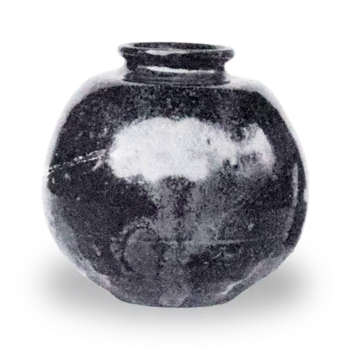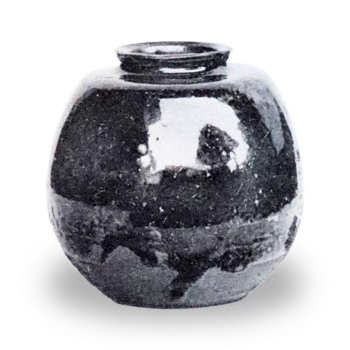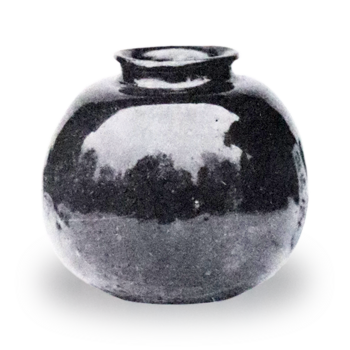
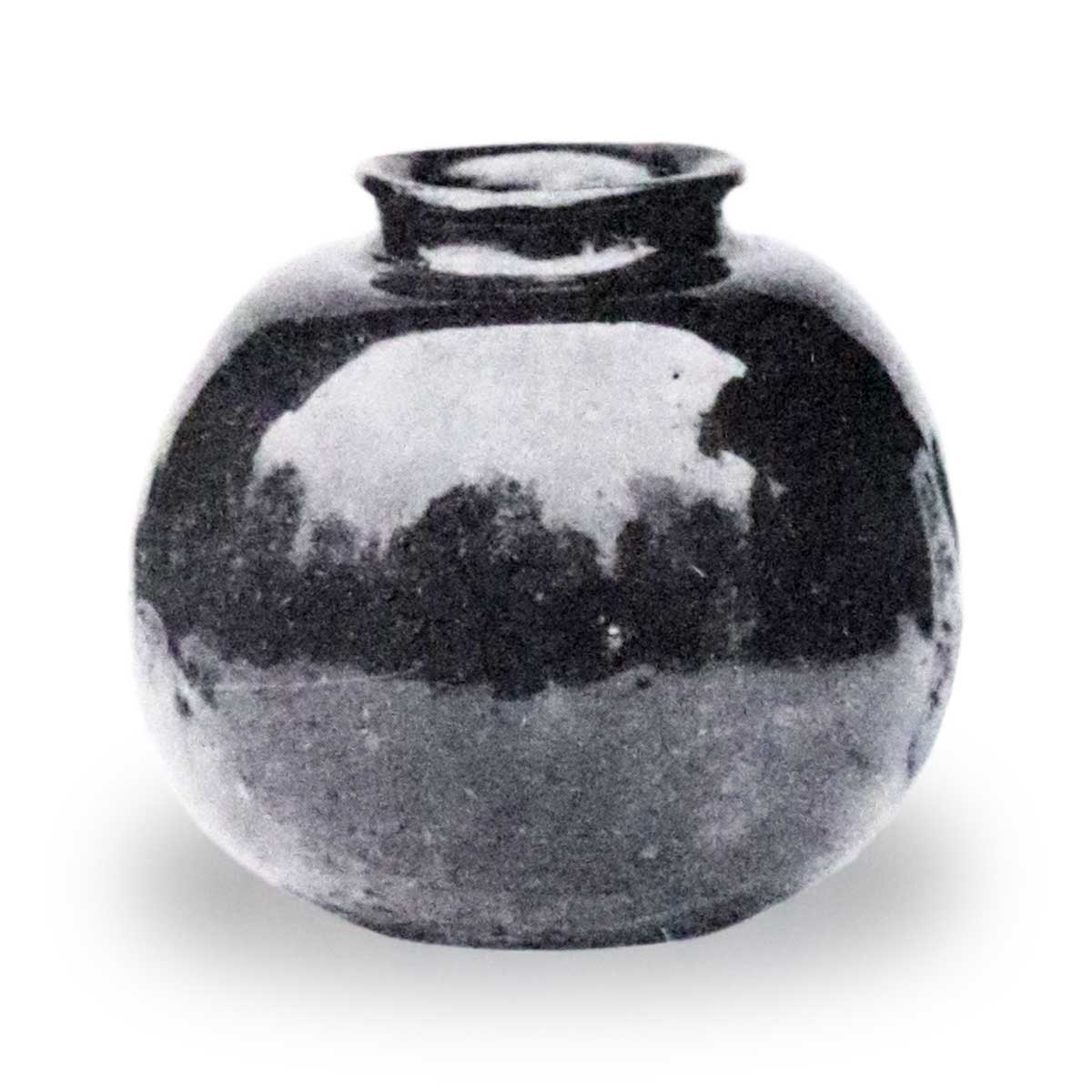
Chinese-made (Tang-style) Daimeibutsu. Collection of Mr. Nobuyo Masuda, Tokyo
Name
Takeno Jōō owned two eggplant-shaped tea caddies: this one, simply known as the “Jōō Nasubi,” and another owned by the Kōnoike family, which bears the characters “Mitukushi” and Jōō’s signature on the bottom. The Chaji Hiroku lists the famous eggplant-shaped Meibutsu known to the world as “Kitano Nasubi, Daigo Nasubi, Bungo Nasubi, Sōgo Nasubi, Shōō Nasubi, Mitsukushi Nasubi, and Hyōgo Nasubi,” making it clear that there have long been two types: the “Shōō Nasubi” and the “Mitsukushi Nasubi.” However, many tea ceremony texts confuse these two eggplant-shaped tea caddies, making it difficult to distinguish between them. In this book, we have decided to refer to this particular tea caddy simply as the “Shōō Nasu,” and to designate the one from the Kōnoike family as the “Shōō Nasu (also known as Mitukushi Nasu),” thereby distinguishing between the two.
Dimensions
Height: 1 sun 8 bu 6 rin (approx. 5.6 cm)
Body diameter: 2 sun 1 bu (approx. 6.4 cm)
Mouth diameter: 9 bu (approx. 2.7 cm)
Base diameter: 1 sun (approx. 3.0 cm)
Height of the koshiki (rim): 1 bu 8 rin or 2 bu (approx. 0.5 cm to 0.6 cm)
Weight: 15 monme (approx. 56.3 g)
Accessories
Lids: 2 pieces, ivory, Shōō and Rikyū
Storage bag: Kanachi Kinran (gold brocade), lining lost, white long cord with a red cord fastener
Fukusa (wrapping cloth): Brown twill satin ground, Shōō period
Pouches: 3
Ōuchi-hishi Kinran; lining is light green kaiki (silk fabric); cord fasteners are long red cords
Navy-blue ground with arabesque pattern; lining is missing; cord fasteners are long purple cords
Guangdong weave; lining is iridescent sea-green silk; cord fastener is purple
Pouch box: Paulownia wood; Shunkei lacquer
“Donshu (donsu), Shōō eggplant-patterned pouch; Sanai; Kinran; Guangdong”
Wooden mold: Flowering quince (karin) with ivory window lid
Wooden mold box: Paulownia wood; Shunkei lacquer
“Shōō eggplant wooden mold”
Hikiya: Black lacquered; one hole at the top of the lid. No pouch; wrapped in a purple crepe fukusa.
Inner box: Paulownia wood, Shunkei lacquer; paper label on the inside; made by Shōō
Outer box: Paulownia wood, slip-on lid; made by Shōō
Outer case: Black lacquered; with lock
Master case: Paulownia wood, Shunkei lacquer
“Sho’o Eggplant Tea Caddy”
Accompanying Hanging Scroll: 1 scroll, painted by Sho’o
(Note) The text and address written in the hand of Daikoku-an (Takeno Sho’o) are difficult to read, and since there is no description regarding the eggplant tea caddy, this section is omitted.
Accompanying Letters: 2 letters
Notes on the Shōō Eggplant Tea Caddy
- Tea Caddy: Height 1 sun 9 bu (approx. 5.8 cm), weight slightly over 15 monme (approx. 56 g), size 2 sun 1 bu (approx. 6.4 cm) (measured across the widest part). Color: amber; clay: light yellow shu-de.
- Pouches: 4
Kasu Guangdong weave
(Breakdown) Large inner diamond-patterned Kinran
Kanachi Kinran
Replacement satin bag
All of these are bags that Shōō used. - Lids: 2
(Breakdown) 1 by Shōō
1 by Rikyū - Hanging scroll with a letter by Shōō: 1 scroll
- Letter by Funakoshi Iyo-no-kami
- Letter by Kobori Samasuke
- Two boxes (inner and outer) made by Shōō
- Furoshiki wrapping the inner tea caddy: This has been in Shōō’s possession since he owned it.
The above
is in accordance with the catalog on the right. Should there be any discrepancies, please feel free to inquire with us at any time in the future. The above is correct.
May 20, 1679 (Enpō 7, Year of the Goat)
Nabeshima Tatewaki (Seal)
Memorandum
The total of 500 ryō in koban gold is the payment for Shōō’s eggplant-shaped tea caddy.
Of this amount
- I have just received 200 ryō in koban gold.
The remaining - 300 ryō in koban gold is to be paid as follows: 150 ryō at the end of next year and 150 ryō at the end of the year after that. This serves as proof for future reference.
May 26, the Year of the Goat, Enpō 7
To: Obito Nabeshima
Ichirobei Kawaguchi (Seal)
Chōzaemon Ishii (Seal)
To: Lord Matsudaira Yamato-no-kami
Lord Sakubei Niwa
Enclosed Letters: 2 (1 to Iyo-no-kami Funakoshi, 1 to Samasuke Kobori)
I have read your letter. Now, regarding the “Jōō Eggplant” you showed me the other day, you have inquired about it. As I have stated before, since this is a Meibutsu eggplant tea caddy with no hidden flaws, the price is a matter of negotiation between the seller and the buyer, ranging from 150 to 200 pieces (approximately 1,500 ryō). For such a long-renowned item, the price is not necessarily fixed. I humbly acknowledge your inquiry.
November 3
Funakoshi Iyo-no-kami, Seal
To Mr. ○○○○
(The recipient’s name has been blacked out with ink)
I have read your letter. Regarding the tea caddy you showed me, it is a Meibutsu I have seen before. It is the “Jōō Eggplant.” It is a tea caddy that Enshū-no-kami (Kobori Enshū) is also well acquainted with. As this is not a Meibutsu for which a price can be easily stated, if you feel you wish to acquire it even at a high price, it would be best to purchase it. I have heard that it was previously valued at 150 mon (approximately 1,500 ryō), but the deal did not go through. If that is the case, I believe it is possible that a deal could be reached even at that price this time. It is a truly magnificent piece. Sincerely.
May 13
Kobori Samasuke (Seal)
To: [Name]
(The recipient’s name has been blacked out with ink)
Miscellaneous Notes
The major varieties of the Meibutsu “eggplant” tea caddies known to the world are roughly as follows:
Kitano Eggplant, Daigo Eggplant, Bungo Eggplant, Sōgo Eggplant
Kyōgoku Eggplant, Shōō Eggplant, Mitsukushi Eggplant, Hyōgo Eggplant
(From Secret Records of Tea Ceremonies)
Items exhibited at the Kitano Grand Tea Gathering on October 1, 1587 (Tenshō 15)
Owned by Tsuji Gen’ya: 1. Eggplant-shaped tea caddy; previously owned by Shōō: 1. Painting of peonies by Shunkyō
(From Illustration of the Kitano Grand Tea Gathering, held by Kitano Shrine, Kyoto)
Eggplant: This name has no other meaning; it is simply called this because it resembles the shape of an eggplant. There are two types of eggplant shapes: one without a koshiki (a protrusion at the mouth) and with a broad back, and another with a basin-like opening. However, one might mistake a “shiribukura” for an eggplant. One should understand that an eggplant has a round bottom, while a shiribukura has broad shoulders (where the shoulders are thrust out). It is said that the “Sho-o Nasu” owned by Nabeshima Munehiji and the “Kokushi Nasu” owned by Takimoto-bo of Hachiman-yama also conform to the description above. In the past, during formal tea ceremonies using a tray stand, only the Nasu tea caddy was used. From the time of Sen no Rikyu (So-eki) in the mid-16th century onward, the style became more informal, and caddy types such as Katatsuki, Bunrin, Marutubo, and Shiribukura came into use.
(From Manpō Zenshū)
History
Originally owned by Takeno Jōō, it was passed down to Tsuji Gen’ya of Kyoto and exhibited at the Kitano Daichajō on October 1, 1587 (Tenshō 15). It subsequently came into the possession of Matsudaira Taitō, the feudal lord of Kashima in Hizen. In May of Enpō 7 (1679), Matsudaira Yamato-no-kami, lord of Musashi-Kawagoe Castle, purchased it for 500 ryō in koban gold coins. It had been passed down within his family ever since, but on December 25, Taisho 8 (1919), when the family’s collection was put up for auction at the Ryogoku Art Club in Tokyo, it was purchased by the current owner for 45,800 yen.
Field Notes
I examined the piece in person on October 23, 1919, at the residence of Count Naoyuki Matsudaira in Shimo-Nibancho, Kojimachi Ward, Tokyo.
The rim is flared outward, and the rim edge is irregular. The marks left by the spatula on the inside of the rim are intriguing, and the soft, squishy texture of the glaze is indescribable. A band of blue-lapis-blue glaze runs around the base in a single line, and the overall amber color has a beautiful luster. A single band runs around two-thirds of the body. Within the amber-colored glaze surrounding this band, a lapis lazuli-blue glaze drifts like clouds. From the shoulder to the base, where the glaze becomes more vivid along with the form, the same lapis lazuli-blue glaze can be seen. There is also a small area of missing glaze near the band around the middle. Within this, there is a tool mark (paddle mark) about the size of a red bean; the area from the rim downward reveals the vermilion-colored clay, and there is one spot where a kiln gap (an area without glaze) extends up to the waist line. The thread cut (the mark where the bottom was separated) is fine, and there is a tool mark extending toward the rim of the base. Inside, the glaze covers the rim, while below that, wheel marks run down the interior, forming a swirl at the bottom. Overall, it feels light in the hand, the glaze is soft, and the form is elegant; among teapots of this type, it is one of the most rich in the flavor of tea (chami).