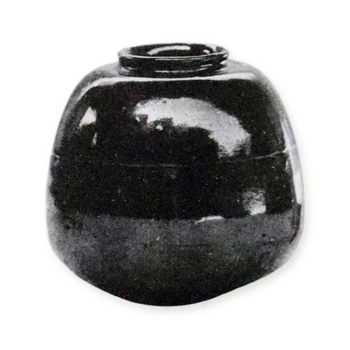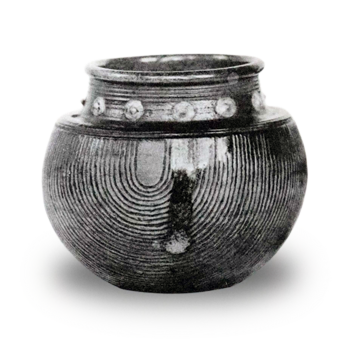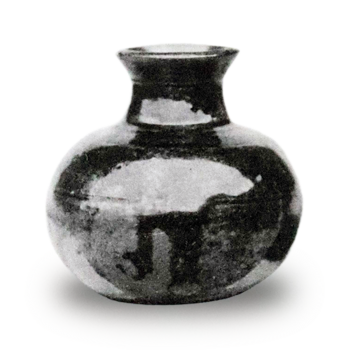
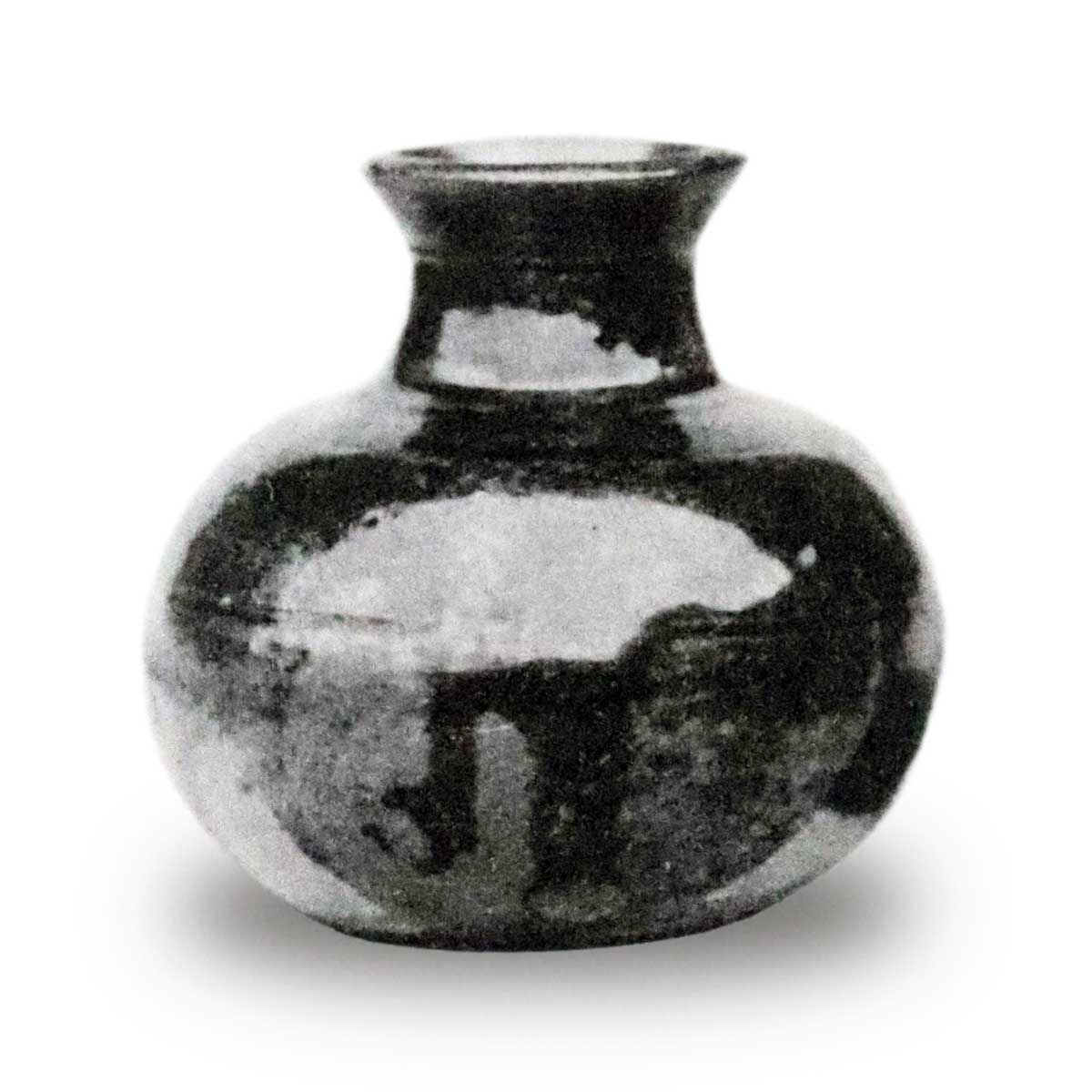
Chinese Ware, Collection of Baron Konoike Zen’emon
Name
The Ben’gyoku-shū states: “The term ‘Rotei-guchi’ (donkey’s hoof mouth) is written as ‘驢蹄’ and read as ‘usagi-uma’ (donkey’s hoof); it is so named because the shape of the rim resembles the print of a horse’s hoof.” In other words, this tea caddy was named thus because the shape of its rim resembles a donkey’s hoof.
Dimensions
Height: Approx. 6.2 cm (2 sun 5 rin)
Body diameter: Approx. 6.6 cm (2 sun 1 bu 7 rin)
Mouth diameter: Approx. 3.0 cm (1 sun)
Width of “Donkey’s Hoof” rim: Approx. 0.8 cm (2 bu 5 rin)
Base diameter: Approx. 2.7 cm (9 bu)
Height of the neck (koshiki): approx. 2.0 cm (6 bu 5 rin)
Weight: approx. 58.5 g (15 monme 6 bu)
Accessories
・Lid: 1, with a “su” (pattern)
・Storage pouch: None; wrapped in purple chirimen donsha (crepe silk)
・Pouches: 2
Donshu Shimotsuma (lining: kakishiro; tying cord: purple)
Donshu Shōō (lining: brown cotton; tying cord: purple)
・Storage box: Paulownia wood, natural finish
“Tang-style Donkey Hoof”
(in a frame)
“Tang-style Donkey Hoof Round Teapot Pouch: Donshu Shimotsuma, Donshu Shōō”
・Hikiya (a tube for storing tea caddies): Tagayasan wood
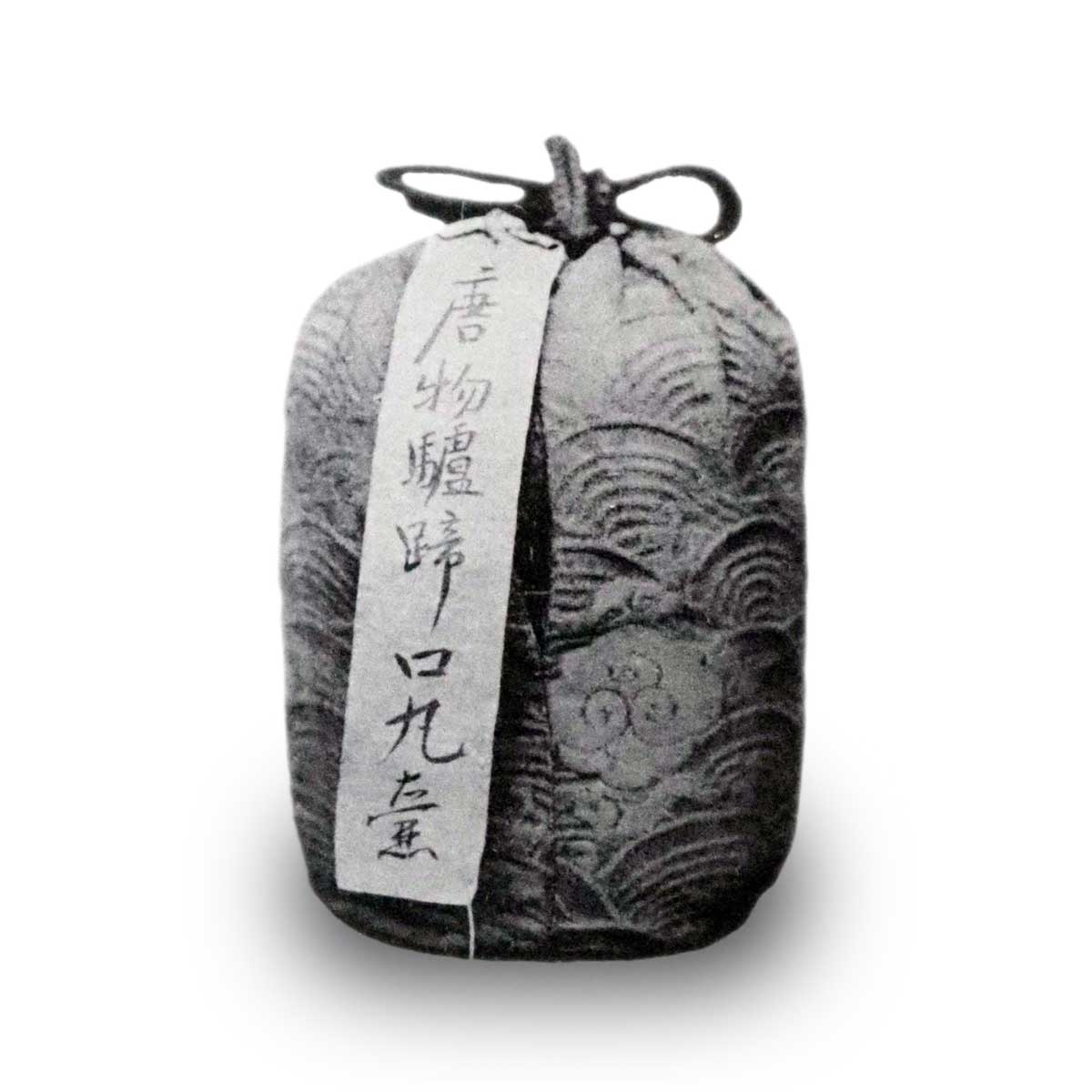
Pouch: Navy-blue ground with a rough coastal wave pattern (lining: Donshu with gold-accented flower-and-bird design; tying cord: brown)
・Box: Paulownia
Miscellaneous Notes
Rotei: The rim is particularly noteworthy. However, it is a small teapot, and there are only two of its kind in the world.
(From Yamagami Sōji Ki)
The “Donkey’s Hoof” tea caddy is so named because the shape of its rim resembles a horse’s hoof. Many round pots and water droppers also feature this “Donkey’s Hoof” rim design.
(From Chayū Shōden Shū)
“Donkey’s Hoof” is read as “usagi-uma (donkey) no hizume.” It is so named because the shape of its rim resembles the print of a horse’s hoof. It measures approximately 7.9 cm (2 sun 6 bu) in length, 24.7 cm (8 sun 1 bu and a half) in circumference, 3.5 cm (1 sun 1 bu and a half) in rim diameter, and 3.8 cm (1 sun 2 bu and a half) in base diameter. The clay is pale yellow, and the thread-cut decoration is fine and delicate. The underglaze is a pale red, while the overglaze is black, with a light ink-colored glaze mixed in and applied sparsely. This is a Chinese ware piece glazed in the Seto style.
(From Manpō Zenshū)
Donkey’s Hoof Vase, Chinese ware: Height approx. 6.7 cm (2 sun 2 bu 1 rin), body diameter approx. 6.7 cm (2 sun 2 bu), mouth diameter approx. 3.3 cm (1 sun 8 rin), base diameter approx. 3.0 cm (1 sun). The height of the neck from the shoulder is approximately 2.1 cm (6 bu 8 rin); the depth below the rim is approximately 1.8 cm (5 bu 8 rin); and the shoulder width is approximately 3.5 cm (1 sun 1 bu 4 rin). The height of the “rotei” (the protruding rim) at the mouth is approximately 0.6 cm (2 bu). This corresponds to the description in this book.
(From Kokin Meibutsu Ruiju)
Donkey-Hoof Round Jar
(From the Kōnoike Storehouse Register, a record kept by Kagaya Sōzō during the Manji era)
History of Transmission
Since this tea caddy is recorded in the Kōnoike Storehouse Register, a record kept by Kagaya Sōzō during the Manji era (1658–1661), it is evident that it had been passed down to the Kōnoike family prior to that time.
Record of Actual Observation
On May 18, Taishō 10 (1921), I viewed the actual object at the villa of Baron Kōnoike Zen’emon in Kitae Village, Nakagawa District, Osaka Prefecture.
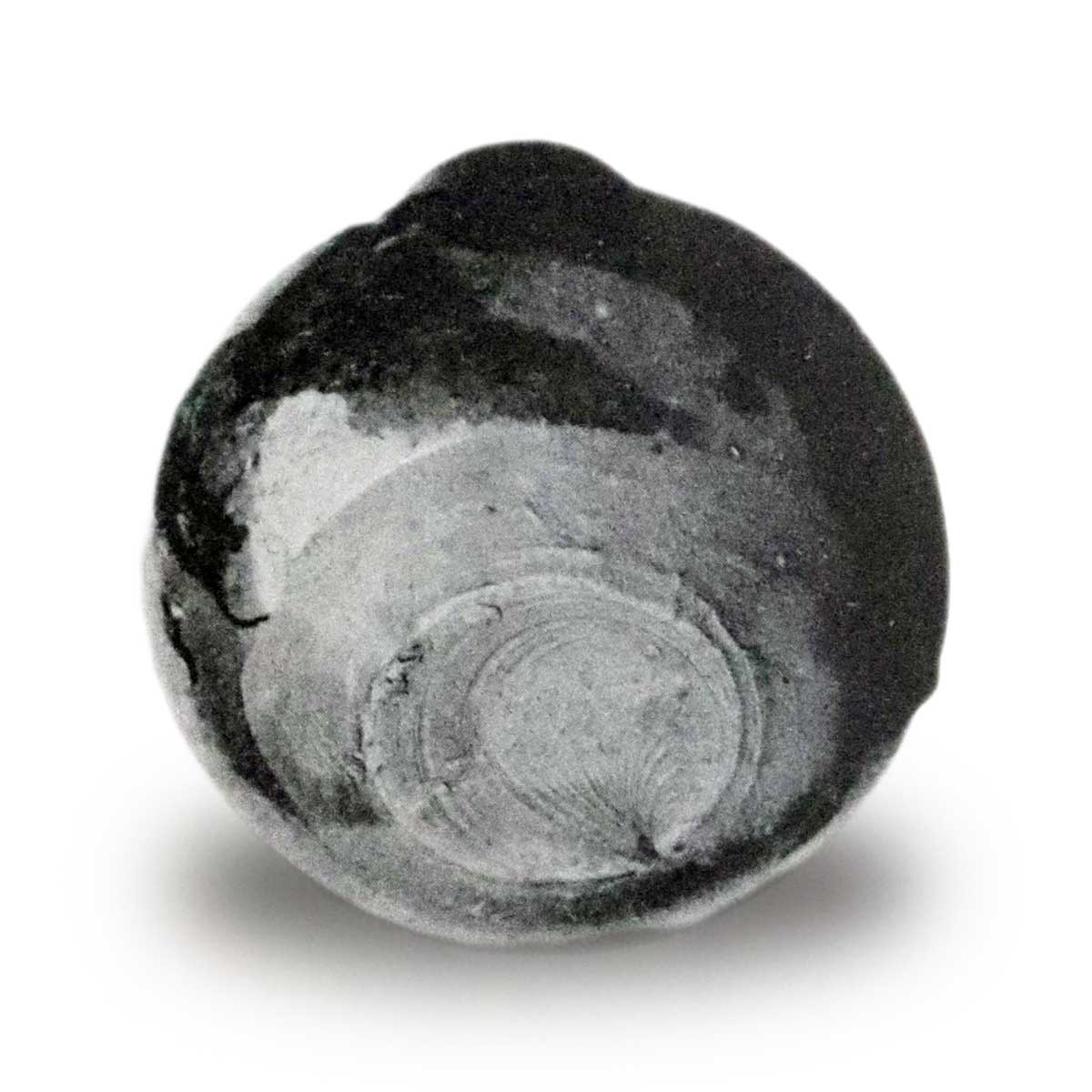
The rim is single-beveled and flares outward toward the top; the body is tall, with a flared lower section, and features a constriction (cinch) midway down. On the inside of the rim, this constriction forms a step, and because it resembles the shape of a donkey’s hoof, the piece bears this name. There is one raised ridge at the base of the body and one recessed ridge on the body itself; in some places, part of the recessed ridge appears to be double-layered. From the rim downward, the clay reveals vermilion and grayish-brown tones, with a thin layer of red water glaze applied in some areas. The thread marks are fine, but there are misalignments at their starting points, and some areas show “sticking” (traces of other objects adhering inside the kiln) or are partially flat.
Overall, a black amber glaze creates patterns on a persimmon-colored base with a purplish tint. Beneath the body ridge, a long, horizontal streak of black metallic luster extends like a haze; the pattern features black amber glaze dripping thickly from the middle of the steamer, splitting into two streaks below the body ridge, one of which is slightly longer and extends to the unglazed edge near the base. Within this, yellow glaze and a blue-lapis lazuli hue appear, making the overall appearance even more magnificent. Additionally, there are two areas of yellow glaze patterns extending from the rim of the vessel to the area around the body cord. Overall, it possesses a beautiful luster, and the variations in its appearance are beyond description. The interior is coated with the same glaze as the exterior on the inner surface of the bowl; below that, the wheel marks are coarse and circular, and the center of the base forms a swirl. It is in pristine condition, and the unique design of the donkey-hoof rim goes without saying.