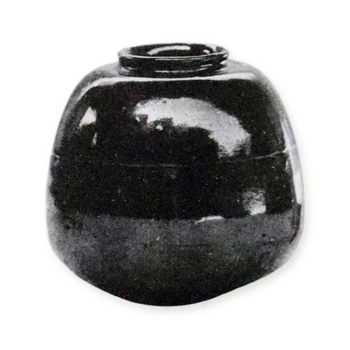
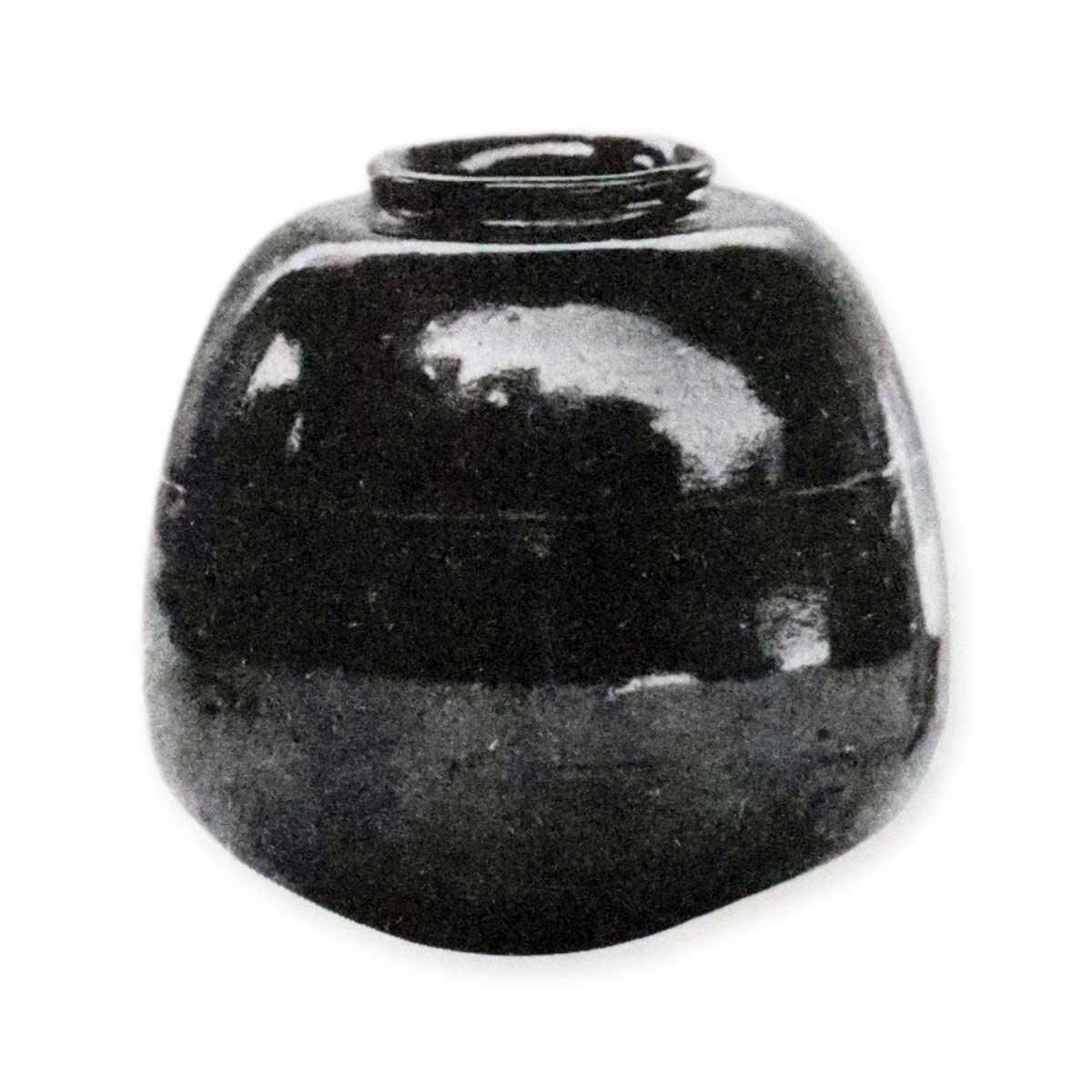
Daimeibutsu (Chinese ware) | Major Treasure | Collection of Marquis Hosokawa Moritatsu
Name
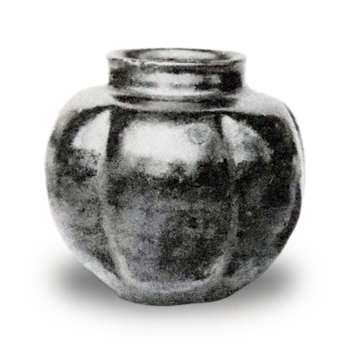
This is a shiribukura tea caddy that belonged to Sen no Rikyū. In Kobashi Ryakuō’s Chaji Shūran (Compendium of Tea Ceremonies), it is written: “Rikyū disliked round tea caddies and preferred shiribukura. He owned two ‘eribukura’ tea caddies.” The Shadō Shōden Shū states: “A ‘shiribukura’ tea caddy refers to a poorly shaped eggplant-shaped tea caddy. It is said that Gassan referred to it as ‘Naga-nasu’ (Long Eggplant), and while there is a Meibutsu (famous tea caddy) featuring a painting of an eggplant, it is said that this shiribukura resembled a long eggplant. However, some shiribukura have a flat base.”
Dimensions
Height: Approx. 6.1 cm (2 sun)
Body diameter (at the waist: approx. 6.4 cm (2 sun 1 bu); at the base: approx. 6.7 cm (2 sun 2 bu))
Mouth diameter: approx. 2.7 cm (9 bu)
Base diameter: approx. 2.7 cm (9 bu)
Height of the neck (koshiki): approx. 0.3 cm (1 bu)
Shoulder width: approx. 0.5 cm (1 bu 8 rin)
Weight: approx. 71.3 g (19 monme)
Accessories
・Lid: 1 piece, plain (no inlay)
・Storage pouch: light green-purple chirimen nightgown fabric (wrapping cloth), deep purple donsha
・Pouches: 3
New Guangdong (lining: iridescent; tying cord: brown)
Ito-nishiki (lining: iridescent; tying cord: purple)
Used Striped Guangdong (lining: iridescent; tying cord: purple)
・Storage box: Paulownia wood; inscription by Hosokawa Sansai (Tadaoki)
“Rikyu Erinukura, Pouches, Three”
・Hikiya (tea caddy): Black lacquer; the top (upper section) is heavily chamfered
Pouch: Smoked leather; cord is pale green with a four-round-knotted design
・Inner box: Paulownia wood, natural finish; inscription by Hosokawa Sansai
“Rikyu Shirinukura”
・Outer box: Thick leather
・Large outer case: Lacquered wood; hinged lid with lock
・Catalog of tea caddies: 1 copy
Memorandum
- Rikyu’s “Shirinu-kura” tea caddy
Lid: Ivory, 1 piece - Purple chirimen nightgown (wrapping cloth)
- Hikiya: Black lacquered; housed in a leather pouch
- Upper box: Paulownia wood
Inscription: In the handwriting of Sansai (Hosokawa Tadaoki)
Upper wrapping: Pale yellow fukusa - Bags: 3
Inside - 1 piece: Threaded brocade
- 1 piece: Kandou
- 1 piece: High-grade Kandou
The item on the right is to be placed in a separate box
Shōtoku 6 (1716)
Year of the Goat, October 22—Revised - Accompanying letter: 1 copy
The wrapping cloth for the tea caddy had become damp and was creaking when being taken in and out of the tea caddy, putting it in a very precarious condition. Therefore, after consulting with the attendants, I decided to wrap it in a purple fukusa. The previous wrapping cloth was stored inside the tea caddy box, placed on top of the tea caddy.
September, Tenpō 2 (1831)
Yamada
Sugano
To Lord Zaitsu, Lord Hanino, and Lord Inoue
Miscellaneous Notes
Shiribukura
This name has existed since ancient times. Looking at the painting of an eggplant in Gassan, I see that my eggplant resembles a shiribukura. Since the potter who made that vase modeled it after an eggplant, my eggplant should also be modeled after one; however, since arriving in Japan, this long eggplant has been considered inferior and is called shiribukura.
In the past, No’ami and So’ami both said, “It is essential for a small pot to have the shape of an eggplant; if it differs even slightly, it is not an eggplant.” For this reason, later sukiya (tea masters) held that one should not acquire Shiri-bukura and debated their prices. A genuine eggplant-shaped pot was expensive, costing 100 kan; later, the price rose to 500 kan. In recent years, the price has risen even further, and it is said that a small eggplant-shaped pot from Nara is worth as much as 2,000 kan.
(From Higashiyama-den Kashiki no Ki: Chaki Meibutsu Zui, attributed to Soami’s own writings)
Shiribō: These are small pots found in shops in the town, and their number is unknown. Among these small pots, there were once famous pieces worth 500 kan or 300 kan, but in the present day, they are no longer highly prized by owners. All of them are meant to be placed on a square tray.
(From Yamagami Sōji Ki)
Rikyū Shiri-hō: A Chinese import. It is from the same period as the Hasegawa Bunrin, Shino Maru-tsubo, and Fukiage Bunrin. When compared to the Nitta (Katatsuki) and Setaka Fudō, the application of the glaze is characteristic of the same era, but it is inferior in terms of age and style. It is of the same rank as the Iki (Katatsuki), Aoki (Katatsuki), Honno-ji Bunrin, and Mt. Fuji Katatsuki.
(From The Origins of Seto Pottery by Fumai)
Shiribukura Tea Jar: A Chinese import. It is mentioned in the Meibutsu-ki and is referred to as “Rikyu Shiribukura.” It was later owned by Lord Hosokawa Sansai (Tadaoki) and is now located in Higo (Kumamoto).
(From Kusama-bon Rikyu Kōji Hyakue Cha-no-ki)
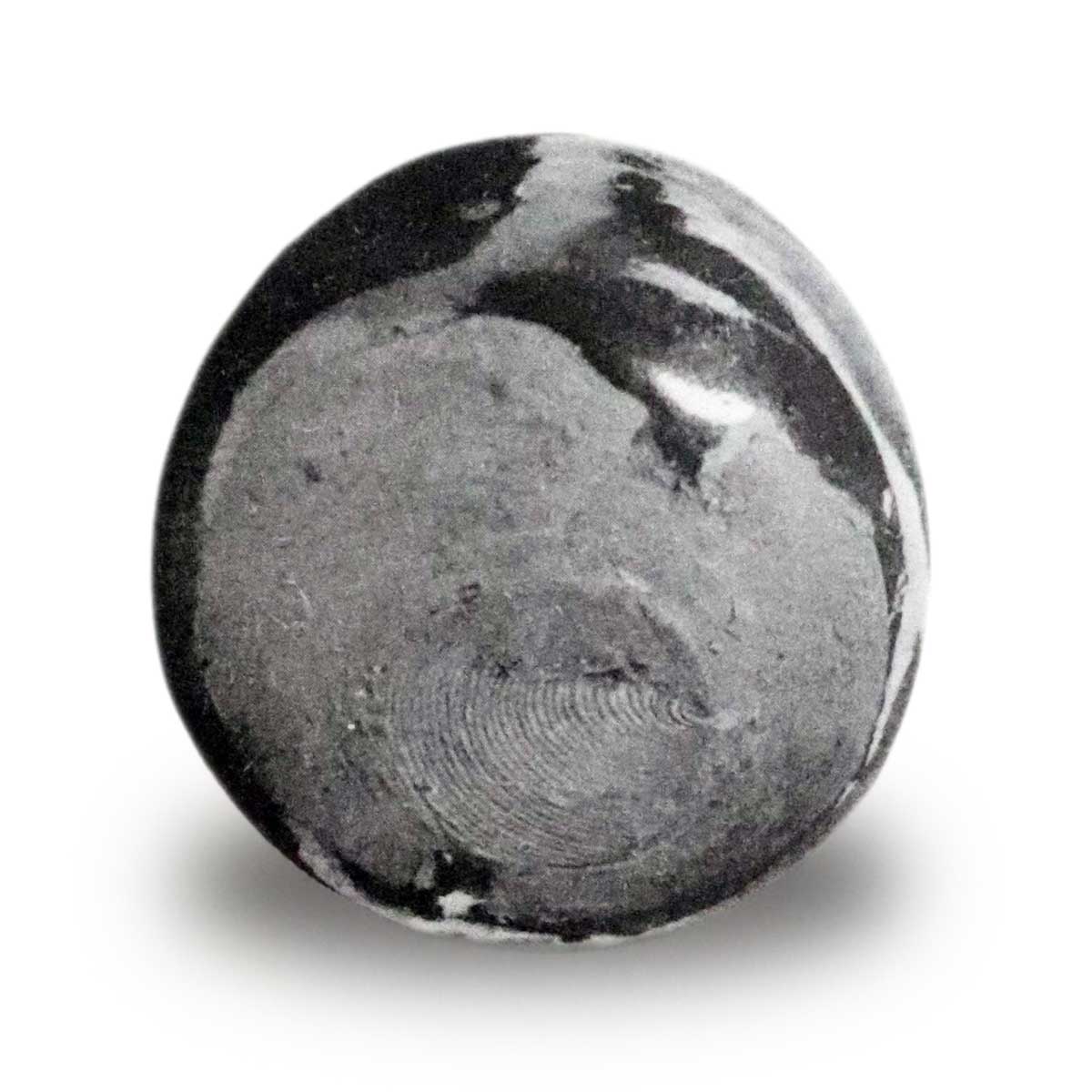
Chinese-Style Shiribukura: This piece is named for its flared base. The clay is pale red, and the rim’s fold is of a crude (sloppy) workmanship. It possesses a naturally delicate quality, and the thread-cutting appears somewhat coarse. The underglaze is an amber glaze with a slight reddish tint, while the overglaze is a deep amber color that appears slightly raised. Within the underglaze, there are “hima” (glaze-free areas) that are finger marks. “Hima” refers to the fingerprints left when holding the tea caddy during its creation and glazing; this is why the lines of the fingers are clearly visible. There are also tea caddies where “hima” occurs naturally, sometimes resulting from the glaze not fully melting inside the kiln. These “hima” areas are always covered with a thin glaze. The base glaze of this tea caddy features black quail-spot patterns. In Fujishiro’s pottery, pieces exhibiting this characteristic are called “Nenuke.” See the entry on “Katatsuki” for details. (Illustration of the tea caddy included)
(From Manpō Zenshū and Chaki Bengyoku Shū)
According to a story told by the abbot of Kyōan (Sen Sōtan) to Sōsa (Zuiryū), Sōeki (Rikyū) favored tea caddies with a rounded base and owned as many as two of them. He presented one to Sansai (Hosokawa Tadaoki), and the other was passed down to my family; however, when I fell ill in my youth and faced financial hardship, I gave that tea caddy to my niece, Kyubei, in exchange for money. However, I never bought it back, and the other party, unaware that it was a Meibutsu, likely allowed it to be forgotten. It is said that the tea caddy was coated entirely in amber glaze.
(From Chawa Shimetsu-shū)
There are two “Rikyu Shiri-fukura.” One was passed down from Sen Sōsa and is now in Kuwana (another version states, “It is now in the possession of Sōfu”). The other was passed down from Sen Sōan and is in the possession of Ueda Sōgo.
(From Senke Chūkō Meibutsu-roku)
Shiri-fukura: According to Sōshin, a text at Fushin-an states that this Shiri-fukura was once owned by Lord Hosokawa Sansai.
It is said to be likely an ancient Seto ware. In a note by Tsuchi-mon Hisayoshi from Keichō 18 (1613), it is stated that Shōan’s tea caddy, “Shirifukura,” was one that Rikyū had possessed. That said, Rikyū may have owned several of them.
(From Rikyū Hyakukai-kai by Kanji-an Munenobu)
According to a memorandum from Shūun-an, tea gatherings were sometimes held at outdoor tea ceremonies (nodate) or hunting grounds. When Sōeki (Rikyū) served tea at Daizenji Mountain, I accompanied him and observed the etiquette closely. Rikyū Kōji remarked, “Although there are no fixed rules for outdoor tea ceremonies, the ceremony cannot be held unless every element of formality is in place. First, one must not allow oneself to be so captivated by the scenery that the tea gathering loses its focus. It is especially important to ensure that the guests’ minds remain engaged. For this reason, it is best to use special utensils, such as a treasured tea caddy. On Mount Daizenji, a “shiribukura” was concealed within the tea box. One must give this careful consideration.”
(From Kissa Gokhiroku and Zoku Chawa Shin’ō)
Morning of the last day of the 10th month of the Dingchou year, Tenshō 5 (1577)—A tea gathering hosted by Sōeki (Rikyū)
Guests: Imai Sōkyū, Tsuda Sōyuki, Yamaoka Sōmu, Takeno Sōka
A long tray without a peach blossom pattern was placed on the toko, with a plum blossom arrangement. The host sat in the hand-washing area; on the toko was a large pot from Hashidate draped with a net, and the tea caddy was an “eribukura.” An Ise tenmoku on a black-lacquered stand.
(From the Imai Sōkyū Diary)
Morning of the 26th day of the first month, Tenshō 6 (1578): Tea gathering hosted by Sen Sōeki (Rikyū)
Rikyū-shiri-bukura
Guests: Sōyuki, Sōji
In the hearth was a kettle with a clean lining; a hand bucket was hung on the adjustable hook from the start. On the tokonoma, a willow arrangement was displayed in a narrow, long tray; a tenmoku with a ash-glazed finish was placed on an Amagasaki stand, accompanied by a Bizen mizushi (water jar). The “Shiribukura” tea caddy was placed in a pouch, and tea was prepared without a tray.
(From Tsuda Sōyuki’s Tea Ceremony Diary)
Morning of September 30, Tenshō 15 (1587) — Four-and-a-half-tatami room
Guests: Priest Kokei, Priest Shun’ya, Priest Gyokufu
A shihō-kama kettle, a Seto mizushi, a “Shiribukura” tea caddy, a black tea bowl, an oritame (tea scoop), a bamboo ring (lid rest), and a small Bizen tube as the flower vase.
(From Rikyū Hyakue Chado-sho)
(Note) The “Shiribukura” tea caddy was used very frequently during Rikyū’s Hyakue tea gatherings. According to the current Hyakue Kai, it was used a total of 27 times, with 66 guests in attendance.
October 1, Tenshō 15 (1587)—Kitano Grand Tea Ceremony—Rikyū’s Assigned Section
Tea caddy: “Shiribukura.”
(From The Record of the Kitano Grand Tea Ceremony)
On October 1, Tenshō 15, Lord Hideyoshi hosted a tea gathering at the pine grove in Kitano. The purpose was to observe the manners and the quality of the utensils of tea enthusiasts from both the capital and the countryside. Tea connoisseurs gathered in large numbers with great enthusiasm, and Tokuzan-in Gen’i and Sen Sōeki (Rikyū) served as organizers. Over 350 samurai and others attended the gathering. Tea rooms were set up at Ukon-no-Baba, beneath the pine trees on either side, in the shade of plum trees, and among the rocks, where tea was served to Lord Hideyoshi. Lord Tadaoki (Hosokawa Tadaoki) also set up a tea house beneath the Kageo Pine and named it “Shōkō-an.” This is why it is known by that name.
Lord Hideyoshi also casually set up three tea seating areas, adorned them with renowned tea utensils, and personally served tea to the guests, who were divided into three groups. The first group consisted of Lord Konoe Nobusuke, Lord Hino Terushi, Lord Tokugawa Ieyasu, Lord Oda Nobuo, and Tsutsumi Nobukane. The second group consisted of Lord Hashiba Hidenaga, Lord Hashiba Hideatsu, Maeda Toshiie, Gamō Ujisato, Inaba Sadamichi, and Sen no Rikyū. The third group consisted of Oda Yuraku, Lord Hashiba Hidenaga, Hachiya Yoritaka, Ukita Naoie, and Lord Tadaoki.
After the tea ceremony concluded, he stopped here and there to partake of tea. This event is known as the Kitano Grand Tea Ceremony. Among the items presented by Sōeki (Rikyū) at the tea ceremony and currently held by our family (the Hosokawa family) are the “Shiri-hō Tea Caddy” and the “Taro-head Water Jar.”
(From the Imperial University Historical Materials Edition of The Hosokawa Family Chronicles)
Morning of the 9th day of the 8th month of the Year of the Tiger, Tenshō 18 (1590), at Rikyū’s residence in Kyoto
Guests: Hisayoshi and Shōan (two people)
A two-tatami mat room. A “Cloud Dragon” kettle. A small board. A tea ring (Hiramena-ri: shaped like a flounder), polished with two pieces of unwashed silk without interruption. A Seto water jar. A rounded-bottom kettle (the pouch was a deep indigo-blue). A well-style tea bowl. A folded tea scoop.
(From the Matsuya Diary)
Hosokawa Tadaoki (Governor of Etchū) was born in Kyoto in Eiroku 6 (1563). He was, in fact, the eldest son of Nagaoka Hyōbu-no-suke Fujitaka. On March 19, Keichō 6 (1601), in recognition of his military achievements at Gifu and Sekigahara, he was presented with a Rikyū-style “shiri-hō” tea caddy by Daito-in-dono (Tokugawa Hidetada). This was because Tadaoki had long yearned for it. On October 2, Kan’ei 2 (1625), when he paid a courtesy call to bid farewell before heading to his fief (Kumamoto), Lord Taito-in personally served him tea that he had prepared himself; Tadaoki was also presented with the wakizashi “Kiyomizu Tōshirō Yoshimitsu” and was allowed to lead the horse. This was proof that she remembered Tadaoki’s words from long ago: “It has been my lifelong wish to wear this short sword and enjoy preparing tea using the Rikyu Shirifukura tea caddy.” He passed away in Yatsushiro on December 2, Shōhō 2 (1645), at the age of 82. His principal wife was the daughter of Akechi Mitsuhide (Garasha).
(From Kansei Shūshū Shokafu)
Rikyu Shirifukura—Owned by Uetsu-no-chū-dono.
(From Daimeibutsu, handwritten by Kizuka Motokori)
(Note) “Uetsu-no-chū” is an abbreviation for Hashiba Etchū-no-kami. Hosokawa Tadaoki, known as Hosokawa Etchū-no-kami, was once granted the surname Hashiba by Hideyoshi.
Rikyu Shirifukura—Owned by Hosokawa Sansai’s adopted daughter.
(From Komonbuki)
Rikyu Shirifukura—Hosokawa Etchū-dono (in her possession).
(From Higashiyama Go-mono Uchi Betsuchō)
Rikyu Erinukura—Chinese small jar—Hosokawa Sansai’s elderly adopted daughter (in her possession).
(From Ganka Meibutsu-ki)
Rikyu Shirihō—Chinese ware—Daimeibutsu—Hosokawa Sansai (owner).
(From Kokin Meibutsu Ruiju)
Rikyu Shirihō—Himo-me (originally?)—Hosokawa Sansai (owner).
(From Gomono Godōki)
It is said that in March of Keichō 6 (1601), when Lord Tadaoki paid his respects to Shogun Hidetada in Osaka, the Shogun commended him for his military achievements at the Battle of Sekigahara. He then took out this tea caddy, which had been passed down from Rikyū, and bestowed it upon him, saying, “I have heard that you desire this item so much that you would even trade your domain for it, so I shall present it to you now.” This tea caddy was originally Rikyū’s most prized possession, and he even used it during the Great Tea Ceremony at Kitano. Legend has it that its pouch was made from a scrap of the headscarf thrown by Hideyoshi. Along with a hanging scroll featuring a poem about birds by Lord Fujiwara no Teika and a water jar shaped like a taro root, this item is counted among the three most famous tea utensils of the Hosokawa family. In the second year of the Kan’ei era (1625), the Shogun (Hidetada), recalling that Tadaoki had once expressed his desire to “perform the tea ceremony with the Kiyomizu Tōshirō wakizashi at my side and the Shiri-hage tea caddy in hand,” bestowed upon him that very Tōshirō wakizashi. With this, Tadaoki is said to have fulfilled his long-held wish, placing the two treasures on either side of him and taking delight in admiring them morning and evening.
(From the documents of the Hosokawa Marquis family)
On October 1, Tenshō 15 (1587), Lord Hideyoshi hosted a tea ceremony at the pine grove in Kitano (omitted). Of the items Sōeki (Rikyū) presented at that tea ceremony, our family currently possesses the “Shirihō” tea caddy and the “Imōto” water jar. The bottom of this water jar bears Rikyū’s seal (signature), and it was acquired from a merchant named Sumiyoshiya in Sakai. (omitted)
On the 3rd day of the first month of Tenshō 18 (1590), Lord Nagamatsu (aged 12, later Lord Tadatoshi) traveled to Sunpu, and when he made his first visit to Kyoto on the 13th of the same month, Lord Ieyasu requested of Lord Tadaoki: “Since Lord Nagamatsu was raised in the countryside (provinces), he is likely unfamiliar with court etiquette; I ask that you take special care to guide him.” (omitted). It is said that this was the first time Hideyoshi met Lord Nagamatsu. He reportedly left Kyoto on the 17th day of the first month and returned to Suruga. Due to these circumstances, Lord Taito-in (Hidetada) treated Lord Tadaoki with particular favor throughout his lifetime. Consequently, among the Meibutsu he bestowed upon him were a calligraphic work by Kanawatashi, a tea caddy with a rounded bottom by Rikyu, a wakizashi by Kiyomizu Toshishiro Yoshimitsu, a waist ornament from the Morike family, a sword by Samonji, and a waist ornament by Shindo Go Horikuni.
(Excerpt from Chronicle of Lord Hosokawa Sansai)
On March 17, Keichō 6 (1601), he entered his residence in Osaka, and on the 19th, he was granted an audience with Lord Ieyasu, who treated him to a feast and was in an exceptionally good mood. On the same day, Lord Hidetada praised him for his military achievements at Gifu and Sekigahara and bestowed upon him Rikyū’s “Shirihō” tea caddy.
It is said that Lord Hidetada had remembered Rikyu’s earlier jest—that he would “trade his entire domain for it”—and that this was Lord Hidetada’s intention to grant that wish at that moment. The “Shiribō” tea caddy was Rikyu’s most prized possession, and it is said that Rikyu himself remarked, “This is surely the item of the highest rank—one that is placed on a tray rather than carried on the shoulder.” It was also presented at the Kitano Grand Tea Ceremony. This pouch was originally a headscarf thrown to Rikyu by the Taiko (Hideyoshi); when Rikyu was ordered to make a pouch for the tea caddy from Kandou fabric, he first set aside enough material for the “Shirifukura” pouch and then used the remainder to make a pouch for the thrown headscarf, which he presented to the Taiko. This tea caddy was passed down to Tango-no-kami Yukitaka (Hosokawa Yukitaka: the grandson of Sansai and the great-grandfather of Hosokawa Tsunatoshi), but was later presented to Lord Tsunatoshi (Hosokawa Tsunatoshi).
(From the Imperial University Historical Materials Collection, Hosokawa-ke-ki)
History
This tea caddy was owned by Sen no Rikyū; it was frequently used at Rikyū’s Hyakue tea gatherings and was also displayed at the Kitano Daichayū. It subsequently became the property of the shogunate, and on March 19, Keichō 6 (1601), when Hosokawa Sansai paid his respects to Shogun Hidetada in Osaka, he was granted this tea caddy as a reward for his service in the battles of Gifu and Sekigahara. Hidetada also recalled that Sansai had once said, “I wish to perform the tea ceremony wearing the Kiyomizu Tōshirō wakizashi and using a ‘Shiri-hō’ tea caddy.” Consequently, in the 6th year of Kan’ei (1629), he summoned Sansai once more and bestowed upon him the Tōshirō wakizashi. Thus, Sansai finally fulfilled his long-cherished wish and is said to have treasured this tea caddy above all others.
It was subsequently passed down to Sansai’s adopted daughter, and later inherited by Hosokawa Tango-no-kami Yukitaka, Sansai’s grandson who became the lord of Uto Castle in Higo Province (30,000 koku). During the reign of Tsunanori, Lord of Etchū of the Hosokawa clan, it was returned to the main branch of the family. Since then, the Hosokawa family has passed down this tea caddy, along with a hanging scroll featuring a poem about birds by Lord Fujiwara no Teika and a water jar shaped like a taro root, as the “Three Famous Artifacts” from generation to generation.
Record of Actual Viewing
On October 19, Taisho 8 (1919), I viewed the actual object at the residence of Marquis Hosokawa Moritatsu in Takada-Oimatsu-cho, Koishikawa Ward, Tokyo City.
The rim is rounded with a shallow fold, and its exquisite craftsmanship is unparalleled. There are two areas on the rim that have been repaired with lacquer, and the area around the “koshiki” (a raised band) is slightly sunken. The body has a gently sloping shoulder that gradually bulges toward the base, where the unglazed clay is visible at the very bottom. The purple glaze varies in intensity from dark to light and has an overall blackish hue, but when held up to the light, it displays an exceptionally beautiful purple luster.
A thin, raised ridge runs all the way around the body, and just below this line is a single round protrusion resembling a red bean. The decorative pattern cascades like an avalanche of the same glaze from the tip of the shoulder, stopping at the rim near the base. Below the rim, the vermilion-colored clay is exposed; the thread-like glaze lines are fine and distinct, with about two small splatters of glaze within them.
On the side opposite the decorative motif, there is a similar cascade of glaze that stops at the unglazed rim. Inside, the glaze covers only the rim.
Overall, the piece has an elegant posture, exudes extreme refinement, and features exquisite craftsmanship and an intriguing visual appeal. It is clear that this was not by any chance a favorite of Rikyu, nor was it a coincidence that Sansai treasured and cherished it.