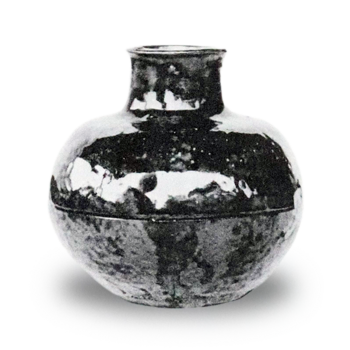
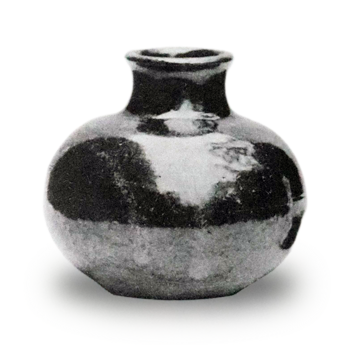
Made in China; Collection of Marquis Toshiyuki Maeda
Name
“Futamura” is believed to be the surname of the original owner, but its provenance remains unclear at this time. It is possible that this was once owned by Futamura Toshiyasu, who is mentioned in Mitsui Takafusa’s book Chōnin Kōkenroku. The book states: “Toshiyasu was originally a retainer of the Echigo clan (Matsudaira Tadateru). He became a rōnin during the reign of Ichihaku-kyō (Matsudaira Tadateru, the owner of the Hatsuhana Katatsuki), and resided in Shimotateuri Muromachi. The residence of the money changer Zenroku was originally the home of this Toshiyasu. He lent money to the Hosokawa, Satsuma, and other daimyo families, but fell into ruin at the same time as Ishikawa (Ishikawa Jian, the owner of the “Spear Scabbard”), and so on.”
Dimensions
Height: approx. 6.36 cm
Body diameter: approx. 6.82 cm
Mouth diameter: approx. 3.03 cm
Base diameter: approx. 3.03 cm or approx. 3.18 cm
Neck length: approx. 1.58 cm
Weight: approx. 76.9 grams (20.5 monme)
Accessories
One lid: 1 piece, with a recess
One storage pouch: purple silk, cord tied in a purple tsugari knot
One separate purple fukusa
Two pouches
Shukō satin; lining: umi-ki; cord: purple tsugari knot
Yabee Kōtō; lining: unlined satin; cord: purple tsugari knot
The tag attached to the pouch reads: “Received from the Chūnagon in Inaba”
Single-pouch box: Paulownia, natural wood
Inscribed: “Two bags for the Nimura-maru Vase”
One Hikiya storage box: Black persimmon wood
Bag: Tōzan pattern; lining is damaged; cord is dark brown with a tsugari knot
One inner box: Paulownia wood, chamfered edges, Shunkei lacquer
“Nimura-maru Vase”
One outer box: Paulownia wood, natural finish, new
“Nimura-maru Vase”
Miscellaneous Notes
Nimura Maru Vase: The clay is grayish-brown; the lower glaze is amber; the upper glaze is black. The thread-cut pattern on the base has an overall dry, crisp finish. There is a single ridge running down the body; the section where this ridge is clearly visible measures approximately 10.45 centimeters. There is also a single ridge at the rim.
(Marquis Maeda Family’s Register of Artifacts)
Nimura Maru Vase: Made by Kan. The Hikiya mark is “Kurokaki.” The pouches are of the “Tōsan” style. There are two pouches: one is made of Jukō satin with a “Kaiki” lining, and the other is made of Yazaemon Kōtō with a “Kaiki” lining. The inscription on the box lid reads “Nimura Maru-tsubo”; the author is unknown. An attached tag states, “Received as a gift from the Chūnagon from Inaba. Nimura Maru-tsubo; one lid is to your liking.”
(From the Maeda Family Collection)
Provenance
It appears to have been owned by a certain Nimura before being passed down to the Maeda Marquis family. Since the tag attached to the pouch of this tea caddy states, “Received from the Chūnagon by Inaba,” it was likely bestowed by Marquis Maeda Toshitsune—known as Komatsu Chūnagon—upon his retainer, Inaba, and later returned by that retainer to the Maeda Marquis family.
Field Notes
On December 1, Taishō 8 (1919), I examined this piece in person at the residence of Marquis Maeda Toshitame in Honfuji-chō, Hongō Ward, Tokyo City.
The rim is thick and rounded, and the flared rim is somewhat deep. There is a single, wide recessed groove around the base.
Amid the rich, deep black amber glaze covering the entire piece, reddish hues reminiscent of persimmons (kaki-kinki) appear in places, and the flow of the amber-colored glaze stops just short of the base. There is a single sunken groove running halfway around the body of the tea caddy. The piece is rich in textural variations, and the beauty of its luster is beyond words. There is a single spot below the cord-like groove on the body where the piece has been repaired with lacquer. From the rim downward, the vermilion-clay body is exposed; the thread-cut is somewhat coarse, and there is a misalignment in the spatula marks at its starting point. Inside, the glaze covers the rim; below that, wheel marks run around the interior, forming a swirl pattern at the center of the base. There are no flaws; this teapot is perfectly formed and possesses the finest glaze quality—a teapot that embodies all ten virtues.