
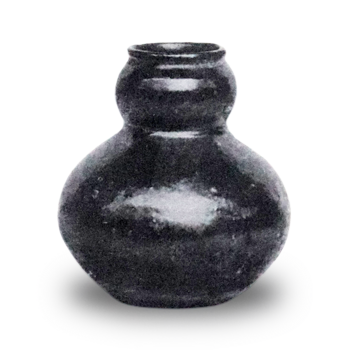
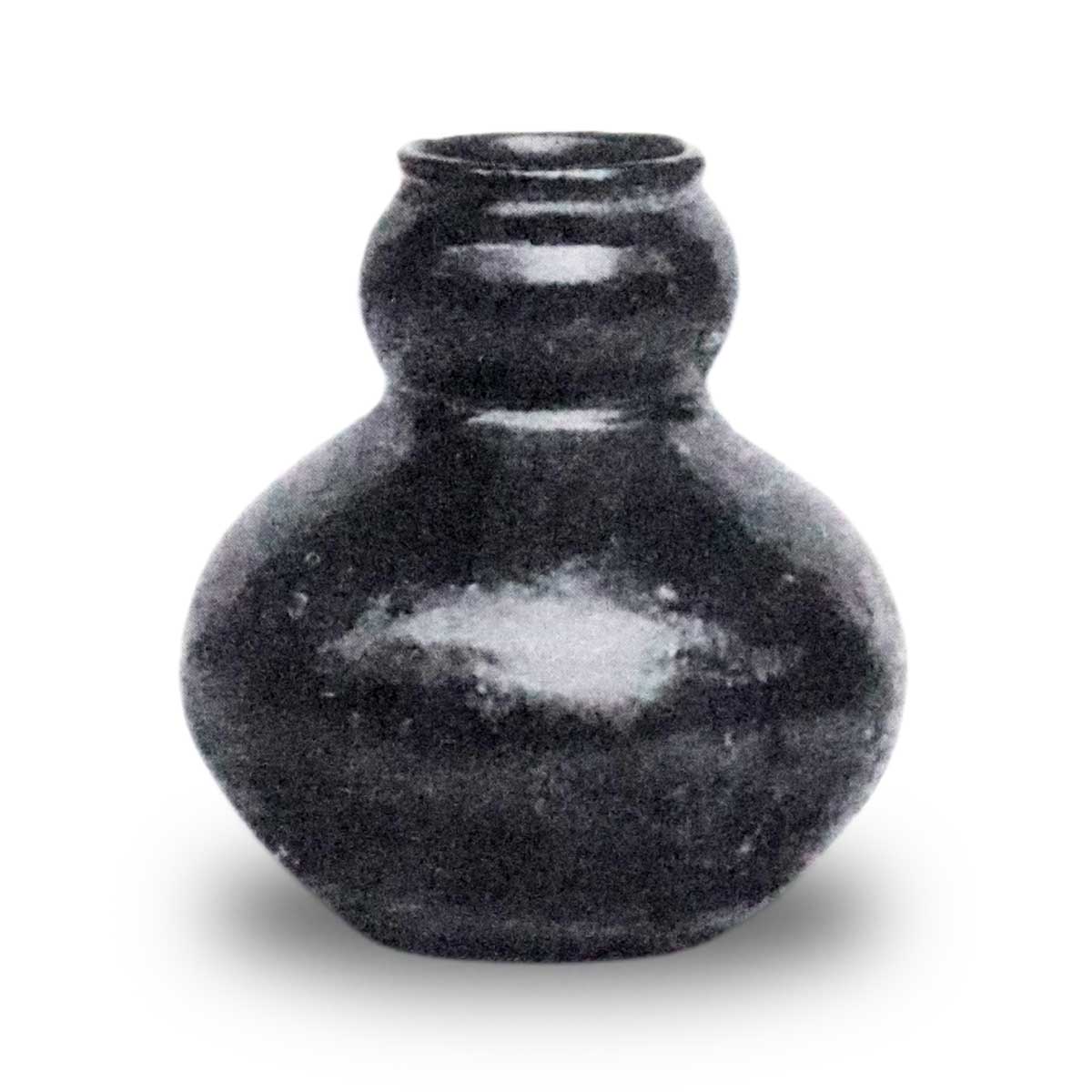
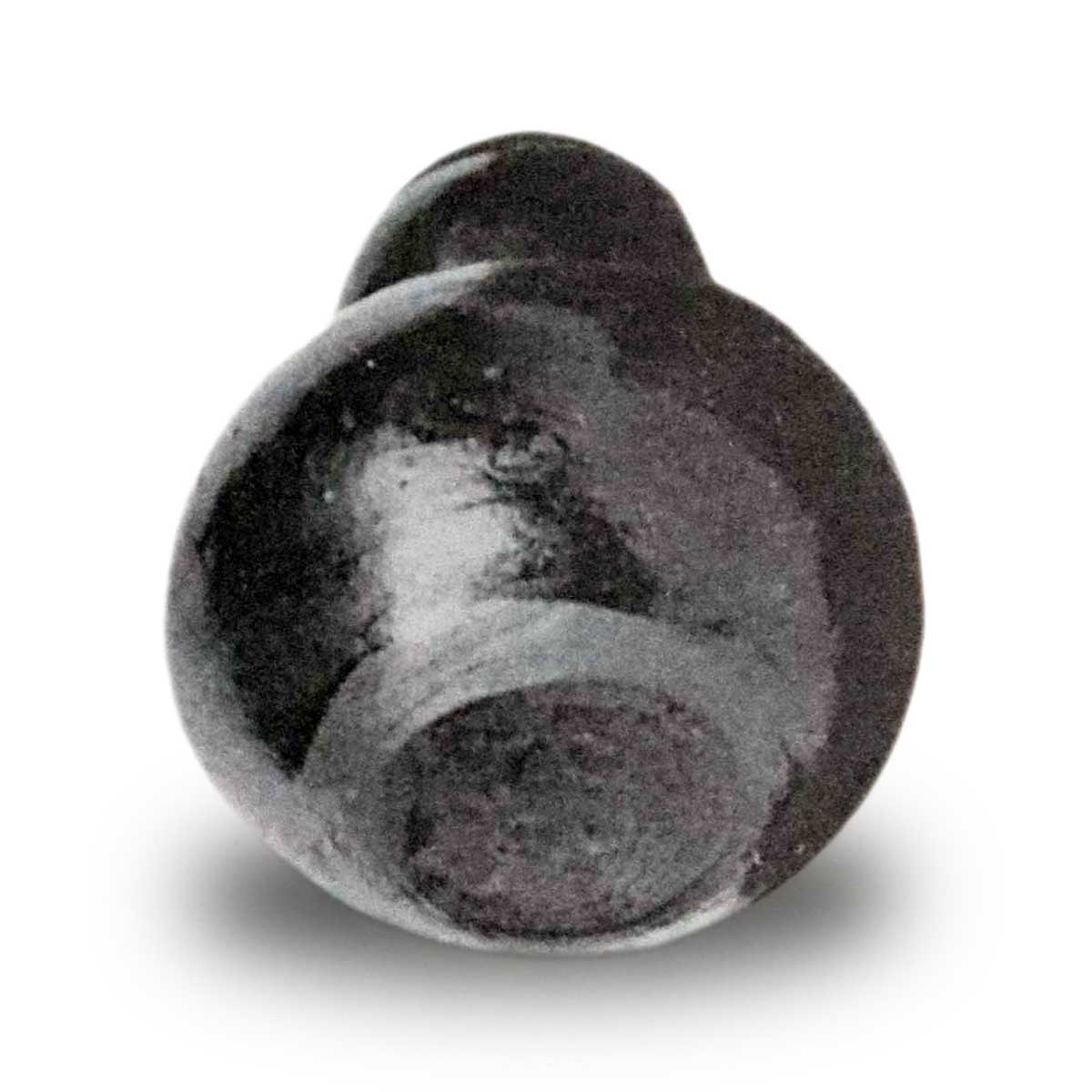
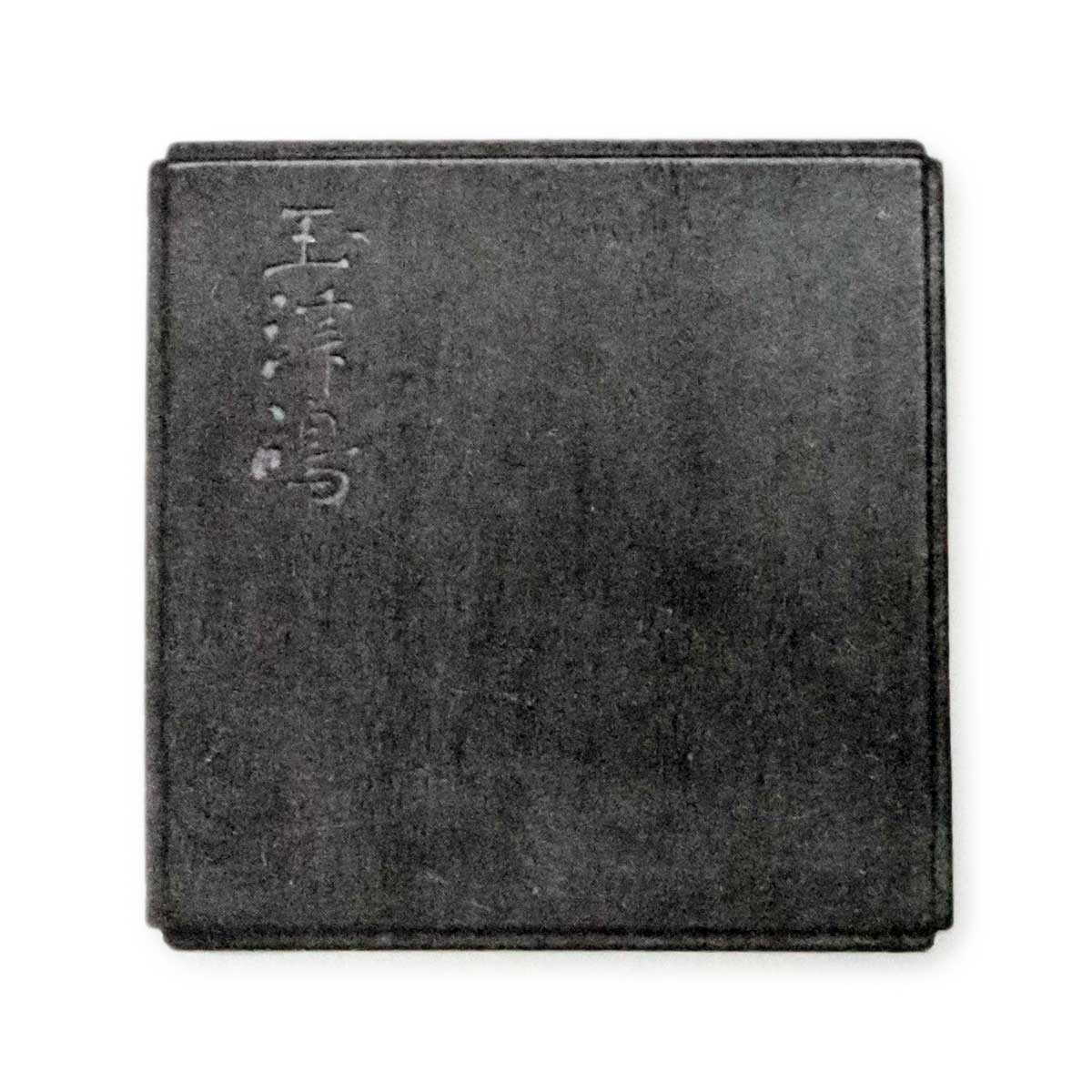
Made in China; Gourd-shaped tea caddy; Collection of Tokugawa Yoshichika, Marquis
Origin of the Name
It was likely Kobori Enshū, the author of the inscription on the box, who named this tea caddy “Tamatsushima.” Furthermore, on the underside of the lid of the pouch-style box, in the hand of Katagiri Sekishū, are inscribed the name “Tenka Rokuhōtan” and
“If I should ever again find a beautiful jewel at Waka-no-Ura, O God of Tamatsushima, do not let this tea caddy be overlooked among the many Meibutsu that shine with equal brilliance.”
(If I were to find another beautiful jewel at Waka-no-Ura, O God of Tamatsushima, please do not let this tea caddy be overlooked among the many famous Meibutsu that shine with equal brilliance.)
This waka poem is inscribed there. This poem was composed by Tadamune Tadamasa and is included in the Zoku Senzai Wakashū with a preface stating, “Among the poems composed by people at Ishiyama-ji Temple when former Grand Counselor Fujiwara no Tameuji compiled the Zoku Shūi Wakashū.” If one considers the meaning of this poem, it becomes clear that it conveys the message that this tea caddy must not be omitted from the list of Meibutsu.
Dimensions (converted using 1 sun ≈ 3.03 cm and 1 monme ≈ 3.75 g)
Height: Approx. 5.61 cm (1 sun 8 bu 5 rin)
Body diameter: Top approx. 2.73 cm (9 bu), Bottom approx. 5.15 cm (1 sun 7 bu)
Mouth diameter: approx. 2.12 cm (7 bu)
Base diameter: approx. 2.18 cm (7 bu 2 rin) or approx. 2.42 cm (8 bu)
Height of the koshiki (steamer): approx. 0.15 cm (5 rin)
Weight: 33.75 g (9 monme)
Accessories
・Lids: 3
・Lid box: Made of natural paulownia wood; the inscription reads as follows:
“Tamatsushima
Chinese gourd tea caddy, inscribed ‘Tamatsushima’
Ivory lids: 3
Breakdown: 1 in the style of Sen no Rikyū, 1 in the style of Kobori Enshū (Sōfu), 1 in the style of Katagiri Sekishū”
・Storage pouches: 5
Jukō satin (purple cord)
Persimmon-colored Guangdong weave (velvet cord)
East-colored (yellowish-brown) small-checkered Guangdong weave (brown cord)
White-ground Guangdong weave (velvet cord)
Chinese-made Kinran with flower-and-bird patterns on a pale green ground (purple cord)
・Storage Box: Unfinished paulownia wood
The inscription on the front of the lid is as follows (in the hand of Katagiri Sekishū):
“Han Gourd Bag: Pearl-Luster, Persimmon-Colored Kantō (Guangdong), East-Colored Small Checkered (Checkered), Kantō, Kantō Woven-Tied”
The inscription on the underside of the lid is as follows (written by Katagiri Sekishū):
“The origin of the Hiyodori: It is one of the six in the world.
The Uesugi Hiyodori (bestowed upon Lord Tsunanori) is the first tea caddy.
The one owned by Lord Inaba Mino-no-kami Masanori is the second.
The one at Shinshu-an in Daitoku-ji Temple.
The one formerly owned by Sakuma, now in the possession of Maeda Tsushima.
The Chaya Hyotan: originally owned by Hon’ami Kōteki, it was passed down to Chaya Chōi, and after being requested by Sōko, it is now in the possession of Honda Yasushige.
(As the sixth item following these)
“If it were found again at Waka-no-ura, it would be Tamatsushima—do not let it be counted among the same number of lights.”
Tamatsushima
(Note) The statement in the annotation on the right that “Lord Tsunanori received it” is likely an erroneous tradition. Please refer to the entry on “Uesugi Hyōtan.”
・Hikiya (a tube for storing the tea caddy): Made of tagayasan wood, featuring relief carving (a technique for carving characters in relief) and characters in gold leaf.
“Tamatsushima” written by Kobori Enshū (Sōfu).
・Wooden mold: Made of paulownia wood, with an ivory lid.
・Box: Made of hardwood (possibly a tree of the Taxus family); the rim is made of red sandalwood (a type of rosewood) and features sunken carving (a technique for carving characters into the surface).
The inscription on the paper covering the box reads as follows:
“Tamatsushima, Chaya Hyotan, Tamatsushima. Hikiya by Kobori Enshū, carved inscription on the box”
・Outer box: Made of hinoki cypress; board thickness approximately 2.12 cm (approx. 7 bu).
“Chinese-made Hōtan, Tamatsushima”
Inscription on the box: Kobori Enshū (Masakazu)
Transmission record for the pouch box: Katagiri Sekishū
・Accompanying Inscription: One certificate of authenticity (kyokusho) written on hosho paper
“The carved characters on the lid of the tea caddy written by Kobori Enshū, the gold-powder characters on the Hikiya carver’s name, and the inscriptions detailing the provenance on both sides of the bag-style box lid written by Katagiri Sekishū Sadamasa are all undoubtedly in their own authentic handwriting. End.
Year of the Tiger, May
Kobun Ryōchū (Appraiser)”
Provenance
According to the aforementioned inscription by Katagiri Sekishū detailing the provenance of this gourd-shaped tea caddy, it is considered one of the “Six Gourd Tea Caddies of the Realm.” It is said that this tea caddy entered the Owari Tokugawa family during the reign of Lord Tokugawa Naritaka. Naritaka was the son of Shogun Tokugawa Ienari; although he was once adopted into the Tayasu family, he succeeded to the Owari family during the Tenpō era. He went by the pen name “Kinjō Sanjin” and, as a connoisseur of the tea ceremony who loved tea utensils, many of the treasures currently held by the Owari Tokugawa family were items he cherished. According to elderly residents of Owari, during Naritaka’s era, the tea ceremony suddenly became a huge craze in the town of Nagoya Castle, and as a result, the sweets served with tea became exceptionally luxurious.
Record of Actual Observation
On June 5, Taishō 8 (1919), I had the opportunity to view this item in person at the residence of Marquis Tokugawa Yoshichika in Ozone-chō, Higashi Ward, Nagoya City.
This is a small gourd-shaped tea caddy made in China. It has a wide mouth and a thin construction, with a single raised ridge running around the underside of the rim. The overall color is persimmon-brown with a metallic luster; within this hue, a streak of yellow glaze runs from the rim for a length of approximately 1.8 cm to 2.1 cm (6 or 7 bu). Shallow wheel marks encircle the body, and a black amber glaze covers one-third of the teapot, extending from the body down to the exposed clay at the base. The thread-cutting is fine, and the base clay is vermilion-red (reddish-brown), with a slight indentation in the center.
The rim is crafted with such precision that it resembles an ancient bronze vessel; despite its small size, it possesses many remarkable features. It is an exceptionally refined teapot, so much so that one could say the entire body exudes a sense of courage and vigor. Inside, the glaze covers only the area around the rim.

