
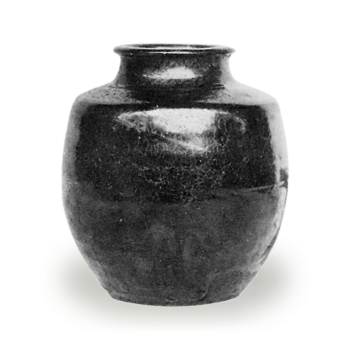


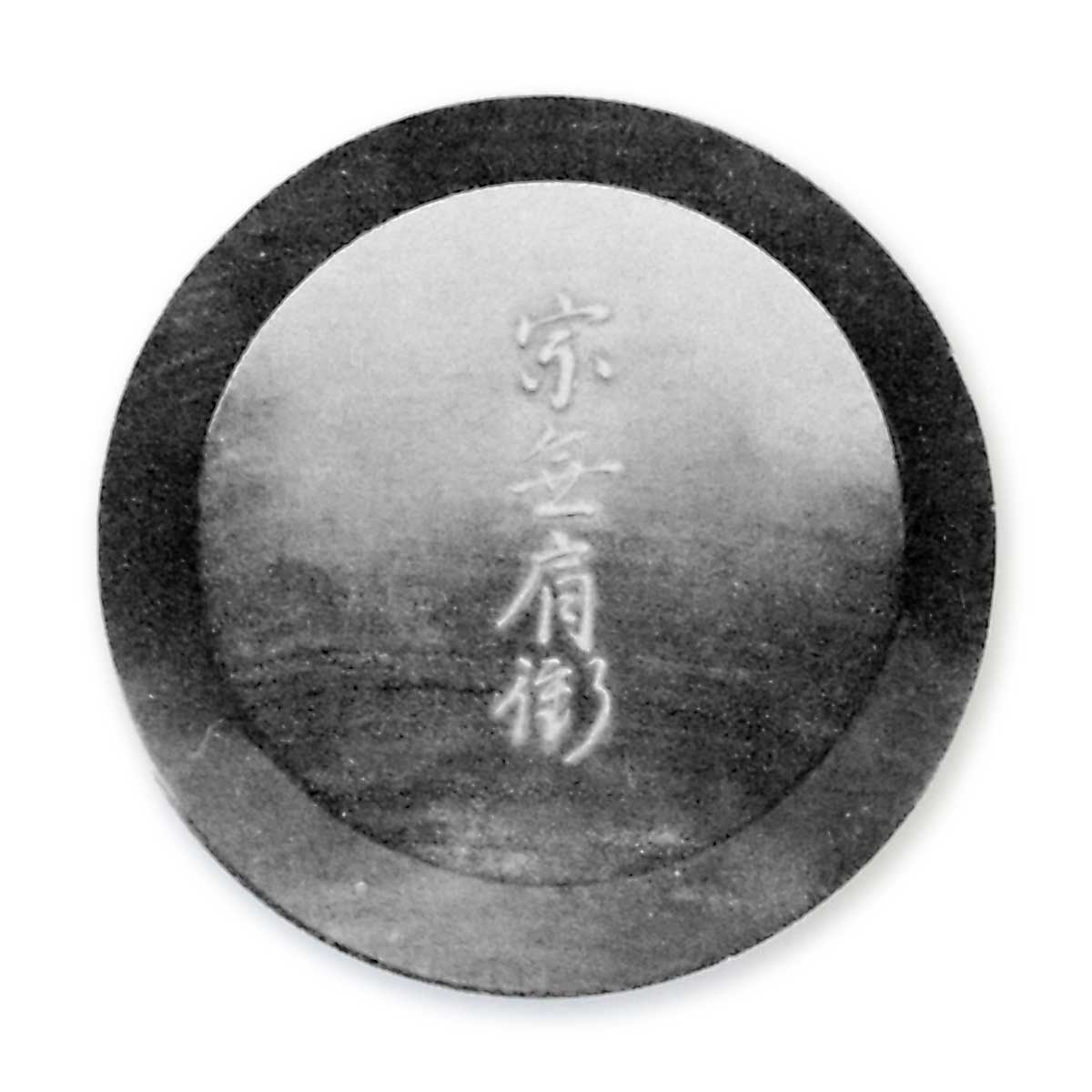
Kansaku, Daimeibutsu (Masterpiece), Also known as: Sumiyoshi Katatsuki, Owned by Marquis Tokugawa Yoshichika
[Origin of the Name]
It is called “Sōmu Katatsuki” because it was owned by Sumiyoshiya Yamaoka Sōmu, a merchant from Sakai; it is also known as “Sumiyoshi Katatsuki.” The Kokin Chajin Keifu (Genealogy of Tea Masters Through the Ages) records that “Yamaoka Sōmu was known as Sumiyoshiya Kichizaemon of Sakai, and was in fact the son of the military commander Matsunaga Hisahide.” He served Toyotomi Hideyoshi and held a fief of 400 koku, gaining a reputation on par with Sen no Rikyū (Sōeki), Imai Sōkyū, and Tsuda Sōyuki. He made Shisen-ji his base, invited Kokushi Haruya to serve as the first head priest, and it is said that Priest Amuro of Daitoku-ji (Murasakino) was Sōmu’s son.
Furthermore, Chaji Shūran states, “Sumiyoshiya Sōmu is an old-fashioned and authentic tea master. For example, he would carefully consider and decide in advance on combinations such as which tea caddy to use with which tea bowl or which water jar, and he always arranged the utensils in the same way; however, depending on the mood of the day or night, he would host tea gatherings with even deeper feeling. While some people said, ‘Sōmu’s tea ceremony is too plain and not good,’ Sen no Rikyū (Kyū-kōji) praised him highly.”
[Dimensions]
Height: Approx. 9.0 cm (2 sun 9 bu 8 rin)
Body diameter: Approx. 8.2 cm (2 sun 7 bu 2 rin)
Mouth diameter: Approx. 4.4 cm (1 sun 4 bu 5 rin)
Base diameter: Approx. 4.7 cm (1 sun 5 bu 5 rin)
Koshiki (rim) height: Slightly over 1 cm (slightly over 3 bu)
Shoulder width: Approx. 1.5 cm (5 bu)
Weight: Approx. 161 g (43 monme)
[Accessories]
・Lid: 1 (ivory)
・Storage bag: White chirimen silk
・Covers (bags): 2
(1) Brown ground with Kinran design (lining: iridescent, cord and mesh trim: purple)
(2) Stored-away-ground Donshu brocade (lining: iridescent, cords and mesh: purple)
・Storage box: Paulownia wood, inscribed with gold powder, silver plum-blossom-shaped ring fittings
・Hikiya (carrying case): Karin wood, carved frame, characters “Sōmu Katatsuki” in gold powder. Its bag is Shokō brocade with a two-tone design (half yellow ground, half blue ground)
・Inner box: Unfinished paulownia wood, with the characters “Sōmu Katatsuki” in gold powder
・Outer box: Black lacquer, with the characters “Sōmu Katatsuki” in gold powder
[Miscellaneous Notes]
Morning of December 8, Eiroku 7 (1564) — Tea gathering hosted by Sumiyoshiya Sōmu (Guests: Sōtatsu, Sōkyū)
“On the hearth was a clear glass kettle with a thin chain; in the alcove, a katatsuki (Sōmu Katatsuki) was displayed.
This tea caddy (jar) has two streaks of glaze run (nadare) on the front; one reaches halfway down, while the other extends all the way to the bottom and overflows. The glaze flows out from the surface, and where the trail’s tip passes, the form is slightly distorted, with the rim tapering toward the bottom. The underglaze appears to have a blackish hue, and the interior of the rim is unglazed. The overglaze is black; the clay particles are coarse overall, and the texture of the underglaze is evident throughout.”
(From Tsuda Sōyuki’s Chayū Nikki)
Noon, November 17, Tenshō 20 (1592) at Nagoya, Hizen
Tea gathering hosted by Sumiyoshiya Sōmu (Guest: Kamiya Sōtan, one person)
“In a three-mat tea room, one mat is elevated to a higher level, and there is no entrance; the room is separated by a single sliding door. A katatsuki is placed in a bag on the hanging shelf.
This katanuki is covered in a thick layer of black glaze. The exposed clay is a bluish black, with a single streak at the rim where the glaze has pooled. There is no trace of glaze runoff—just a mere 1 or 2 mm—at the boundary with the exposed clay. It is a somewhat tall tea caddy. The cover (bag) is made of Donshu, and the cord is light green. It has a distinctive shape, and the construction of the bottom appears to be unfinished.
(From Sōtan’s Diary)
January 17, Bunroku 2 (1593), at noon, at Nagoya
Sōmu’s tea gathering (Guest: Kamiya Sōtan, one person)
“A three-and-a-half-mat tea room. (Omitted) In the hand-washing room (near the water house), a katatsuki is placed in a bag.
This katanuki has a single ridge near the rim; it is tall, large, and has a broad body. The glaze is thick and black. There are areas where the clay is exposed, about 2–3 mm (a few millimeters) in size. The base appears to be unfinished, while the lid is new. The base of the tea caddy is shaped like a persimmon stem. The cover is made of Donshu silk with a small-patterned arabesque design, and the cord and net are purple.”
(From Sōtan’s Diary)
The “Sōmu Katatsuki” is owned by Lord Satake Shuri-daifu. (From Ganka Meibutsu-ki)
The “Sōmu Katatsuki” is a Tang-style, Daimeibutsu, owned by Satake Shuri-daifu. (From Kokin Meibutsu Ruiju)
“Sōmu” is a Daimeibutsu, owned by Lord Satake Shuri-daifu. (From Rinpō Kiryū)
Satake Yoshitaka (Shūri-daifu) was born in the 4th year of Keichō and succeeded to his father’s estate on February 26, the 10th year of Kan’ei. On March 28, he visited the castle to express his gratitude for inheriting the family headship, and on that day, he presented the Sumiyoshi Katatsuki tea caddy, a basket-shaped flower vase, and a sword by Nagamitsu—all heirlooms of his father (Yoshinobu)—to the Shogun’s household. On May 8 of the same year, when he requested leave to return to his domain (Akita) for the first time, the Shogun re-bestowed upon him the Sumiyoshi Katatsuki tea caddy that he had previously presented.
(From the Kansei Revised Genealogies of Various Families)
Satake Yoshikata (Ukyō-daifu, Yoshizumi) was born in the 14th year of Kan’ei and visited the castle on February 21, 12th year of Kanbun, to express his gratitude for inheriting the family headship. On this day, he presented to the Shogun’s household, as heirlooms of his father (Shūri-no-daifu Yoshitaka), a tachi by Toshitsune, a sword by Bizen Nagamitsu, and a “Sōmu Katatsuki” tea caddy. He passed away in Yokote on June 24, Genroku 16. He was 67 years old. His principal wife was the daughter of Matsudaira Dewa-no-kami Naomasa.
(From the Kansei Revised Genealogies of Various Families)
On February 21, Kanbun 12, he presented a sword (Nagamitsu) and the tea caddy “Sōmu Katatsuki” to the Shogunate (Kōbōke) as heirlooms of Satake Shūri-daifu, and presented a pair of folding screens (painted by Sekimura, valued at 50 silver coins) to the Ooku (the Shogun’s consort).
(From Gyokuro-sō)
These items were bestowed upon the Lord of Owari, the Chūnagon, as the personal effects of the late Shogun Tsunayoshi.
・Wakizashi: Ichian Masamune (valued at 200 pieces of silver)
・Tea caddy: Sōmu Katatsuki
(The Shogunate’s envoy was Tsuchiya Sagami-no-kami)
(From Shiojiri by Amano Nobukage)
[History]
Originally owned by Sumiyoshiya Yamaoka Sōmu, a native of Sakai, it was used at Sōmu’s tea ceremonies during the Eiroku, Tenshō, and Bunroku eras, as recorded in the aforementioned miscellaneous notes. It subsequently came into the possession of Satake Yoshinobu, lord of the Akita domain. In February of the 10th year of Kan’ei (1633), when his son, Yoshitaka, succeeded to the family headship and presented his gratitude, it was offered to the shogunate as a memento of his father. However, on May 8 of the same year, when he returned to his domain to bid farewell, it was bestowed upon him once again by the shogunate. On February 21, Kanbun 12 (1672), Yoshitaka’s son, Yoshikata, presented it once more to Shogun Ietsuna as a memento of his father upon succeeding to the family headship. Subsequently, following the death of Shogun Tsunayoshi in January of Hōei 6 (1709), it was bestowed upon the Owari Chūnagon (the Owari Tokugawa family) as part of his estate, and has been passed down ever since, becoming a treasured possession of that family (the Owari Tokugawa family).
[Record of Actual Viewing]
On June 5, 1919 (Taisho 8), I viewed this item in person at the residence of Marquis Tokugawa Yoshichika in Ozone-cho, Higashi Ward, Nagoya City.
The entire tea caddy is covered in a dark amber glaze, and traces of the same glaze flowing down (a “slide”) extend all the way to the edge where the clay body is visible, with the glaze pooling slightly thicker there. Crazing (fine cracks in the glaze) or larger cracks extend across the entire surface. Although the deep color of the dark amber glaze makes the damage difficult to discern clearly, it appears that countless repairs using lacquer (urushi-zumi) have been applied. The exposed clay below the rim is red clay (shu-de), and the height of the line where the glaze stops is inconsistent; one side of the rim at the bottom is slightly higher. The cutting line on the bottom (the mark where it was separated from the potter’s wheel) is very distinct, and there is a firing crack (fire crack) at its starting point.
The tip of the rim is slightly pointed like a clam shell, the neck is tall, and the lower part is flared. A single groove runs around approximately half the circumference of the tea caddy. The protrusion at the shoulder forms a shape resembling an eave. On the interior, glaze covers the neck, with a ring of wheel marks extending below it; a swirl pattern is found in the center of the base.
The texture of the deep, reddish-brown shudai clay is rare even among other Chinese-made tea caddies (Han-style tea caddies). It is imposing and grand in scale (majestic in appearance), and appears to be a tea caddy well-suited to the tea masters of the Momoyama period.

