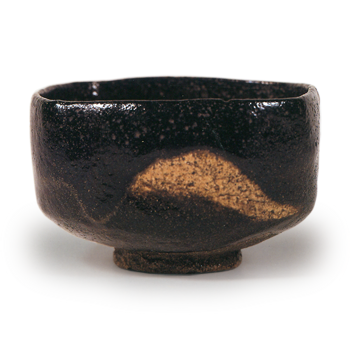
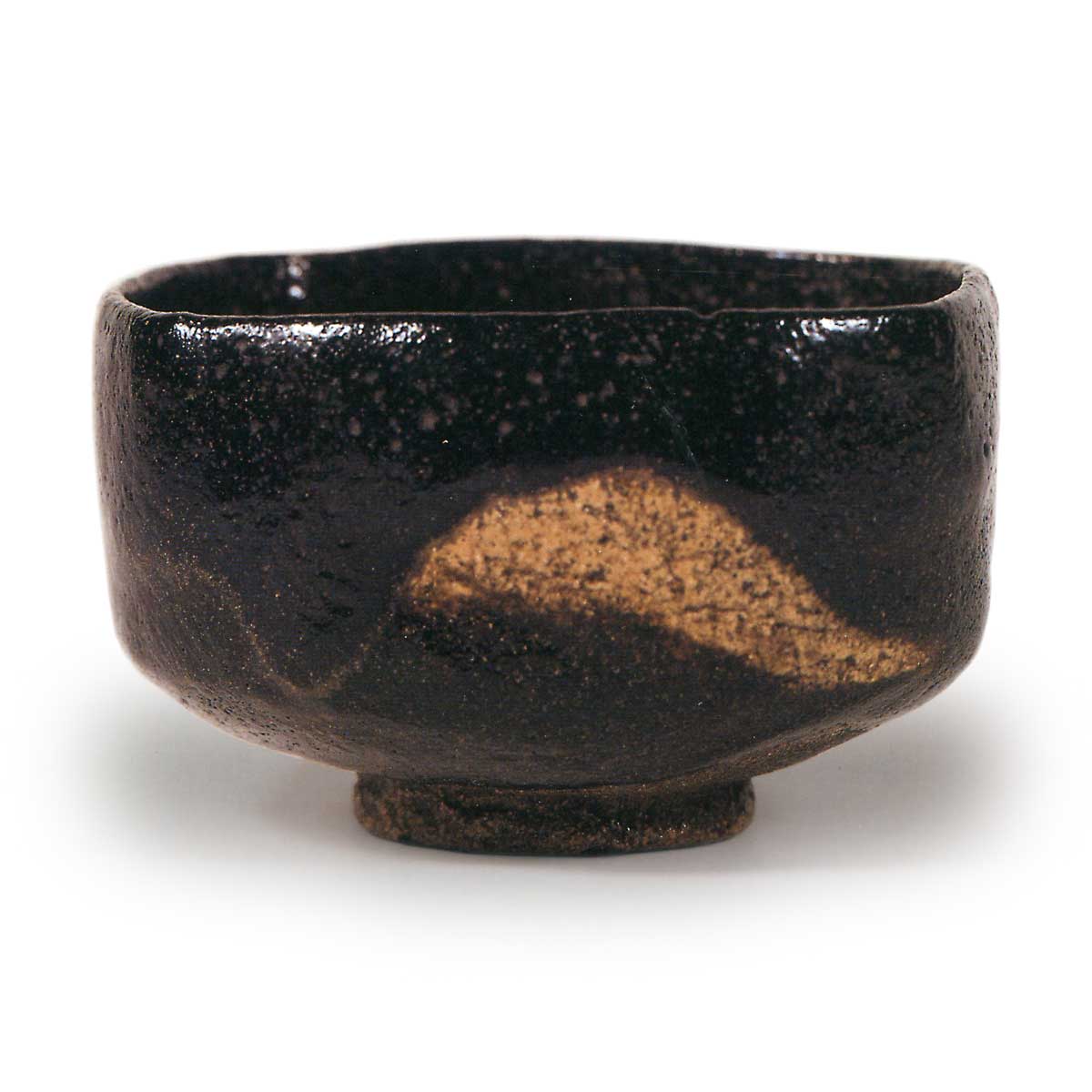
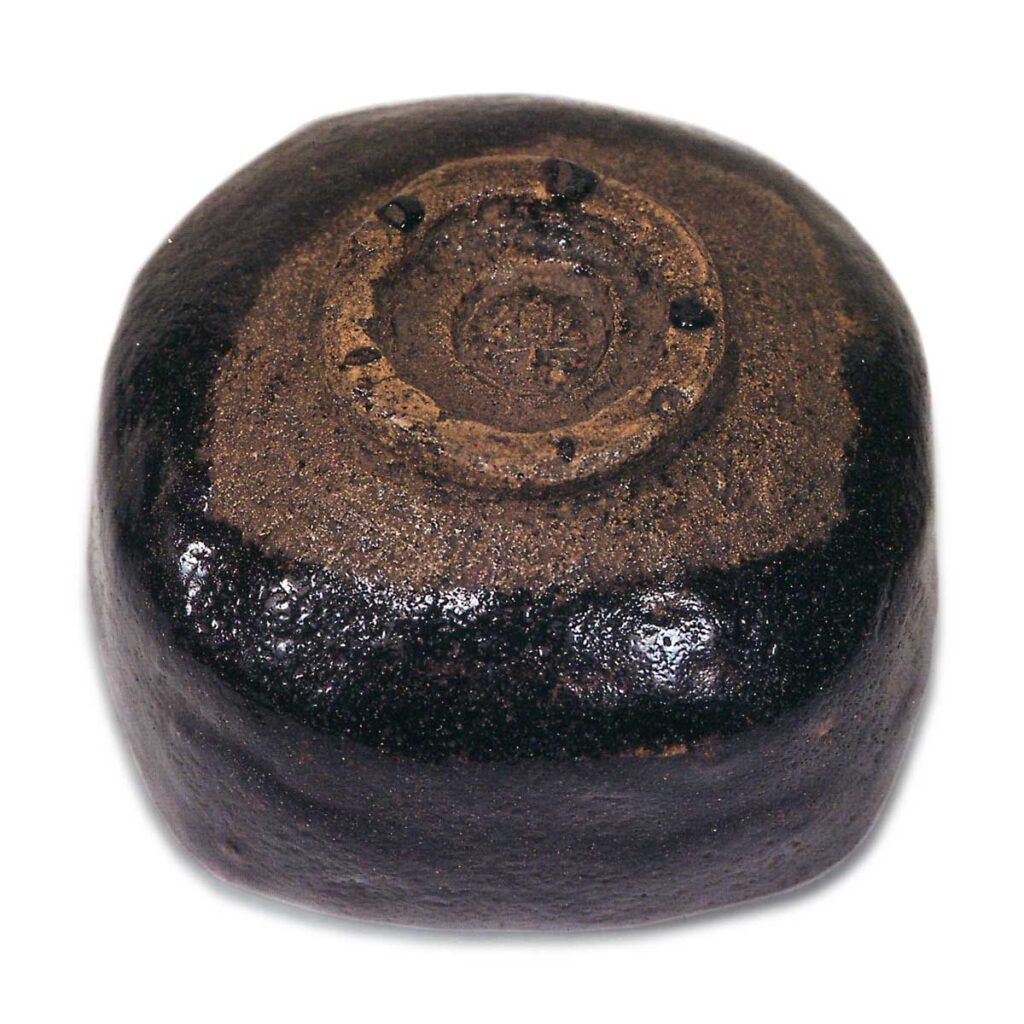
Height: 7.3 cm; Mouth diameter: 11.5 × 13.0 cm; Foot diameter: 5.7 cm
On the underside of the inner box lid, Kakukaku Saigenso has written: “Black Nonkō Masu Tea Bowl, Left (Seal).” During the time of Ryōryō Sai, inspired by Chōjirō’s “Seven Varieties,” Dōnyu’s tea bowls—the four black bowls titled “Masu,” “Chidori,” “Shishi,” and “Inazuma,” along with the red bowls “Fūrin” “Wakayama,” and “Nue”—these three red bowls—and designated them as the “Nonkou Seven Varieties,” making them his representative works. Among these, “Masu” is highly regarded as the foremost masterpiece among Dōnyū’s black tea bowls.
Indeed, among the Dōnyū tea bowls I have seen, this is a bowl with the ingenious craftsmanship unique to the master Dōnyū; it can be said to possess all the characteristics of Dōnyū’s black tea bowls, including the earthen texture, black matte glaze, and yellowish highlights.
As the name “Masu” suggests, this is a tea bowl with a square body; the section from the waist to the foot is rounded, and the foot flares slightly from the edge to the base, though the base itself is not rounded like that of a Chōjirō-yaki tea bowl. The interior of the foot is deeply carved, and a “Raku” mark is stamped near the center, though the imprint is not very distinct.
Compared to Chōjirō-yaki, Dōnyū’s tea bowls are generally formed much thinner; in particular, the rim of this bowl is made thin—commonly referred to as a “clam-shell rim”—and is slightly curved inward. The interior is boldly spacious and large; this spaciousness, combined with the rounded shape from the waist to the foot, reveals Dōnyū’s unique artistic touch. The black glaze is thin around the middle but thick from the rim down to the body, creating an effect reminiscent of a hanging curtain; this is known as Dōnyū’s “curtain glaze” and is a notable feature. Meanwhile, at the base of the body, there is a triangular section where the black glaze has been intentionally omitted, revealing a thin layer of transparent glaze with a yellowish tint. This is also a standard technique of Dōnyū’s, clearly intended to achieve a decorative effect. The area around the foot is left unglazed in a roughly triangular shape. While precursors to this type of unglazed foot can be found in some of Jōkei’s tea bowls, it was Dōnyū who first employed this technique deliberately. Furthermore, the presence of black glaze adhering to the five kiln marks on the foot is another characteristic feature of Dōnyū’s work. The bowl was originally owned by the Osaka merchant Suiya, and later passed through the Akahoshi and Isono families.