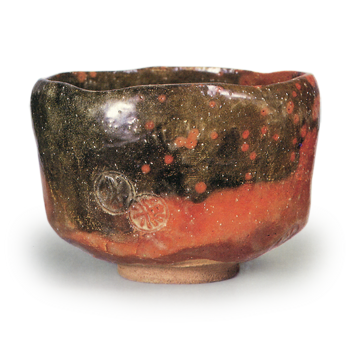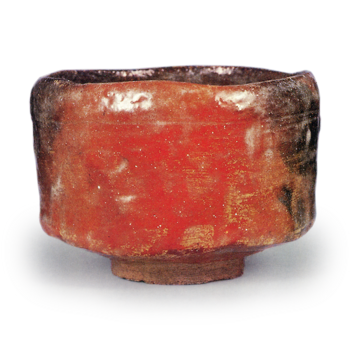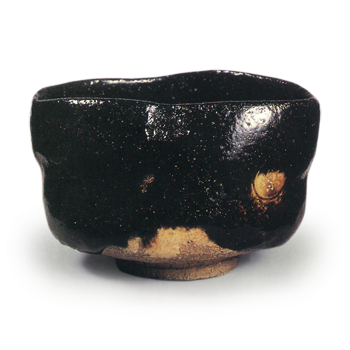
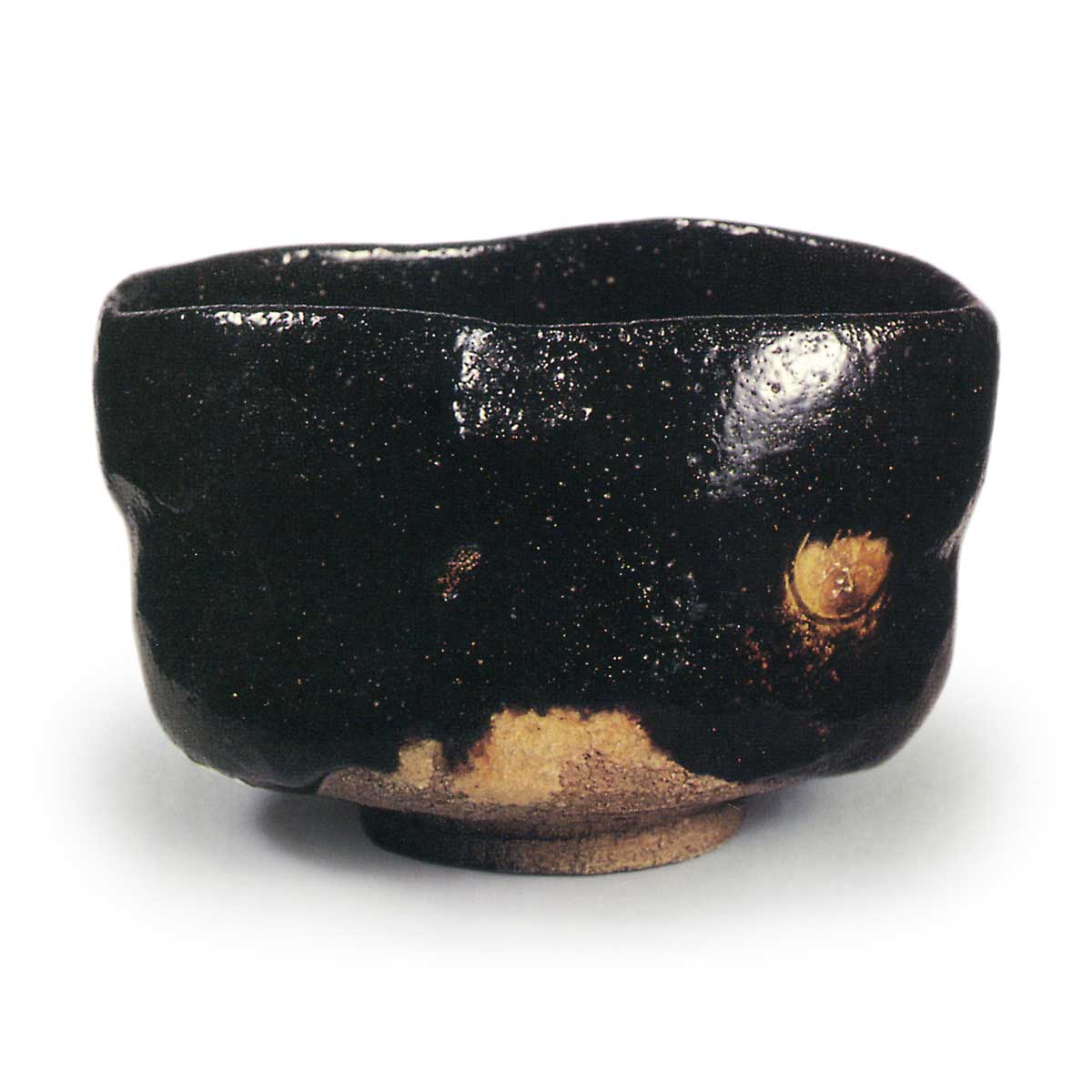
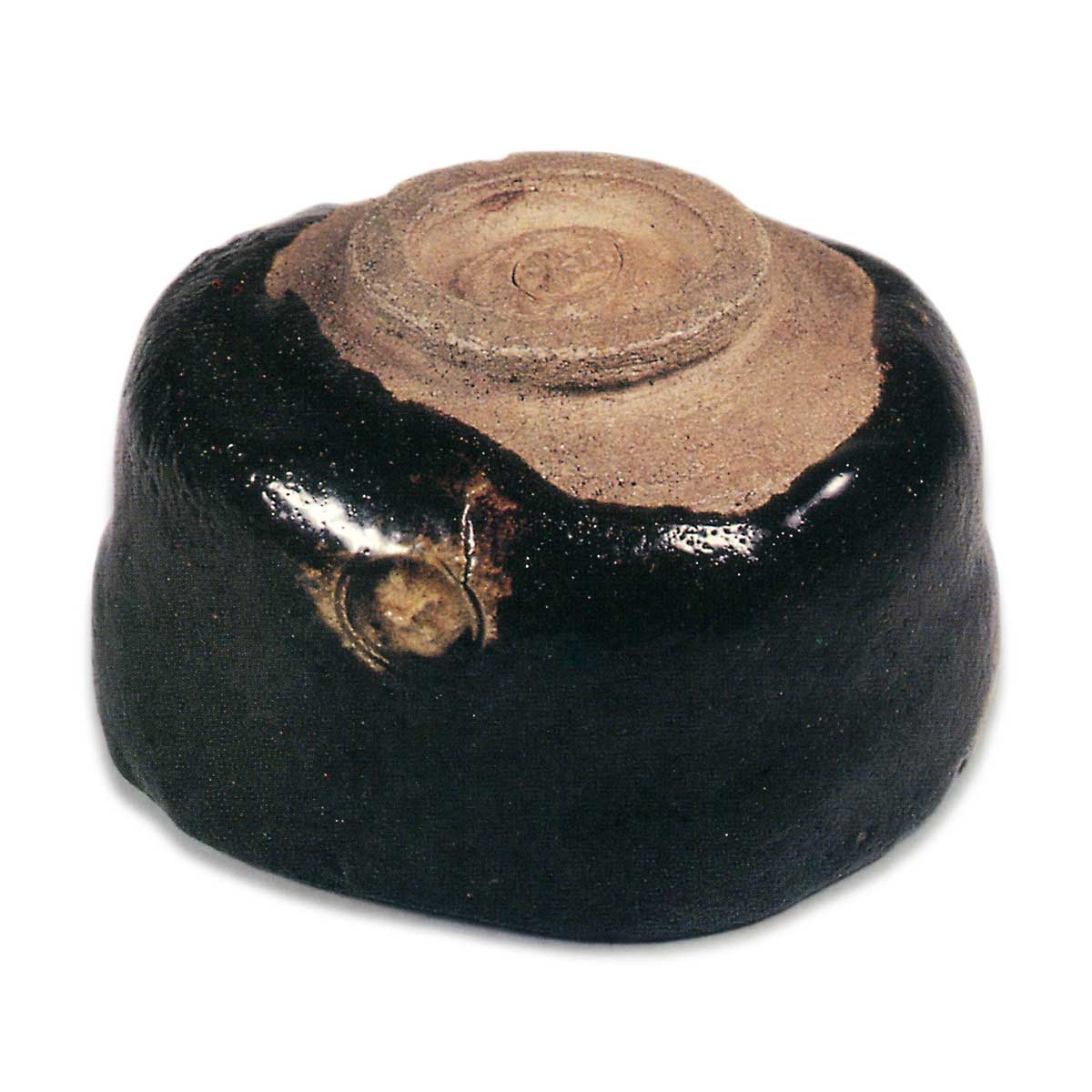
Height: 7.9 cm; Mouth diameter: 7.6–11.5 cm; Foot diameter: 5.1 cm
Unusually for a Raku tea bowl’s original box, this one is made of high-quality paulownia wood with a straight grain. The lid’s exterior bears the inscription “Inzumi Kurochawan” (Black-stamped tea bowl), while the underside of the lid features the inscription “Mei Iri Fune” (signed “Irifune”) written by Rokusai. On the underside of the box’s base, the inscriptions “Seal of the 11th-generation Kei-nyu, Boxmaker Yuko, Joiner Risa” indicate that, in addition to Kei-nyu—who crafted the tea bowl—the boxmaker Risa and the bag maker Yuko each added their own marks. This suggests that it was a special custom-made piece commissioned by a distinguished family.
The bowl itself is an outstanding piece that can be called a masterpiece among Kei-nyu’s works, and as noted on the lid’s exterior, it features a “seal-exhaustion” finish. The body is stepped, and the rim is skillfully shaped to bulge outward toward the rim while curving inward—a truly masterful technique that clearly demonstrates Kei-nyu was no ordinary craftsman. The rim features pronounced undulations, giving it a distorted, shoe-like shape, while the large, circular footring has a wide base and is finished with a crisp, elegant precision. Five seals used by Kei-nyu are stamped on the inside of the footring, the body, and the lower section. Specifically, the early “Raku” seal (spiderweb seal) is stamped on one side of the body, while a cursive “Raku” seal similar to Ryōnyū’s is stamped on the other. On the interior, there is a “Raku” seal selected from Tō Kishō’s calligraphy collection, commonly known as the “middle seal,” on the foot, the “Hakuraku” seal used after his retirement; and on the side of the foot, a square seal reading “Eleventh Generation Kikan.” The black glaze was omitted over the seals stamped on the body and interior, and a transparent glaze was applied instead, intended to highlight the decorative effect of the seals.