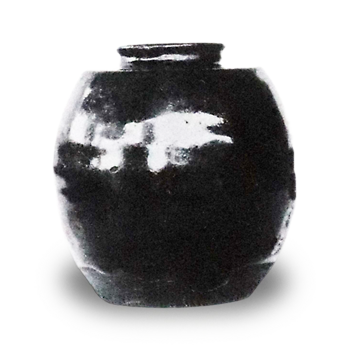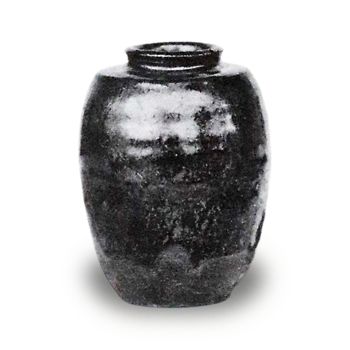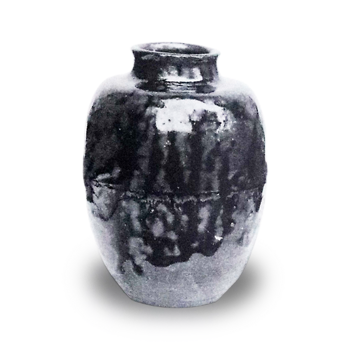
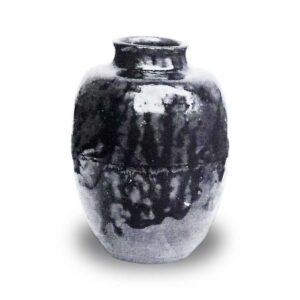
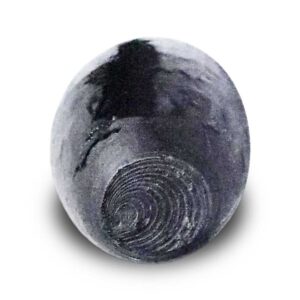
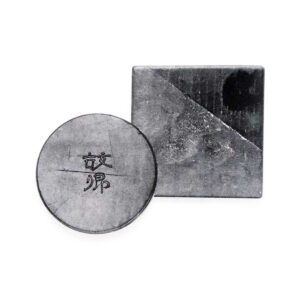
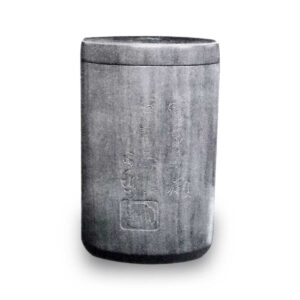
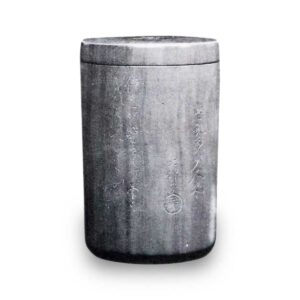
Old Seto, Revival-Period Meibutsu, Collection of Marquis Toshiyuki Maeda
[Background and Origin]
According to the Matsuya Diary, “Lord Toshitsune Maeda (Hizen-no-kami), lord of the Kaga Domain, acquired a Katatsuki tea caddy from Kizuya in Nara and named it ‘Kokyō’ (Hometown), recalling the era of the late Lord Kobori Enshū. This name derives from the phrase ‘ito wa shitanakute’ found in the Ise Monogatari. The fact that ‘ito wa shitanakute’ is also inscribed on the body of this tea caddy’s Hikiya (the wooden tube that holds the tea caddy cover) is based on the opening passage of the first chapter of the Ise Monogatari,
‘Long ago, a man, having undergone his coming-of-age ceremony, went hunting in the village of Kasuga in Nara, where he held a fief. In that village lived two sisters who were exceptionally graceful and alluring. The man caught a glimpse of them, and, finding unexpectedly beautiful women—so beautiful as to seem out of place in the old capital (his hometown)—his heart was thrown into turmoil…”
Based on this context, it is likely that this tea caddy, which originated in Nara, was named ‘Hometown.’”
[Dimensions (Converted to Modern Units)]
- Calculated using the following conversions: 1 sun ≒ 3.03 cm, 1 bu ≒ 3.03 mm, 1 rin ≒ 0.303 mm, 1 monme ≒ 3.75 g
・Height: 3 sun = approx. 9.09 cm
・Body diameter: 2 sun 2 bu 5 rin = approx. 6.82 cm
・Mouth diameter: 1 sun 0 bu 2 rin (1 sun 02 rin) = approx. 3.09 cm
・Base diameter: 1 sun 0 bu 5 rin to 1 sun 1 bu = approx. 3.18 cm to 3.33 cm
・Koshiki height: 3 bu 2 rin = approx. 0.97 cm
・Shoulder width: 3 bu = approx. 0.91 cm
・Weight: 31 monme 5 bu = approx. 118.13 g
[Accessories]
・6 lids (Su/Sumori; 5 of which are stored in a separate box)
・Lid box: Paulownia (unfinished wood)
— “Hometown Replacement Lids, Set 5”
— “Hometown Shoulder-Strike”
・Storage Pouch: Embroidered ha-niwa fabric with cut-out design, twill-weave brown (a small tag attached to the tea caddy reads “purple silk-bound gauze”)
・Covering (pouch) 3 sets:
- Ōtōgiri, red ground with antique gold lattice (restored: purple)
- Tea-colored ground with antique gold lattice (restored: purple, Kasumi-hana-maru crest)
- Yasaburō Kantō (restored: pale tea)
・Pouch box: Paulownia (unfinished wood; characters are inscribed perpendicular to the wood grain)
[Furusato Tea Jar Pouch (Detailed Contents Listed)]
・Kogin-ran, O-tō-giri
・Brown-ground Kogin-ran
・Yasaburō Kantō
・Hikiya (tea scoop): Made of holly; interior coated with Tame-nuri lacquer (shows signs of cracking and transparency; the bottom also has a crack)
— Inscription: “Furusato”
— Calligrapher on the lid: Kobori Enshū
・Inscriptions on the Body (handwriting of the three artists is as follows):
“Snow-cold northern peaks, plum fragrance on southern branches” Ryumin-shi Hakusō (Venerable Gyokushitsu)
“Some people come, stirred by emotion” Ketsushin-shi (Venerable Kōgetsu)
“Since I longed to be with you, my heart has become bewildered” (Kobori Enshū)
・Replacement Lid for “Hometown”
— Inscription: Kobori Enshū
(Page Number: 99)
[Outer Box]
Inscription: “Old Hometown”
Paulownia wood with vertical grain, Shunkei lacquer finish, with beveled corners. Other parts made of paulownia wood.
・Outer Box (Nested Box): Paulownia (unfinished wood, new)
Inscription: “Furusato”
[Miscellaneous Notes (Excerpts from Related Literature and Records)]
・From the Matsuya Diary:
“Lord Hizen-no-kami of Kaga was presented with a Seto Katatsuki from Kizuya in Nara. It was originally named ‘Furusato’ during the time of Lord Kobori Enshū. The name is derived from the Ise Monogatari.”
・From Sakurayama Ichiyu’s Notes:
“Furusato: Lord Matsudaira Kaga-no-kami’s Furusato tea caddy was also named by Kobori Enshū. Monks Sawan (Hōrin) and Kōgetsu, who were present at the tea gathering, were involved; the name is derived from the verse, ‘Since I longed for my hometown, my heart was in turmoil.’ Yamanaka Kisaï recounts that both Monk Sawan (Gyokushitsu) and Monk Kōgetsu left accompanying notes.”
・From The Maeda Marquis Family’s Register of Artifacts:
“Furusato Katatsuki—listed in the Furusato Seto Meibutsu-ki. The upper part is pale yellow (light yellow-green/blue), the lower part is persimmon-colored (persimmon glaze), and the upper part is coated with black glaze. The base is finished with a thread-cut edge, and the entire piece features a mottled pattern, making for a truly magnificent piece. There is a single horizontal band running along the body, located 1 bu 5 rin (approx. 4.5 mm) above the base. The section where this band appears most clearly measures 3 sun 2 bu (approx. 9.7 cm).”
・From Maeda Family Collection: Lower Volume:
“Hometown Shoulder-Strike: Ancient Seto. Three pouches (Dai-tō, Yazaemon Kantō, tea-colored phoenix-patterned matching set with silk lining). Six lids. One box (inscribed ‘Furusato’; the inscribed section features Kiriharu-kei lacquer with vertical grain, while the uninscribed section features Kirishiri-ri lacquer). Hikiya has a sandalwood base with an Uchidame lacquer finish (inscribed “Furusato”); the pouches are by Yasaburō. On the side of the upper box is inscribed: ‘Snow-cold northern peaks, plum fragrance on southern branches; Ryūmen-shi (Hōkō/Hakushū).’ On the exterior of the upper right box is a single panel; on its side, in the handwriting of Lord Enshū, is written: ‘How charming you are.’ Genuine Itokiri.”
・From Meibutsu-ki:
“Furusato, Seto Katatsuki, owned by Matsudaira Kaga-no-kami. Viewed on July 15, Kan’ei 14 (1637).
Dimensions: Height 3 sun (approx. 9.09 cm), body diameter 1 sun 2 bu 5 rin (approx. 3.79 cm*—as per the original text. actually 2 sun 2 bu 5 rin?), shoulder width: 1 sun 7 bu 5 rin (approx. 5.30 cm *possibly shoulder diameter*), mouth diameter: 1 sun 0 bu 7 rin (approx. 3.24 cm), base diameter: 1 sun 1 bu 1 rin (approx. 3.36 cm).
Includes 6 lids and 3 pouches (Daitō Kinran Maru crest with purple border, Yamazaki Kirikinran with purple border, and Yabee Kantō with brown border).
The Hikiya mark is carved on a cherry wood base with a thin, dark lacquer finish on the inside, bearing the inscription “Hometown.” The pouches are by Yabee Kantō. The box is made of paulownia wood and bears the inscriptions: “Snow-cold northern peaks, plum fragrance on southern branches—Ryūmin-shi’s seal,” “Disturbed by the coming and going of people—Kasen-shi,” and “It was so pitiful that my heart was moved to tears.”
[Provenance]
This tea caddy was originally housed at Kizuya in Nara, but when Lord Maeda Toshitsune of Myoboin discovered and acquired it, Kobori Enshū named it “Hometown” in reference to a story from the Ise Monogatari. Since then, it has been passed down through the Kaga Maeda family to the present day.
[Field Observation Record (Observation Record as of Taishō 8)]
On December 1, Taishō 8 (1919), the piece was examined in person at the residence of Marquis Maeda Toshiyuki in Honfuji-chō, Hongō Ward, Tokyo City.
The rim has a shallow turn-up, and against a pale persimmon or pale purple ground color, it features a mottled pattern of black glaze with a beautiful luster. The shoulder is slightly rounded, and a single recessed groove runs around the body. The lower portion reveals the iron-rich unglazed clay body, and there are two spatula marks around the rim of the base. The traces of the thread cut are rough and extremely distinct.
Inside, the glaze covers the rim; below that, wheel marks run around the interior surface, and the center of the base forms a tomoe (swastika) pattern.
Overall, the distinctive characteristics of the ancient Seto glaze are fully evident, and the beauty of the quail-spot pattern is beyond description. In particular, a single horizontal streak of metallic glaze appears near the body’s ridge, adding an interesting visual element; this teapot is a masterpiece that is flawless in both form and glaze color.