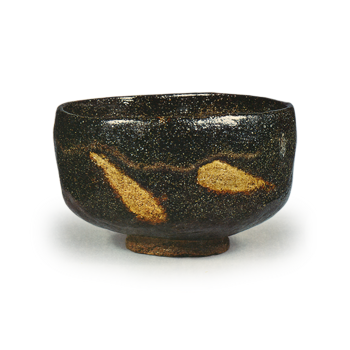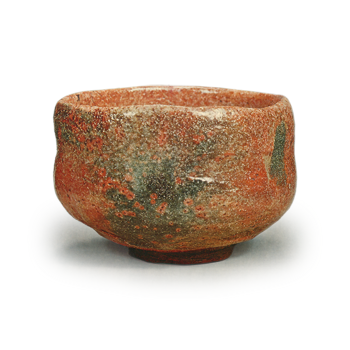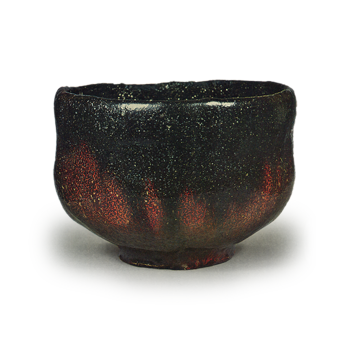


Kuro-raku, Nonkou, one of seven types
Accessories
Inner box: paulownia, white wood, inscription by Takuza
Inside lid: inscription by Eizan
Outer box: cedar, white wood, inscription by Ryoza
Inside lid: inscription by Rokuza
Cover: Tea-colored large paulownia crest Junko
Provenance
Omotesenke
Record
Honcho Toki Koshō, Kanzō Zatsuki, Taisho Meiki Kan
Dimensions
Height: 8.3–8.8 cm, Mouth diameter: 11.9–12.6 cm, Foot diameter: 5.7 cm, Same height: 0.6 cm, Weight: 321 g
The name “Inazuma no Etsu” was given to this piece because of the striking red glaze around the base, which contrasts beautifully with the jet-black glaze.
The body is thin, with a slightly curved rim and a narrow waist, and the base is rounded without a glaze. The bright red glaze around the waist stands out beautifully against the jet-black background, creating a striking feature.
Vermilion glaze is considered to be the signature of the second generation of Nonkou, but it was actually one of his own glazing techniques that he developed. The foot is large with four eyes on the base and a half-moon shaped opening inside. This bowl is unique among the seven types of Nonkou bowls. It is a tea bowl with a long history, passed down in the Omotosenke school of tea ceremony, and is only used for special occasions.