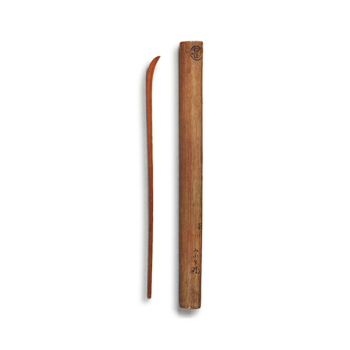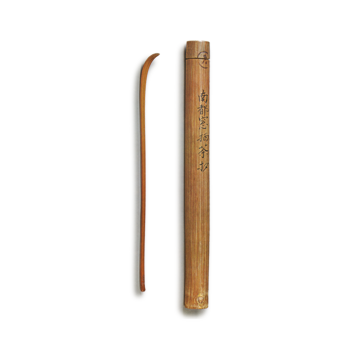
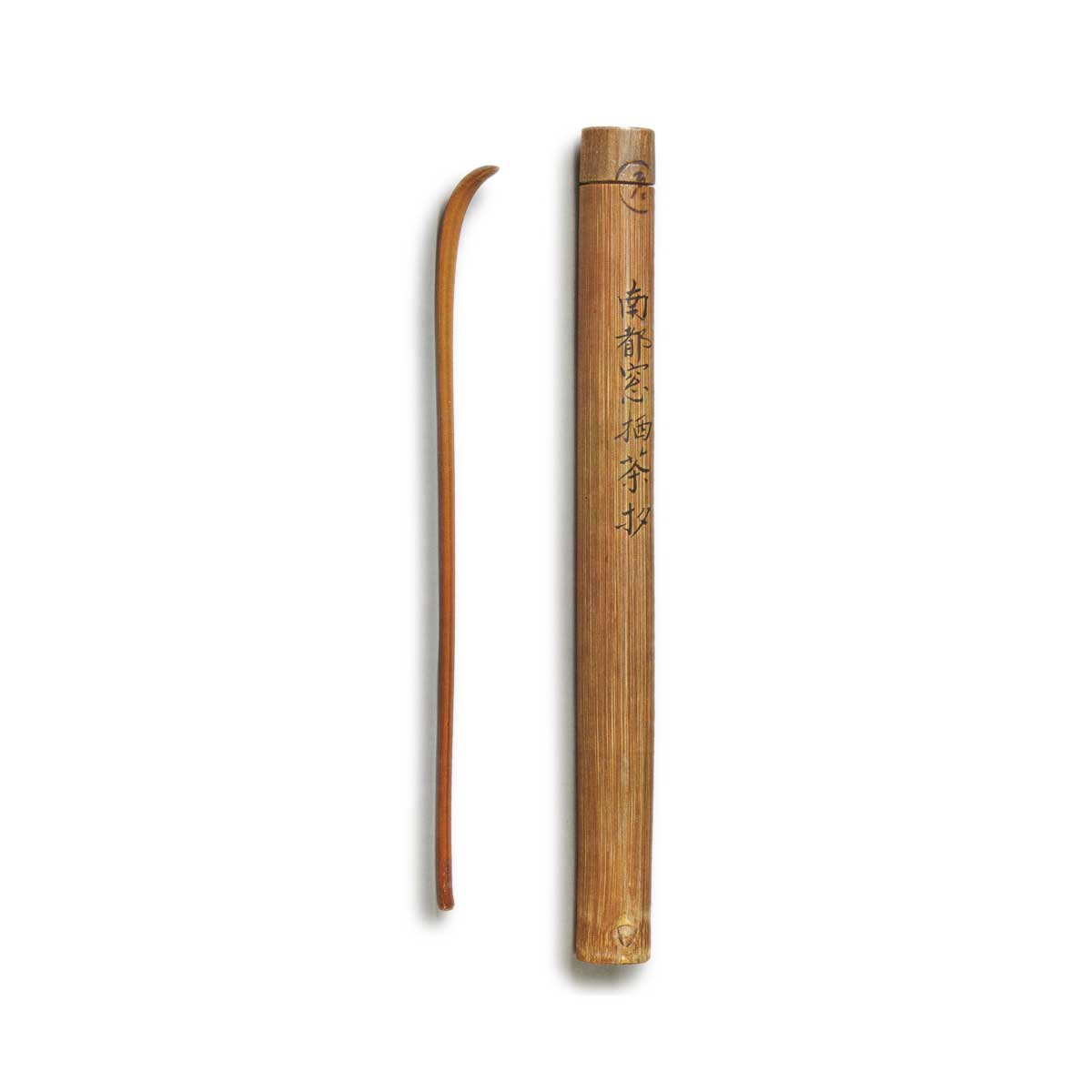
Revival Treasure, Passed Down by the Hirase Family
Brief Biography
Madozumi, also known as Sōsei, is only recorded as the craftsman who carved the underside of Shōō’s tea scoop; his biography is otherwise obscure. The tea book Seigun Ōgi Shū by Imai Sōkyū, introduced by the late Suzuki Hantcha, contains an anecdote about Sōsei, a Nara wabi-cha practitioner.
In 1533 (Tenbun 2), Shōō, aged 32, traveled from Kyoto to Nara with two purposes: to view Shōhō’s heron painting and to be invited to Sōsei’s tea gathering. That day, Shōō brought only one attendant, so the guests shared a single manju bun between them, while Sōsei ate one bun alone. His manner was said to be utterly natural. The bamboo scoop was crafted from green bamboo by Sōsei. Its appearance was long-haired and elegant, resembling a crane.
Tea Scoop
As promised, it is a long scoop with a stopper. The carving “Madosu” is visible on the upper part of the stopper. The overall construction is thin, but the lower end is somewhat thicker.
Tube
A genuine tube with a nest hole visible near the bottom. Written by Dōoku, bearing Dōoku’s mouth seal.
Accessories
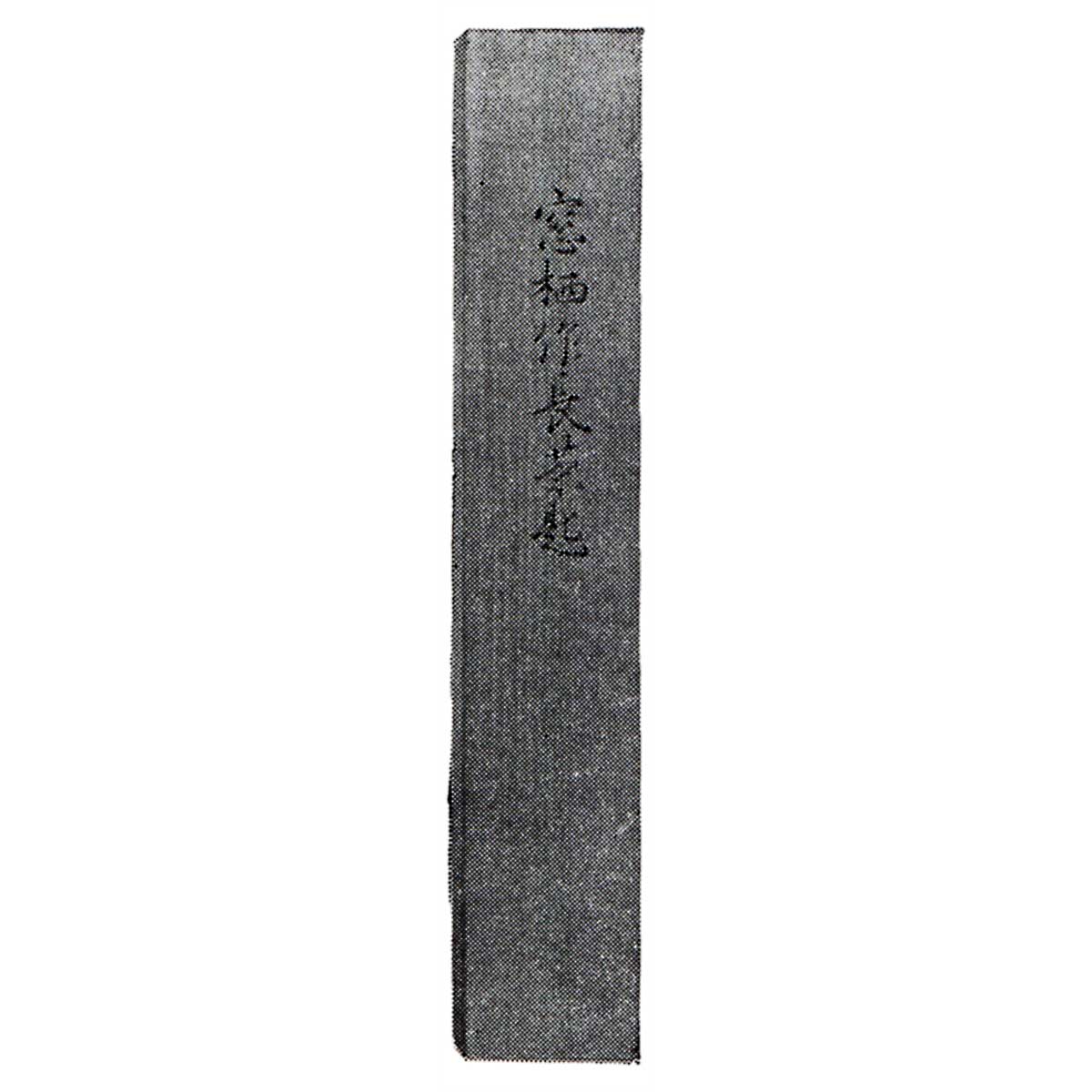
Outer box: Paulownia wood with white lacquer, inscribed by Hirase Roka
Recorded in
Chōkō Meibutsu-ki (Teaspoon without Sōki’s seal, made by Shōō, with “Sōki” carved on the spoon, by Sakamoto Shūsai) Three Hundred Selected Teaspoons
Addendum
Yamanaka Dōoku was the middle ancestor of the Kōnoike family. The Kōnoike family’s present collection of tea utensils by ancient tea masters like Jukō and Shōō exists because of Dōoku. Originally in the possession of Sakamoto Shūsai (Kanshi-an Sōshin), Dōoku desired it, inscribed the tube, and it later passed to Hirase Rōka in the modern era.
Dimensions
Tea Scoop
Length: 20.7 cm
Width: 0.6–1.0 cm
Thickness: 0.25 cm
Tube
Length: 24.8 cm
Diameter: 2.35 cm