
Lord Chōbei, Passed Down in the Maeda Family
Brief Biography
His original name was Sakusuke, given name Masakazu, Buddhist name Dōyū. He received the name Sōfu from his Zen master Shun’ya. His pen name was Gōhōan. Born in 1579 in Kobori Village, Sakata District, Ōmi Province. His father, Shinsuke Masatsugu, was a retainer of Ōwada no Dainagon Hidenaga and lord of Bitchū Matsuyama (Takahashi) Castle. Enshū himself inherited Matsuyama Castle with its 12,460 sen revenue at the age of 26. His wife was the adopted daughter of Tōdō Takatora. In hereditary government posts, he served as Commissioner for Imperial Palace Construction and Suruga Construction Projects, was appointed Junior Fifth Rank, Lower Grade, Governor of Totomi Province, and subsequently served as Commissioner for the construction of Nagoya Castle’s main keep, the Imperial Palace, and Fushimi Castle’s study. He was transferred from Matsuyama to Asai District, Suruga Province
he was appointed Junior Fifth Rank, Lord of Tōtōmi. He further served as Commissioner for the construction of Nagoya Castle’s main keep, the Imperial Palace, and Fushimi Castle’s study. He was then transferred from Matsuyama to Asai District, Ōmi Province, becoming Commissioner of Fushimi. He served as Commissioner for the temporary palace in Osaka Castle’s main enclosure, and for the construction of Nijō Castle, the Imperial Procession Palace, and the Sento Imperial Residence. In 1629 (Kan’ei 6), he was awarded a bonus of 1,000 Sen.
In his later years, he oversaw the construction of Omi-Mizuguchi Castle, the Sento Garden, and the tea room at Nijō Castle. His final projects were the Shinagawa Palace and Tōkaiji Temple. He died in Fushimi on the sixth day of the second month in 1647 (Shōhō 4), aged 69. His death poem reads: “Yesterday, I thought it was the dawn, but now I see it was just a dream. My body, which has done nothing, feels the chill of the dawn.” His representative tea rooms include Ryuko-in’s Mitsuan, Gohō-an’s Bōsen, and Konji-in’s Hachisō.
His tea style was that of Furuta Oribe’s senior disciples. His status was inherited by his master in the tea ceremony of the second shogun, Hidetada, and became the tea ceremony of the third shogun, Iemitsu. In his comprehensive artistic sensibility for tea ceremony, he differed in taste from Oribe. He was a restorer of the so-called refined elegance of courtly beauty—delicate, graceful, and dignified—and a genius across ceramics, poetry, calligraphy, and appraisal. Specifically, in ceramics, he guided the Enshū Seven Kilns, selected renowned Meibutsu from the Seto kilns for revival, and excelled in appraising Japanese and Chinese tea utensils. His calligraphy aimed at Teika’s style, pioneering a new form for tea utensil box inscriptions and adopting tea utensil names from imperial anthologies, creating an epoch in tea ceremony cultural history.
Tea Scoop
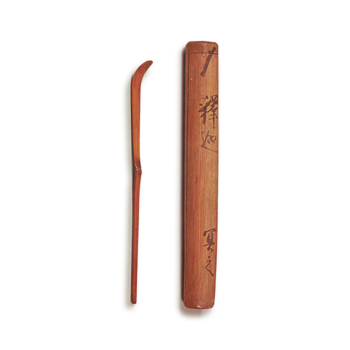
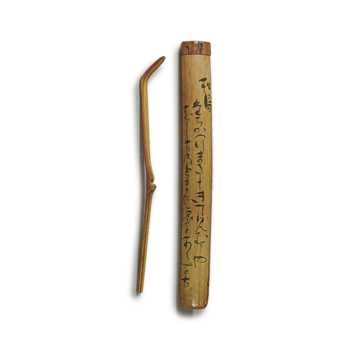
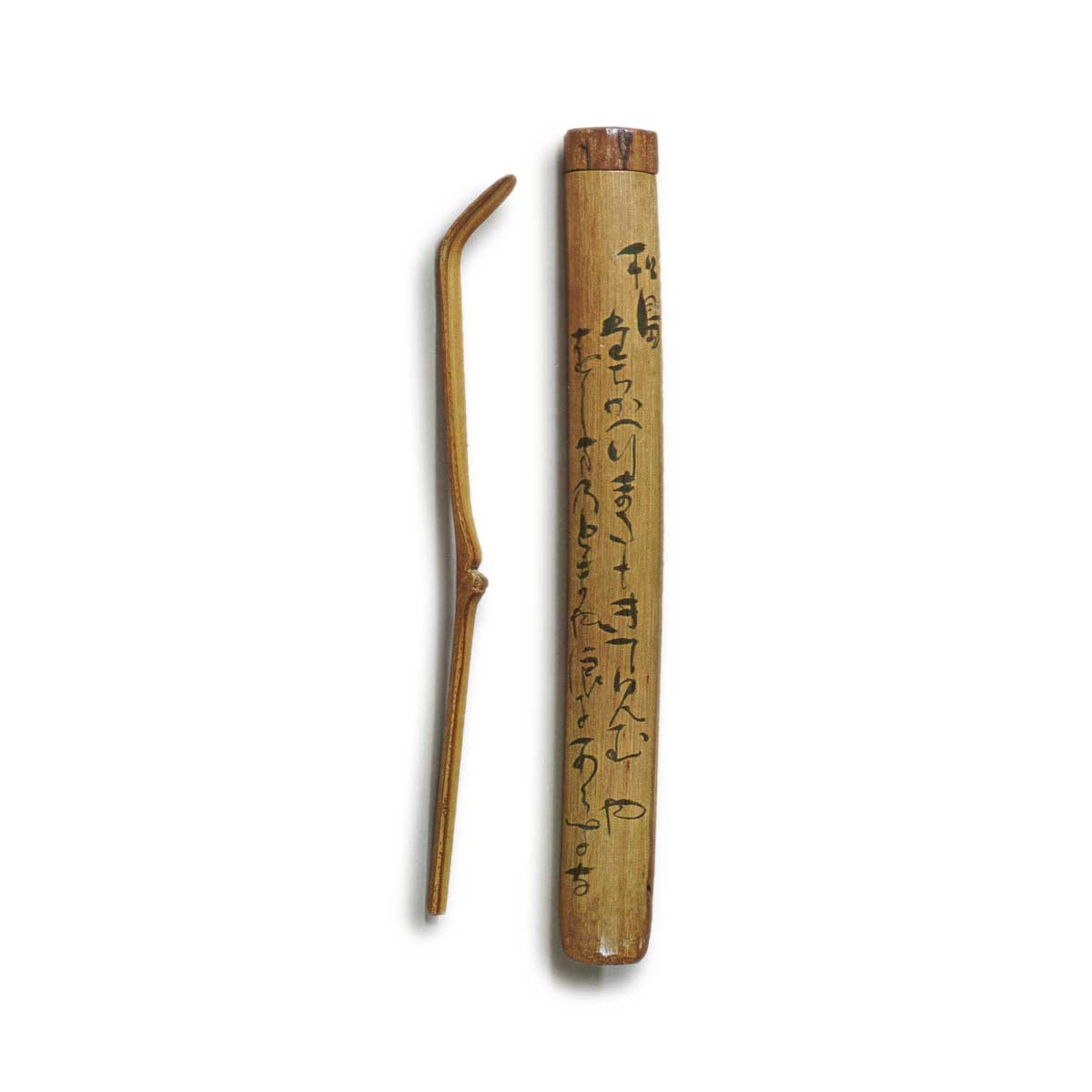
Both the tube and scoop are exceptionally well-preserved, ranking as the foremost Enshū tea scoop. The scoop is made of remarkably fine bamboo, featuring an overall black-and-white striped pattern with sesame-like specks within the black mottled sections near the cut end. Small indentations at the nodes also create an attractive texture. The scoop tip follows the Arima-yama style (explained later), thick-walled with a prominently raised middle section.
Case
Its excellent preservation, appearing as if newly made, confirms its long storage in the depths of the Maeda family’s treasury.
The bamboo, like the “Rangyoku,” is flat, and Enshu skillfully and beautifully inscribed it using a type of curved bamboo. The handle is made of striped persimmon wood, and Enshu crafted it with considerable care.
The poem reads: “Matsushima, I’ll return again to see it… □□□… Oshima’s shore, it’s not the waves… Lord Chobei, the bed, Enko.”
Accessories
Inner box: Paulownia wood, natural finish, paper label, inscription
“Teascoop No. 2: Enshū Teascoop, Inscription ‘Matsushima’”
Postscript
The Matsushima poem is from the ‘Shinkokin Wakashū’, Volume 10, by Toshishige. Leaving the “Matsushima” in the poem blank is an interesting touch. The name Tōko is also rare. Chōbei was Tachibana-ya Sōgen, a beloved disciple of Enshū who received instruction from him in tea, calligraphy, poetry, and more.
Published in
Three Hundred Selected Tea Scoops
Dimensions
Tea Scoop
Length: 18.0 cm
Width: 0.5–1.0 cm
Thickness: 0.3 cm
Tube
Length: 22.2 cm
Diameter: 2.3 cm