Accessories: Box (unfinished paulownia wood); Inscription by Kobori Enshu
Underside of lid: Inscription by Priest Kogetsu (Chinese poem)
Accompanying letter by Masuda Don’o
Dimensions
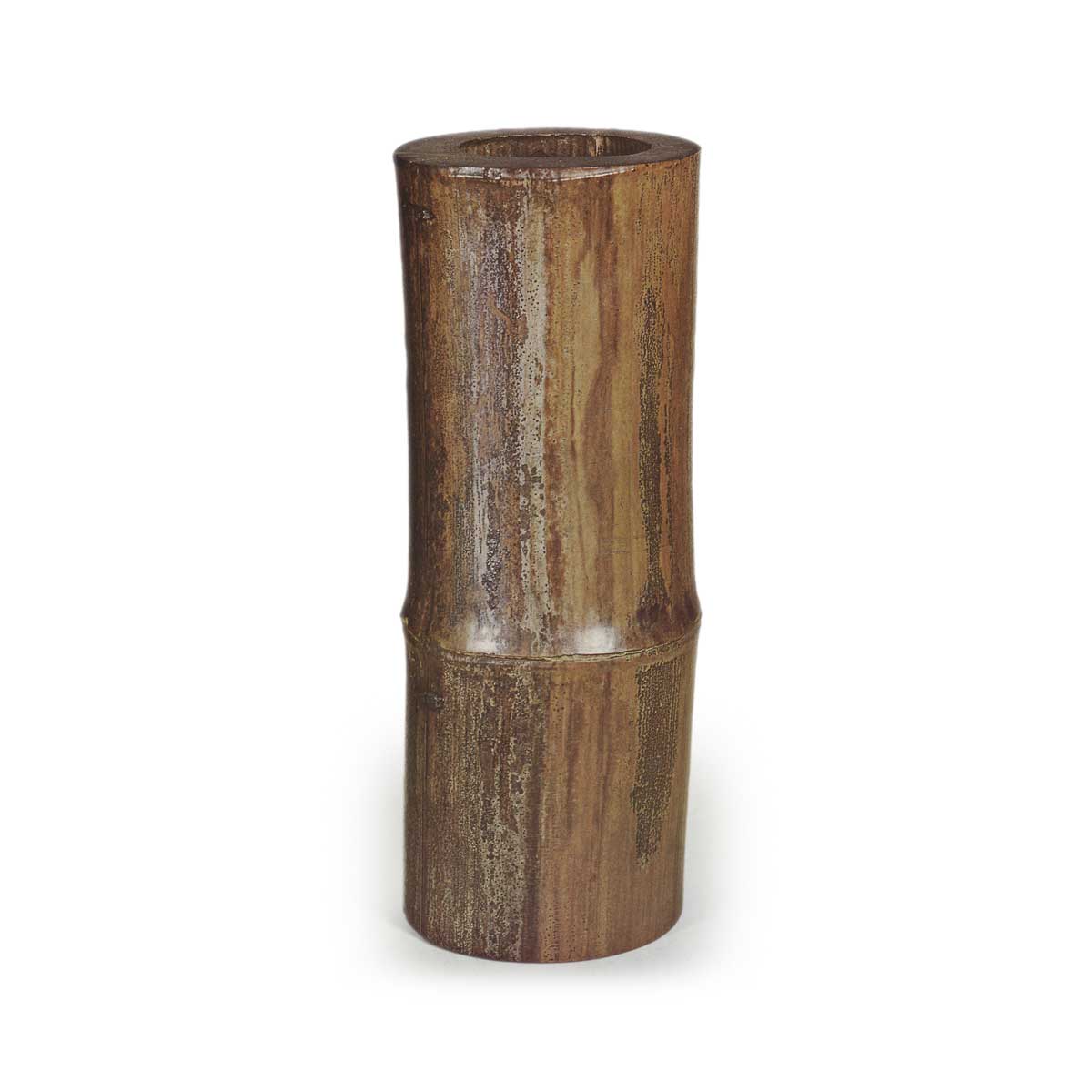
Height: 27.4 cm; Mouth diameter: 10.8 cm; Body diameter: 10.7–11.4 cm; Base diameter: 9.8–10.7 cm; Weight: 625 g
Listed in: Enshū Collection Register, Collection of Meibutsu Through the Ages
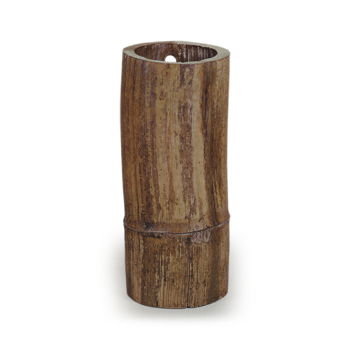
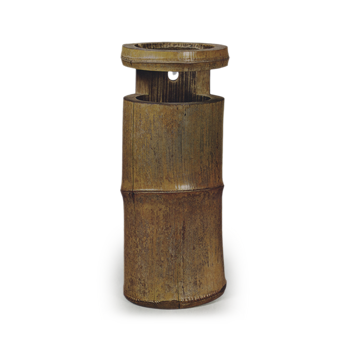
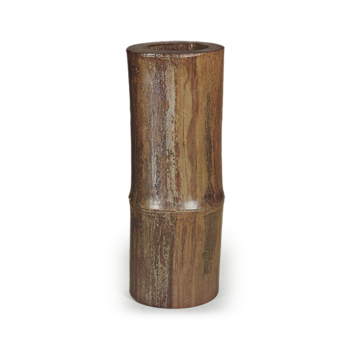
It was generally accepted that the most difficult tea utensils to purchase were the tea scoops. To a layman, it is incomprehensible that a single small bamboo scoop could cost hundreds of thousands or even millions of yen. However, even more difficult to acquire are bamboo flower vases—specifically, those of the Enshū school. That scrap of bamboo, with no proof of the maker’s identity (fortunately, in the Senke school, the maker’s name is always inscribed on the vase itself), comes only with a box bearing the maker’s signature—a situation that is barely acceptable. The box and the vase appear to be entirely separate entities.
This “Miyama-ki,” for example, is like a shakuhachi flute: it has no floral window, no signature—it is nothing more than a scrap of bamboo. Unless one is a person with considerable courage to buy, it is not something one can afford. What makes it even more interesting is that connoisseurs dismiss the signed version as a forgery, claiming that the unsigned stick is the genuine article.
This flower vase is listed as a flower vase in the “Enshu Storehouse Ledger” and as a Meibutsu in the “Collection of Famous Artifacts Through the Ages,” and this single piece has long been regarded as Enshu’s representative work.
Unlike Rikyu, Enshu was extremely discerning in his selection of bamboo and possessed a keen sense for discovering its beauty; this is equally true of his tea scoops. The inscription “Fukayama-ki” derives from the following waka poem:
Though the cherry blossoms in the deep mountains
were not visible even at the treetops,
they have now appeared in full bloom.
Furthermore, Priest Kogetsu inscribed the following Chinese poem on the back of the box:
Amidst the dense forest and deep mountains, there lies a unique contemplation of the Buddhist path.
The place where the World-Honored One expounded the Dharma—a single branch of flowers blooms, accompanied by the sound of a goose drum.
This flower vase was purchased and held in the collection of Mr. Watanabe Ki when, in 1886 (Meiji 19), Enshu’s great-grandson, Sōchū, sold 182 items stored in two chests and five trunks from the Kobori family’s inherited inventory. Later, in 1896 (Meiji 29), following the end of the First Sino-Japanese War and during a period of economic prosperity, Mr. Watanabe sold this “Deep Mountain Wood” for 500 yen. For Masuda Don’o, who purchased it, this represented a considerable financial stretch, making it a topic of conversation in the art world. After the war, when it left the Masuda family and was transferred to a certain household in the Kansai region, it fetched a remarkable price.
Box: Unfinished Paulownia wood; Inscription: Calligraphy by Kobori Enshu
Deep Mountain Wood: Crafted by Sōfu
Inside of Box Lid: Inscription by Priest Kogetsu (Chinese Poem)
Deep within the mountains, where trees grow thick, the moon and frost reach all places
May we all join together to honor the Buddha for ages to come
The fragrance of a single flower accompanies my solitude
Accompanying Note: Written by Masuda Don’ō
Both the box and the inscription for the “Deep Mountain Wood” flower vase
and the inscription by Priest Kogetsu
are truly magnificent
Inspired by the inscription “Deep Mountain Wood,”
I recalled Saigyō’s verse:
It seemed as though the cherry blossoms,
which appeared as flowers,
were the very branches of that “Deep Mountain Wood.”
I believe this must be the verse in question. Through this verse,
the spirit of tea has also been evoked. (Excerpt)
Don’ō (Seal)