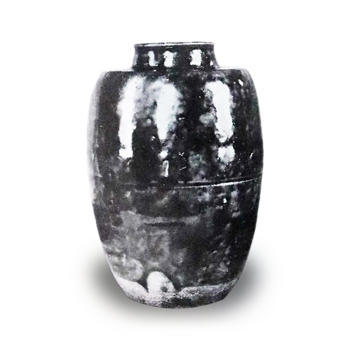
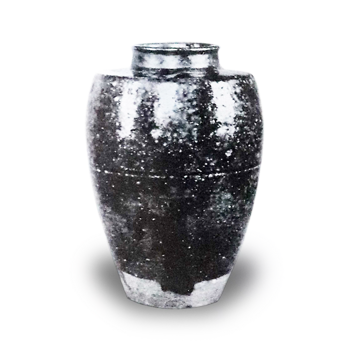
Ooseto, Osaka—Collection of Mr. Jiro Yamada
[Name]
This name derives from the fact that it was once owned by Tokunaga Nyudo Jusho. According to the Hankanfu, in the fall of Keichō 5 (1600), Jushō set out for Ōshū in the retinue of Tokugawa Ieyasu; however, upon hearing that the Battle of Sekigahara had ended, he spurred his horse to catch up with Ieyasu. During that pursuit, he beheaded two enemy samurai and 63 foot soldiers, and paid his respects to Ieyasu at Suribachi Pass. In November of that year, he was granted a reward consisting of Takasu Castle (Takatsuki Castle) along with extensive additional territories. Furthermore, his fief was increased by 20,000 koku, bringing his total holdings to just over 50,000 koku. Records indicate that he passed away on December 19, Keichō 17 (1612), at the age of 64.
[Dimensions (converted to centimeters)]
Height: 3 sun 6 bu (approx. 10.9 cm)
Body diameter: 2 sun 7 bu 7 rin (approx. 8.4 cm)
Mouth diameter: 1 sun 3 bu (approx. 3.9 cm)
Base diameter: 1 sun 5 bu (approx. 4.6 cm)
Koshidaka (height of the kettle): 4 bu (approx. 1.2 cm)
Shoulder width: 6 bu 5 rin (approx. 2.0 cm)
Weight: 55 monme 5 bu (approx. 208.1 g)
[Accessories]
・Lids: 2 (nest-shaped)
・Wrapping: Silk mon-sha
・Storage pouches: 2
- Keitō-gire (lining: grayish-blue, cord: purple tsugari)
- Antique pouch (Bears the inscription “Tokunaga Katatsuki”)
(These are housed in a curved cypress wood container)
・Karamono Ningyo Donshu (lining: light blue, cord: Tsugari purple)
(This is wrapped in mon-sha silk)
・Wooden mold: Made of rosewood, 1 piece
・Wooden mold box: Made of paulownia wood, natural finish
- “Oseto Wooden Mold”
・Hikiya: Made of rust-colored ironwood (Tagayasan)
- Pouch: Tanji brocade (lining: striped umi-ki, cord: Tsugari brown)
・Inner box: Paulownia, natural wood
・Outer box: Paulownia, natural wood (There is a sheet of paper with two vermilion seals stamped on it beneath the outer covering paper)
- Inscriptions reading: “Ōseto Wooden Tea Caddy,” “Tose Tea Caddy,” “Items in the Collection of Heikun Sanbō,” and “From the Akahoshi Family Collection”
(Note) Heikun Sanbō is the family name of the Mizoguchi family, former lords of the Echigo-Shinobata Domain.
・Attached tag: 1
- “Ōseto Tea Caddy”
(The inscription on the wrapping paper on the right reads as follows)
Its name also appears in the inventory record for July of the first year of Kyōhō (1716, the Year of the Fire Monkey). When Kobori Sōchū (a tea master and descendant of Kobori Enshū) visited in February of the fourth year of Kōka (1847, the Year of the Earth Goat), he confirmed the name as “Tokunaga” based on his own account; consequently, this tag was removed and the item was put into storage.
・Accompanying Note: 1 copy
This tea caddy, labeled “Ōseto” on the bottom tag, is undoubtedly the “Tokunaga Tea Caddy” described in the three-volume Meibutsu-ki. I am recording this here, though my handwriting is crude, to serve as evidence for future reference.
Early March, Sōchū (seal)
Received on the 13th day of the 3rd month of the 4th year of Kōka (1847, Year of the Goat), from the son of Kobori Daizen Sōchū.
[Miscellaneous Notes]
・Kose-to Tokunaga: Height slightly less than 3 sun 6 bu; body diameter 2 sun 7 bu 7 rin; the body has a coil-like pattern and a hairline crack. Shoulder width: 2 sun 6 bu; mouth diameter: 1 sun 3 bu; base diameter: 1 sun 5 bu. The lid is a round pouch; the inner lid is a “sam-bukuro” (a pouch resembling those made from ironwood); the cover is brocade, and the lining is brown. Inside the outer box, there is a paper tag inscribed with “Ōseto.”
(From Kokin Meibutsu Ruiju: Shiyu-no-bu)
・Kose-to Tokunaga: In the 10th month of Kyōhō 1 (Year of the Fire Monkey), it was in the possession of Mizoguchi Hōki-no-kami (Lord of the Shibata Domain). (The descriptions of dimensions and accessories are the same as in Kokin Meibutsu Ruiju.)
(From Meibutsu-ki)
・Regarding Ōseto: Murata Jukō and Shōō have noted that, historically, items referred to as “Ōseto” were particularly prized and admired for their large size and substantial feel in the hand. Consequently, tea caddies such as the “Harukasumi” of the Hachisuka family of the Awa-Tokushima Domain, the “Tokunaga” of the Mizoguchi family, and the “Yamazakura” of the Yabuuchi family are celebrated as Meibutsu. As times have changed, the Oseto style is now appreciated for its sense of spaciousness and grace.
(From Illustrated Catalog of Meibutsu Tea Utensils by Kazuraku Kusama)
・Tokunaga: A Meibutsu Oseto. On April 11, Meiji 37 (1904), it was sold at auction by the Mizoguchi family for 1,530 yen. It had a crack at the Ikeda mark and was acquired by the Akahoshi family.
(From Tsurezure no Tomo by Seika Matsuyama)
[History of Ownership]
It was passed down from the collection of Tokunaga Hōin Jushō to the Mizoguchi family, lords of the Echigo Shibata Domain. In April of Meiji 37 (1904), during an auction of tea utensils from the family’s collection, it was acquired by the Akahoshi family for 1,530 yen. On June 11, Taisho 6 (1917), during the first auction of the Akahoshi family’s collection, it was purchased by the current owner (Mr. Ichijiro Yamada) for 22,200 yen.
[Field Notes (Record of Actual Observation)]
On May 19, Taisho 10 (1921), I examined the piece in person at the residence of Mr. Ichiro Yamada in Minami-Kyutaro-cho 2-chome, Higashi Ward, Osaka City.
The rim is round, with no flaring at the edge. The body is relatively low and flared outward at the base; the shoulder is smooth and extremely wide, tapering sharply to a crisp, pointed tip. A single sunken ridge runs all the way around the body; the unglazed clay (base) is visible from the lower rim downward, and the thread-cutting marks (traces of the thread used to form the base) are fine. Amid the meticulous craftsmanship, there are slender “clay flaking” marks. Against an overall reddish-brown base with a purplish tinge, a black amber glaze spreads across the entire surface, forming a pattern resembling quail spots and exhibiting a very beautiful luster.
There are traces of repairs where a large crack extending from the rim to the body was mended. Inside, the rim is glazed, while the area below it is marked by fine wheel marks. The center of the base forms a swirl pattern. True to the name “Ōseto,” this is a large, majestic tea caddy.