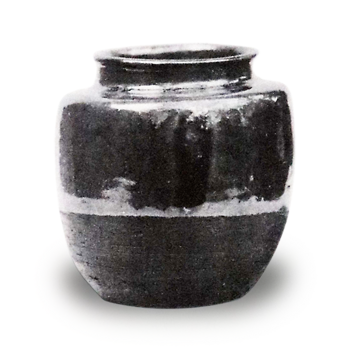
[Collection]
Tokyo, Collection of Mr. Morinosuke Mitsui
[Description]
This name was given because of the glaze’s exceptionally beautiful and splendid coloration; its origin is the same as that of other tea caddies bearing the same name.
[Dimensions (converted to centimeters)]
Height: 2 sun 1 bu 8 rin (approx. 6.6 cm)
Body Diameter: 2 sun 1 bu (approx. 6.4 cm)
Mouth Diameter: 1 sun 3 bu (approx. 3.9 cm)
Base Diameter: 1 sun 5 bu (approx. 4.5 cm)
Neck Height: 1 bu (approx. 0.3 cm)
Weight: 40 monme 1 bu (approx. 150.4 g)
[Accessories]
・Lid: 1 (made from the “ivory nest” section)
・Storage pouches: 2
- Cloud-patterned silver lattice (Lining: brown shichiko weave; cord: purple)
- Donshu pattern (Lining: kabejiro; cord: brown)
・Storage box: Paulownia, natural wood (marked “Imoko Replacement Pouch”)
・Hikiya: Tagayasan wood, with the characters “Yamazakura” (Mountain Cherry) rendered in gold powder
(Supplementary Notes on Pouches and Box)
・Mountain Cherry pouch: Horizontal-striped Guangdong style (lining: striped satin; cord: purple)
・Box: Paulownia, natural finish (bears an inscription by Kobori Enshū, inscribed as “Imoko”)
[Miscellaneous Notes, Provenance, and Analysis]
・“Yamazakura Imoko”: Written in the hand of Sōfu (Kobori Enshū). It is said to refer to “the previous imo.” (Enshū Zōchō)
・“Imoko”: Written in ink on the box lid. The name “Yamazakura” is written in gold powder on the Hikiya. The base is persimmon-colored with a black glaze; the way the landscape emerges through the glaze and the metallic luster is magnificent. (See Tea Jar Illustrations (Makuan Bunko, Series A, No. 18))
・“Imoko Tea Jar” (from Chayū Hyōrin Taisei):
This shape is called an “Imoko tea jar” because it resembles the small tubers that grow around a parent taro root. It measures approximately 2 sun 8–9 bu (about 8.5–8.8 cm); pieces with sharply defined shoulders are considered top-quality, and a straight, slender form is highly valued. While some are pale red or pale yellow, most are coated with a “mizu-yaku” (a translucent glaze). A rim with a twisted edge is considered desirable; the glaze on the body and below exhibits a deep persimmon color with a pear-skin texture, while the upper portion is coated with a pale black glaze. This is called “Koshikawari” and is highly prized by collectors. There are also pieces featuring yellow glaze drips on the pale black glaze or splashes of yellow-amber glaze, resulting in a wide variety of glaze colors. Approximately 350 years have passed since these pieces were first produced during the Genroku era.
・“Imono-ko” (from Chaki Mekiri-shū):
The shape features rounded shoulders and tapers toward the base. The rim is thick and lacks a twisted edge. Most examples have a low-profile rim, and there are no large-sized pieces. The base glaze is a pale persimmon color, with black glaze applied in spot-like or patterned designs. There are also examples with red or yellow glaze patterns, and some feature a base glaze finished in a lustrous persimmon color. The specific lineage of the “Imo-no-ko” is identified and named based on the appearance of the glaze and the thread-cut marks on the bottom.
・“Imono” (from Chaki Meibutsu Zui by Kazuraku Kusama):
It is said that these were first created long ago during rituals to enshrine the Kamado-gami (stove deity) and were named “Imono” because they multiply one after another like sweet potato tubers, symbolizing the prosperity of descendants and the flourishing of the family. For this reason, they are also frequently found in later Seto ware and other styles.
[Field Notes]
Record of an on-site inspection conducted on June 20, Taisho 9 (1920), at the residence of Mr. Morinosuke Mitsui in Toriizaka-cho, Azabu Ward, Tokyo City.
The rim is wide, with no constriction or flaring, and the shoulders are rounded. The body tapers slightly, forming the so-called “Imo-no-ko” shape. Persimmon-colored, metallic, black-amazu, and white-blue glazes intermingle in a complex pattern, creating a magnificent visual effect. In particular, there is a large “avalanche” (nadare) of yellow glaze mixed within the white-blue glaze; as it reaches the base, it turns black-amazu in color, and the beautiful luster and the variations in the glaze’s appearance are beyond words.
Toward the shoulder, there is a single spot where the clay has frayed—a small chip or dent resembling a wormhole. Below the rim, the unglazed body is charred black; the thread cut is rough, and there are areas where the clay has frayed and worn away. The entire interior is covered with a glaze that has a beautiful luster, and in the center of the base, the wheel marks form a swirling pattern.