
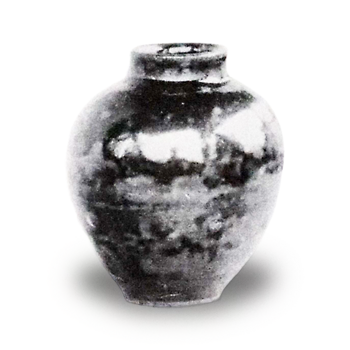


Kose-to Bunrin—Meibutsu of the Revival Period—From the Collection of Count Matsudaira Naoaki
Kobori Enshū named this tea caddy after an ancient poem (such as the verse by Gon-Chūnagon Teika in the Hyakunin Isshu) that describes the tea caddy’s austere, unadorned appearance as resembling the act of “sprinkling seaweed salt water” (a process used in salt production).
[Collection]
Owned by Count Matsudaira Naoaki
[Dimensions (Converted to Centimeters)]
・Height: Approx. 6.36 cm (2 sun 1 bu)
・Body Diameter: Approx. 5.45 cm (1 sun 8 bu, at the shoulder)
・Mouth diameter: approx. 2.36 cm (7 bu 8 rin)
・Base diameter: approx. 2.42 cm (8 bu; the circular base is slightly worn)
・Neck height: approx. 0.61 cm (2 bu)
・Weight: approx. 46.5 g (12 monme 4 bu)
[Accessories]
・Lids: Four pieces
- Two of them: Made in the “Kamado-butadate-zen” style. One is a sake cup lid without straw, and the other is without straw.
- All four of the above fit into the “kakego” (a shallow tray placed inside a tiered box) of the pouch-style case.
・Storage pouch: White chirimen; lined with white habutae; purple cord.
・Cover pouches: Four
- Keitō-gire pattern; cord is kuzushiki-kaiki.
- Sasazuru-donsu pattern; cord: indigo velvet.
- Yojirikané pattern; cord: Kuzushiki-kaiki, “Ren-shio.”
- Goshuin-gire: Lining is Tamamushi-kaiki; cord is purple.
・Pouch box: Paulownia wood, natural finish, with silver and gold fittings.
・Hikiya: Karan; the lid is decorated with a sixteen-petaled chrysanthemum painted in silver powder and the character for “longevity” (寿). Designed by Kobori Enshū.
- The body features the character “Moshio” rendered in gold powder.
- Pouch: Red wool fabric (Kōmō-gire), lined with pure yellow silk (Donshu), with a purple cord.
・Inner box: Natural-finish paulownia wood, inscribed by Kobori Enshū with “Kose-to Bunrin.”
・Outer box: Paulownia, natural wood finish; constructed in the “kichōmen” style; inscribed by Matsudaira Fumai: “Kose-to Bunrin Moshio.”
・Wrapping: Sarasa fabric; lined with Onando-cha-colored ha-ni-bu-te silk.
[Miscellaneous Notes and Summary of Literature Entries]
Kokin Meibutsu Ruiju
Moshio. An “Koseito” piece, a renowned work from the revival period. Owned by Matsudaira Dewa-no-kami. Height approx. 6.36 cm, body diameter approx. 5.45 cm, mouth diameter approx. 2.27 cm, base diameter approx. 2.42 cm; features a slight circular base. Includes four lids; the storage pouch is made of white chirimen (lined with habutae). . Four pouches (chikuto-giri style with purple cord; sasa-tsuru-donsu style with matching cord; gold-on-velvet style with brown cord; and shuin-giri style with wisteria-colored cord). The pouch box is made of untreated paulownia wood with no inscriptions. The word “Moshio” is inscribed where the lids are stored. The cord on the cloth wrapping the protective cover is brown. The box is made of untreated wood with no inscriptions and features silver fittings. Illustrated in Koseito Bunrin (includes a diagram of the tea caddy).
“Rin-Hō-Kame-Ryū”
Moshio Bunrin. Old Seto. Formerly owned by the Lord of Unshū (Matsudaira Fumai). The persimmon-colored ground features a mottled black pattern and is of fine workmanship. The thread-cut decoration on the bottom is fine and exquisite.
“Chronicle of Meibutsu Tea Jars”
Moshio. Old Seto Bunrin. The base (lower part of the body) is coated with glaze, while the clay at the bottom is white and moist. There is some wear along the rim of the main thread-cut. Overall, the piece is well-made, with a persimmon-colored body that has a reddish tint, and the glaze run on the upper part is magnificent.
“The Origins of Seto Pottery” by Lord Matsudaira Fumai
Moshio. An ancient Seto piece. It dates from the same period as the Rokujō Katatsuki and Hago styles.
Hōian Bunko, Volume K, No. 9
Old Seto, Moshio. The rim rises high, and the glaze is slightly firm. A thin layer of black glaze is applied to the base; black glaze predominates overall, with sesame glaze and yellow glaze appearing in patches. The “Hon-ito-kiri” pattern is finely executed and of high quality.
“Kyōhō 4th Year Memorandum” (from the Tea Ceremony Record)
・On January 22, Kyōhō 4 (1719), at the Governor’s tea ceremony (attended by Lord Kato Daimaru Shōsuke, Lord Hosokawa Nagato-no-kami, Lord Kato Hei-nai, Lord Oka Dōkei, and Lord Takeda Kyōan), the tea caddy “Moshio Koseto” (round tray, red interior, chestnut exterior) was used.
・On November 22 of the same year, at a tea ceremony hosted by the Governor of the Province (held in the Sukiya-style tea room), the tea caddy “Moshio Koseto” (with a black-lacquered folding tray) was used.
History
During the Kyōhō era, it was owned by Hosokawa Etchū-no-kami (of the Hosokawa family), but was later passed down to Fuyuki Kiheiji, a wealthy merchant of Fukagawa, Edo. In the 7th year of An’ei (1778), through the mediation of Takeya Chūbei (Fujino Muneiku), Lord Matsudaira Fumai (Matsudaira Naomasa of the Matsue Domain) purchased it for 300 ryō in gold.
Field Notes (Viewed on May 7, Taisho 7, at the residence of Count Matsudaira Naoaki in Motomachi, Yotsuya Ward, Tokyo City)
The rim is not flared outward; the base below the neck is broad. The vessel is jar-shaped with gently sloping shoulders, tapering from the body to the base, differing from the typical Bunrin style.
It is generally free of flaws; black glaze bleeds unevenly over a persimmon-colored ground, and a single black line runs around the body. There are particularly many quail-spot-like marks above this line, while below it there are several small, pimple-like protrusions resembling rice crackers.
From the rim downward, shallow wheel marks run across a reddish clay body, and the rim of the base is worn. It is quite unusual that the starting (and ending) point of the thread-cut decoration is so close to the center of the base.
Perhaps to accommodate placement on a tray, the area around the thread cut is worn away; glaze covers only the interior and the rim, while shallow wheel marks encircle the portion below, and the center of the base is deeply indented.
Although it is free of flaws, it is a piece with a strong sense of wabi (a deeply austere aesthetic); while it lacks a bit of elegance and refinement, its overall form is well-defined, making it a tasteful and distinctive tea caddy.

