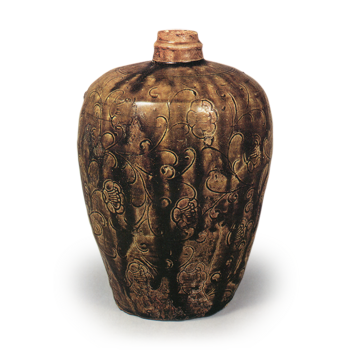
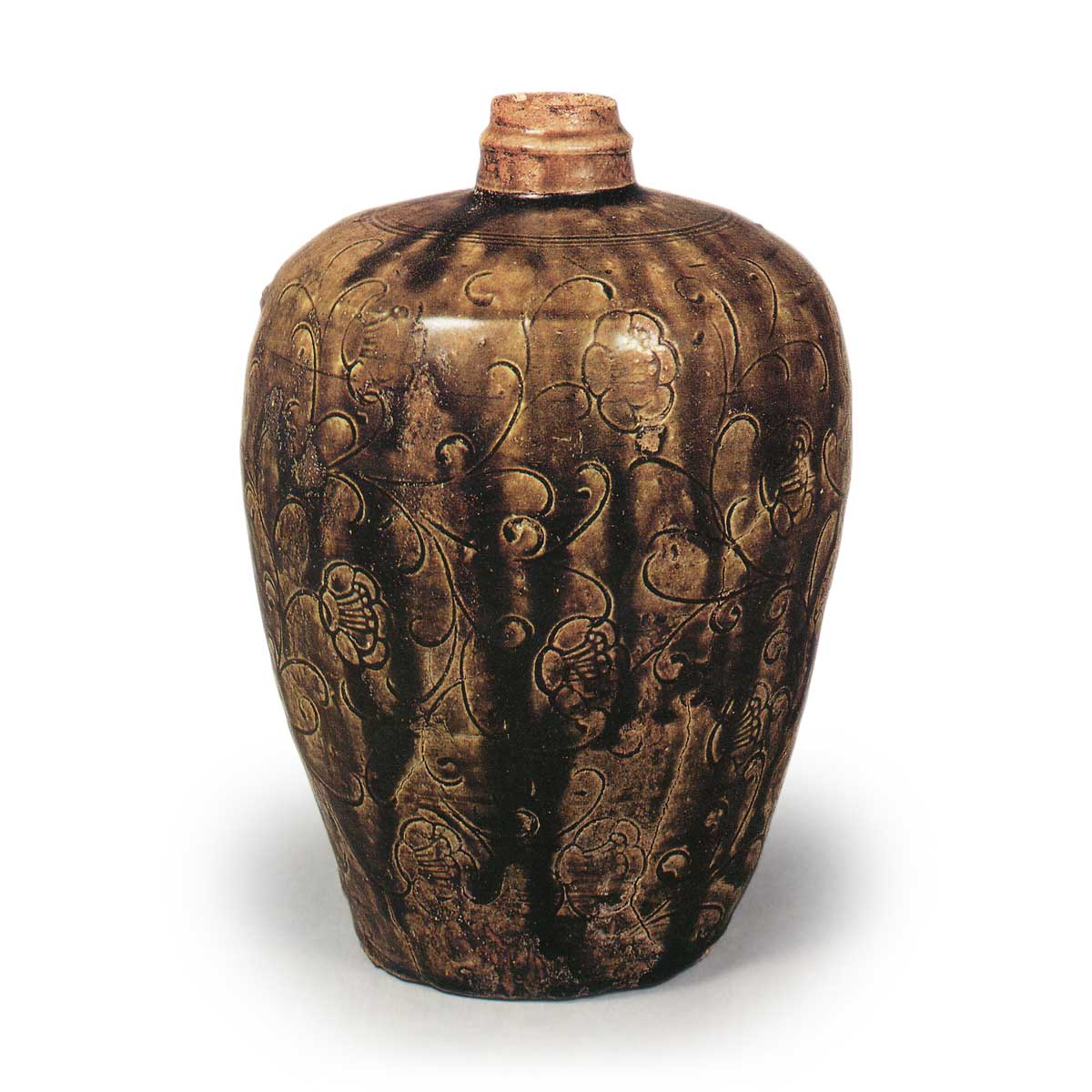
Excavated from Tahoji Yagura, Ougigaya, Kamakura, Kanagawa
14th century
Height 23.9cm, mouth diameter 3.2cm, body diameter 16.3cm, bottom diameter 9.5cm
Jokomyoji Temple
This is one of the Koseto period’s plum vases, which were used as warehouse vessels. It is thought to have been made between the end of the Kamakura period and the Nanbokucho period (1392-1333), judging from the slightly rounded and blunted central band and the large and stable base. It is made of rolled-up clay with a ground surface. The design is a camellia pattern in the Inka technique on the entire surface of the body with a three-jawed chinkaku line in the center of the shoulder. The design is from the early period when the entire surface of the body began to be covered by the design, and only the same design is irregularly stamped on the body. The shaft is light brown in color, and the glaze is markedly uneven. A mountain is visible on the lower half of the body.