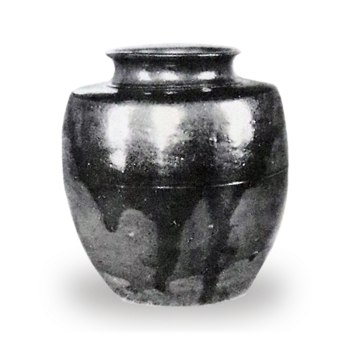
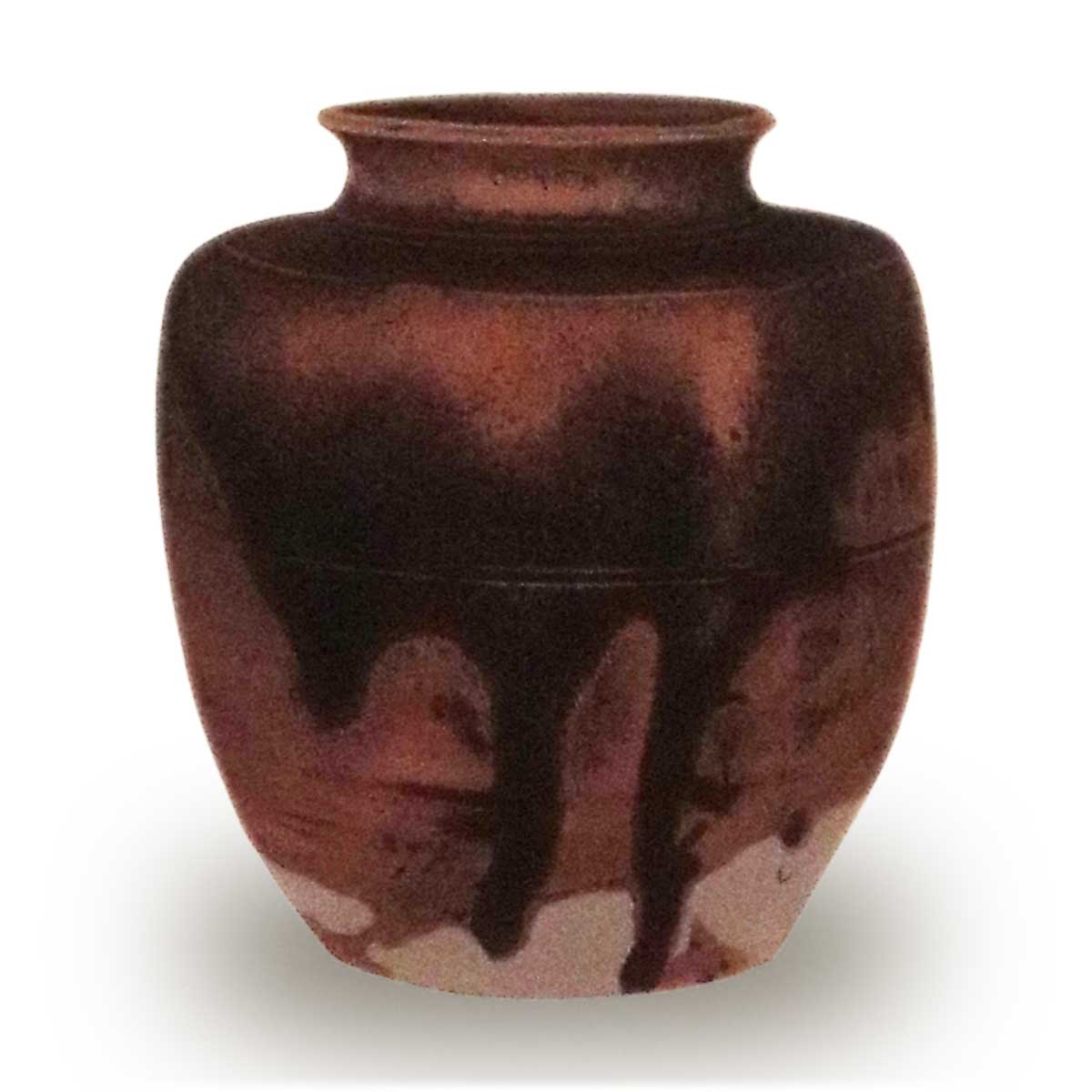
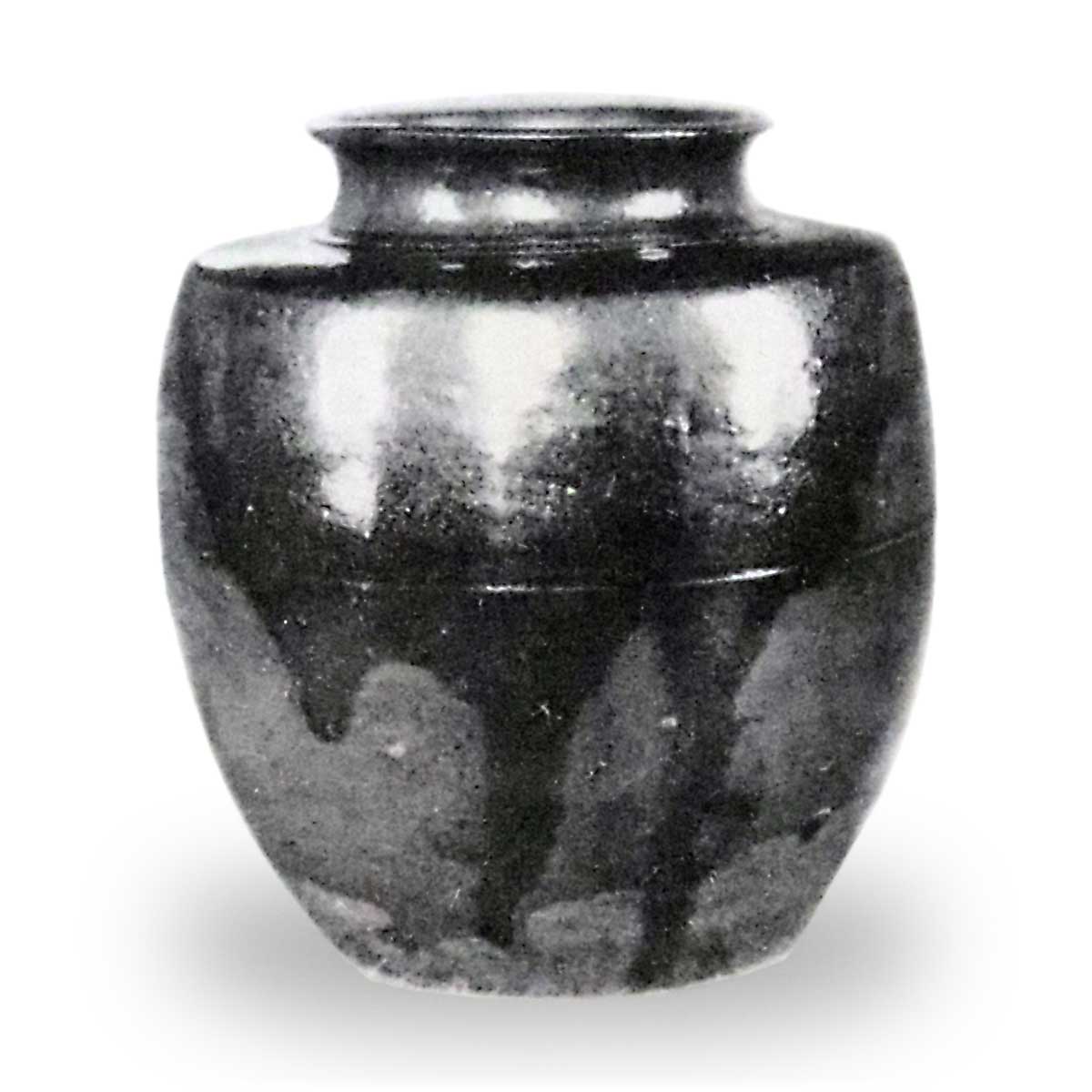
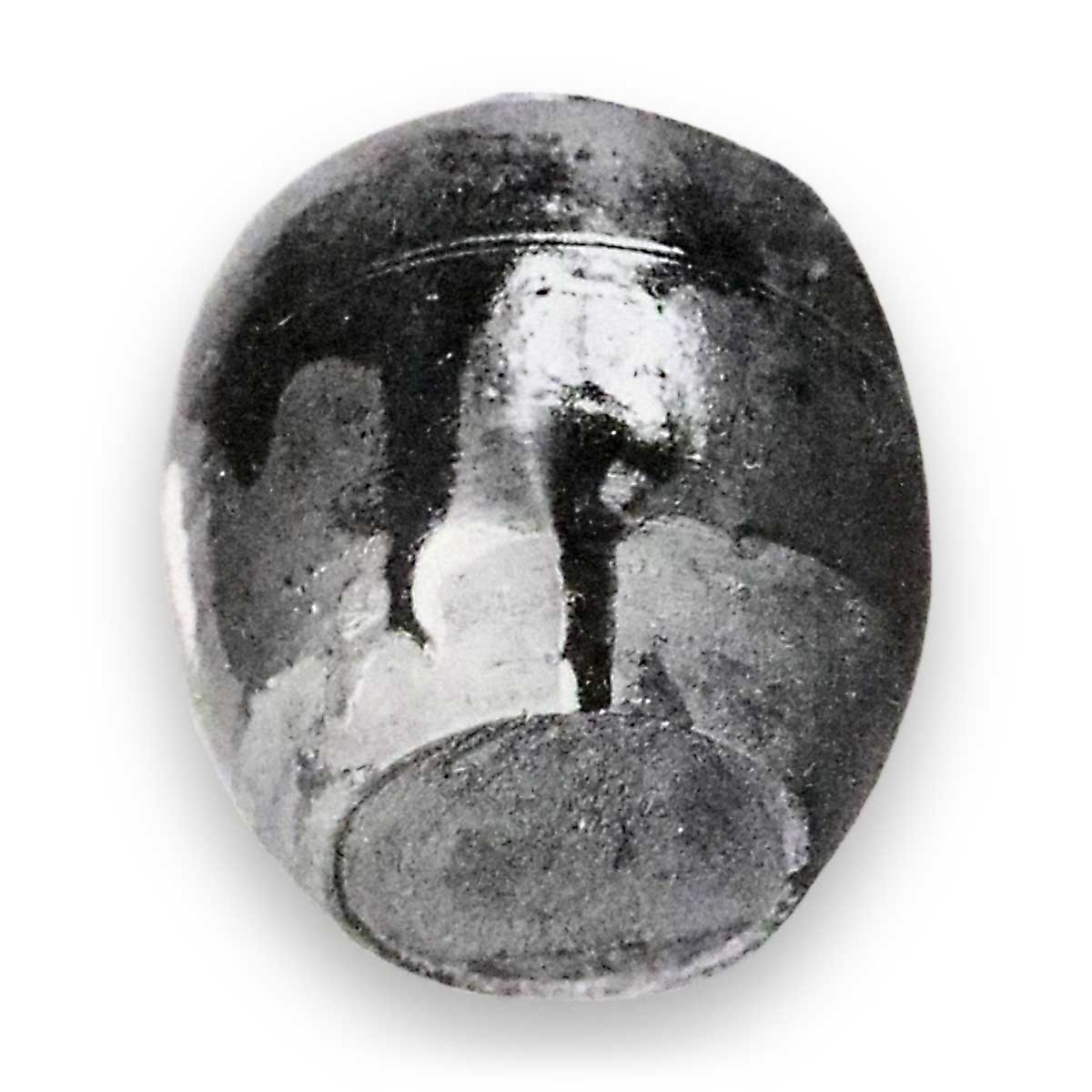
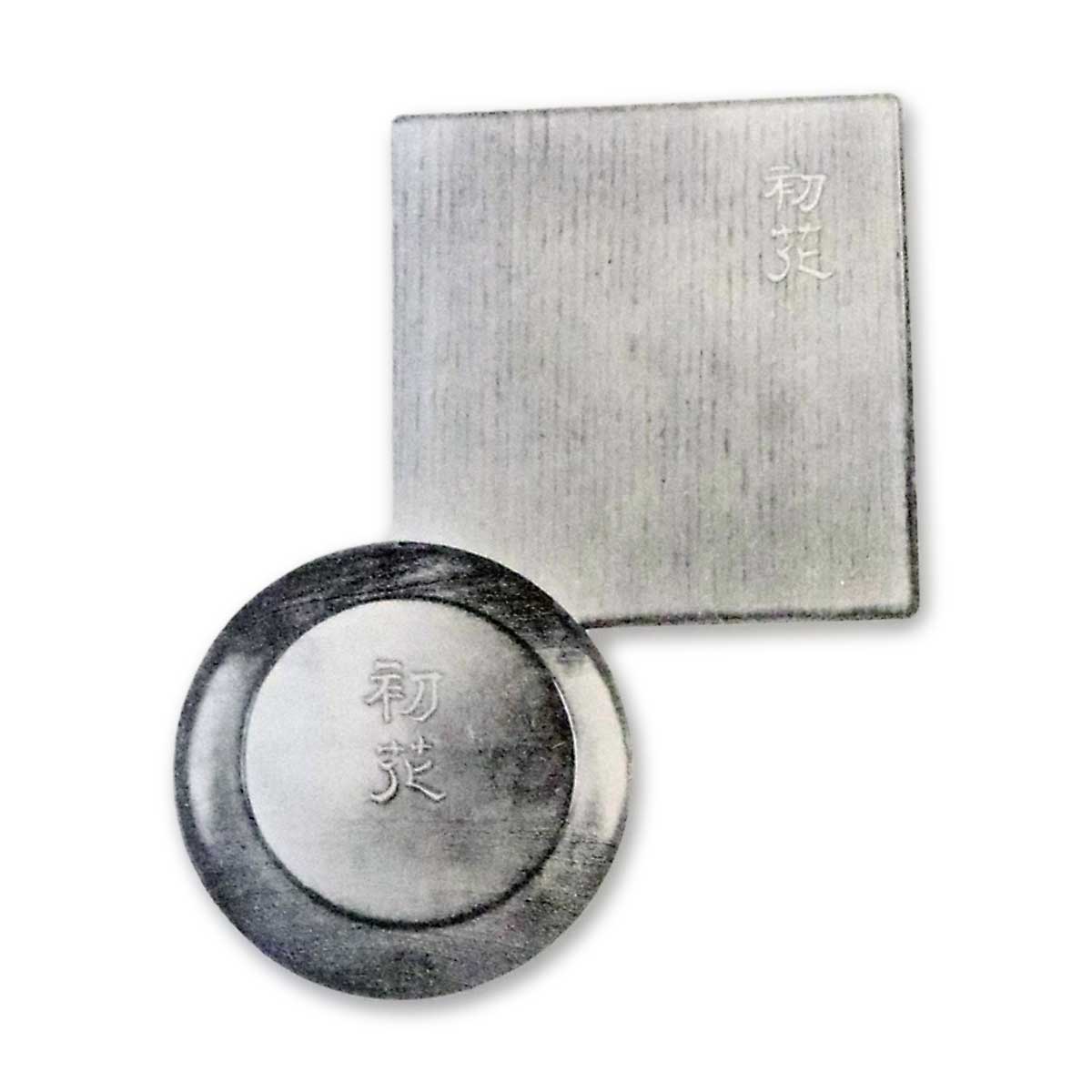
Made in China; Daimeibutsu; Formerly in the Collection of Duke Ietada Tokugawa
Name
It is said that Ashikaga Yoshimasa of the Muromachi Shogunate named this tea caddy “Hatsuhana.” This likely refers to its elegant shape and the beautiful color of its glaze, suggesting it resembles the first famous flowers (such as plum blossoms) that bloom ahead of spring across the land.
Dimensions
Height: 2 sun 7 bu 5 rin (8.33 cm; measured as 2 sun 8 bu or 2 sun 7 bu depending on the measurement point)
Body diameter: approx. 9.9 cm (2 sun 6 bu)
Circumference: approx. 31.1 cm (8 sun 2 bu)
Mouth diameter: approx. 4.7 cm (1 sun 5 bu 5 rin)
Base diameter: approx. 4.7 cm (slightly over 1 sun 5 bu)
Height of the neck (koshi): Approx. 1.1 cm (3 bu 5 rin)
Shoulder width: Approx. 1.4 cm (4 bu 5 rin)
Weight: Approx. 139.9 g (37 monme 3 bu)
(Note) Since the dimensions of this tea caddy differ slightly from those recorded in various historical texts (such as the Meibutsu-ki and Manpō Zenshū), we measured it as described above.
Accessories
・Storage bag (for careful preservation): White ha-ni-bi
・Lid: 1
・Pouches: 2
- Donsu (silk satin) with arabesque and dragon patterns. Lining is kaiki (a type of silk fabric); the cord is a purple twisted cord.
2. Fine nine-dragon and bird sash pattern (the designated front side is made of Shukō satin, while the side panels are made of Shōō satin with a reverse weave). The lining is high-quality kaiki, and the cord is a light brown twisted cord.
・Storage box: Unfinished paulownia wood (inscribed in ink on the box: “Hatsuhana O-fukuro”)
・Hikiya (wooden tube for storing the tea caddy): Exotic wood base, rim decorated with gold powder. (Gold powder on the carved inscription “Hatsuhana”)
(Pouch for the hikiya): Tang-style woven fabric, red ground with yellowish-brown and Kinran floral patterns; cord is a purple twisted cord.
・Inner box: Unfinished paulownia wood (inscribed with “Hatsuhana” in gold powder)
・Outer Box: Black lacquered, rim of the lid decorated with gold powder (inscribed with “Hatsuhana” in gold powder)
The item is wrapped on all sides in a brown silk quilt (Kaiki), with cotton quilts stuffed above and below it, and a brown quilt placed on top before being placed inside the outer box.
・Box for Accompanying Documents (box for documents): Unfinished paulownia wood (inscribed with “Hatsuhana Yosho” in gold powder)
The following documents are stored inside this box.
・Accompanying document: 1 sheet of hosho paper, folded in half with writing on both sides.
(Front: Tax exemption certificate from Ieyasu)
Presenting the “Hatsuhana” teapot (tea caddy) that you possess is a truly commendable gesture. When I offered to grant you a fief in return, you declined and stated another wish; therefore, in accordance with your wishes, I hereby exempt you from all celebratory duties (obligations during festive occasions), sake duties (taxes on sake brewing), and all other duties (taxes and labor obligations).
I hereby certify that you shall permanently retain the above privileges for generations to come and shall never violate this agreement.
March 1, Tenshō 12
Ieyasu’s Seal
Nensei (Recipient)
(Back: Later Confirmation)
Regarding the complete exemption from all duties granted due to the presentation of the small jar “Hatsuhana” during the Tenshō era, I hereby certify that this exemption shall remain in effect permanently, as stated in the previous certificate.
March 17, Genna 3 (1617) Imperial Seal: Nensei
Regarding Nensei of Okazaki Village, Nukata District, Mikawa Province, as stated in the two certificates from Tenshō 12 and Genna 3, the exemption from all duties shall never be violated.
July 11, Kanbun 5 (1665) Imperial Seal
[Miscellaneous Notes]
There are three katatsuki tea caddies renowned as Meibutsu: “Narashiba,” “Hatsuhana,” and “Nitta.” Currently, only “Narashiba” remains in the Shogun’s collection and is worthy of being placed in the first-class storage chest.
(From Kokon Chawa by Kanamori Tokusui and Kakusho by Katagiri Sekishu)
On June 16, the Year of the Goat, I attended the Shogunate’s annual ceremony (Kashō) and unexpectedly had the opportunity to view three Meibutsu tea caddies. I have recorded the details as follows.
Today, I was fortunate enough to be granted a private viewing of the three tea caddies—“Hatsuhana,” “Osozakura,” and “Aka no Koromo”—as they were being taken out for maintenance. The clay of “Hatsuhana” appears pale yellow, but upon closer inspection, it is actually purple. The glaze is applied thinly, and it has been fired to a hard finish; the brown glaze shines beautifully, and the black patterns are exceptionally interesting. It is truly a piece worthy of the Shogun’s household. The bottom shows signs of having been cut from a slab (with marks where it was separated from the slab), and the rim is twisted more sharply than on ordinary tea caddies; there are wheel marks here, and it is a flawless piece. There are two pouches, both made of old satin. Since the dimensions commonly cited differ from the actual measurements, I will investigate them further and record them later. (Dimensions and diagram)
(From Kankyū Gohitsu)
Hatsuhana, made in China. Presented by Matsudaira Bizen-no-kami on December 6, Genroku 11. Height: 2 sun 8 bu (omitted) The base is made from a raised slab; the ground glaze is persimmon purple with black speckles. The rim’s outward flare, protruding like a tsuba, is unique to this Hatsuhana. The body is not too thin, the form is elegant, and it can be considered the finest teapot in existence. There are two ridges at the junction of the shoulder and the rim, and one ridge on the body. (Includes descriptions of accessories such as pouches and boxes, with illustrations)
(From Catalog of the Tokugawa Family’s Collection of Tea Utensils)
(Note) This catalog was compiled by the calligraphy expert Ryochu in 1882 and submitted to the Tokugawa family.
Hatsuhana, made in China. Owned by Matsudaira Bizen-no-kami, then by Ōmonjiya in Kyoto, followed by the Taikō (Hideyoshi), and subsequently by Ichihaku of Echizen (Matsudaira Tadanori). It is made using the spatula-forming technique and features two ridges at the junction of the shoulder and the rim.
(From Chaki Shosun Kaku-sho)
Hatsuhana: A tea caddy from the Shogun’s personal collection. Made in China. Of the highest quality, with purple clay; an exceptionally fine antique piece. The rim’s turned-up edge is elegant, with two ridges at the neck and one on the body. The shoulder is slightly rounded, and the body has a slight bulge.
The base color is a pale chestnut with a brownish tint, and the transparent glaze is exceptionally vivid. A black glaze encircles it, flowing down from both sides of the shoulder and converging into a single line where the glaze stops. It cascades (drips) like the letter “V,” creating a truly magnificent (artistic effect). The base is flat, with no matcha-colored glaze whatsoever; instead, it is covered with an exceptionally fine black glaze. (Dimensions, accessories, and an illustration of the tea caddy are included)
(From Hōan Bunko, Series A, No. 3)
(Note) Since the anonymous tea book held in the Hōan Bunko contains a vast number of illustrated catalogs and item lists, for convenience, the illustrated catalogs are listed as “Series A, No. X,” and the item lists as “Series B, No. X.”
As there are numerous miscellaneous notes regarding Hatsuhana, they are presented in the following order: (1) the Nobunaga era, (2) the Hideyoshi era, and (3) the Tokugawa era.
(1) The Nobunaga Era
Hatsuhana: Lord Nobunaga, Minister of the Interior (From the Higashiyama Go-mono Uchi Bettei)
Hatsuhana Katatsuki: Belonged to Lord Nobunaga (From the Tenshō Meibutsu-ki)
Hatsuhana: Belonged to Lord Nobunaga (From the Manpō Zensho)
February 27, Eiroku 12
Since the governance of the town of Sakai had fallen into disarray, Lord Nobunaga ordered the magistrates, Priest Nichijo and Murai Tamon-no-suke, to restore order. Furthermore, since Lord Nobunaga had no shortage of gold, silver, rice, or money, he established a rule to purchase renowned Meibutsu from China. First, he acquired:
・The “Hatsuhana” held by the Daimonjiya merchant in Kyoto
・Yujobo’s “Fuji Eggplant”
・The “Bamboo Ladle” from Hōō-ji
・Ikegami Nyōkei’s “Kabura-nashi (Flower Vase)”
・Sano’s “Painting of a Hawk”
・Emura’s “Momoso (Peach Base)”
(Regarding these items) he dispatched Yūkan and Niwa Gorōzaemon as envoys to purchase them by paying gold, silver, and rice, thereby establishing their appraised value as the finest Meibutsu in the land. (The Hunt for Meibutsu)
(From The Chronicles of Lord Nobunaga)
The only authentic, ancient “Unkaku” tube (tea utensil) in existence is the one held by this Ōmonjiya. This Ōmonjiya tube was originally owned by Ōmonjiya Sōkan, just as he had owned the “Hatsuhana Katatsuki”; however, while the “Hatsuhana” was presented to Lord Nobunaga, he retained possession of this tube. The aforementioned Ōmonjiya Sōkan was a disciple of Matsumoto Sōsaku, who was himself a disciple of Murata Jukō; by the time of Sen no Rikyū, the line had passed to Sōkan’s son, Sōmi.
(From the documents of the Sakai family of Hanzu, etc.)
Noon, April 3, Tenshō 2 (1574) — An unexpected tea gathering (hosted by Lord Nobunaga) in the upper hall of Shōkoku-ji
Guests: Yūkan-an, Sōeki (Sen no Rikyū), Sōkyū, Sōyuki
In the tokonoma hung a painting of “Ten Thousand Miles of Mountains and Rivers” by Gyokuboku. In front of it stood a low, square tray with a vase of mame-no-hana (red clover blossoms).
The tea caddy was “Hatsuhana”; two Yasui tea bowls were placed on a long tray. The “Hatsuhana” tea caddy was just under 2.7 sun in height, with a raised bottom. (Records of the fabric and cord patterns of the bag).
(From “Excerpts from the Diary of Imai Sōkyū”)
April 3, 1574, Noon: Tea Gathering at Shokoku-ji (Held Suddenly)
In the tokonoma hung a painting of the “Ten Thousand Miles of Mountains and Rivers” by Gyokkan. On the floor, the ‘Hatsuhana’ tea caddy and two Yasui tea bowls were placed on a long tray, and Umesetsu prepared the tea. I saw the “Hatsuhana Katatsuki” for the first time. There are three streaks of glaze drips (nadare). The rim is delicately shaped, and a thick layer of persimmon-colored glaze covers a thin layer of the same color. The clay is purple, and the base is rough, as if it had been scraped away. Even within the glaze’s color, there is a charm that seems to incorporate the clay’s purple hue, and the glaze is exceptionally beautiful. The back of the pot looks particularly beautiful; the glaze appears whitish yet seems to be peeling, and the quality of its color is beyond words. One of the glaze drips is slightly shorter, and this detail catches the eye a bit. The shape appears somewhat tall, but overall, it has a well-balanced form. The rim seems low, yet it too is well-proportioned.
( From Tsuda Sōyuki’s Tea Ceremony Diary)
On October 28, Tenshō 5 (1577), Lord Chūjō Nobutada (Nobunaga’s eldest son) of Gifu visited Azuchi. He stayed at the residence of Yorizumi Gorōzaemon (Nobuhide Niwa), and Lord Nobunaga sent him a set of Meibutsu tea utensils. The messenger was Terada Zen’emon.
The items consisted of eight pieces: Hatsuhana, Matsubana, a painting of wild geese, a bamboo flower vase, a chain, a Fuji-nami kettle, a Dosan tea bowl, and an Uchi-aka tray.
(From The Chronicles of Lord Nobunaga)
As Lord Chūjō (Nobutada) was traveling to Azuchi to spend the New Year, the Minister’s Household (Lord Nobunaga) bestowed these Meibutsu tea utensils upon him. The messenger was Takada Zen’emon.
Eight types of tea utensils (Hatsuhana, Matsubana, etc.).
That is all. The following day, three additional items, including a tea scoop, were bestowed via another messenger, bringing the total number of tea utensils received by Lord Chūjō to eleven. As a token of gratitude, he visited the castle on the night of the last day of the month, and subsequently, on December 4 of the same year, Lord Chūjō hosted a tea gathering. This was a gathering to showcase the tea utensils received at the end of the previous year.
(From “Sōkenki”)
In January of Tenshō 6, a tea gathering was held for the Lord’s household (relatives of Lord Nobunaga). The Minister of the Imperial Household, Hōin, prepared the tea.
Guests:
Chūjō-sama (Nobutada), Hashiba Chikuzen-no-kami (Hideyoshi), Yorizumi Gorōzaemon-no-jo (Nobuhide), and others.
Regarding the tea utensils bestowed upon Chūjō-sama.
(A painting of a wild goose, a tea caddy named “Katatsuki Hatsuhana,” etc.)
His Lordship (Lord Nobunaga) commanded, “Hold a tea gathering using these utensils and show them to everyone.”
(From the Imperial Household Agency’s Tenshō 6 Tea Ceremony Record)
Chūjō-sama (Nobutada) personally prepared three servings of tea, after which the Minister of the Imperial Household, Hōin, took over. Tea was served to everyone, and after the tea utensils were put away, the guests requested, “We would like to see ‘Hatsuhana,’” so it was brought out on a crimson tray. At that time, the “Matsubana” tea caddy was put away, and “Hatsuhana” was displayed in Takigawa (Sakon)’s alcove.
(From the Imperial Household Agency’s Tenshō 6 Tea Ceremony Record)
Lord Nobutada decided to spend the New Year in Azuchi and arrived there on the 28th. He immediately offered his New Year’s greetings and presented various gifts, including horses and swords. He was bestowed with Meibutsu such as “Hatsuhana” and “Matsubana,” which he humbly accepted, and on the night of the last day of the month, he expressed his gratitude.
(From Taikoki)
(2) The Hideyoshi Era
Hatsuhana Katatsuki: In the possession of the Kanpaku (Hideyoshi). Even after the famous Meibutsu Hishaku Nasu was presented, this tea caddy continues to be cherished as a special delight. It is one of the Three Great Treasures of the Realm (along with Nitta and Narashiba).
(From The Records of Yamagami Sōji)
July 2, 1583, at noon: Lord Chiku (Hideyoshi) held his first tea ceremony at Osaka Castle
Guests: Sōeki (Sen no Rikyū), Sōyuki
The Hatsuhana Katatsuki was filled with tea and placed on a shihō-bon tray.
The Hatsuhana appeared slightly smaller than when I had seen it before, and its shape seemed narrower toward the bottom. It does not seem to feature any special techniques, but the quality of the clay is excellent, and the glaze feels thinner and drier than before. The shaping of the rim and the curve of the shoulder are so magnificent they defy description. The curve of the shoulder is gently sloping and rounded, making it all the more intriguing.
(From Tsuda Sōyū’s Tea Ceremony Diary)
September 16, 1583: Lord Hideyoshi hosted a tea gathering and assembled a collection of Meibutsu tea utensils.
The Hatsuhana Okatamashi was placed on a square tray and displayed as an “O-mono” (an item belonging to Hideyoshi).
(From Tsuda Sōyū’s Tea Ceremony Diary)
Morning of October 7, Tenshō 11: Hideyoshi’s tea gathering
The Hatsuhana Katamashi was placed in the hand-washing room and the screen room.
(From Tsuda Sōyū’s Tea Ceremony Diary)
On the night of October 14 and the morning of October 15, Tenshō 12, a tea gathering hosted by Lord Hideyoshi was held in the Yamazato tea room within Osaka Castle.
The Okatamashi was Hatsuhana. The first guests included Sōeki (Sen no Rikyū) and Hosokawa Yūsai.
(From the Unshū Matsudaira Family’s Koden Shukai no Ki)
On the morning of February 24, Tenshō 13 (1585), a tea gathering was held at the Yamazato (tea room) within Osaka Castle.
The guests were Lord Sanesuke (Oda Nobuo) and Lord Gengo, and Lord Toyotomi Hideyoshi himself prepared the tea.
The tokonoma was decorated with a hanging scroll of “Blue Maple” and a “Hatsuhana” katatsuki tea caddy. I (Tsuda Sōyū) and Sōeki (Sen no Rikyū) waited in the next room.
On March 5, 1585, a large-scale tea gathering (Ōchayū) was held at Daitoku-ji Temple in Kyoto, where tea connoisseurs from Kyoto and Sakai gathered, bringing their prized tea utensils. The Sakai group was divided into north and south sections, and Sōeki (Sen no Rikyū) and I (Sōyuki) circulated appraisal certificates (origami) to evaluate the utensils. (Omitted) Samurai and daimyō close to Lord Hideyoshi who practiced the tea ceremony also participated in the same manner. About 50 people participated from Kyoto.
First, the decorations prepared for Lord Hideyoshi in the abbot’s quarters (hōjō) at Sōken-in.
A painting of “Blue Maple” by Gyokkan, a calligraphy work by Kidō, and a kaburanashi flower vase were placed on a thin wooden board. (Omitted)
Next, the tea ceremony presided over by Sōeki (Sen no Rikyū).
Tea was served from a kettle by Otogozé, a water jar shaped like a taro root, and a tea caddy named “Yonjūishi.” The set included a well-style tea bowl, a lacquered Tenmoku stand with a large turtle-shaped lid, and a “Hatsuhana” shoulder-rest tea caddy.
On March 8, 1585, the sequence of decorations for Lord Hideyoshi at Kitano in Kyoto.
This occurred when tea was served at the tea house.
The tea caddy was “Yonju-ishi,” and the tea leaves were from the same source. The tea caddy was a “Hatsuhana” katatsuki; a “Oto-gozen” kettle with a small chain was used; the water jar was “Imoto”; and a lapis lazuli tenmoku bowl, an Ido tea bowl, and a cylindrical flower vase were used. However, the master of ceremonies (chato) was Soeki (Sen no Rikyu).
A tea ceremony performed by Sen no Rikyu at the small imperial residence (Kogosho) where the Emperor was staying.
First, a tea caddy named “Jōō Nasu” with a Kinran cover.
Second, a white tenmoku tea bowl placed on a serving tray.
Third, a hanging scroll in the tokonoma featuring a painting of a bell by Gyokkan.
Fourth, the tea caddies were the Meibutsu “Nitta” and “Hatsuhana.”
First, the tea pots are “Yonju-ishi” and “Matsuhana.”
The tea described above was served to the daimyo.
October 7, Tenshō 13 (1585) — Sōeki (Sen no Rikyū)’s seal
I have sent a letter from Lord Hideyoshi to Priest Haruya, so I would be most grateful if you could view it together with him. That is all.
To Priest Kokei
(Record of the Tea Ceremony in Tenshō 13, held in the Imperial Household Agency)
On January 3, Tenshō 15 (1587), at the grand tea gathering held at Osaka Castle.
In its usual place in front of the daiko (shelf for tea utensils),
the “Hatsuhana” katatsuki tea caddy was displayed on a square tray (shihōbon). Sōyū was also present.
The form of the Hatsuhana features a rim shape identical to that of the Meibutsu “Nitta,” but its neck is slightly shorter, more compact, and tilted. The lower section appears slender. The clay has a slightly blackish yet whitish hue; it is not as white as the “Nitta,” and is darker than “Nitta.” The underglaze is black with a yellowish tint, while the overglaze forms cloud-like patterns on both sides, converging in one spot and cascading down onto the unglazed body like an avalanche. There are decorative marks around the rim, and the body features a band-like pattern (potter’s wheel marks).
In the early hours of June 26, 1587, a tea ceremony was held by the Kampaku (Toyotomi Hideyoshi). The three-mat tea room featured a tokonoma alcove, where a painting by Asayama (or Muqi) was hung. In the center of the tokonoma, the “Hatsuhana” katatsuki (a famous tea bowl presented to Hideyoshi by Tokugawa Ieyasu to celebrate his victory over Shibata Katsuie) was placed on a square tray.
When the meal ended and it was time for tea, the Hatsuhana katatsuki was placed in front of the mizushi. The Kanpaku himself prepared the tea.
The tea was thick matcha. (Hideyoshi) was considerate toward me (Shimazu Yoshihisa), saying, “You are likely unaccustomed to thick matcha,” and added three scoops of matcha. The tea bowl was a Goryeo-style bowl called “Ido,” and I heard that this bowl is the origin of the name “Ido chawan.” The tea kettle was a “Semehiba.” For Ijuin Chutō, who was also present, five scoops were added.
Tennojiya Sōyuki came out to the ni-jiri-guchi to guide us, and when the tea ceremony ended and we were leaving, Sōyuki saw us off all the way to the entrance of the ni-jiri-guchi. The painting of Mount Asayama remained hanging on the wall until we had departed.
When the Kanpaku prepared the tea, he did so not in the agura (relaxed) posture, but in the formal posture of orizashi (one knee raised). Around 4:00 p.m. that day (the hour of the Monkey), we departed by boat.
(Note) Jitsumei-ko is the posthumous name of Shimazu Yoshihisa.
( From The Diary of Lord Jitsumei’s Journey to the Capital)
October 〇, Tenshō 15 (1587) — Kitano Grand Tea Ceremony
Third Seat: Sakai, Senshū — Tsuda Sōkyū (in charge)
- Hatsuhana (Matsuya’s records list this as Katatsuki) and others were used.
(From The Record of the Kitano Grand Tea Ceremony and other sources)
Kitano Daichajō Account: List of Lord Hideyoshi’s Utensils: “Nitta Katatsuki” appeared at the First Seat, and “Hatsuhana” at the Third Seat.
(From Taikōki)
Grand Tea Gathering (Kitano Grand Tea Gathering)
It is said that “Hatsuhana” was served at Muneyuki’s seat, “Narashiba” at Rikyu’s seat, and “Naruto Katatsuki” at Munezo’s seat.
(From the Documents of the Sakai Family of Wakasa Province)
Morning Tea Ceremony on November 16, Tenshō 20: Regarding the Decorations
(At the tea room in the mountain village of Nagoya, Hizen, where tea was served to the daimyō)
The “Hatsuhana Katatsuki” was displayed on a square tray in the tokonoma.
(3) Tokugawa Period
Hatsuhana: A treasure of the Shogunate. Nitta, Hatsuhana, and Narashiba are the three Meibutsu of the realm. It is a personal possession of the Shogun; in the past, it was owned by Toriibishaku. Lord Echizen-no-kami (Matsudaira Tadanori) received it as a gift from Lord Gongen (Ieyasu), and in recent years, Lord Echigo-no-kami (Matsudaira Mitsunaga) presented it to the Shogunate.
(From Tatamima Sōchadō Sentei)
Regarding the tea caddy named “Hatsuhana” bestowed by the Divine Lord (Ieyasu) upon Lord Shōshō (Matsudaira Tadanori) as a reward for the Siege of Osaka.
(The origin of this is as follows:) There was a man named Nensei in Mikawa who presented this tea caddy to Ieyasu, stating, “It is said that this is Yang Guifei’s oil jar, and I have acquired it.” Since some claimed it was a Meibutsu known as “Hatsuhana,” Ieyasu intended to grant Nensei a fief of 500 koku as a reward, but Nensei replied, “I do not desire a fief. What I wish for is the privilege to brew sake in this province (Mikawa); there is no greater joy than this.”
“That is easily done,” he said, and bestowed a letter granting him the privilege.
However, Ieyasu’s official records state that “Hatsuhana was given to Hideyoshi,” which is difficult to understand. It is unclear whether, after being presented to Hideyoshi, it returned to the Tokugawa family and was subsequently bestowed upon the Shōshō-dono. (The rest is omitted; an episode concerning Nensei’s descendants)
(From Shinsho by Arai Hakuseki)
Hatsuhana: Originally owned by Matsudaira Bizen-no-kami of the Echigo clan, it is now housed in Edo Castle.
The ledgers of the Imperial Treasury record that the Hatsuhana tea caddy was presented by Bizen-no-kami, and that 40,000 ryō in gold was granted as payment on the very same day.
(Continued from previous page) He was presented with a teapot. This teapot was presented to the Divine Lord (Ieyasu) by Matsudaira Seizō Nyōsei, a rōnin from Nagasawa in Mikawa Province. Nyōsei was the illegitimate son of Matsudaira Hyōgo-no-kami Katsumune, but due to certain circumstances, he had been living among the common people. In March of the 12th year of the Tenshō era, a letter granting special privileges was bestowed upon Matsudaira Nyōsei of Nagasawa. This was because he had presented a Hatsuhana-tsubo (a tea caddy) the previous year. In those days, tea caddies were called “tsubo,” while the pots used to hold tea leaves were called “hatsuhana-tsubo.”
It was a relic of Taiko Hideyoshi and was later owned by Ukita Hideie, the Chūnagon of Bizen.
(From Meibutsu)
On May 21, Tenshō 11 (1583), the Divine Lord (Ieyasu) sent Ishikawa Kazumasa as an envoy to congratulate Hideyoshi on his victory over Shibata Katsuie and presented him with the “Hatsuhana Pot” (a tea caddy). This pot had been presented to Ieyasu by Matsudaira Nensei, a rōnin from Mikawa. (Omitted) Nensei’s son had no official stipend, but during the reign of Lord Taito (Hidetada), he was appointed as a magistrate in the Nakazumi area of Enshu and granted 500 koku.
(From Bukoku Hennen Shusei)
Matsudaira Chikazane (who took the Buddhist name Nensei upon entering the priesthood). He served Tōshōgū (Ieyasu) from the 6th year of Eiroku, holding positions such as district magistrate. He was assigned to serve Lord Nobuyasu (Ieyasu’s eldest son), but in the 3rd year of Tenshō, he resigned from his post due to certain circumstances and went into seclusion. In the 7th year of Tenshō, upon hearing of Lord Nobuyasu’s incident (his seppuku), he could not bear the grief and entered the priesthood.
In April of Tenshō 11, he visited Hamamatsu Castle, paid his respects to Ieyasu, and presented a tea caddy named “Hatsuhana.” Ieyasu was greatly pleased and offered to grant him a fief, but Nensei firmly declined. Ieyasu then ordered him, “Produce tea and present it to me.” So, he found a good tea plantation, was granted land, and from then on produced and presented tea every year. In the 12th year of the Tenshō era, when Ieyasu said, “If you have any wishes, speak them,” Chitaku (Nensei) replied, “I would like permission to brew sake.” Ieyasu then granted him a letter of permission and bestowed upon him a tea bowl bearing the imperial crest, instructing him to adopt the “Two-Leaf Aoi” as his family crest. He passed away in the 9th year of the Keichō era.
(From Kansei Shūshū Shokafu)
Hatsuhana: Owned by Lord Matsudaira Ichihaku (Echizen Matsudaira Clan). (From Kokin Meibutsu Ruiju)
Hatsuhana: Imperial artifact. Presented by Matsudaira Ichihaku (to the Shogunate). (From Rinpu-shu)
Lord Matsudaira Tadanori (who later entered the priesthood and became Ichihaku). In May of the 20th year of Keichō (the era name was changed to Genna), he marched to the Battle of Osaka Summer Campaign. At the Ōte Gate of Osaka Castle, he achieved the distinction of being the first to strike with his spear and took the heads of Sanada Yukimura and others. As a reward, he was granted a Hatsuhana vase and a sword by Sadamune.
(From Bukō Shin’ōshū)
When Tadanaga paid his respects at Ieyasu’s headquarters, Ieyasu took his hand and praised him highly, saying, “This is the greatest feat of the day; you are truly my grandson.” Even when the daimyo gathered at Nijo Castle, Ieyasu summoned Tadanaga and said, “As long as my bloodline continues, the Echizen clan (continued from the previous page) shall never be extinguished,” and reportedly bestowed upon him a Hatsuhana tea caddy as a parting gift (a gift) in the form of a Hatsuhana tea caddy.
(From Tokugawa Jikki Furoku)
On May 10, 1615, during an audience with the Taisho (Ieyasu) at Nijo Castle. Ieyasu summoned Matsudaira Tadanori and said, “Your father was a filial son who served with utmost loyalty. You, too, have conquered Osaka Castle, and your achievements are unmatched in the realm. Naturally, I should grant you a letter of commendation, but since you are of the Tokugawa clan, I shall refrain from doing so. I shall leave behind a testamentary instruction that, as long as your descendants do not rebel, you shall never be treated with disrespect. “A decision regarding your reward will likely be made at a later date, but for now, as proof of this, I shall bestow upon you the Hatsuhana tea caddy,” he declared. Lord Hidetada conveyed this and presented it to him, and he was also given a wakizashi by Sadamune.
Tadanori returned to his residence, showed the pottery (Hatsuhana) and the wakizashi to his clan, and said, “Land holdings should be granted to us at a later date, so in the meantime, investigate the merits of your retainers and prepare for their rewards.” However, the increase in his fief was slow in coming. As Tadanori had a short-tempered and fiery disposition, his anger reached its peak, and it is said that he smashed the tea caddy (Hatsuhana) he had received into pieces and distributed the shards among his retainers.
(From Shin Tōkan)
[History]
According to the aforementioned notes, this Hatsuhana Katatsuki was originally owned by Torii Inseki of Nara, and was subsequently passed down to Ōmonjiya (Hikita Sōkan) of Kyoto. Oda Nobunaga purchased this tea caddy from Ōmonjiya in the 12th year of Eiroku (1569), and used it at a tea ceremony at Shōkoku-ji Temple in the 2nd year of Tenshō (1574).
In Tenshō 5, when his eldest son, Nobutada, defeated Matsunaga Hisahide, Nobunaga was overjoyed and presented him with the Hatsuhana tea caddy and other famous tea utensils as a reward. Nobutada invited his generals to view them during the New Year’s celebrations the following year.
When Nobutada committed seppuku during the Incident at Honnō-ji in Tenshō 10, he was in the midst of his army, so he likely did not have the caddy with him at the time. In any case, the tea caddy survived unscathed and subsequently passed into the hands of Matsudaira Nensei. In April of Tenshō 11, Nensei presented it to Tokugawa Ieyasu, who was granted the privilege of exemption from various duties as a reward.
In Tenshō 11, after Toyotomi Hideyoshi defeated Shibata Katsuie, Tokugawa Ieyasu presented the Hatsuhana Katatsuki to Hideyoshi the following month to celebrate the victory. Ieyasu presented this tea caddy to Hideyoshi less than a month after acquiring it. Hideyoshi cherished it deeply and used it in various locations, including Kyoto, Osaka, and Nagoya. In particular, the fact that Sen no Rikyū used this Hatsuhana when he prepared tea in the presence of Emperor Go-Yōzei (the Imperial Tea Ceremony) in 1585 is the most famous episode, adding great luster to the history of this masterpiece. After Hideyoshi’s death, this tea caddy passed into the hands of Ukita (Ukita) Hideie as part of Hideyoshi’s estate. Shortly after Hideie’s defeat at the Battle of Sekigahara, it returned to Ieyasu, who, in the first year of Genna, bestowed it upon Matsudaira Tadanori (Ichihaku), a distinguished hero of the Siege of Osaka.
Prior to this, Tadanori had heard rumors that he would be granted a Meibutsu tea caddy as a reward, so he secretly concealed a different tea caddy in his robes when he went to the castle. When he finally received the “Hatsuhana,” he declared, “This is not something I should keep to myself; I should share it with my retainers,” and smashed the (fake) tea caddy he had brought with him. People were greatly surprised and it caused quite a stir, but legend has it that when the shogunate questioned him about the truth of the matter, Tadanori immediately produced the genuine “Hatsuhana” to clear his name.
Alternatively, it is said that this is a fabrication concocted by later generations because another teapot bestowed upon Tadanori’s descendants by the shogun had a large crack, and that it does not actually refer to the “Hatsuhana.” However, the fact that such a story has been passed down can be seen as proof of both Tadanori’s highly unconventional character at the time and the fact that “Hatsuhana” was an extremely famous tea caddy.
It is believed that Hatsuhana was subsequently passed down to Matsudaira Bizen-no-kami, the lord of the Tōtōmi-Otaki domain. Records state, “On December 6, Genroku 11 (1698), Matsudaira Bizen-no-kami presented it. On the same day, a grant of 40,000 ryō in gold was bestowed.” Thus, having once again become a possession of the Shogun’s household (Ryūei), Hatsuhana has remained in the Tokugawa family to this day.
In summary, the provenance of the Hatsuhana Katatsuki can be briefly outlined as follows:
Toriibishaku ─ Hikita Sōkan (Daimonjiya) ─ Oda Nobunaga ─ Oda Nobutada ─ Matsudaira Nenji ─ Tokugawa Ieyasu ─ Toyotomi Hideyoshi ─ Ukita Hideie ─ Tokugawa Ieyasu ─ Matsudaira Tadanori (Ippaku) — Matsudaira Bizen-no-kami — Tokugawa Tsunayoshi (Shogunate)
[Viewing Record]
On November 8, 1918, I had the privilege of viewing this piece in person at the residence of Lord Tokugawa Ietatsu in Sendagaya, Tokyo Prefecture. While there are numerous Daimeibutsu Chinese tea caddies, none likely surpass this “Hatsuhana” in the depth of emotion its refined elegance evokes.
To list its outstanding features: it is as vivid and beautiful as if it had just emerged from the kiln, with not a single scratch or flaw. It is plump yet not angular; the shoulders are rounded and full, the body swells gracefully, and it tapers down to a narrow base while maintaining a beautiful curve all the way to the rim. From every angle, it displays an elegant and exquisite craftsmanship.
Upon close inspection of each part, there are fine wheel marks on both sides of the rim, and the turned edge is crisp and sharp—so finely crafted it seems it could cut the hand—a detail not found on other tea caddies. Of the two raised ridges running along the neck, one is slightly higher; the shoulders are covered in a glossy black glaze, and a slightly thicker groove encircles the body. The overall base color is a pale purple with a slight metallic sheen, and compared to other tea caddies, the glaze color is exceptionally vivid. Its distinctive features include a pattern of three black-glazed streaks of varying lengths resembling an avalanche (or drips), as well as a scene evoking billowing clouds.
Generally, Chinese tea caddies have a dark base color and often lack distinct patterns, but this caddy has a light base color and a very dark black glaze, making its appearance indescribably vivid. The bottom has crinkles like crepe silk, and it feels extremely light in the hand.
There are various theories regarding the date of manufacture of this Chinese tea caddy, but since it is traditionally known as “Yang Guifei’s Oil Jar,” it is at least 700 or eight hundred years old. That it has survived to this day in perfect condition, having escaped countless perils while changing hands time and again, is nothing short of a miracle, and one cannot help but celebrate the continued existence of this National Treasure. Since “Hatsuhana Katatsuki” deserves to be ranked first among them, we have heeded the intent of those who named it in the past and have chosen this renowned piece to grace the opening of this volume.