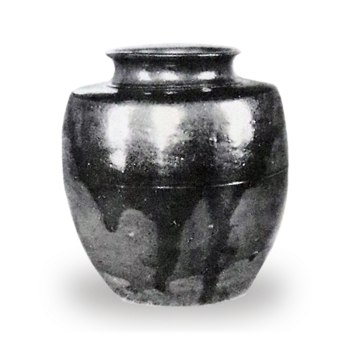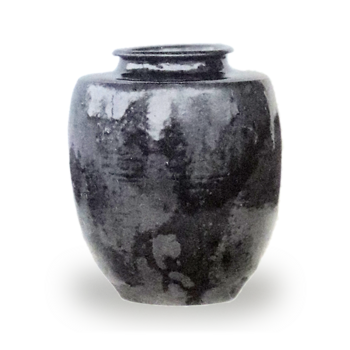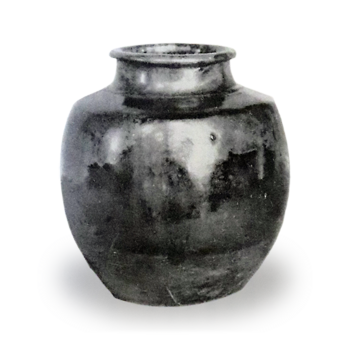
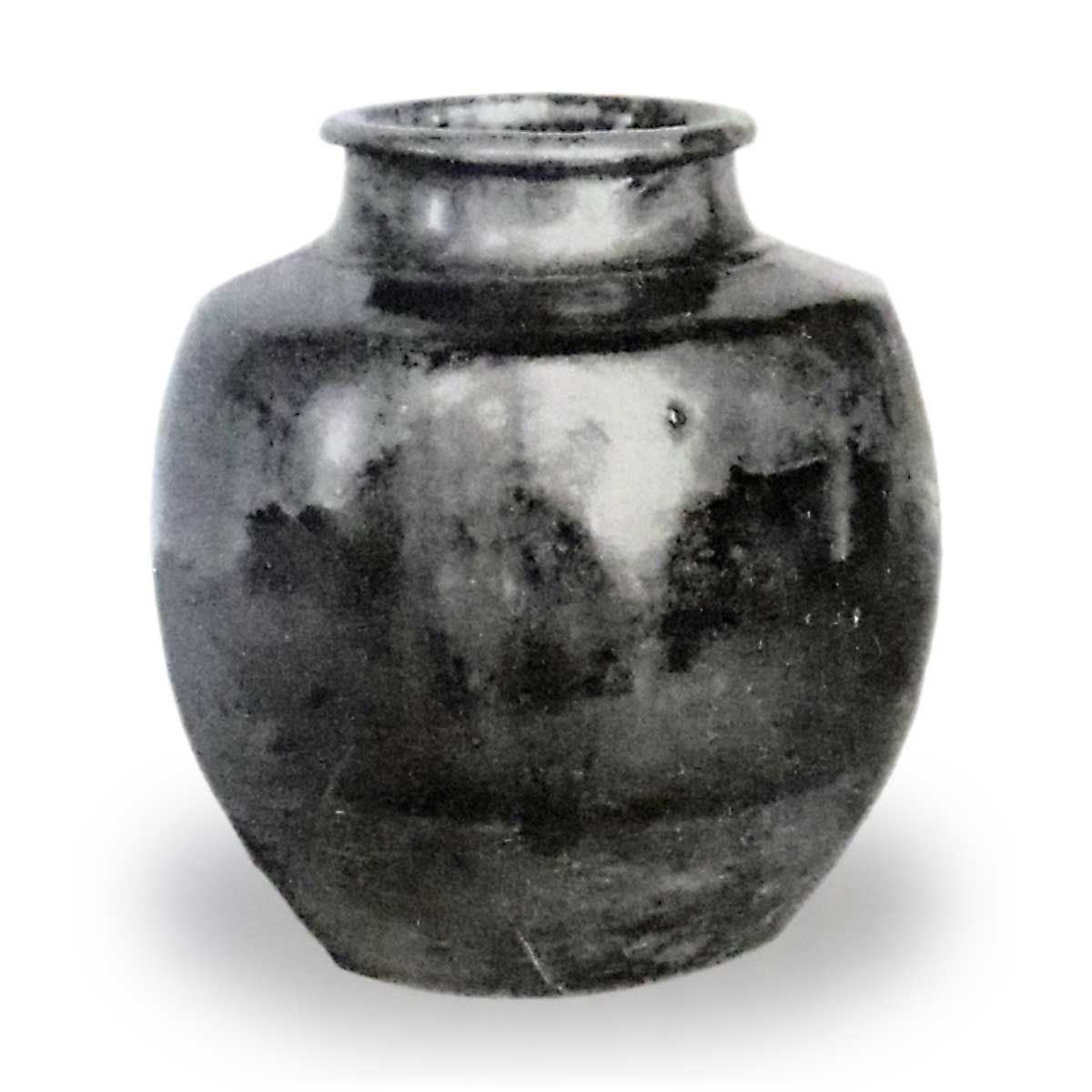
Chinese-made (manufactured in China) Daimeibutsu: Owned by Marquis Tokugawa Kuniyuki
[Name]
This name likely derives from the name of its original owner. Although *Shokameiki* states that it was “owned by Nitta, Lieutenant General of the Left,” there is no clear evidence to support this. Furthermore, *Shinsho Taikoki* contains the following entry:
“Among the possessions of His Excellency Kanpaku Hideyoshi is an item known as the ‘Nitta Katatsuki.’ Furthermore, an item known as the ‘Shiki Katatsuki,’ which was once owned by Sōyuki of Sakai in Izumi Province, later became part of Lord Hideyoshi’s collection. Regarding the ‘Nitta Katatsuki,’ it should originally have been written as ‘Sanada Katatsuki,’ but the scribe mistakenly wrote ‘Nitta’ instead. This ‘Nitta’ refers to a tea caddy fired by a man named Kato Shirozaemon-no-jo, a resident of Seto in Owari Province, who inherited the tea caddies and pots brought back from China by Zen Master Eisai from Priest Myoe of Togano. This is commonly known as ‘Kuchihage.’ At that time, there were no secret techniques for firing, and because the pieces were fired with the rim facing down, there were areas where the glaze did not cover the rim. Furthermore, the shape was not well-formed. However, Shirozaemon-no-jo traveled to Song China in the company of Zen Master Dogen, where he learned the proper sequence of firing and the technique of creating a clay sheath for all pottery pieces and firing them with the bottom facing down. Upon returning home and applying these methods, the glaze melted well, the clay settled properly, and the pieces turned out magnificently. This is what is known as “Sanada.” Fujishiro (Kato Shirozaemon-no-jo) continued the tradition for four generations. Since he traveled to Song on the same ship as Zen Master Dogen during the Kenryaku era (1211–1213), this spans a period of over 340 years until Tensho 13 (1585). However, there is a tea caddy bearing an inscription on its shoulder dated October 3, 1339 (Reiō 2), which reads, “Made by Fujishirō; I hereby certify this.” Since there is a gap of roughly 100 years between the Reiō and Kenryaku eras, we should infer the period based on this.”
The interpretation of “Sanada” in the *Shinsho Taikoki* is a kind of alternative theory, but it is by no means convincing. The Imperial Household Agency’s *Tenno 13th Year Tea Ceremony* and *Tsuda Sōyuki’s Tea Ceremony Diary* clearly record “Nitsuta,” and the lid of the *Hikiya* (the container for the tea caddy) also bears the inscription “Nitsuta.” The *Uno Mononobe-ki* spells it “Nita,” and the list of tea utensils in Taiko (Hideyoshi)’s own handwriting, held by Viscount Motoyuki Mōri, reads “Nintakatsuki” in kana. Therefore, it should be referred to as “Ninta,” but it should not be read as “Shinden.” Furthermore, since both “Nita” and “Nitta” appear in the *Manpō Zenshū*, there is no doubt that it refers to “Nitta.” It is only regrettable that the identity of this person (Nitta) remains unknown. This tea caddy has long been known by the name “Tenka-ichi.” The references to “Katatsuki Tenka-ichi” found throughout the *Rikyu Hyakueki* refer specifically to this Nitta Katatsuki. The book *Rikyu Hyakueki* states, “Katatsuki Tenka-ichi; in older texts, Nitta Katatsuki; it is in the possession of the Kanpaku (Hideyoshi).”
[Dimensions]
Height: approx. 8.5 cm
(2 sun 8 bu)
Body diameter: Just over 7.6 cm (just over 2 sun 5 bu)
Circumference: Approx. 24.5 cm (8 sun 1 bu)
Mouth diameter: Approx. 4.5 cm (1 sun 5 bu)
Base diameter: Approx. 4.5 cm (1 sun 5 bu)
Height of the neck (koshi): Just under 1.5 cm (just under 5 bu)
Shoulder width: approx. 1.1 cm (3 bu 5 rin)
Weight: approx. 120 g (32 monme)
[Accessories]
One lid: ivory (1 piece); the underside is soot-stained from fire
One storage pouch: navy blue ground with Kinran small peony and diamond pattern; lining is umeki (a type of silk fabric); cord is Enshu purple
One set of pouches: 2 pieces
Brown ground with sword-tip plum blossom pattern, Donshu silk. Lining: iridescent silk. Cord: navy blue
Tiered weave, Donshu silk. Lining: white silk. Cord: purple
Pouch box: Paulownia wood. Inscription written along the grain of the wood
Nitta Katatsuki tea caddy replacement pouch. Inscription in ink
One storage tube (for holding the tea caddy): Black lacquer
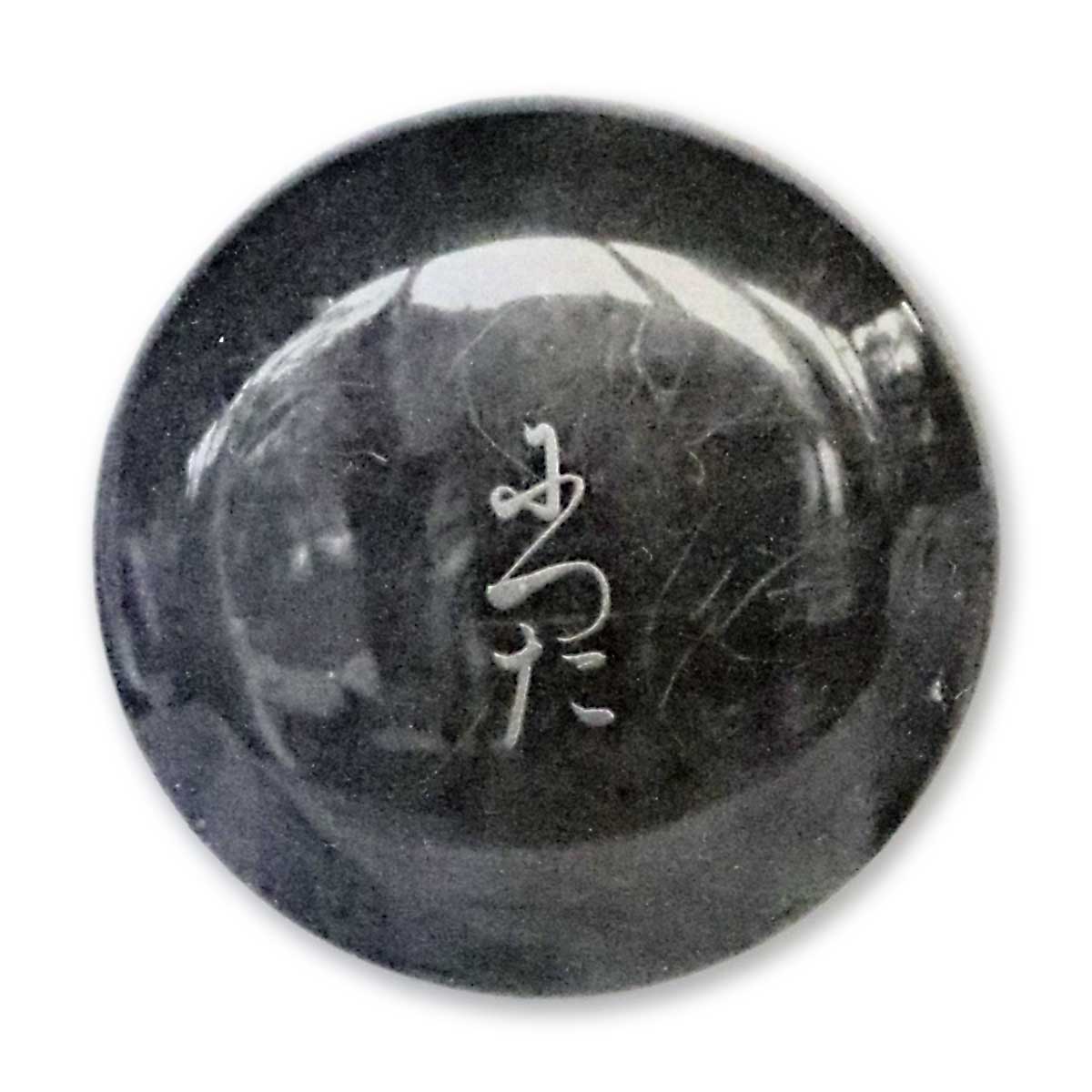
“Nitsuta” written in gold powder. Author unknown.
Contents: White ha-ni-ju cotton-padded cushion, cord is white
Outer box: Paulownia wood, natural finish
“Nitta Katatsuki” written in ink. Author unknown.
[Miscellaneous Notes (Descriptions of the Nitta Katatsuki in historical records)]
Nitta Katatsuki: Once owned by Murata Jukō. This teapot is the finest of its kind in the land and is in the possession of the Kanpaku (Hideyoshi). Along with Hatsuhana and Narashiba, it is one of the three most famous Meibutsu in the land. It was passed from the Governor of Bungo (Ōtomo Sōrin) to the Kanpaku. It is said that two types—one resembling the Nitta Katatsuki and one shaped like an eggplant—were sold for 10,000 kan. (Recorded by Yamagami Sōji)
Nitta Katatsuki (Katatsuki): Currently in the possession of the Kanpaku. It was once owned by Jukō. This jar is the finest of its kind in the land. (Collection of Meibutsu)
Nitta Katatsuki: Located in the Western Provinces. Owned by Ōtomo Sōrin. (Tenshō Meibuki)
Katatsuki Nitta: Owned by Ōtomo Sōrin. (Otomo Kōhai-ki)
Nita: Also written as “Nitta.” Owned by Otomo. Height approx. 8.5 cm, width slightly over 7.6 cm, circumference approx. 24.5 cm. Base diameter approx. 4.5 cm, mouth diameter approx. 4.5 cm, neck height slightly under 1.5 cm, body height approx. 3.9 cm. There is an illustration of the tea caddy. (Manpō Zensho)
Nitta Karamono: Daimeibutsu. Owned by the Lord of Mito. (Kokin Meibutsu Ruiju)
Nitta: Made in China. It is from the same period as the Sekitaka Fudō, Gyokudō, and Tanamura. Furthermore, it has the same construction and glaze application as the Sekitaka Fudō. The Hirano-yama-i and Ikoma from Seto also have the same glaze application. (From *The Origins of Seto Pottery* by Matsudaira Fumai)
Nitta: It was destroyed by fire. It appears in Lord Mito’s illustrated catalogue. (Rinbōkiryū)
Nitta: It bears an inscription stating “Lord Mito.” It was once owned by Jukō. It was part of Lord Hideyoshi’s collection. Some pieces are inscribed as “The Finest Katatsuki in the Land.” The inscription also notes that it passed from the Ōtomo family to Lord Hideyori. (From the Hōan Bunko edition *Kanka Meibutsu Ki*)
Nitta Katatsuki: Owned by Mito. A famous Meibutsu once owned by Jukō, considered the finest in the land. Owned by Miyoshi Sōsan. Owned by the Ōtomo clan of Kyushu. Owned by Lord Hideyori, or possibly by Sōsan. (Komeibutsu Ki)
Nitta Katatsuki: It is said that this tea caddy was damaged in a fire at Osaka Castle and restored by Fujishige (a lacquer artisan).
It was presented as a gift and became a possession of the Shogun’s family at Edo Castle. It was also bestowed upon the Lord of Mito. Nitta, Hatsuhana, and Narashiba are the Three Meibutsu. Utensils of the Shogun’s family. (Sekkan-sō: A Guide to the Mysteries of the Tea Ceremony)
Nitta Katatsuki: Owned by Nitta Sadanaka, it was subsequently passed to the Oda family, Toyotomi Hideyoshi, and then bestowed upon Lord Tokugawa Ieyasu.
It became part of the Mito family’s collection. It was a personal possession of Lord Toyotomi Hideyoshi, and it is said that Sen no Rikyū (Sōeki) used this katatsuki to prepare tea when it was presented to Emperor Ōgimachi. Later, it is said that Hideyoshi himself used this tea caddy to prepare tea during the Kitano Daichajō, an event attended by Lord Tokugawa Ieyasu. Height: approx. 8.6 cm, body diameter: approx. 7.9 cm, mouth diameter approx. 4.5 cm, base diameter approx. 4.5 cm, shoulder width approx. 1.2 cm, height from mouth to shoulder edge approx. 1.2 cm. An illustration of the tea caddy is included. (Collection of Famous Tea Utensils from Various Families)
April 17, 1550 (Tenshō 19), at the hour of the Horse (around noon)
Two men, Ryuki and Sōzon, arrived as messengers from Ōtomo Sōrin.
One: Shoulder-striking “Nitsuta”
The bag is made of Kandou (striped woven fabric) lined with gauze, giving it a certain charm. The cord is crimson.
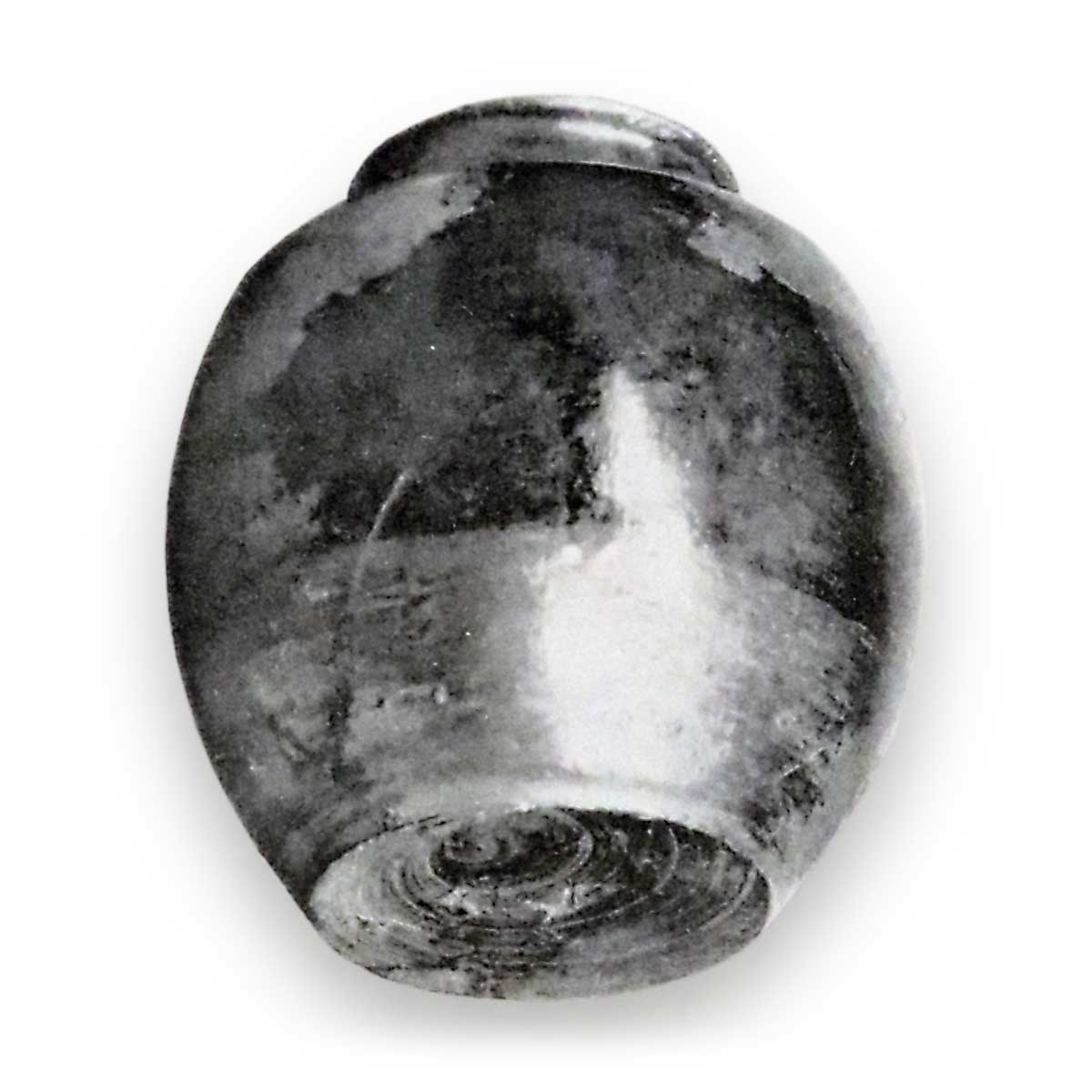
(The appearance of the tea caddy) is as shown on the right: it is clean and simple, with a graceful rise at the neck, giving it a plump and composed feel. The shoulders do not jut out abruptly but are rounded and full. The clay appears thin and white, with a smooth texture yet full of character. The base glaze is a light black with a slight hint of lapis lazuli. It is a truly striking color. The overglaze is on the surface, and from this glaze, two streaks of drips (traces of flowing glaze) run down the front, flowing thickly toward the left side of the jar. The glaze drips off near the shoulder, and vermilion has fired out along the edges of both streaks. The glaze has piled up and stopped there. There are also spots where a little glaze has adhered to the sides. At the tips of the two streaks, there is a certain charm in the slightly mingled glaze. (Tsuda Sōyuki’s Tea Ceremony Diary)
(Omitted) Akechi Samasuke (Mitsuharu/Hidemitsu) rode his horse up the slope and dismounted beneath the solitary pine tree at Karasaki. He let the horse catch its breath while he sat down at the base of the pine. Seeing the enemy pursuing him along the beach, he calmed his mind and rested. When the enemy drew within about five cho (approximately 545 meters), he mounted his horse and galloped straight toward Sakamoto Castle. At the castle’s main gate stood the Enma Hall; there, he dismounted, cut the knot in the reins, tied one end to a ginkgo tree, and the other to the lattice of the hall. He attached a note to a piece of paper he had on hand and wrote with his writing set, “This is the horse that Akechi Samasuke Mitsuharu rode across Lake Biwa.” He himself stormed into Sakamoto Castle, stabbed to death the wife and children of his lord, Akechi Mitsuhide, followed by his own wife and children, and then Samasuke also committed suicide. Finally, he set fire to the main keep.
At that time, he took with him the following Meibutsu—renowned throughout the land and treasured by the shogunal family for generations: the “Sute-ko Tea Jar,” the “Turnip-less Vase,” the “Asayama Hanging Scroll,” the “Fudō Kuniyuki Tachi,” the “Niji Kunitoshi Katana,” the “Karasumaru Incense Burner,” the “Shikihimo Kama,” the “Yagen Tōshirō” (short sword), the “Oto-gozen Kama,” the “Nitta Katatsuki,” and the “Matsubana Vase.”
“Shigi Katatsuki,” “The Greatest Tachi in the Land: Yoshimitsu,” “Two Scrolls of Calligraphy by Kyodo,” “The Wakizashi of Honegui,” “The Tachi of Miyoshi Masamune with Two Inscriptions (Masamune).” These seventeen items had been stored at Sakamoto Castle after the capture of Azuchi Castle. They were wrapped in a karori nightgown and a futon, tied together with several women’s obi sashes, and lowered from the main keep. Then, addressing the attacking forces below, he said, “Although the Akechi clan will be destroyed, I believe it would be the height of cruelty to lose these Meibutsu, so I am handing them over. Please deliver them to the young lords of the Shogun’s family,” he said, handing them over to the attackers. This was widely praised as a stark contrast to the incident where Matsunaga Hisahide smashed the Hiragumo tea kettle (the anecdote of Hisahide’s explosive death alongside the famous Hiragumo during the Battle of Shigisan Castle). At that time, Ninotani (a retainer of Akechi Mitsuhide) had a servant carry a white-dyed haori featuring a blue cloud and dragon design and sent him to Saikyo-ji Temple in Sakamoto, entrusting him with the task of arranging his funeral rites after his death (omitted). (Ninotani Kabuto Origin Document)
(Note) The *Ninotani Kabuto Origin Document* is a scroll held by the Kishu Tokugawa family “Ninotani Helmet” held by the Kishu Tokugawa family.
On this occasion, Hideyoshi requested two items—the “Nita (Nitta Katatsuki)” and the “Nitari (Nitari Nasu)”—from among his many possessions, to be presented to Lord Ōtomo, the governor of Bungo Province. The Nita is a Katatsuki tea caddy, while the Nitaru is an eggplant-shaped tea caddy. They were sent along with 120 kan of silver and a Yasui tea bowl. Two envoys, including Miyaki Nyudo, received these two items in April and returned safely to Osaka Castle. It is also said that the chief envoy was Ankokuji Ekei of the Mōri clan of Aki Province. (Recorded by Uno Mononobe)
On the morning of May 2, Tenshō 13 (1585), His Lordship (Hideyoshi) arrived, and Sōeki (Sen no Rikyū) prepared tea. That same evening, the “Nitarinashu” and “Nitta Katatsuki” arrived from Bungo at Hideyoshi’s residence. He examined them immediately, viewing the two side by side. (Tsuda Sōyuki’s Tea Ceremony Diary)
The “Nitarinashu” was sold by Shōetsu to the Governor of Bungo (Ōtomo Sōrin). The price was 50 kan. Subsequently, the Governor sold both this “Nitarinashu” and the “Nitta Katatsuki” to the Kanpaku (Hideyoshi) for 100 kan. It had previously been owned by Murata Jukō.
It is a peerless treasure. It is now in the possession of the Kanpaku (Hideyoshi). (Record of Tea Transmission)
Sen no Rikyū’s Tea Ceremony at the Small Palace within the Imperial Court
Shōō Nasu (Tea Caddy) in a Kinran pouch; Shiro Tenmoku (Tea Bowl); Numbered Stand
In the tokonoma: Gyokkan’s “Bell Painting”; on the daiko:
Tea caddies: “Nitta” and “Hatsuhana”
A water jar with a rimmed bucket, a ladle holder with a walnut-shaped mouth, a water spout, a metal kanji (perhaps fire tongs?), a small arare-style kettle, and a furo with milk-shaped legs. The lid rest is metal; in front of it a “Sorori” flower vase with chrysanthemums. A large white yam-shaped water jar, a metal ladle holder, a turtle-shaped lid, a water spout, a kettle with a cord, and a lid rest shaped like a trivet. On a separate tatami mat to the side, a 40-koku leaf tea caddy with a lid cover of navy-ground Kinran and a red cord. A “Shokka” teapot, with a spout cover of white Kinran and a light blue cord.
Tea was served to all the daimyo.
(Tenshō 13) October 7th, Sōeki (Rikyū)’s seal
I have written down the details of the tea served at the imperial court and sent them to Priest Haruya. It would be best for you to review them there.
End
To Priest Kokei (Ministry of the Imperial Household Edition, *Tea Ceremony of Tenshō 13*)
January 3, Tenshō 15 (1587), Year of the Rooster: Regarding the Grand Tea Ceremony at Osaka Castle. When I went to the castle around 4:00 a.m. on January 3, Sōyū greeted me at the gate, and I met Sōeki (Rikyū) for the first time. The sight of daimyo and lesser lords arriving on foot or by carriage was truly spectacular. (Omitted) Once permission was granted, I was observing the proceedings alongside everyone else in the presence of the Kanpaku (Hideyoshi). He asked, “Which one is the monk from Chikuzen?” (referring to Kamiya Sōtan), to which Sōyuki replied, “This is him.” The Kanpaku then said, “Have the others step aside; let only the monk from Chikuzen be clearly seen.” (Omitted) “Give that monk from Tsukushi a generous serving of tea from the ‘Forty-Koku’ [a Meibutsu tea caddy],” he commanded, so Sōeki stepped forward and served him a bowl. It was a well-bowl, wide and spacious. “Show him the Nitta Katatsuki as well,” he instructed, and Sōtan was the only one permitted to view it. (Sōtan’s Diary)
Display
First Tier: Eggplant-shaped tea caddy, white tenmoku, charcoal scoop, gourd-shaped vessel, well-style tea bowl, tenmoku with thin, curly hair-like glaze
Second Tier: Tea caddy, tenmoku on a stand, ladle holder, small box, brazier kettle, lid rest, rimmed bucket, two well-style tea bowls stacked—Sōmu served. Matsumoto eggplant on a tray with a red interior.
Also, a bamboo tea scoop and a Shudoku (possibly his work).
First stand: A kettle with a cord, a water jar shaped like a taro root, an Amago tenmoku, a Bizen-yaki tea scoop holder, and a turtle-shaped lid for the water container. The lid rest is a godoku. A lacquered tenmoku with a tea whisk inside. A charcoal container and a gourd. Sōyū is at the front.
A Nitta katatsuki on a square tray. Sōeki (Rikyu)
An interesting katatsuki on a square tray. Sōmu
One: The front third of the daishi
A Hatsuhana katatsuki on a square tray. Sōyuki
The Nitta piece does not have particularly broad shoulders; it is rather plump. There are two glaze drips on the front, and some on the back as well. The glaze is peeling, and there are no visible band-like marks on the footring; the bottom is thread-cut. There are two or three small stones; the clay has a bluish tint and is whitish toward the top, looking as if it had just been washed. There are two ridges at the base of the rim, one of which is below the constriction. The neck rises steeply. (Sōtan’s Diary)
This refers to a tea gathering held on the morning of February 25, Tenshō 15, in the Yamazato tea room at Osaka Castle.
Lord Yamaoka of Tsushima and Sōtan
(Omitted) The room was two tatami mats in size, with a tokonoma alcove measuring four shaku and five sun (approx. 1.36 m). A calendar was hung on the wall, and there was a hearth in the left corner, with a dōkago basket beside it. A flat kettle with a rounded rim stood there, and a hanging scroll titled “Evening Bell” was displayed in the tokonoma. When the two men entered, the Kanpaku (Hideyoshi) soon appeared and said, “Look closely,” speaking while remaining standing. Soon, refreshments were served, but the attendant was a page boy of about 15 or 16 years of age. He was made to roll up the hanging scroll in the hand-washing room, remove the bag (of Nitta Katatsuki) (continued on the next page)
, and place it on the four-sided tray, and so on. (Sōtan’s Diary)
October 1, Tenshō 15 (1587) — Kitano Grand Tea Ceremony
Catalog of Lord Hideyoshi’s Tea Utensils
1. Calligraphy by Kyūdō 1. Kaburanashi flower vase
1. Painting of a bell 1. Eggplant-shaped tea caddy
1. Shōō Tenmoku 1. Shōō Eggplant
One: White Tenmoku; One: Shiga tea caddy
One: Nitta Katatsuki; One: White-glazed square tray
(Items other than the tea caddy and tea bowls are omitted) (Record of the Kitano Tea Gathering)
October 14, 1587 (Tenshō 15), Noon: Regarding the tea gathering of the Kanpaku (Hideyoshi) at Jurakudai
Sōyū and Sōtan
(Omitted) His Excellency called out from the back entrance, “Shall we have a meal?” I replied that it would be a great honor. A kettle with a rope handle was placed on a trivet in the corner of the hearth, and a clay water jar was in a carrying basket. A Nitta Katatsuki was placed on a square tray, and so on. The Nitta ware had two ridges at the base of the rim and one mark from the band; the glaze was amber-colored, and the drips were black. There was a single high ridge at the base of the lid’s knob, and the top of the knob was flat. (Sōtan’s Diary)
Morning of November 20, Tenshō 15
4.5-mat room: Hariya Sōwa, Ise Ritsuami
A square kettle and a water jar from Shin-Seto. Inside were wasabi, carp salad, and a soup with flat mushrooms.
A Kimori tea bowl and the Tenka-ichi Katatsuki (Nitta Katatsuki).
A leather box and rice.
A large jujube was placed in a tea caddy and set in the tokonoma.
Later, a square tray was brought out. Sweets: baked wheat gluten, tofu skin (tofu skin).
Seto water jug.
Shakuhachi chrysanthemum vase.
Regarding the Katatsuki Tenkaichi, old texts state, “The Sen Nitta Katatsuki is at the Kanpaku’s residence; it is the Tenkaichi that Juko once possessed.” It appears to have been in Sen no Rikyu’s possession around this time. (Rikyu Hyakukai Kai)
The morning of November 17, Tenshō 20 (1592; Bunroku 1) at Nagoya
A tea gathering hosted by the Taikō (Hideyoshi). It was the opening ceremony (kaki-otoshi) of the mountain retreat’s tea room.
The attendees on this occasion were Matsuura Dōka, Lord Ikeda of Bitchū, Sōtan, Hori Kanemono, and Funakoshi Gozaemon—five people in total. (Excerpt)
In the corner hearth, a large “Jūshi” jar was placed behind the charcoal with a cover over it. In the tea caddy, a Nitta Katatsuki was set on a square tray; tea utensils were arranged in a lacquered Tenmoku bowl, with a clay water jar and a lid below. The lid rest (for the water jar?) was made of copper. The tea room was named Kyūmu.
Regarding the Katatsuki (Nitta). On the front, there are two cascading patterns, one long and one short. On the sides, there are two more resembling cascades, and at the back, a slightly angular cascade. The base is thread-cut; the clay is reddish, while the exterior is blackish and appears bleached. It has a rugged appearance (illustration included). The thread-cut pattern extends toward the rim. (Sōtan’s Diary)
November 14, Tenshō 20: Tea Ceremony—Regarding the Decorations
Tea was served to the daimyō at the mountain retreat in Nagoya. From November 14 through the 17th
In the tokonoma hung a scroll of “Evening Bell”; in front of it, a small eggplant-shaped tea caddy (chakin) was placed on a square tray, etc.
November 15, same year: Tea Ceremony: Arrangements
In the tokonoma, a hanging scroll titled “Morning Mountain”; in front of it, a small eggplant-shaped tea caddy placed on a square tray, etc.
Morning of November 16, same year: Tea Ceremony: Arrangements
In the tokonoma, a hanging scroll titled “Falling Geese”; in front of it, a “First Flowers” shoulder-rest vase placed on a tray, etc.
November 17, Morning: Tea Ceremony – Arrangements
A hanging scroll titled “Yoru-ame” in the tokonoma; in front of it, flowers arranged in a solori vase placed on a thin board; in the corner hearth, a “Sute-ko” teapot with a Kinran cover and a red cord. Beyond the corner, the “Oto-gozen” kettle. A Nitta katatsuki placed on a square tray, etc.
The above describes the decorations in the mountain tea room from the 14th to the 17th. (Sōtan’s Diary)
Two envoys from Ming China (Chief Envoy Xie Yongzi and Deputy Envoy Xu Yiguan), along with their interpreter Su Xitang, were served tea in the Yamazato tea room on the morning of June 10, Bunroku 3 (1594), as had been agreed upon aboard the ship. The roji featured various medicinal herb gardens, and the village at the foot of the mountain was naturally charming, with trees stretching their branches, and the stream trickling down the rocks looked very refreshing. True to its name, “Mountain Village,” its charm was endless.
The arrangement of the four-and-a-half-mat tea room
1. “Returning Sails” by Gyokkan 1. A flower vase with a narrow mouth
1. A Nitta katatsuki
Items on the Shelf
1. An eggplant-shaped tea caddy, placed on a red tray 1. A tenmoku bowl
1. A kettle and a water jar with a rimmed bucket
1. Water spout, kanji (fire tongs?) 1. Ivory tea scoop
Since Hideyoshi himself served the tea, everyone was so awestruck they could not utter a word. And since he personally prepared the tea for us, his demeanor—though deeply humbled by such hospitality—did not seem that of a foreigner, but rather that of a man who understood the refined tastes of the present age; there was absolutely nothing to criticize. (Shosho Taikoki)
While Lord Hideyoshi was stationed at Nagoya in Hizen, a tea ceremony was held on June 10 in a tea house in the mountain village to entertain the chief envoy and deputy envoy from Ming China. This garden was designed by Ishida Mitsunari (Master Carpenter), making use of the dense, ancient pine trees that grew there. However, it is said that the reed path leading from the main castle to the mountain village was constructed by Teranishi Chikugo-no-kami.
Decorations
1. Gyokkan’s “Painting of Returning Sails” 1. Narrow-mouthed flower vase
1. Nitta Katatsuki
Shelf
1. Eggplant-shaped tea caddy, placed on a red tray 1. Tai Tenmoku
1. Kettle, water spout, and small bowl
1. Water jar with a handle 1. Ivory tea scoop
Decorations in the Five-Colored Chain Room
One: Gyokkan’s “Painting of a Dead Tree” One: Flower vase without a base
One: Fuji incense burner One: Katatsuki (headscarf-style)
Decorations in the Kitchen Room
One: Kōhimo kettle One: Taro-shaped water jug
One: Rounded-bottom tea caddy One: Well-style tea bowl
In this room, Tomoami performed the tea ceremony and served tea to the various daimyo. It is said that the list of these tea utensils was not written by an expert, so it is not entirely reliable. (Secret Records of Tea Ceremonies)
Morning of February 24, 1597 (Keichō 2, Year of the Rooster) — The Taikō (Hideyoshi)’s Tea Gathering at Osaka Castle
The room was a five-mat space; in the tokonoma hung a hanging scroll titled “Evening Bell” (omitted). On the pillar opposite, pale-colored flowers were arranged in a celadon vase; the four-sun hearth had a fine rim; on the shelf, a Nitta was placed on a square tray, and so on. Those granted tea this morning were Sōtan, Sōnin, and Dōtetsu, who were in attendance, and Aoki Hōin, who joined at Hideyoshi’s request, making a total of four. When we arrived as dawn was breaking, he opened one of the sliding doors at the entrance to the veranda of the tea room, and while standing, commanded, “Crawl in,” and had the upper sash window opened (continued on the next page). (Omitted) The thin tea was prepared by Tomoami. A colored paper scroll by Teika was hung in the alcove of the four-and-a-half-mat room, and so on. Regarding the Okatamashi (Nitta), the details of the Nitta style are recorded in detail. (Sōtan’s Diary)
It was decided that the Taiko (Hideyoshi) would cede Osaka Castle to Lord Hideyori and build a castle in Fushimi. Large stones were hauled from the depths of Daigo, Yamashina, Mount Hiei, and Kumogazaka to construct high stone walls; turrets and gates were erected; and many trees were planted, and soon the castle was completed. Its magnificence was beyond words. After moving here, he deeply studied the teachings of Furuichi Harima-no-kami, the disciples of Murata Jukō (Jusō and Jugo), the etiquette of Takeno Jōō, and the tea ceremonies of Sen no Rikyū and Kitakō Dōchin. In the mountain village, he built a four-and-a-half-mat tea room using agarwood. The rim of the hearth was made of agarwood, and when heated by charcoal, a wonderful fragrance wafted in all directions. He arranged various items such as a hanging scroll of “Night Rain” by Gyokkan, a flower vase without a stem, a kettle with a twisted cord, and a water jar from Kiyomizu, or alternatively, a hanging scroll of Kyodo and Taien, a narrow-mouthed flower vase, a kettle with small hail-like patterns, a Nitta Katatsuki, and a water jar with a rimmed bucket, and served tea to military commanders of all ranks with these diverse decorations. Looking out from the tea room, the swift currents of the Uji River flow, the thatched roofs of Uji’s village homes lined the horizon, with Byōdō-in, Makino Island, and Yamabuki Rapids visible in the distance. To the southeast, a range of mountains stretched out, with verdant peaks towering overhead, pine and cypress trees hanging their branches, and the buildings of Daigo-ji temple standing in rows; the sound of evening temple bells in the distance purified the soul. Following those peaks are high mountains and passes such as Kisen-ga-take and Mimurodo; ancient pines hang their branches, the wind sounds like the notes of a koto, and the cries of monkeys crossing the night are deeply melancholic. At the foot of the mountains lies the Kannon-do, a pilgrimage site. To the west, from Hachiman-yama, Saki, Kitsune-gawa, Yodo, and from Hitokuchi to Eguchi, Hashimoto, and Hirakata, the river flows long and leisurely; the view at dusk of boats traveling up and down the river is truly exceptional. To the north, the city of Kyoto extends, with tall houses surrounding it in layers, along with estates large and small. Since the river flows alongside the town, boat traffic is frequent, making it truly the finest castle. (Supplement to the Record of the Conquest of Korea)
According to *Meiki-yori*, on May 28, 1615 (Genna 1), Fujishige, Fujimoto, and Fujitsune—a father and his two sons—were summoned to Nijō Castle and ordered, “There must be some Meibutsu tea caddies that survived the fire among the ruins. Go there and search thoroughly.” They traveled downriver by boat at night and dug through the dirt and ashes day and night without rest, and indeed, they discovered five Meibutsu tea caddies. They first performed temporary repairs and brought them to Kyoto on June 12. The tea caddies were the Nitta Katatsuki, Shiki Katatsuki, Tamakaki Bunrin, Ko-Katatsuki, and Ōjiri-bari. As a reward, they were granted a stipend for 120 people. (Shinsho Taikoki)
On May 7, 1615 (Genna 1, Year of the Wooden Rabbit), after the fall of Osaka Castle, Fujishige, Fujimoto, and Fujitsune—father and sons—were summoned from Nijo Castle on May 28 of the same month. Honda Uezono-no-suke (Masazumi), acting as magistrate, conveyed the following imperial decree: “There must be numerous famous Meibutsu, such as those secretly treasured by Lord Hideyori. If, by any chance, even a single item has survived the fire, it would be greatly valued. Fujitsune hurried to the ruins of Osaka Castle with the imperial decree: ‘Even if the utensils are shattered into pieces, search thoroughly to gather them all and ensure they are not lost.’ He was ordered, ‘Hurry to Osaka and search carefully around the large storehouse where the Meibutsu tea caddies are likely to be found.’” That same night, he set sail for Osaka and spent several days digging through the dirt and ashes day and night. Sure enough, he quickly found the famous Meibutsu tea caddies and other broken items. He performed temporary repairs on them first and brought them to Kyoto on June 12. The tea caddies were:
1. Nitta Katatsuki 1. Maki (Shiki) Katatsuki
1. Tamakaki (Kaki) Bunrin 1. Ko-katatsuki
1. Ōjiri-hari
I brought these five Daimeibutsu to Nijo Castle and presented them through Lord Honda Uezono. When Lord Ieyasu saw them, he praised them highly. He immediately summoned Fujimoto and Fujigen to his immediate presence and granted them an audience. He then declared, “It is unprecedented that such Meibutsu have been discovered in such a miraculous and wondrous manner,” and, in high spirits, dismissed us. We were immediately informed by Lord Honda Uezuke, acting as our representative, that we had been granted 100 koku of rice and stipends for 20 retainers as a reward. This is truly an honor for our family and a happiness beyond compare. (Scroll attached to the “Mogana” in the Iwasaki Family Collection)
On August 18, 1635 (the Year of the Boar), in the Yamazato (tea room) of the Ninomaru of Edo Castle, I served tea to His Lordship of Mito.
Attendees: Lord Hosokawa Etchū-no-kami, Lord Mōri Kai-no-kami, Lord Tachibana Hida-no-kami
Tea Ceremony Utensils
One hanging scroll: Calligraphy by Fujiwara no Teika (Amabuki style), by Gosei
One flower vase: Celadon
One tea caddy: Nitta
One tea bowl: Zeze-yaki
Various other room decorations (Memorandum by Honkin Sōgi, Yamamoto Hōdō)
[Provenance]
It is said to have originally been owned by Murata Jukō and passed down to Miyoshi Sōsan. The entry for April 17, Tenbun 19 (1550) in the *Tsuda Sōyuki Chayū Nikki* does not name the host of the tea gathering but merely records that this tea caddy was actually seen; it is presumed that this was likely a tea gathering hosted by Sōsan. It was subsequently passed down to Oda Nobunaga. However, following the Incident at Honnō-ji in Tenshō 10 (1582), it was temporarily moved from Azuchi Castle to Sakamoto Castle by Akechi forces. Although it should have been handed over to the attacking forces along with other famous tea utensils by Akechi Mitsuharu (Samasuke), for some reason this tea caddy did not fall into Hideyoshi’s hands and subsequently became the property of Ōtomo Sōrin of Bungo. Consequently, in April of Tenshō 13 (1585), Hideyoshi requested it from Sōrin, dispatching Ankokuji Ekei and Miyaki Nyūdō to Bungo. They brought it back to Osaka on the evening of May 1, whereupon Hideyoshi was said to have been overjoyed and presented Sōrin with 100 kan (or, according to some accounts, 120 kan) in payment, along with a “Nitarinashu” (a type of eggplant). After becoming one of Hideyoshi’s treasures in this manner, there are numerous records of this tea caddy being used. First, on October 7, 1585, in the presence of Emperor Ōgimachi, Sen no Rikyū prepared tea using this tea caddy and the “Hatsuhana Katatsuki.” He also used it at the grand tea ceremony at Osaka Castle on January 3, 1587; the tea gathering at Osaka Yamazato on February 25 of the same year; the grand tea gathering at Kitano on October 1; and the tea gathering at Jurakudai on October 14. On November 20 of the same year, Rikyu presented this tea caddy at the “Rikyu Hyakukai” (Rikyu’s 100th Tea Gathering); it is likely that Rikyu had asked Hideyoshi to borrow it. If so, on November 17, Tenshō 20 (1592), while stationed at Nagoya in Hizen Province, Hideyoshi used this tea caddy to entertain various daimyō. On June 10, Bunroku 3 (1594), he also used this tea caddy to entertain the two Ming envoys, Xie Yongzi and Xu Yiguan. Furthermore, considering that he used it for the tea ceremony at Osaka Castle on February 24, 1597 (Keichō 2), as well as for the tea ceremony held the following year upon the completion of Fushimi Castle, it is clear just how much Hideyoshi cherished and valued this tea caddy. In May of Genna 1 (1615), after the fall of Osaka Castle, Fujishige, Fujimoto, and Fujigen—a father and two sons—were commissioned by Tokugawa Ieyasu to retrieve several Meibutsu tea caddies from the burnt ruins within the castle. This tea caddy was among them, Fujishige restored it using lacquer, and when he presented it to Ieyasu for his inspection in Kyoto on June 12, he was rewarded with 100 koku of rice and a stipend for 20 retainers. Subsequently, Lord Tokugawa Yorifusa of Mito received it as a gift, and on August 18, 1635 (Kanei 12), he used it at a tea ceremony held at his residence; it has been passed down through the generations to the present day.
[Firsthand Account]
On September 2, 1918, I viewed the actual item at the residence of Marquis Tokugawa Kuniyuki in Komegicho, Honjo Ward, Tokyo.
It is of Chinese manufacture and dates from the same period as pieces such as “Hatsuhana,” “Aburaya,” and “Gyokudo,” but the neck (kama) is slightly longer, and the rounded shape around the shoulders gives it a slightly different character from those pieces. A sunken groove runs all the way around the base of the neck, and the rim is shaped with a clam-shell edge , and the entire piece has a lustrous, pale yellowish-gray glaze. This tea caddy was salvaged from the ashes by Fujishige and Fujimoto, father and son, after the fall of Osaka Castle. Although one side of the body was severely damaged, they restored it with lacquer; the area where it was placed shows faint traces of the melted glaze. Furthermore, since some parts were pieced back together with lacquer after being shattered into pieces, it is about 5 monme (approximately 19g) lighter than other tea caddies of the same type; this is likely due to the difference in specific gravity between the original clay and the lacquer. However, the lower section down to the base remains in its original form, made of grayish-brown clay. While tea caddies of this type are typically made using the “ita-oki” method (cutting from a slab), this particular piece was crafted using the “hon-ito-kiri” method (cutting with a thread). Furthermore, the interior bears traces of the potter’s wheel, forming a spiral pattern that converges at the center of the base. With its superb form and elegant refinement, it is by no means a coincidence that this piece has long been counted among the most renowned Meibutsu of ancient Chinese origin.