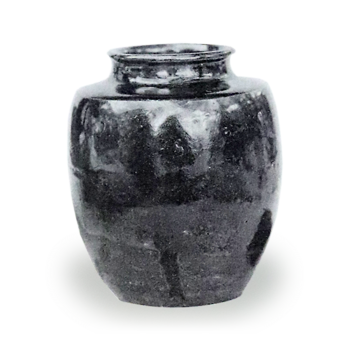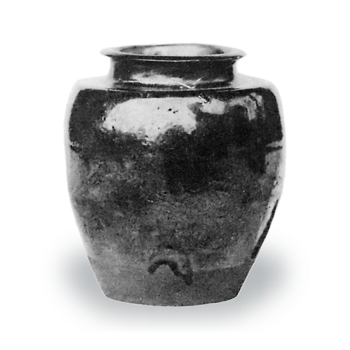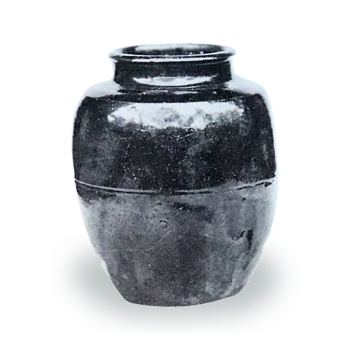
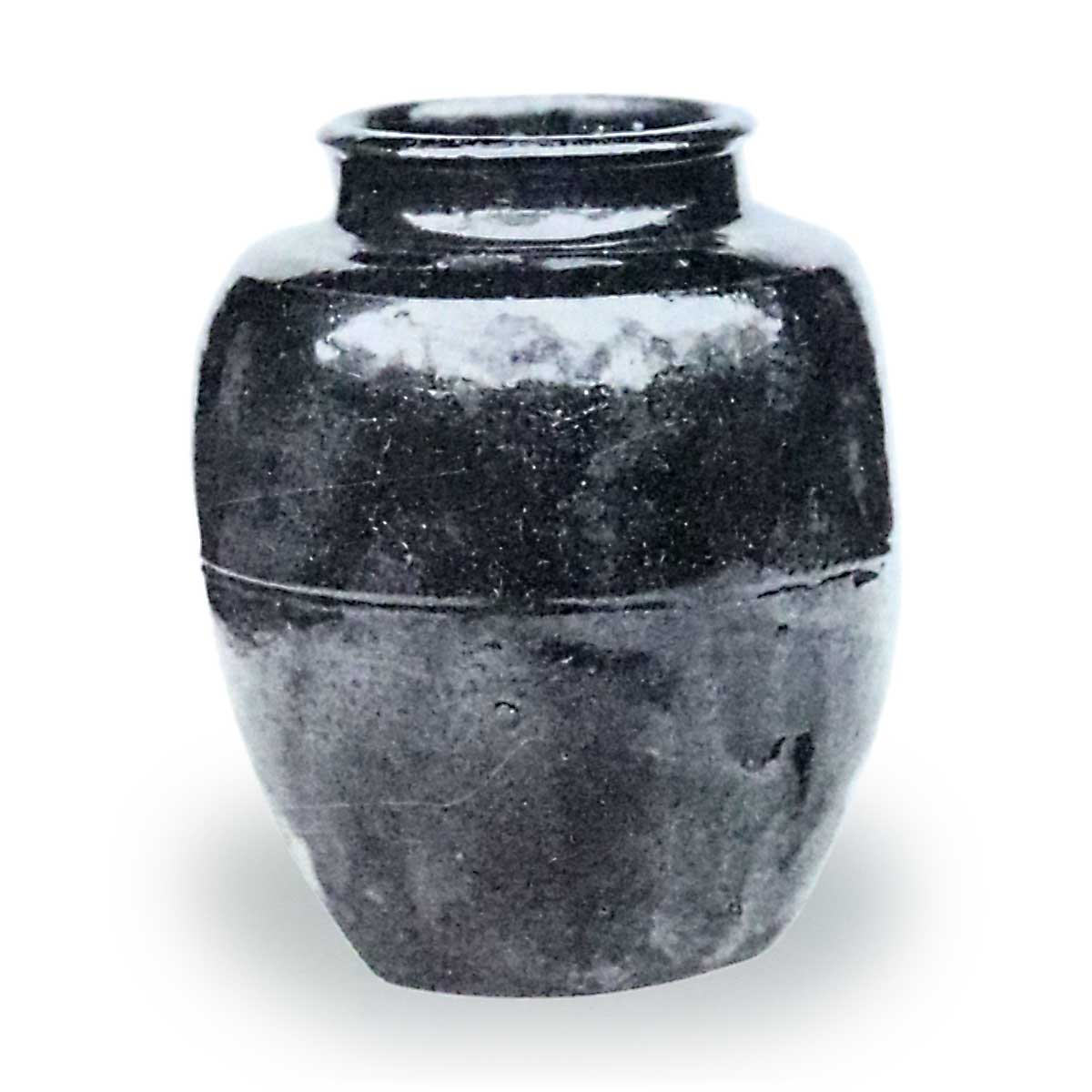
Made in China (Han-style) | Daimeibutsu | Owned by Count Naotada Ii
Name
According to the *Kobunbuki* (Record of Ancient Antiques), this was previously owned by Miyō no Tairō; thus, the name likely refers to the owner, though the details of its provenance are unknown.
Dimensions
Height: 2 sun 9 bu
Body diameter: 2 sun 4 bu 5 rin
Mouth diameter: 1 sun 4 bu
Base diameter: 1 sun 3 bu 2 rin, or 1 sun 4 bu
Lid height: 3 bu 5 rin
Weight: 40 monme 2 bu
Accessories
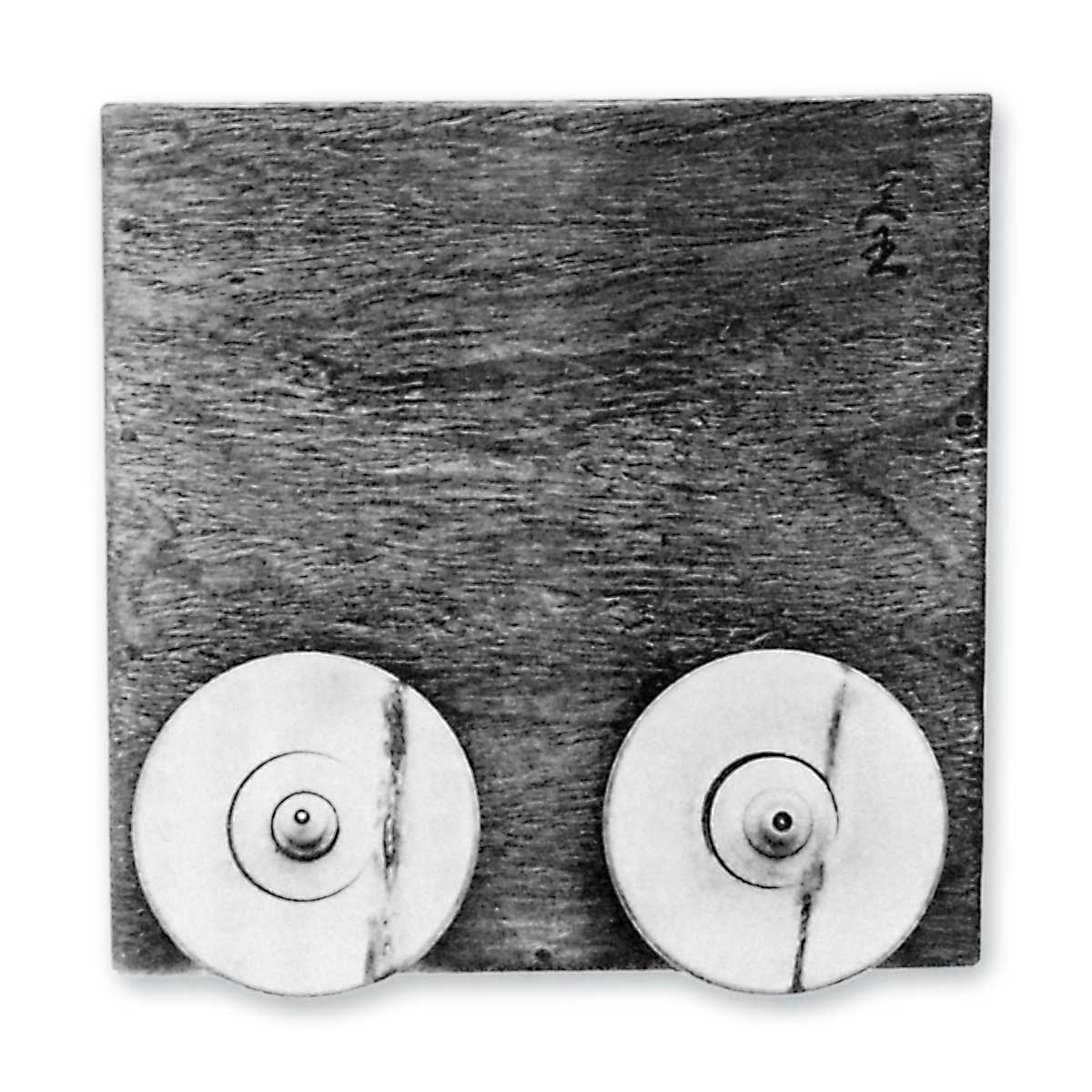
1. Two lids (with hole patterns). They fit into the inner tray of the pouch box.
1. Three pouches (covers)
Light green ground with cloud-and-crane damask (Donshu). Lining is chatsure; cords and fasteners (strings and knots) are purple
Light yellow ground with blue wave pattern in satin (Donshu). Lining is iridescent silk; cords and fasteners are purple
Velvet ground with tortoise shell pattern. Lining is light brown “kaiki” silk; cords and fasteners are light green
One antique pouch
Guangdong stripe pattern. Lining is solid brown; cords and fasteners are purple
The item on the right is folded and placed inside wrapping paper.
One: Bag box, paulownia, natural wood, with label (attached paper)
Miyō shoulder-strap tea caddy bag
One: Hikiya, black lacquer
No bag; wrapped in a brown ha-niwa double-layered kimono.
One: Inner box, paulownia, natural wood, with label written across the grain of the wood.
Miyaō
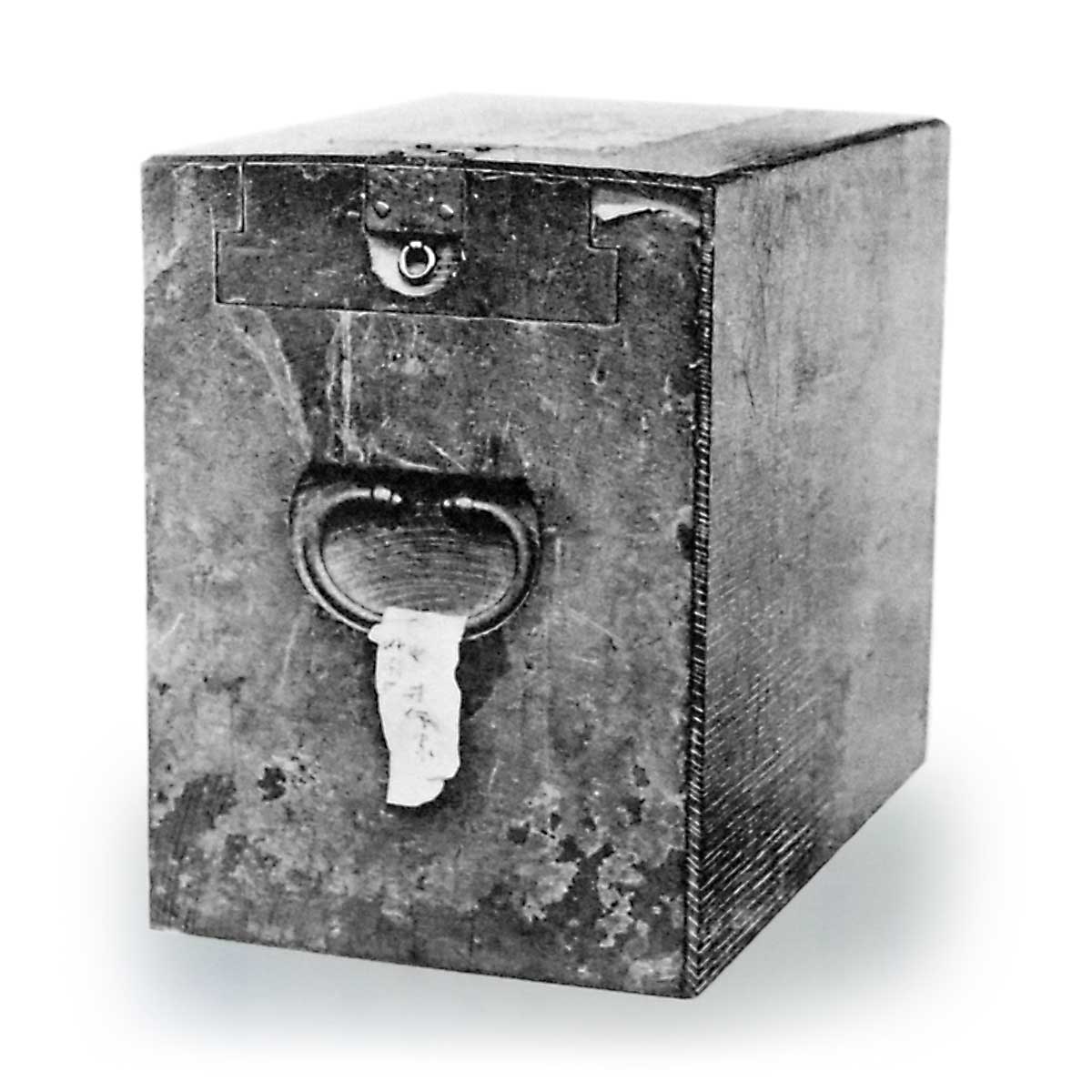
1. Outer Box: Zelkova, hollowed out, with iron rings and an iron lock
Height: 9.2 sun; Length: 1 shaku 1.7 sun; Width: 9.8 sun
Sliding lid; Thickness: 1.7 sun
Miscellaneous Notes
Miyaō: Ii no Sōbetsu. Previously owned by Miyaō no Tadafu, and later by Miyauchi no Kyō Hōin.
(Kobutsuki)
Miyō Katatsuki: Owned by Miyauchi-kyō Hōin.
(Higashiyama Go-mono Naibetsuchō)
Miyō-tsutsumi (Miyō): Inscription in red ink by Lord Ii Sōbe; owned by Miyō-daifu.
(Ganka Meibutsuki)
Miyō Karamono Daimeibutsu: Ii Sōbe-no-kami.
(Kokin Meibutsu Ruiju)
Miyaō Katatsuki: Possessed by the Minister of the Imperial Household, Hōin. Height: 2.8 sun; width: slightly over 2.4 sun; circumference: 7.6 sun; base: 1.4 sun; mouth: also 1.4 sun; height (kettle height): 3.5 sun; bulge: 1.5 sun; glaze: dark persimmon color; underglaze: light persimmon color; clay: dark with a bluish tint.
(Illustration of the tea caddy appears here).
Miyō Katatsuki
(Manpō Zenshū)
April 30, Tenshō 5 (the last day of the month) — Minister of the Imperial Household, Hōin
The guest was Sōyuki, alone.
A furo, a flat kettle, and two round buckets were placed on a long board.
In the tokonoma, the katatsuki (tea caddy) was placed on a square tray and enclosed in a white-ground Kinran bag.
The tenmoku tea bowl has a gray glaze, a black base, and a turtle-shaped lid; a Goryeo tea bowl is used for thin tea.
I saw the above katatsuki for the first time. It is a teapot (tea caddy) that was once owned by Asakura Kurozaemon.
(Tsuda Sōyuki’s Tea Ceremony Diary)
On the morning of January 8, Tenshō 9 (Year of the Snake), a gathering was held at Azuchi hosted by the Minister of the Imperial Household, Hōin.
The guests were Sōnō, Sōji, and Sōyuki.
In the tokonoma hung a colored paper scroll by Fujiwara no Teika bearing the poem “The Wind Blows.” A fixed-length chain favored by Takeno Jōō was suspended from the hearth, and a bag-shaped box was placed in the center aisle.
A katatsuki (tea caddy) was placed on a shihō-bon (square tray), with a red-gold (copper) washbasin, the tip of a gold rod, and a yōhen tenmoku placed on an Amagasaki stand beneath it.
For the usucha (thin tea), a tea whisk was placed in a Goryeo tea bowl.
(Tsuda Sōyuki’s Tea Ceremony Diary)
On the 16th day of the ninth month of the 11th year of Tenshō (the Year of the Goat), a tea gathering was held by Lord Hideyoshi, and the tea utensils were prepared. The number of participants was
five: the Minister of the Imperial Household, Hōin; Sōeki (Sen no Rikyū); Araki Dōkun; Mosuya; and Sōyuki. There were two tea rooms, and the spectators
were Ikeda Katsunori (Tsuneoki) and Yakushi Tokun.
Decorations for the 4.5-mat room
In the tokonoma: Bunrin (tea caddy), square tray by Sōyuki
Hatsuhana (shikatōchi): placed on a square tray, personal items (belonging to Hideyoshi)
Incense burner and incense container placed on a long tray by Sōyuki
Incense burner placed on a square tray by Sōeki
The hanging scroll was a painting of “Evening Bells” by Gyokkan (a personal item). Later, Matsumoto Nasu (tea caddy) was brought out by Chikushu (Kamiya Sōtan) and Ryōsei.
In front of the tall folding screen
Nagezukin Katatsuki (tea caddy) placed on a square tray by Sōan
Koshimi Katatsuki (tea caddy) placed on a square tray by Sōeki
Miyō Katatsuki (tea caddy) by the Minister of the Imperial Household
(Tsuda Sōyuki’s Tea Ceremony Diary)
From the morning of the 15th day of the 10th month of the 11th year of Tenshō (the Year of the Goat), a tea ceremony was held all day in Lord Hideyoshi’s private quarters. The tea
masters (chadō) were Sōeki, Imai Sōkyū, and Tsuda Sōyuki.
The guests were Sōkun, Kyūmu, Yūkan, Yūsai, Shōan, Sōan, Sōji, Sōmu,
Sōfu, Sōharu, Fujita Han’emon, Ukita Tadaya, Sakuma Moriharu,
Takatsuji Ukon, Shibayama Gen’nai, Imai Hayato, Yoshida Suke, Matsui Shinsuke,
Nakagawa Chūkichi, Hosoi Shinsuke, Makimura Chōbei, Enjōbō, Higuchi Iwami,
Tokunken Yakuen.
One: A Shōō arare kettle and a trivet on the hearth.
One: A painting of “Night Rain” (by Gyokkan) in the tokonoma, with a large Sute-ko jar in front of it.
One: A vase of slender-stemmed narcissus flowers arranged on the shelf.
One: On the display shelf, a Miyako-style shoulder-rest cup placed on a square tray, and an Amago tenmoku tea bowl placed on an Amagasaki stand.
Below that, a Hishaku bucket (omitted hereafter).
(Excerpt from the Diary of Imai Sōkyū)
October 19, Tenshō 11 (1583) – Gathering of the Minister of the Imperial Household and the Buddhist Priest
The arrival of Lord Hideyoshi; Sōeki and Sōkyū were present.
1. A painting of “Wild Geese” in the tokonoma; in front of it, a Miyō Katatsuki placed on a square tray.
1. On the shelf, three types of vessels—a bucket, a walnut-shaped cup, and a matching pair—all belonging to Inshaku.
1. A Haisuki Tenmoku placed on an Amagasaki stand; for the thin tea, a large tea bowl was used. After the tea ceremony, a large Kinka jar was sent to the Minister of the Imperial Household and Priest from Lord Hideyoshi.
These were sent to the Minister of the Imperial Household, Hoin. That is to say, the large “Kogotengu” teapot was presented by the Minister of the Imperial Household, Hoin, to Lord Hideyoshi, and the three items on the shelf were also presented to Lord Hideyoshi.
(Tsuda Sōyuki’s Tea Ceremony Diary)
Ii Naotaka, Head of the Ministry of Public Works: Born in Fujieda, Suruga Province, in the 18th year of Tenshō (1590) (omitted) When he captured Osaka Castle, he took 375 enemy heads, and on November 2 of the first year of Genna (1615), he received a letter of commendation from Lord Daito-in (Tokugawa Hidetada) and was granted a fief of 50,000 koku in Ōmi Province. In Suruga Province, he was summoned before Tōshōgū (Tokugawa Ieyasu), who commended him for his recent military achievements and bestowed upon him a Samonji sword and a Miyō tea caddy. He passed away on June 28, Manji 2 (1659), at the age of seventy.
(Kansei Revised Genealogies of Various Families)
The tea caddy of Miyō was bestowed upon him in Suruga in the first year of Genna (the Year of the Rabbit) by the Gongen-sama (Tokugawa Ieyasu), who sent Andō Tatewaki as his messenger. The imperial decree instructed him to pass it down through his family and cherish it; this was an undeserved blessing resulting from the praise he received for his military achievements at the Battle of Osaka (the Siege of Osaka).
(Documents of the House of Ii, Count)
History
Originally owned by Asakura Kurozaemon, it was passed down to Miyao-no-taifu, at which point it first came to be known as the “Miyao Katatsuki.” It subsequently came into the possession of the Minister of the Imperial Household, Hōin, who presented it to Hideyoshi in the 11th year of Tenshō (1583). However, during the fall of Osaka Castle in the 1st year of Genna (1615), Tokugawa Ieyasu acquired it and bestowed it upon Ii Naotaka, the Head of the Sweeping Department, who had distinguished himself in battle at that time. Since then, it has been passed down as a treasured heirloom of the Ii family to the present day.
Record of Actual Viewing
On October 25, 1920, I had the opportunity to view the piece in person at the residence of Count Ii Naochika in Ichibancho, Kojimachi Ward, Tokyo.
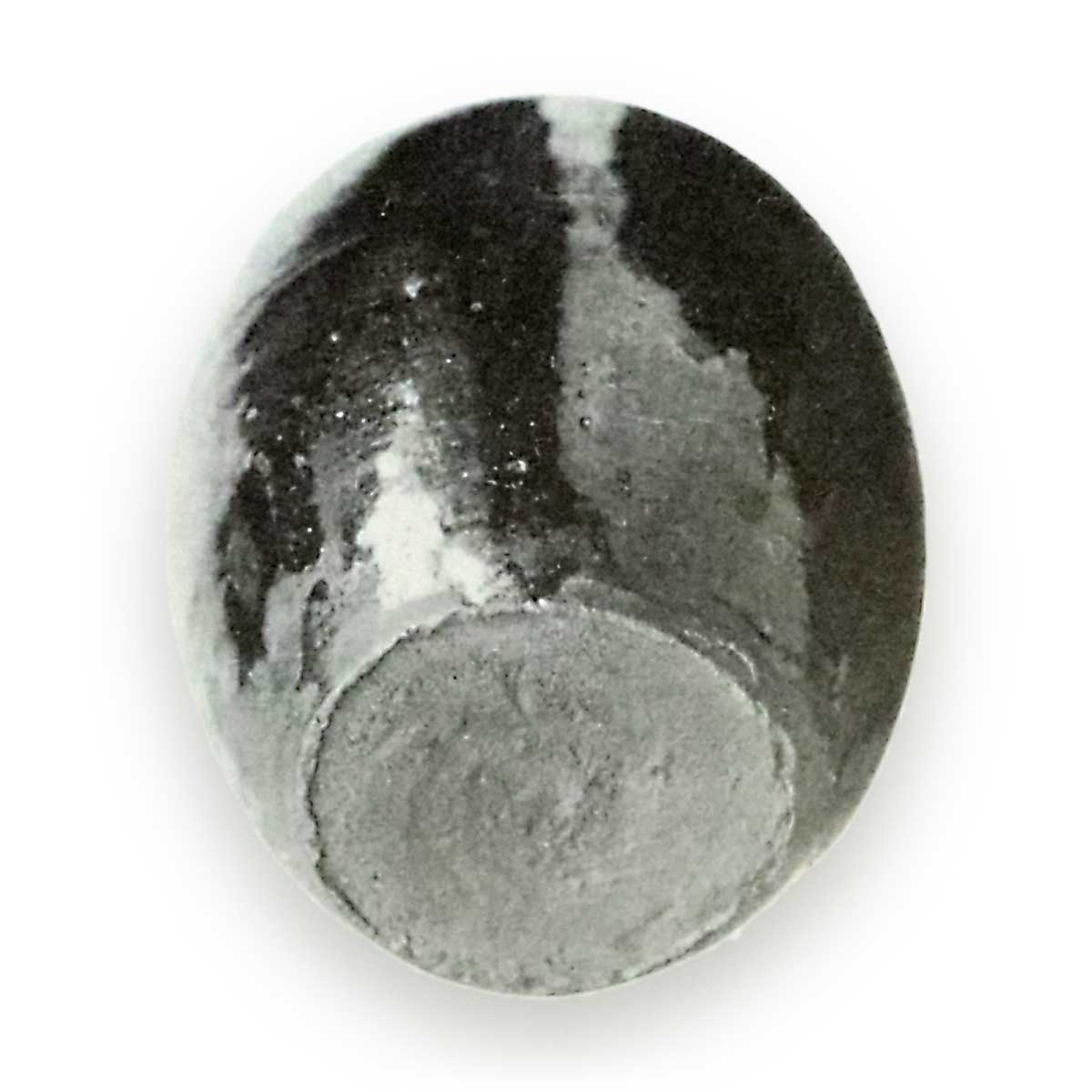
The rim is shaped with a double-beveled, turned-back edge and a sharp tip; the base of the koshiki (foot) is flared, and two irregular black lines run around its circumference, one of which is a raised line (ukigane). The shoulder is slightly chamfered, the body is flared, and a single sunken line runs around half the circumference of the tea caddy. The exposed clay at the base is of varying heights, and in some places, the glaze has broken away, forming “fire gaps” (hima). The base is raised, and the rim is worn. The overall body is covered in a black amber glaze over a pale purple base, with a slight brownish tint; in the glaze pools, a blue-lapis-lazuli-colored pattern is visible. The form features a single flowing line (ichinadare), rising from both sides below the shoulder, converging into a single line below the body cord, and stopping at the base of the footring. The glaze pools are thick, and the blue-green glaze appears particularly beautiful. Inside, the glaze covers the rim; below that, coarse wheel marks run across the entire surface over a watery glaze, and at the center of the base, they form a swirl and slightly converge. The form is well-proportioned and of high quality; the base color is a purplish-brown that is vividly clear, allowing the black amber glaze to stand out distinctly. Both the yellow glaze and the blue lapis lazuli glaze possess a beautiful luster. The tea caddy is entirely free of flaws and fully possesses the dignity of a Daimeibutsu.