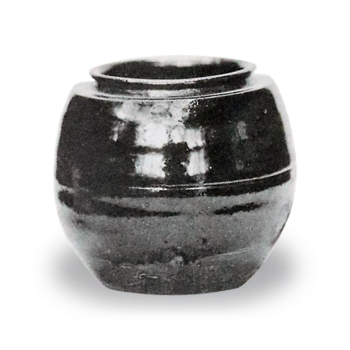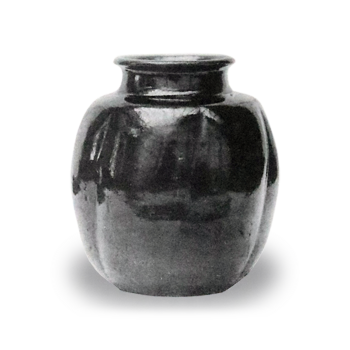
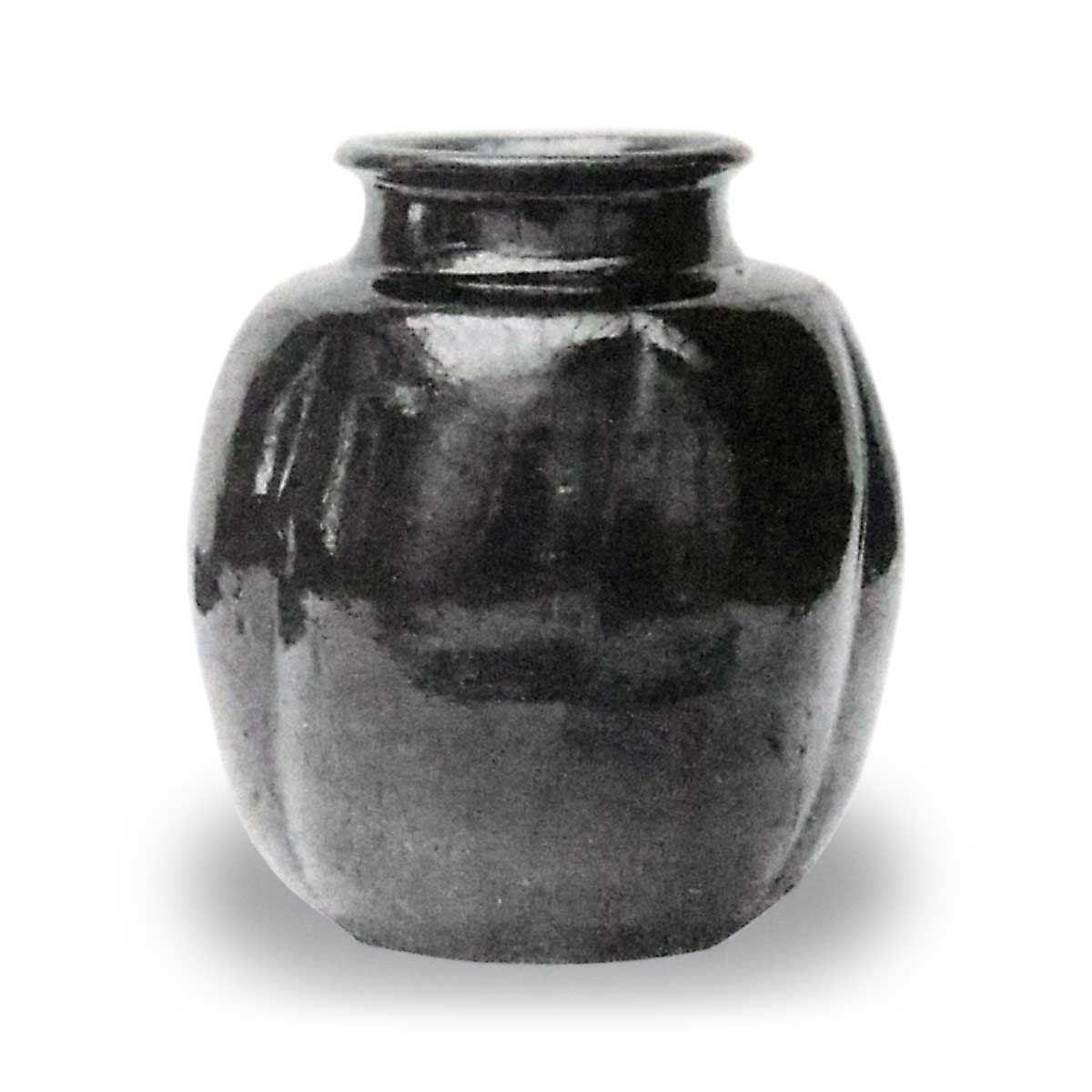
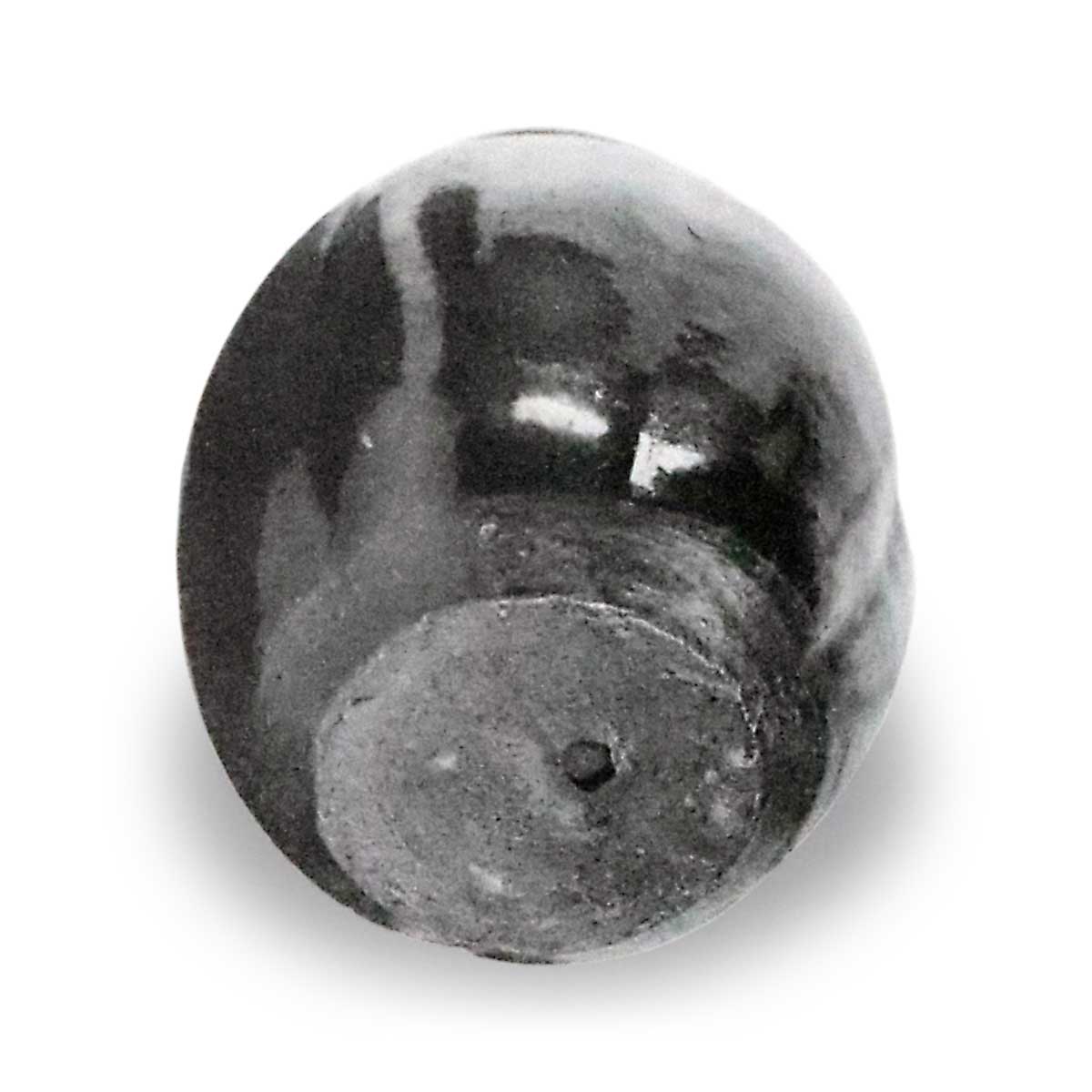
A Daimeibutsu tea caddy made in China (Han-saku)
Also known as “Kii-dodaka.”
Currently in the collection of Marquis Tokugawa Yorimichi (of the Kishu Tokugawa family).
Origin of the Name
It was named for the large vertical “herame” (marks left by a spatula) on the body of the tea caddy. Kanamori Tokusui’s Kokon Chawa states: “Among the Kishu family’s treasures is a Chinese tea caddy known as the Herame Katatsuki. It is said that the ‘Akoda’ tea caddy, favored by Jushinsai of the Omotesenke school, was crafted based on the design of this Katatsuki.”
It is also known by the alternative name “Kii-dōtaka,” and Chaki Benran notes, “All tea caddies of the type called Dōtaka are made in this style.”
Modern Equivalents of Dimensions and Weight
Height: Approx. 10.0 cm (3 sun 3 bu)
Body Diameter: Approx. 8.8 cm (2 sun 9 bu)
Mouth Diameter: Approx. 3.6 cm (1 sun 2 bu)
Base Diameter: Approx. 4.9 cm (1 sun 6 bu 2 rin)
Koshiki Height: Approx. 1.4 cm (4 bu 5 rin)
Shoulder width: approx. 1.0 cm (3 bu 2 rin)
Weight: approx. 144 g (38 monme 4 bu)
List of Accessories
There is one lid, which features a recessed rim. The storage bag is made of white habutae silk with a white cord.
There are two types of cover bags: one with a “plum blossom and arabesque pattern on a dark blue ground” and another with a “checkered pattern on a tea-colored ground.”
There is a box to hold these bags, labeled “Hikiya-style Katatsuki, two bags.” The outer box is black lacquered with gold-leaf lettering.
The carrying case is black lacquered, and the bag features a “treasure motif” pattern on a dark blue ground.
The inner box is made of natural paulownia wood and bears the inscription “Hirame-me Katatsuki Tea Caddy,” while the outer box is black lacquered with gold-leaf lettering.
Characteristics of the “Hirame-me Katatsuki (Dōtaka)” as seen in various tea manuals
The Chaki Benran describes the “Dōtaka” form as follows:
“The style (technique) of ‘Dōtaka’ includes Chinese tea caddies such as the Kishū-style imperial ‘Hira-me Katatsuki (original style)’, the Sendai Lord’s ‘Higuchi Katatsuki’, and the Sakai family’s ‘Sakai Katatsuki’, all of which belong to this category. There are vertical grooves (standing lines) around the body, carved with a spatula, and some areas are slightly warped. Because the space between these grooves gradually rises (bulges), it is called ‘Dōtaka.’”
Records of the “Hira-me Katatsuki (Dōtaka)” found in various tea books (continued)
・‘Kokon Chawa’: (Continued from the previous page) The Agoda tea caddy favored by Sen Jushinsai of the Omotesenke school was created by modifying this Hira-me Katatsuki. The exterior is finished in tame-nuri lacquer, the interior is natural black wood, and the lid knob (ushi) is made of ivory.
・『Matsuya Hoki』: The “dōtaka” shape can be found in both Chinese imports and Seto ware. The rim is high, and both the upper and lower edges taper slightly inward, giving it a vertically elongated shape. It is said that the “dōtaka” owned by Lord Tachibana Sakon has no traces of a spatula. Items called “dōtaka” are exceptional, and once you become accustomed to them, they are very pleasing to the eye.
・“Kobutsu-ki”: A ‘dōtaka’ Chinese tea caddy. Owned by the Kii family.
・“Ganka-butsu-ki”: A “dōtaka” Chinese small jar. Owned by Lord Kii.
・Manpō Zenshū, Bengyoku Shū: Dōtaka. The origin of the name “Dōtaka” is unknown, but it is likely because the body of the tea caddy has a high section (bulge). It is described as a Chinese Dōtaka, with dimensions such as a height of three sun and seven bu recorded along with an illustration. It states: “The clay is light reddish in color. The rim is well-formed with a turned-back edge, and the base is flat. The base glaze is chestnut brown with a fine luster. The upper glaze is the same color but slightly darker, flowing slightly higher. This forms the body’s ridges. Horizontal ridges run diagonally at a slightly higher position.”
・Kokon Meibutsu Ruiju: Dōtaka (Daimeibutsu). Owned by Lord Kii. The record includes the dimensions, the pattern on the pouch (a light persimmon-colored ground with diamond-shaped monogram and Donshu), the Hikiya carver, and the outer box with Shunkei lacquer.
(Note: In Matsudaira Norimichi’s Meibutsu, an entry with exactly the same dimensions and accessories is listed, stating that it was “owned by Mizonokuchi of Hōki.” This Mizonokuchi Dōtaka is currently a Ko-Seto tea caddy owned by Takao Masuda, and it appears that Meibuki and Kokon Meibutsu Ruiju mistakenly conflated information regarding the Mizonokuchi Dōtaka and the Kii Dōtaka (this work).)
Records from Tea Ceremony Accounts of the Azuchi-Momoyama Period
・On the morning of October 28, Tenbun 21 (1552), at a tea ceremony hosted by Beniya Sōyō.
A “Hera Katatsuki (spatula-marked katatsuki)” was displayed on a square tray in the tokonoma. It is recorded that “there are six spatula marks. It is housed in a Kinran bag with a white background.” (From Tsuda Sōyuki’s Tea Ceremony Diary)
・On the morning of November 19, Tenshō 9 (1581), at a tea gathering hosted by Shioya Sōetsu. The guest was Kamiya Sōtan, a tea master from Hakata.
A large jar was displayed in the tokonoma, placed inside a net. During the hand-washing (rest) break, this “tōtaka” tea caddy was displayed on a shihō-bon tray alongside the water bucket. The record states: “I saw this tea caddy for the first time. It is of the tōtaka shape. The quality of the clay is not good, but the glaze is fine. The rim is not well-made.” (From Imai Sōkyū Nikki)
A Gift from the Imai Family to the Shogun’s Household
Imai Sōton (Kyuan), the son of Imai Sōkyū—a wealthy merchant of Sakai and a prominent tea master—succeeded his father in 1627 (Kan’ei 4) and took control of the Sakai Goryōsho (a territory directly administered by the shogunate). Thereafter, he frequently traveled to Edo to attend the Shogun’s evening gatherings and was entrusted with matters of tea administration (Ocha no Koto).
Sōton presented numerous national treasures that had been treasured in his family, such as the “Hand-Lantern Vase,” “Shōō Eggplant,” “Tall-Bodied, Shoulder-Striking Tea Jar,” and “Matsushima Leaf Tea Jar,” to the Shogun’s family. He passed away in 1633 (Kan’ei 10) at the young age of 32. (From Kansei Shoshu Shokafu. In this way, the “Takataka Katatsuki” tea caddy became part of the shogunate’s collection.)
Records of the Kishu Tokugawa Family’s Treasures and Ieyasu’s Heirlooms
(Records of tea utensils based on documents of the Kishu Tokugawa family)
・Tea caddy: Uchigumori
・Flower Vase: Kinuta (Pestle)
・Hanging Scroll: “Fisherman’s Village at Sunset” by Kyodo, Sesshu, and Bokei
・Tea Caddy: Vermilion Robe
・Tea Bowl: Cloud-and-Dragon Underglaze Blue, Oribe Ash-Glazed Tenmoku
・Tea Caddy: Tamagaki (with a white Kanto-style pouch)
・Tea Bowl: Yellow Tenmoku, Tahi-san Bowl on a Pinewood Tray
・Tea caddy: Herame Katatsuki (Spatula-Patterned Katatsuki)
This “Herame Katatsuki (Spatula-Patterned Katatsuki)” was a tea caddy frequently used by Lord Tokugawa Ieyasu. After his death, it was presented to the Kishu Tokugawa family as one of the “Suruga Owakemono” (Suruga Heirlooms) distributed as mementos. (From Kishu Family Documents)
Another Trigger for Rikyu’s Seppuku? The Conflict Over the “Takataka Tea Jar”
While everyone offers various theories regarding the reasons Sen no Rikyu was driven to commit seppuku, the detailed circumstances were known to Kinoshita Yukei, a member of Toyotomi Hideyoshi’s court circle (a companion who entertained him with stories).
When Hideyoshi was in a bad mood, Rikyu would not engage with him at all, and would only go to see Yukei once Hideyoshi’s temper had cooled. However, Yukei refused to see him, saying, “I do not know a man named Rikyu,” which greatly angered Rikyu.
On one occasion, when Hideyoshi asked Yukei, “Is there anything unusual happening?” Yukei mentioned the matter concerning Rikyu’s daughter (such as the request to have her become one of Hideyoshi’s concubines). Afterward, Yukei met with Rikyu’s wife twice to convey this intention, but she refused to agree, replying, “In any case, nothing can be done unless I speak to Rikyu directly.” The matter was thus conveyed to Rikyu, but he refused to agree, and his relationship with Hideyoshi (behind the scenes) deteriorated further.
Around that time, Maeda Gen’i (Tokuzenin), a leading figure in the Toyotomi regime, relentlessly slandered Rikyu, ultimately driving him to commit seppuku.
Why did Maeda Gen’i harbor such a deep grudge against Rikyu? It was because, when Gen’i produced this “tall-bodied tea caddy (possibly a ‘hata-me katatsuki’)” and declared, “This is a katatsuki tea caddy,” Rikyu flatly rejected his opinion, stating, “Gen’i has absolutely no understanding of the quality of objects,” thereby humiliating him.
Even though Hosokawa Sansai had also said, “This is a fine tea caddy,” Rikyu sternly pointed out, “This has the shape of a ‘dōtaka’ and is not a ‘katatsuki,’” which earned him Gen’i’s grudge. This conflict over the evaluation of this “dōtaka tea caddy” is recorded as one of the detailed circumstances that led to Rikyu’s eventual death by seppuku.
(From Fujibayashi Sōgen’s Memoirs. This is an intriguing alternative theory suggesting that a dispute over the appraisal of tea utensils and a matter of pride served as a contributing factor to Rikyu’s death.)
History
Based on a synthesis of the various records mentioned above, this tea caddy was owned by wealthy merchant-tea masters such as Beniya Sōyō and Shioya Sōetsu of Sakai, as well as the father-son duo of Imai Sōkyū and Sōton. It was subsequently presented by the Imai family to the Shogunate (Tokugawa Ieyasu).
It is understood that Ieyasu cherished this tea caddy in his daily life, and after his death, it was presented to the Kii Tokugawa family (the Kishū branch) as one of the “Suruga Imperial Dividends,” and has been passed down within that family ever since.
Academic Inspection Record (Appraisal Record) from the Taisho Era
On October 9, 1919 (Taisho 8), this tea caddy was physically examined at the residence of Marquis Tokugawa Yorimichi in Iikura-cho, Azabu Ward, Tokyo.
The rim is rounded, and the flared edge is shallow. Overall, it is thick and has a plump, substantial build similar to other Chinese-made tea caddies. A single horizontal groove runs around the base. The body is full-bodied, and from the edge of the shoulder to the rim at the bottom, there are six vertical carving marks known as “herame” (spatula marks), arranged at nearly equal intervals and standing out sharply.
The base color is a blend of amber and black, with patterns resembling the grain of zelkova wood appearing in places. The luster is exceptionally beautiful, making this a superb tea caddy worthy of appraisal.
From the hem downward, the clay reveals a reddish-brown color reminiscent of boar’s blood (inchi-iro), and the base is constructed with a raised edge. In the center of the base, there is a single circular indentation in the clay (a “hazena” hole), as well as two firing blisters of varying sizes (swelling caused during firing).
Inside, the rim is covered with glaze, while the area below it shows wheel marks. The center of the base is slightly deeper (forming a large swirl), where a thin layer of watery glaze has pooled. There is also one spot where the glaze has splattered like stars, known as “hibi.”
It feels very light in the hand and is exquisitely crafted. Given its extremely ancient age, this is an exceptionally rare teapot; there is no other example of such a large form among Chinese “Han-style teapots.”